

Netherlands CV Format 2026: Motivatiebrief Norms, Minimum Wage, Permits and Tax
A Dutch CV is a short, factual document with the latest job first, a personal profile at the top and, according to the public employment service, a photo. werk.nl, the job portal of the benefits agency UWV, lists name, address, e-mail, phone and LinkedIn link as the personal details, then a profile,
By AIResume Editorial Team
Last updated: 30 October 2026
A Dutch CV is a short, factual document with the latest job first, a personal profile at the top and, according to the public employment service, a photo. werk.nl, the job portal of the benefits agency UWV, lists name, address, e-mail, phone and LinkedIn link as the personal details, then a profile, work experience, education, side activities and skills, and says an employer looks at a CV for about nine seconds.[^1] It gives no page limit, while the union FNV says a CV should be at most one A4 page.[^2] None of this is law. What the law does regulate is what an employer may ask and keep, what a contract must say, what the job pays at a minimum, and what is deducted from your salary.
This guide covers the CV and the cover letter (motivatiebrief), equal-treatment and data rules, an annotated fictional CV, recognition of foreign qualifications, the minimum wage, the economy, work permits, labour law, social security, taxes and job scams. For the list of job boards, see our Netherlands job-board guide. It is written for EU/EEA nationals (Poland, Germany, Romania and Bulgaria are among the largest groups of residents born abroad), for UK nationals, for non-EU knowledge migrants, for international graduates, for Working Holiday makers and for Japanese nationals.[^3]
Editorial boundary: This is practical job-search guidance, not legal, immigration or tax advice. Our references are the law texts on wetten.overheid.nl, Rijksoverheid (Government.nl), the IND (Immigration and Naturalisation Service), UWV and werk.nl, the SVB (Social Insurance Bank), the Belastingdienst (tax administration), CBS (Statistics Netherlands), Justis (which issues the certificate of conduct), IDW and Nuffic (credential evaluation), the BIG register, the Autoriteit Persoonsgegevens (data protection authority) and the ECB. We only list figures we could read in an official or primary source, and we mark the rest as "reported" or "likely". Some sources could not be opened normally. The Autoriteit Persoonsgegevens, MOFA, the Japanese embassy, werk.nl and fnv.nl refused automated requests, so we read them in a browser; the age-discrimination act (WGBL) text was not read, so its article numbers come from a ruling of the Netherlands Institute for Human Rights; the IND pages on the orientation year, the Blue Card and Japanese nationals are gated by nationality, so we used IND forms and brochures; MOFA press releases on the Japan tax treaty could not be read, so we used the Japanese Ministry of Finance list; CPB figures come through a summary by the employers' association AWVN; and UWV's leave pages could not be read, so we read the Work and Care Act itself. Werkzoeken.nl, Monsterboard and several other job boards did not respond when we tested them for our job-board guide, and we do not list them.
Exchange rates move daily. This guide uses the European Central Bank reference rates of 29 October 2026: EUR 1 = USD 1.1130 = JPY 175.92. At those rates EUR 100 is about US$111 / JPY 17,590.[^4][^5]
Before you apply
- SafetyWing Nomad InsuranceHealth insurance that works in your new country from day one.Get a quote
Affiliate links: we may earn a commission at no cost to you. Affiliate link
Dutch CV format at a glance
| Topic | Practice in 2026 | Law or official guidance |
|---|---|---|
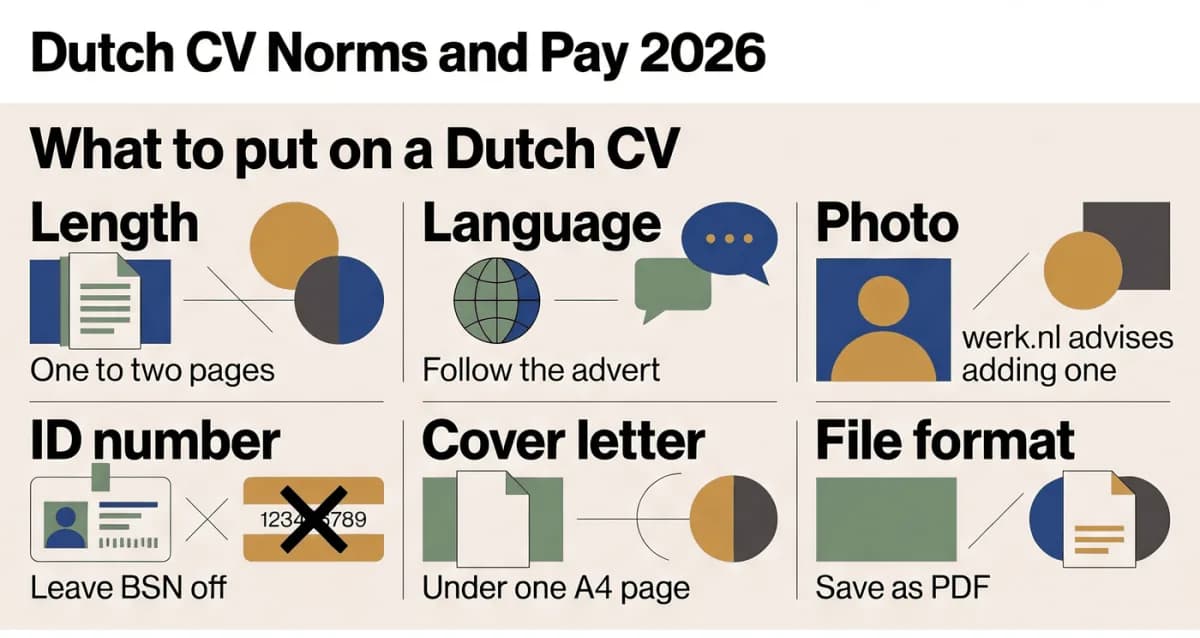
| Length | One to two pages. werk.nl gives no limit; FNV advises at most one A4 page | No official rule[^1][^2] |
| Language | Write in the language of the advert. International firms often advertise in English; Dutch is usually needed in the public sector, health care and customer-facing jobs | Editorial advice; no law |
| Photo | Recommended by werk.nl (2 February 2026): "always add a photo", because employers look less at CVs without one. It asks for a calm background, a visible face, colour and no cropped group photo. Optional by law | No law requires or bans a photo[^6] |
| Personal details | Name, address, e-mail, phone and LinkedIn link. Leave off your BSN (citizen service number) and any ID copy | The Autoriteit Persoonsgegevens (AP) says an employer may not ask for the BSN or a copy of your ID during selection[^1][^7] |
| Date of birth, marital status | werk.nl does not list them. Treat them as optional and leave them out unless the advert asks | No official source treats them as required |
| Work authorisation | Non-EU applicants: one factual line such as "Residence permit valid to June 2027" can save a screener a question. EU/EEA applicants need no line | Editorial tip only |
| Hobbies and personal section | werk.nl lists "side activities"; keep a short line on interests that are relevant | werk.nl guidance[^1] |
| References | Optional. If you name referees, ask them first | The NVP code asks employers to get your permission before contacting references[^8] |
| Cover letter (motivatiebrief) | Preferably shorter than one A4 page and at most five paragraphs | werk.nl[^9] |
| File format | A PDF named cv_Firstname_Lastname, as werk.nl suggests | Editorial advice; no law[^1] |
Equal treatment, personal data and fair hiring
What employers may not ask or do
The Algemene wet gelijke behandeling (AWGB), in the version in force from 1 January 2026, bans discrimination on the grounds of religion or belief, political opinion, race, sex, nationality, hetero- or homosexual orientation and civil status. "Sex" includes pregnancy, childbirth, motherhood and gender identity. Article 5 covers "the offer of a position and the treatment when filling an open position". Enforcement is through the College voor de Rechten van de Mens (the Netherlands Institute for Human Rights).[^10]
The age-discrimination act (WGBL). Article 3 bans a distinction by age when offering a position, and article 7 lists the grounds on which an age distinction can be justified. We read these article numbers in a ruling of the Institute, not in the statute itself.[^11]
Article 7:646 of the Civil Code (BW) bans a distinction between men and women in entering the contract, training, terms, promotion and dismissal, and allows protective terms for pregnancy and maternity. It follows that asking about pregnancy or family plans is very likely unlawful, though we read no rule that says so in as many words. Do not confuse it with article 7:648, which is about distinction by working hours (part-time against full-time), not age or pregnancy.[^12][^13]
Medical questions. The Wet op de medische keuringen, article 4, allows a medical examination only if the job sets special requirements on medical fitness. It may take place only after all other assessments and when the employer intends to hire you, and only a "keurend arts" (examining physician) may ask about health or past sickness absence.[^14]
A law on checks of recruitment practice is not in force. The Wet toezicht gelijke kansen bij werving en selectie was adopted by the Tweede Kamer on 14 March 2023 but rejected by the Eerste Kamer on 26 March 2024.[^15] A new initiative bill (36908, by members Ergin and Van Baarle) was submitted on 3 March 2026; on 30 October 2026 it was still in written preparation in the Tweede Kamer, with no vote and no in-force date.[^16][^17] There is therefore no such law in force.
Sollicitatiecode. The NVP code (July 2025 version) is a voluntary code of conduct drawn up in consultation with the Stichting van de Arbeid. It says an employer should not ask for your salary history, should ask your permission before contacting references, should reply to applicants within two weeks, and should destroy applicant data within four weeks after rejection unless agreed otherwise.[^8]
Personal data
The AP says it is "customary" to delete an applicant's data no later than four weeks after the procedure ends, and that keeping it for up to one year with the applicant's consent is "reasonable". This is guidance, not a statutory deadline.[^7] On ID, the AP says an employer may look at your original document during selection but may not copy, scan or photograph it, and may not ask for the BSN; once you start work, the employer is legally obliged to copy your ID.[^7][^18] This comes from data-protection guidance (the GDPR), not from the foreign-workers act. Criminal data may only be requested where the job justifies it, usually through a certificate of conduct, and an online search about you is allowed only with a good reason, for business information and with prior notice, for example in the vacancy.[^19]
Certificate of Conduct (VOG)
A VOG is issued by Justis. The employer always takes the first step, online only. You then pay and need DigiD, iDEAL and an e-mail address.[^20] The fee is EUR 33.85 (about US$37.7 / JPY 5,950) when the employer starts the digital request and EUR 41.35 (about US$46.0 / JPY 7,270) through the municipality, without VAT. Justis says it usually takes one to four weeks, and digital applicants are told one to eight, so do not promise an employer a date.[^21][^22] A VOG has no legal validity period: it is a snapshot, and the employer or ministry decides how recent it must be.[^21] If you are not registered in a municipality and have no Dutch address, apply by e-mail.[^20]
Structure of a Dutch CV
This section is editorial advice built on the werk.nl and union guidance cited above. A clean order helps both a human reader and an applicant tracking system (ATS):
- Personalia (personal details). Name, city or address, e-mail, phone and LinkedIn link. No BSN.[^1]
- Profiel (profile). Three to five lines on who you are, your strongest skills and the role you want. Rewrite it for each advert.
- Werkervaring (work experience). In reverse chronological order, with employer, job title, place and dates. Under each job, two to four bullets that show a result with a number you can defend at interview.
- Opleiding (education). Also latest first. Give the official name of the award and, if you have one, the outcome of an IDW evaluation (see below).
- Vaardigheden (skills). The tools and methods the advert asks for.
- Talen (languages). Levels, not adjectives: for example "Dutch B1, English C1".
- Hobby's en nevenactiviteiten (interests and side activities). One or two lines, and only if relevant.
Dutch workplace style is direct, so say plainly what you did and what came out of it; avoid superlatives and long personal statements. This is editorial advice, not a rule. Mirror the advert's keywords honestly, use plain headings, a single column and standard fonts, and send a PDF. Our ATS-friendly CV guide explains how.
Annotated fictional Dutch CV
The sample is entirely fictional: person, employers, contacts and numbers. It sets no legal rule, and employers are described generically on purpose. Replace every item with truthful information.
Sanne Voorbeeld, Process Engineer · Eindhoven · [email protected] · +31 6 XX XX XX XX · linkedin.com/in/sanne-voorbeeld-example
*Annotation: fictional contacts. City or street address is normal. No BSN and no ID number. Add a recent colour photo at the top if you follow werk.nl's advice.*
Profiel: Process engineer with six years of experience improving yield on production lines, first at a Rotterdam-based packaging manufacturer and then at an Eindhoven-based semiconductor equipment firm. Holds a Dutch university of applied sciences degree and works in Dutch and English. Looking for a process-improvement role in the Brabant region, full-time, on site with some home working.
*Annotation: three to five lines, rewritten for each vacancy. If you need a permit, add one factual line ("Residence permit valid to June 2027").*
Werkervaring: Process Engineer, an Eindhoven-based semiconductor equipment firm (fictional) · Eindhoven · March 2023 to present
- Cut rework on one assembly line from 9% to 5% by changing the inspection order.
- Wrote 15 work instructions in Dutch and English.
- Trained four new colleagues on the measurement software.
*Annotation: employer and figures are fictional. If readers will not know the firm, say what it makes and roughly how big it is.*
Werkervaring: Production Planner, a Rotterdam-based packaging manufacturer (fictional) · Rotterdam · June 2020 to February 2023
- Built a spreadsheet that cut weekly planning time from five hours to two.
*Annotation: one strong bullet beats a list of duties.*
Opleiding: Bachelor of Engineering in industrial engineering, Example University of Applied Sciences (fictional), Utrecht, 2020.
*Annotation: keep the official name of the award; if the diploma is foreign, mention the IDW evaluation.*
Vaardigheden: Lean methods · Python (basic) · Excel (pivot tables) · SAP (daily user) · statistical process control
Talen: Dutch (native) · English (C1) · Polish (B2)
Hobby's en nevenactiviteiten: Volunteer coach for a youth football team in Utrecht; weekend cycling.
*Annotation: one or two lines, and only if relevant.*
Cover letter (motivatiebrief), references and documents
The motivatiebrief. werk.nl says the letter should preferably be shorter than one A4 page, have at most five paragraphs and be set in a plain font such as Verdana or Arial. It advises sending a PDF named Sollicitatie_Jobtitle_Firstname_Lastname, not repeating the CV, and mentioning a phone call if you had one.[^9] Commonly advised content: a first line that names the vacancy, one paragraph on why this employer, one or two on the evidence from your experience, and a closing line about availability. No law requires a letter.
Open application (open sollicitatie). Many employers accept applications without a vacancy. Commonly advised: find the right contact on the company's site or LinkedIn, say which team you aim for and send a CV with a short letter. Treat this as practice, not an official rule.
Selection and assessments. Interviews, tests and assessments are commonly reported, and the flow varies by employer; we found no official standard. Remember that medical questions are barred until the end of selection (see above).
Written terms of employment. Under BW 7:655, the employer must give you a written or electronic statement signed by the employer. The main items (parties, workplace, function, start date, end date or duration if fixed term, pay, working time and probation terms) are due no later than one week after you start; the other items within one month.[^23]
Probation and notice. Under BW 7:652 a probation period must be agreed in writing. In a permanent contract it is at most two months. In a fixed-term contract it is at most one month if the term is longer than six months but shorter than two years, and at most two months if the term is two years or longer. There can be no probation in a contract of six months or less, and a clause that breaks these limits is void. Non-compete clauses in fixed-term contracts are valid only with a written justification of compelling business interests (BW 7:653).[^24]
BSN, DigiD and a bank account. The BSN is needed once you start work, not to apply. DigiD is the Dutch government login. We did not verify how to obtain a BSN or a bank account, so ask your employer or your municipality.[^7]
Foreign qualifications, languages and regulated professions
IDW evaluation. IDW (the joint credential-evaluation service of Nuffic and SBB, commissioned by the Ministries of Education and Social Affairs) compares a foreign diploma with the Dutch system. The cost for the work route is EUR 148.83 per diploma (about US$165.6 / JPY 26,200), one diploma per application. At present the initial check takes about six working weeks and the evaluation itself about eight more, so plan for three to four months.[^25][^26][^27] IDW values nationally recognised diplomas of at least 1,000 study hours.[^28] The evaluation is advice and usually not mandatory, but an employer may ask for it.[^26] Upload colour scans, and do not upload apostilles. A certified translation is needed only for documents that are not in Dutch, English, German, French or Afrikaans.[^29]
Regulated professions and the BIG register. Doctors, dentists, pharmacists, health-care psychologists, psychotherapists, physiotherapists, midwives, nurses, physician assistants and a few other health professions must be registered under article 3 of the Wet BIG.[^30] The BIG register requires Dutch at B2+ for university-level professions (for example doctors, dentists and pharmacists), B2 for higher-vocational ones (hbo) and B1 for secondary-vocational ones (mbo, for example nurses). The certificate must come from an exam that tests writing, listening, reading and speaking and be at most two years old.[^31] For diplomas from outside the EU, the "declaration of professional competence" route takes on average six months to one and a half years in total. The recognition application is currently free, the Dutch-language and professional tests cost extra, and registration costs EUR 85 (about US$94.6 / JPY 14,950) for five years.[^32][^33] For regulated professions, contact the competent authority before IDW.[^26]
Language expectations. English is widely used in international firms, but Dutch matters in the public sector, health care and customer-facing jobs. We found no neutral source that lists language needs by employer, so read the advert.
Apostille and documents for Japanese applicants
Japan has been a party to the 1961 Apostille Convention since 1970 and the Netherlands since 1965.[^34] MOFA issues the apostille on Japanese public documents (page updated 1 June 2026). Even among member states the receiving body may ask for something else, so check with it first.[^35] IDW does not want apostilles uploaded, so you need one only where an employer, a municipality or the IND asks for it. The Japanese embassy says a Japanese police certificate (a record of criminal history in Japan) is issued by the National Police Agency only when a foreign authority requires it under its laws, and that the apostille may be required, so ask the recipient first. A Dutch employer will usually ask for a VOG, not a Japanese certificate.[^36]
Pay: the statutory minimum wage and take-home pay
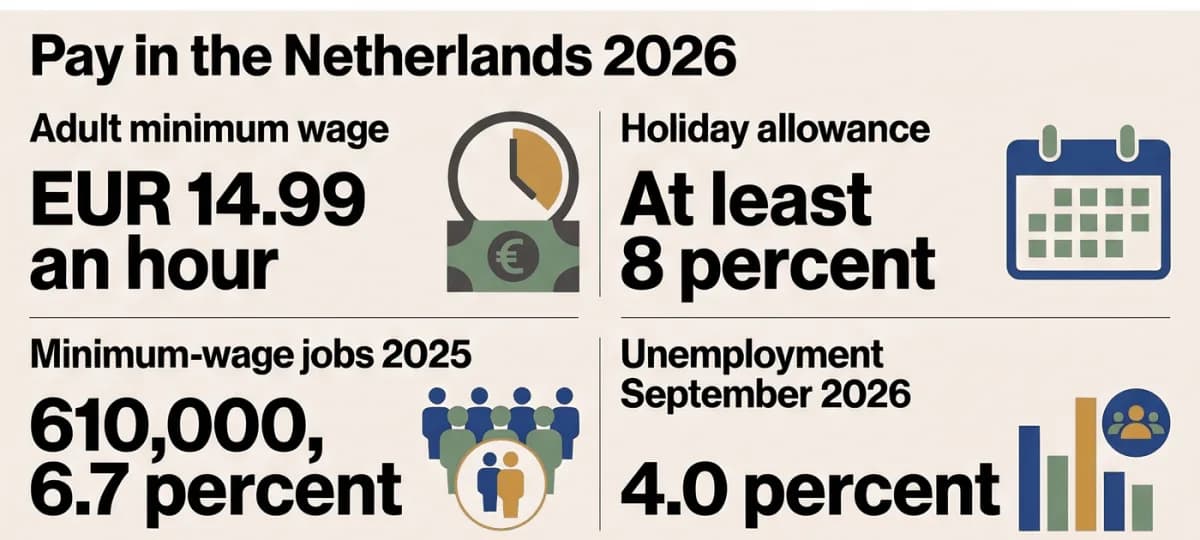
The minimum wage is statutory and hourly, and it applies from age 15. For adults (21 and over) the gross minimum is EUR 14.71 an hour (about US$16.4 / JPY 2,590) from 1 January 2026 and EUR 14.99 (about US$16.7 / JPY 2,640) from 1 July 2026. It is indexed twice a year.[^37]
| Age | Share of adult minimum | From 1 Jan 2026 (EUR/h) | From 1 Jul 2026 (EUR/h) | 1 Jul 2026 in US$ / JPY |
|---|---|---|---|---|
| 21 and over | 100% | 14.71 | 14.99 | 16.7 / 2,640 |
| 20 | 80% | 11.77 | 11.99 | 13.3 / 2,110 |
| 19 | 60% | 8.83 | 8.99 | 10.0 / 1,580 |
| 18 | 50% | 7.36 | 7.50 | 8.3 / 1,320 |
| 17 | 39.5% | 5.81 | 5.92 | 6.6 / 1,040 |
| 16 | 34.5% | 5.07 | 5.17 | 5.8 / 910 |
| 15 | 30% | 4.41 | 4.50 | 5.0 / 790 |
*Source: Rijksoverheid, minimum wage amounts 2026.*[^37]
Employees have a right to holiday allowance (vakantiegeld) of at least 8% of wages (Wet minimumloon, article 15(1)).[^38] At EUR 14.99 an hour that is EUR 16.19 (about US$18.0 / JPY 2,850) including the 8%. Rijksoverheid publishes no monthly minimum, so any monthly figure is our arithmetic: at EUR 14.99 and 36 hours a week, gross pay is about EUR 2,338 a month (about US$2,603 / JPY 411,000); at 40 hours it is about EUR 2,598 (about US$2,892 / JPY 457,000), before holiday allowance. We give no take-home figure, because net pay depends on tax credits, health insurance and your own situation.
CBS reports that about 610,000 jobs, or 6.7% of employee jobs, were paid at the minimum wage in 2025, and that average gross hourly pay in 2025 was EUR 31.79 for men (about US$35.4 / JPY 5,590) and EUR 28.71 for women (about US$32.0 / JPY 5,050).[^39][^40] Collective labour agreements (CAOs) can set higher floors, so ask which CAO covers the job. The skilled-migrant thresholds in the permits section are separate from the minimum wage.
What this means for a job seeker: an adult offer should not be below EUR 14.99 an hour gross from 1 July 2026, with the 8% holiday allowance on top. Check whether the allowance is included in the figure you are quoted.
The Netherlands' economy in numbers
| Indicator | 2020 | 2021 | 2022 | 2023 | 2024 | 2025 |
|---|---|---|---|---|---|---|
| GDP (USD billion) | 932.6 | 1,054.5 | 1,046.5 | 1,135.5 | 1,213.9 | 1,332.8 |
| GDP per person (USD) | 53,468 | 60,142 | 59,123 | 63,516 | 67,465 | 73,684 |
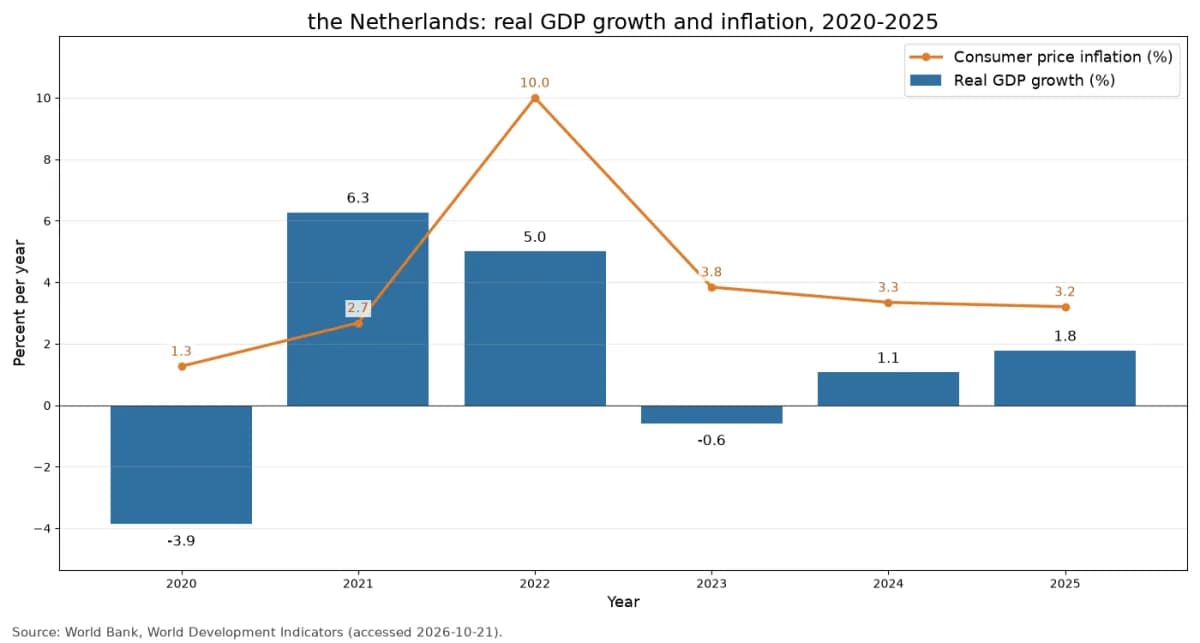
| Real GDP growth (%) | -3.9 | 6.3 | 5.0 | -0.6 | 1.1 | 1.8 |
| Inflation (%) | 1.3 | 2.7 | 10.0 | 3.8 | 3.3 | 3.2 |
| Population (million) | 17.44 | 17.53 | 17.70 | 17.88 | 17.99 | 18.09 |
*Source: World Bank, World Development Indicators (accessed 21 October 2026).*[^41]
World Bank modelled (ILO) unemployment for 2025 is 3.9%, with youth (ages 15 to 24) at 8.8%, and the World Bank counts an international migrant stock of 2,956,518 for 2024.[^41] The national figures are more recent. CBS reports unemployment (ages 15 to 74) of 3.7% in 2024 and 3.9% in 2025, and 4.0% (408,000 people) in September 2026.[^42][^43] Vacancies per 100 unemployed peaked at 142 in the second quarter of 2022, then stood at 91 in the first quarter of 2026 and 95 in the second quarter (provisional), with 375,000 open vacancies at the end of the second quarter.[^44] CBS puts real GDP growth at 1.8% in 2025 and 1.1% in 2024.[^45] The planning bureau CPB forecasts growth of 1.4% in 2026 and unemployment of 3.9% in 2026 and 4.0% in 2027, according to the employers' association AWVN (likely).[^46]
On 1 January 2026 the population was 18,130,208, of whom 5,271,067 (29.1%) were born abroad or had at least one parent born abroad (our calculation from the CBS table).[^47][^3] The Jetten cabinet (D66, VVD, CDA) was sworn in on 23 February 2026. Its coalition agreement of 30 January 2026 aims to get a grip on labour migration but says the expat scheme will not be cut back further.[^48][^49]
What this means for a job seeker: unemployment of about 4% and roughly 95 vacancies per 100 unemployed mean a fairly balanced market, so a tailored CV matters more than volume.
Work permits and rules for foreign workers
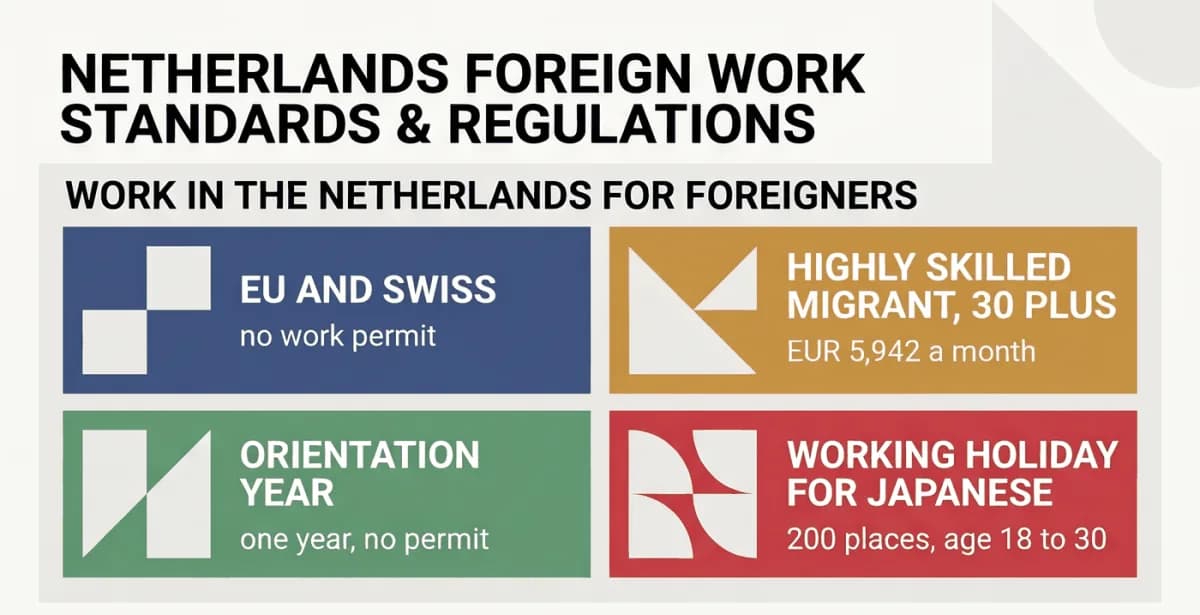
EU/EEA and Swiss citizens need no residence or work permit to work in the Netherlands. For other nationals, the employer applies for a single permit (GVVA, handled by the IND) or a work permit (TWV, issued by UWV after a labour-market test).[^50][^51] We did not verify the registration steps (municipal registration, BSN) in this review, so ask your employer or the municipality.
UK nationals are treated as non-EU nationals unless they hold rights under the Brexit withdrawal agreement. We did not verify a UK-specific route, so check ind.nl for your own case.
Non-EU routes and 2026 amounts
- Highly skilled migrant (kennismigrant), gross per month, excluding holiday allowance. Under 30: EUR 4,357 (about US$4,849 / JPY 766,000). Age 30 or older: EUR 5,942 (about US$6,613 / JPY 1,045,000). Reduced criterion, for those applying during or after an orientation year or within three years of graduating: EUR 3,122 (about US$3,475 / JPY 549,000). The employer must be a recognised sponsor. If you turn 30 with the same sponsor, the under-30 amount stays.[^52]
- EU Blue Card. EUR 5,942 a month, or EUR 4,754 (about US$5,291 / JPY 836,000) under the reduced criterion. The employer need not be a recognised sponsor, but processing is faster if it is. A degree of at least three years, or five years of relevant experience, is required.[^52][^53]
- Orientation year (zoekjaar hoogopgeleiden). Up to one year, not extendable, with work allowed without a work permit. You apply in person within three years of graduating. A foreign institution must be in the top 200 of at least two ranking lists from separate publishers (THE, QS, ShanghaiRanking), checked at the graduation date. The IND fee is EUR 254 (about US$283 / JPY 44,700). A highly skilled migrant permit during or after the year uses the reduced EUR 3,122.[^54][^55][^56]
- Other employment (TWV via UWV). For other cases the employer needs a work permit after a labour-market test, usually inside the single permit.[^51]
- IND fees for 2026. EUR 423 (about US$471 / JPY 74,400) for a highly skilled migrant permit, a Blue Card, and the self-employed routes; EUR 254 for the orientation year; EUR 85 (about US$95 / JPY 15,000) for the working holiday. Fees change each 1 January.[^56]
- Students. International students may work alongside study within limits that we did not verify; check the IND.
- Illegal employment. Since 1 February 2025 the fine for employing a foreigner without the right papers is reported to run from EUR 2,250 to EUR 11,250 per worker (likely; press), depending on culpability. Employers therefore ask for proof of the right to work.[^57][^58]
The IND received 84,480 applications for regular residence in 2025. In the "knowledge and talent" category (highly skilled migrants, the orientation year, the Blue Card and similar permits) it received 19,490 applications and 86% were granted; the largest groups were Indian, Turkish and American applicants.[^59]
Japanese nationals
Japanese nationals are exempt from the entry-visa requirement (MVV) and may stay visa-free for 90 days in any 180, but a residence permit is needed for longer stays.[^60] The labour-market-test exemption that Japanese workers once had came from a ruling of the Raad van State of 24 December 2014 on the old Japan-Netherlands trade treaty. For applications received from 1 January 2017 the normal rules of the foreign-workers act apply, so an employer applies for a single permit like for other non-EU nationals.[^61] The treaty still matters for self-employment: the Dutch-Japanese trade-treaty route needs capital of EUR 4,500 (about US$5,010 / JPY 792,000) for a sole proprietorship, VOF, CV or BV and EUR 11,250 (about US$12,500 / JPY 1.98 million) for an NV, and the IND fee is EUR 423.[^61][^56][^62]
Working Holiday. Applicants must be 18 to 30 at application. The quota is 200 Japanese a year, no MVV is needed and the fee is EUR 85. The permit lasts up to one year, cannot be extended and allows temporary work only. Since 1 April 2026 you apply directly online. The 2026 quota was full on 7 April 2026, and the next applications open on 1 January 2027.[^63]
Japanese residents and agreements. MOFA counted 11,225 Japanese nationals in the Netherlands on 1 October 2025, up 5.3% from 10,656.[^64] The Japan-Netherlands social security agreement has been in force since 1 March 2009 and the tax convention was signed on 25 August 2010 and entered into force on 29 December 2011.[^65][^66]
Foreign workers in the Netherlands in numbers
| Measure | Value |
|---|---|
| World Bank international migrant stock, 2024 | 2,956,518[^41] |
| Immigrants in 2025 | 309,000 (152,000 non-EU/EFTA, 114,000 EU/EFTA, 43,000 Dutch citizens)[^67] |
| Residents born in Turkey, 1 January 2026 | 243,111[^3] |
| Residents born in Poland | 190,458[^3] |
| Residents born in Germany | 121,714[^3] |
| Residents born in India | 80,573[^3] |
| Residents born in Romania | 57,158[^3] |
| Residents born in Bulgaria | 53,852[^3] |
| Japanese nationals, 1 October 2025 | 11,225[^64] |
The CBS figures are residents by country of birth, not workers.
What this means for a job seeker: an EU/EEA citizen can start straight away; a non-EU applicant needs an employer who applies, so compare your gross monthly pay with the thresholds above.
Labour law: hours, leave, notice and dismissal
| Topic | Rule | Law |
|---|---|---|
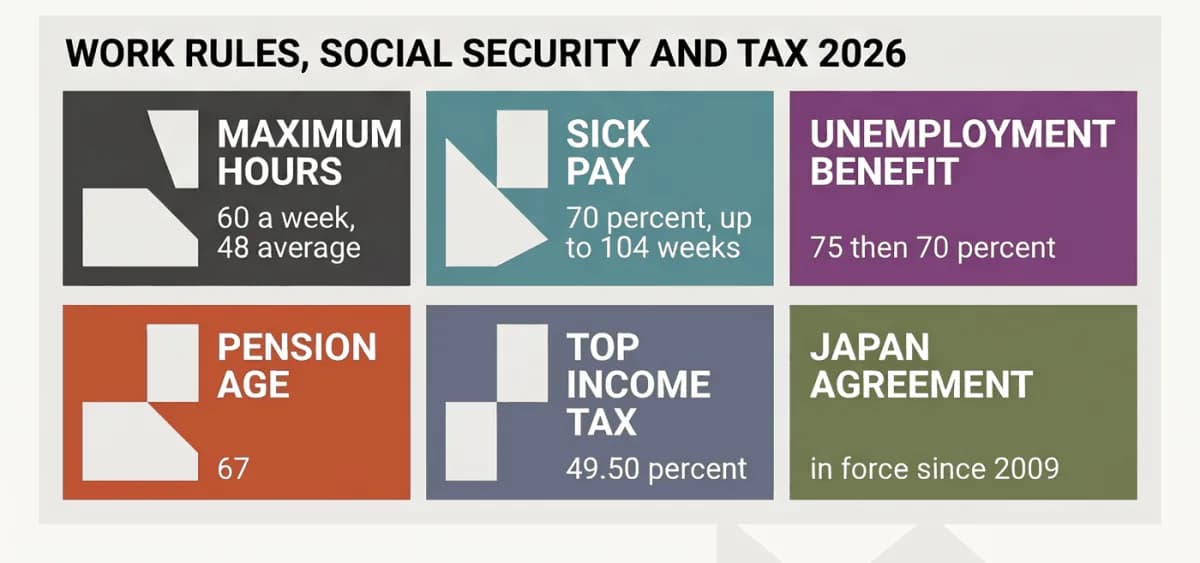
| Maximum hours (18 and over) | 12 hours per shift and 60 per week; average 48 per week over 16 weeks and 55 per week over 4 weeks | Arbeidstijdenwet art. 5:7[^68] |
| Overtime pay | No statutory overtime premium (likely); it is set by CAO or contract | n/a |
| Annual leave | At least four times the weekly working time per year; statutory days lapse six months after the end of the year in which they accrue | BW 7:634, 7:640a[^69] |
| Holiday allowance | At least 8% of wages | Wet minimumloon art. 15[^38] |
| Sick pay | 70% of wages for up to 104 weeks, and at least the minimum wage in the first 52 weeks (CAOs often pay more in year 1) | BW 7:629[^69] |
| Birth leave | Partner: one week at full pay, plus up to five weeks at 70% | Wet arbeid en zorg art. 4:2, 4:2a[^70] |
| Maternity leave | 16 weeks (up to 6 before, 10 after the birth), paid up to the maximum daily wage by UWV | Wet arbeid en zorg art. 3:1[^70] |
| Parental leave | Up to 26 times the weekly working hours per child and per parent, of which 9 weeks are paid at 70% by UWV if taken before the child is one | Wet arbeid en zorg art. 6:2, 6:3[^70] |
| Notice | Employer: 1 month under 5 years of service, 2 months for 5 to 10 years, 3 months for 10 to 15 years, 4 months from 15 years. Employee: 1 month | BW 7:672[^69] |
| Dismissal | UWV permission for economic grounds and long-term incapacity; the kantonrechter (subdistrict court) for personal grounds | BW 7:669, 7:671a[^69] |
| Transition payment | One third of a month's pay per year of service from day one; cap EUR 102,000 in 2026 (about US$113,500 / JPY 17.9 million) or one annual salary if higher | BW 7:673[^71] |
| Termination agreement | 14 days to withdraw in writing (21 days if the right is not stated) | BW 7:670b[^69] |
| Chain rule | More than three fixed-term contracts, or more than 36 months, make the contract permanent | BW 7:668a[^69] |
| Wage claims | Five-year limitation | BW 3:307[^72] |
The Wet arbeid en zorg article numbers come from the law text itself, as UWV's pages on leave could not be read. A proposed merged leave law is only in preparation.[^70]
2026 public holidays
| Holiday | 2026 date |
|---|---|
| New Year's Day (Nieuwjaarsdag) | Thursday 1 January |
| Good Friday (Goede Vrijdag) | Friday 3 April (usually not a day off) |
| Easter Sunday and Monday (Pasen) | Sunday 5 and Monday 6 April |
| King's Day (Koningsdag) | Monday 27 April |
| Liberation Day (Bevrijdingsdag) | Tuesday 5 May (not a general day off in 2026) |
| Ascension Day (Hemelvaart) | Thursday 14 May |
| Whit Sunday and Monday (Pinksteren) | Sunday 24 and Monday 25 May |
| Christmas (Kerst) | Friday 25 and Saturday 26 December |
The dates follow the Rijksoverheid list of official holidays. No law gives a general right to a paid day off on these days; your CAO or contract decides. By custom Liberation Day is a general day off only every five years (2025, 2030), so 2026 is not such a year.[^73]
What this means for a job seeker: ask whether your CAO or contract gives a paid day off on King's Day and Ascension Day, and check any probation clause against the limits above.
Social security: what you pay and what you get
| Item | 2026 rule |
|---|---|
| National insurance (volksverzekeringen) | 27.65% of the first box 1 rate (35.75%): AOW 17.90%, Anw 0.10% and Wlz 9.65%. By our arithmetic the remaining 8.10 percentage points are income tax. The split is reported (likely)[^74] |
| Employee insurances (WW, ZW, WIA) | Unemployment, sickness and disability cover, funded mostly by employer premiums (reported). We did not verify the 2026 percentages, so ask UWV or your employer |
| Basic health insurance (Zvw) | Mandatory; you take out your own policy. Compulsory yearly deductible (eigen risico) of EUR 385 in 2026 (about US$428 / JPY 67,700). Premiums vary by insurer, so compare policies[^75] |
| State pension (AOW) | Age 67 for people born between 1 March 1957 and 31 December 1960, higher for younger cohorts. Each insured year gives 2% of the full pension over 50 years[^76] |
| Unemployment benefit (WW) | 26 of the last 36 weeks worked gives 3 months of benefit; longer needs 4 of the last 5 years; maximum 24 months. 75% of earnings for two months, then 70%[^77] |
| Maximum daily wage for WW | EUR 304.25 (about US$339 / JPY 53,500) from 1 January 2026 and EUR 309.91 (about US$345 / JPY 54,500) from 1 July 2026[^78] |
What foreigners get. Insured years in the Netherlands count towards the AOW pension, and unemployment benefit rests on weeks worked.[^76][^77]
Japan. The Japan-Netherlands social security agreement has been in force since 1 March 2009. It covers pension and health insurance, lets staff posted for up to five years stay in the sending country's system and allows insurance periods to be totalled.[^65][^79]
What this means for a job seeker: your health insurance is a separate monthly cost plus a yearly deductible. If you are posted from Japan, ask your employer whether the agreement keeps you in the Japanese system.
Taxes on employees
For people below AOW age, 2026 income tax on salary (box 1) includes national insurance:[^80]
| Taxable income (EUR) | Rate |
|---|---|
| Up to 38,883 (about US$43,300 / JPY 6.84 million) | 35.75% |
| 38,883 to 78,426 (about US$87,300 / JPY 13.8 million) | 37.56% |
| Above 78,426 | 49.50% |
- General tax credit. Up to EUR 3,115 (about US$3,467 / JPY 548,000), phasing out at 6.398% between EUR 29,736 and EUR 78,426.[^80]
- Labour tax credit. Up to EUR 5,685 (about US$6,327 / JPY 1.00 million) at EUR 45,592, phasing out at 6.510% and reaching zero at EUR 132,920.[^80]
- 30% ruling (expat scheme). In 2026, 30% of salary can be paid tax-free if you meet the salary norm of EUR 48,013 (about US$53,438 / JPY 8.45 million), or EUR 36,497 (about US$40,621 / JPY 6.42 million) for under-30s with a master's. The maximum allowance is EUR 78,600 (about US$87,500 / JPY 13.8 million), which is 30% of the WNT cap of EUR 262,000.[^81] For new cases starting after 1 January 2024 the allowance is 30% in 2024 to 2026, and from 1 January 2027 the maximum is 27%, with a salary norm of EUR 50,436 (about US$56,100 / JPY 8.87 million) and EUR 38,388 for under-30 masters. The law has been adopted. People who already used the scheme before 2024 keep 30% until their 60 months end.[^82][^83] Other changes to the 2027 tax packages are proposals, and we do not apply them here.
- VAT. 21% standard rate and 9% reduced rate.[^84]
No municipal income tax (vs Japan's 住民税)
The Netherlands has no municipal or regional income tax like Japan's resident tax (住民税, juminzei), which is commonly described as about 10% of taxable income. Dutch income tax is national only, as the Belastingdienst's rate tables show.[^80] Municipalities instead charge property tax (OZB), a waste charge (afvalstoffenheffing) and a sewerage charge (rioolheffing), and the regional water boards charge water board tax (waterschapsbelasting). We give no amounts, as they differ by municipality and we found no national average for tenants.
What this means for a job seeker: the credits reduce the final bill, so compare offers on net pay. If you are a recruited expat, ask before you accept whether the employer will apply for the 30% ruling, because the rate changes in 2027.
Where to find jobs, recruitment agencies and job scams
Where to search. Start with werk.nl, UWV's job board, which loads in a browser. Add Werken voor Nederland for central-government roles, EURES for EU/EEA moves, and Indeed Netherlands, LinkedIn and Nationale Vacaturebank for volume. We confirmed that these sites load, not their listings.[^85][^86][^87][^88][^89] Our Netherlands job-board guide compares them.
Recruitment agencies. Two rules protect you. Under the Waadi, article 3(1), no payment may be agreed with a job seeker for labour intermediation, and article 9 bars an agency from asking a worker for payment for being placed as an agency worker.[^90] Certification by ABU, NBBU or SNA is currently voluntary. The Wtta (licensing act for temporary agency work) enters into force on 1 January 2027, and from 1 January 2028 an agency may operate only with a licence from the Nederlandse Autoriteit Uitleenmarkt.[^91]
Scams. The Fraudehelpdesk site was in maintenance when we last checked, so this point rests on search summaries of its pages (likely): fake offers arrive by messaging apps, e-mail and social media, often as home-work or task jobs that ask for money first. Never pay to get a job, do not send passport scans or your BSN before you have verified the employer, check that the advert also appears on the employer's own site, and if you sent an ID copy to a scammer, report it to the Fraudehelpdesk and consider a police report.[^92]
Final checks before you apply
- [ ] The CV is one to two pages, latest job first, in the language of the advert, with a profile written for this vacancy.
- [ ] I decided about the photo (werk.nl recommends one) and left off my BSN and any ID copy.
- [ ] If I need a permit, one line says so; as a non-EU applicant, my gross monthly pay meets the threshold and the employer applies for my permit.
- [ ] The motivatiebrief is under one A4 page, has at most five paragraphs and does not repeat the CV.
- [ ] I asked my referees before naming them.
- [ ] I know which CAO covers the job, and the offer is at least EUR 14.99 an hour gross for adults, with 8% holiday allowance.
- [ ] I will get the main contract terms in writing within a week of starting and the rest within a month; I know the probation and notice rules.
- [ ] I checked whether the 30% ruling applies and what net pay will be.
- [ ] No one has asked me for a fee for a job or a permit.
FAQ
What is the standard Dutch CV format?
There is no legal template. A clear CV of one to two pages (FNV advises at most one A4), latest job first, with a short profile at the top and a photo as werk.nl recommends, in the language of the advert, is the safe default.
Should a Dutch CV include a photo?
werk.nl advises always adding one, because employers look less at CVs without a photo. It is optional by law, and nothing bans it. Use a calm background, a visible face and a colour photo.
Should I put my BSN or date of birth on the CV?
Leave off the BSN. The AP says employers may not ask for it or for a copy of your ID during selection. Date of birth and marital status are not on werk.nl's list, so include them only if you choose to.
How long should a motivatiebrief be?
werk.nl says preferably shorter than one A4 page and at most five paragraphs. Do not repeat the CV.
What is the minimum wage in the Netherlands in 2026?
For adults (21 and over) it is EUR 14.71 an hour gross (about US$16.4 / JPY 2,590) from 1 January 2026 and EUR 14.99 (about US$16.7 / JPY 2,640) from 1 July 2026. Holiday allowance of at least 8% comes on top.
Do I need a work permit?
EU/EEA and Swiss citizens do not. For a highly skilled migrant permit in 2026, the gross monthly salary must be EUR 4,357 under age 30, EUR 5,942 at 30 or older, or EUR 3,122 under the reduced criterion. The IND fee is EUR 423 (about US$471 / JPY 74,400) and the employer applies.
Can Japanese citizens work in the Netherlands on a Working Holiday?
Yes, if aged 18 to 30: 200 places a year, fee EUR 85 (about US$95 / JPY 15,000), up to one year, temporary work only. The 2026 quota was full on 7 April 2026; applications reopen on 1 January 2027.
Can Japanese nationals work without a permit?
No. The labour-market-test exemption that followed a 2014 court ruling ended for applications received from 1 January 2017, so the normal rules for non-EU nationals apply. The old trade treaty still matters for self-employment.
Can an employer ask me health questions or keep my data?
Not before the end of selection: a medical examination may happen only after all other assessments and when the employer intends to hire you, and only an examining physician may ask health questions. The AP calls deletion within four weeks customary, and up to one year reasonable with your consent.
How much income tax will I pay, and what is the 30% ruling?
Box 1 rates for 2026 are 35.75% up to EUR 38,883, 37.56% up to EUR 78,426 and 49.50% above, before tax credits, and they include national insurance. The 30% ruling makes 30% of salary tax-free if you meet the EUR 48,013 salary norm, and the maximum falls to 27% from 1 January 2027 for new cases.
How to use AIResume
Keep one master CV in AIResume and cut a Dutch and an English version for each vacancy: use the advert's keywords, lead with your strongest result, and add the right-to-work line if you need it. Leave out your BSN, export a PDF and check it with our ATS-friendly CV guide before you apply.
Related AIResume guides
- Netherlands job-board guide
- Belgium CV format guide
- Germany job-board guide
- Belgium job-board guide
- Switzerland CV format guide
- Luxembourg job-board guide
- How to write an ATS-friendly CV
Sources
[^1]: werk.nl, make a CV (cv maken)
[^2]: FNV, applying for jobs (solliciteren)
[^3]: CBS, population by origin (table 85384NED)
[^4]: ECB, euro foreign exchange reference rates
[^5]: ECB data portal, EUR/USD and EUR/JPY reference rates of 29 October 2026
[^6]: werk.nl, profile photo tips (2 February 2026)
[^7]: Autoriteit Persoonsgegevens, personal data of applicants
[^8]: Stichting van de Arbeid, renewed NVP Sollicitatiecode (July 2025)
[^9]: werk.nl, application letter (sollicitatiebrief)
[^10]: Algemene wet gelijke behandeling (BWBR0006502)
[^11]: College voor de Rechten van de Mens, ruling 2021-115 (WGBL articles 3 and 7)
[^12]: Burgerlijk Wetboek Boek 7, article 646
[^13]: Burgerlijk Wetboek Boek 7, article 648
[^14]: Wet op de medische keuringen (BWBR0008819)
[^15]: Eerste Kamer, Wet toezicht gelijke kansen bij werving en selectie (35673)
[^16]: Eerste Kamer, initiatiefvoorstel Ergin and Van Baarle (36908)
[^17]: Officiële bekendmakingen, dossier 36908
[^18]: Nederlandse Arbeidsinspectie, identity checks
[^19]: Autoriteit Persoonsgegevens, gathering information about applicants
[^20]: Justis, I need a VOG
[^21]: Justis, what is a VOG
[^22]: Justis, certificate of conduct (VOG)
[^23]: Burgerlijk Wetboek Boek 7, article 655
[^24]: Burgerlijk Wetboek Boek 7, articles 652 and 653
[^25]: IDW, who we are
[^26]: IDW, evaluation for work
[^27]: IDW, longer processing times
[^28]: IDW, international credential evaluation
[^29]: IDW, required documents
[^30]: Wet BIG (BWBR0006251)
[^31]: BIG register, Dutch language proficiency (automatic recognition)
[^32]: BIG register, declaration of professional competence: duration and cost
[^33]: BIG register, registering with a recognised diploma
[^34]: HCCH, Apostille Convention status table
[^35]: MOFA Japan, apostille (page updated 1 June 2026)
[^36]: Embassy of Japan in the Netherlands, certificates (police certificate)
[^37]: Rijksoverheid, minimum wage amounts 2026
[^38]: Wet minimumloon en minimumvakantiebijslag (BWBR0002638)
[^39]: CBS, 610 thousand jobs paid at the minimum wage
[^40]: CBS, labour market in figures 2025: wages and labour costs
[^41]: World Bank, World Development Indicators: Netherlands (accessed 21 October 2026)
[^42]: CBS open data, labour participation table 80590ned
[^43]: CBS, 408 thousand unemployed in September 2026
[^44]: CBS, unemployment fell in the second quarter of 2026
[^45]: CBS, the Dutch economy in 2025: economic growth and spending
[^46]: AWVN, MEV 2027: what employers should know (CPB figures, press)
[^47]: CBS, population figures (table 85496ENG)
[^48]: Rijksoverheid, the government
[^49]: Coalition agreement D66, VVD and CDA (30 January 2026)
[^50]: business.gov.nl, permits for your foreign employees
[^51]: IND, single permit (GVVA)
[^52]: IND, required amounts and income requirements
[^53]: IND, brochure 3086 (EU Blue Card)
[^54]: IND, form 7523 (orientation year)
[^55]: Nuffic, orientation year permits
[^56]: IND, fees and costs of an application
[^57]: Salaris van Morgen, higher fines for illegal employment (press)
[^58]: AWVN, new fine decision under the Wet arbeid vreemdelingen (press)
[^59]: IND, annual figures 2025
[^60]: IND, MVV exemptions
[^61]: Tweede Kamer, government answers on Japanese nationals and work permits (ah-tk-20152016-3142)
[^62]: IND, residence permit for self-employed persons
[^63]: IND, residence permit for working holiday
[^64]: MOFA Japan, survey of Japanese nationals abroad (1 October 2025)
[^65]: Japan Pension Service, Netherlands social security agreement
[^66]: Ministry of Finance Japan, tax conventions list
[^67]: CBS, immigration down in 2025, especially asylum and knowledge migrants
[^68]: Arbeidstijdenwet (BWBR0007671)
[^69]: Burgerlijk Wetboek Boek 7 (BWBR0005290)
[^70]: Wet arbeid en zorg (BWBR0013008)
[^71]: Rijksoverheid, how high is the transition payment
[^72]: Burgerlijk Wetboek Boek 3 (BWBR0005291)
[^73]: Rijksoverheid, official holidays
[^74]: Accountancy van Morgen, 2026 premium percentages for employees and national insurance (press)
[^75]: Rijksoverheid, compulsory deductible (eigen risico)
[^76]: SVB, your AOW pension age
[^77]: UWV, how long WW lasts
[^78]: UWV, how high WW is
[^79]: MHLW, Japan-Netherlands social security agreement
[^80]: Belastingdienst, provisional assessment rates and tax credits 2026
[^81]: Belastingdienst, apply for the 30% ruling
[^82]: Ondernemersplein, 30% allowance for expats becomes 27%
[^83]: SRA, expat scheme (formerly 30% ruling) from 2027 becomes 27%
[^84]: Eerste Kamer, Wet behoud verlaagd btw-tarief (36814)
[^85]: werk.nl vacancies
[^86]: Werken voor Nederland
[^87]: EURES
[^88]: Indeed Netherlands
[^89]: Nationale Vacaturebank
[^90]: Waadi (BWBR0009616)
Your next step
- DeelFor employers hiring across borders: contracts, payroll and visas handled.See how Deel works
Affiliate links: we may earn a commission at no cost to you. Affiliate link