

Israel CV Format 2026: Hebrew vs English CVs, Privacy Rules, Minimum Wage, Visas and Tax
Israel has no legal CV template, and we found no law that prescribes a length, a photo or a language. What the law does regulate is discrimination in hiring (the Equal Employment Opportunities Law 1988 lists 16 protected grounds, age and reserve service among them), what an employer may do with your
By AIResume Editorial Team
Last updated: 1 November 2026
Israel has no legal CV template, and we found no law that prescribes a length, a photo or a language. What the law does regulate is discrimination in hiring (the Equal Employment Opportunities Law 1988 lists 16 protected grounds, age and reserve service among them), what an employer may do with your personal data (Amendment 13 to the Privacy Protection Law has been in force since 14 August 2025), the written notices you must receive, and your pay and entitlements once you start. A photo, an ID number, a street address or a marital-status line on a CV is a matter of practice, not statute.[^1][^2]
This guide covers the Israeli CV and cover letter, fair-hiring and privacy rules, civil service applications, qualifications and licences, documents for Japanese applicants, minimum wage, the economy, visas, labour law, social security, tax and job scams. It is written for Israeli citizens, new immigrants (olim) under the Law of Return, foreign experts on B/1 visas and Japanese nationals. For job boards and channels, see our Israel job-board guide; this article summarises its permit, tax and labour-law material rather than repeating its lists.
Editorial boundary: This is practical job-search guidance, not legal, immigration or tax advice. Our references are the law texts of the Knesset and Nevo (read as Hebrew Wikisource transcriptions), the Ministry of Labor, the Israeli Employment Service, the Civil Service Commission, the Population and Immigration Authority (PIBA), the Israel Tax Authority, the National Insurance Institute (Bituach Leumi, BTL), the Central Bureau of Statistics (CBS), the Bank of Israel and the Privacy Protection Authority (PPA). We only list figures we could read in an official or primary source, and we mark the rest as "commonly advised" or "reported". Some sites refused ordinary access: we read the gov.il pages and the Japanese Ministry of Foreign Affairs (MOFA) pages in a browser, the Hague Conference table was unreachable (Israel's Apostille membership comes from MOFA's list), the Kol Zchut site was closed to us, and the gov.il employment-service and regulated-professions pages reached us only as search excerpts.
Exchange rates move daily. This guide converts at the Bank of Israel representative rates published on 30 October 2026: US$1 = NIS 3.118 and JPY 100 = NIS 1.9822, so NIS 1 is about US$0.321 and about JPY 50.4. At those rates NIS 6,443.85 a month (the minimum wage) is about US$2,067 / JPY 325,000.[^3]
Before you apply
- SafetyWing Nomad InsuranceHealth insurance that works in your new country from day one.Get a quote
Affiliate links: we may earn a commission at no cost to you. Affiliate link
Israel CV format at a glance
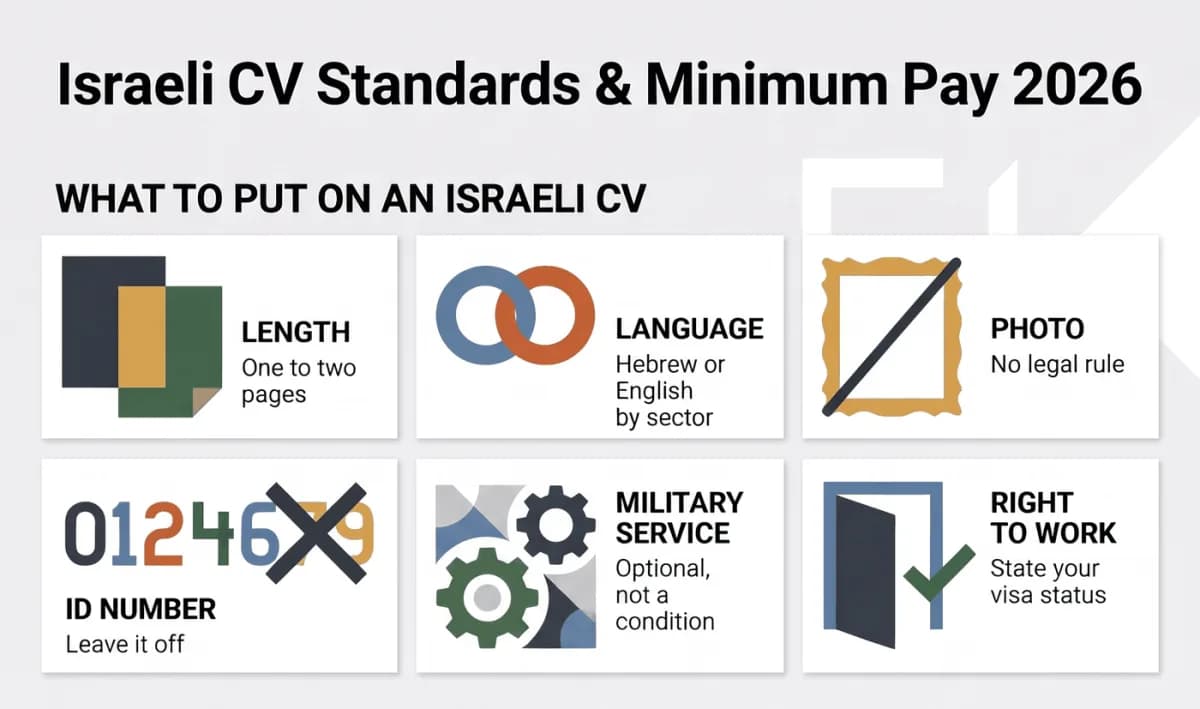
| Topic | Practice in 2026 | Law or official guidance |
|---|---|---|
| Length | One to two pages, longer only for senior or academic roles (commonly advised) | No rule; editorial |
| Language | Hebrew is the main working language; English is common in technology and in roles with international clients. Write in the language of the advert and keep a Hebrew and an English version | Practice; no rule |
| Photo | Optional. Many applicants omit it, but no statute requires or bans one | Market practice, not law[^2] |
| Personal data | Age, marital status, children, place of residence and military service are all protected grounds, so leaving them off is common. An interviewer should not ask about them | EEO Law 1988 s.2(a), s.9(c)[^1][^2] |
| ID number (teudat zehut) | Leave it off; give it on the hiring forms. No statute names it either way | Practice[^2] |
| Military or national service | List it as experience if it is relevant. No law makes service a hiring condition, and adverts may not require or prefer it | EEO Law s.2(a), s.2A; Commission guide[^1][^2] |
| Expected salary | A gross monthly figure in NIS is the convention, usually given when asked | Market convention |
| Right to work (non-citizens) | One line with your actual status, for example "B/1 expert visa holder" (editorial advice) | Editorial |
| References | "Available on request", with two named referees ready | Practice |
| Cover letter | A short e-mail introduction or one page, commonly advised | Editorial |
| File format | One text-searchable PDF unless the advert says otherwise | Editorial |
Discrimination law, privacy and fair hiring
The Equal Employment Opportunities Law
Section 2(a) of the Equal Employment Opportunities Law 1988 bars an employer from discriminating between employees or job seekers on 16 grounds: sex, sexual orientation, personal status (marital status), pregnancy, fertility treatment, IVF treatment, parenthood, age, race, religion, nationality, country of origin, place of residence, views, political party and reserve (military) service, including that of a spouse or of the child's other parent. It covers hiring, conditions, promotion, training, dismissal and retirement benefits. Disability is not in s.2; it is covered by the separate Equal Rights for Persons with Disabilities Law 1998. Except for s.7, the law does not apply to an employer with fewer than six employees (s.21(c)).[^1]
What employers may not ask. The statute bans discrimination, not questions as such. The link to interviews is the burden of proof: if the employer sought information on a protected ground, directly or indirectly, it must prove that it did not discriminate (s.9(c)), and the same presumption applies in a criminal case (s.15(d)). Section 8 requires job adverts not to discriminate and to address both genders.[^1] The Equal Employment Opportunities Commission's guide gives as examples of questions to avoid "Do you have children?", "What did you do in the army?", "Aren't you too old for the job?" and "Are you planning more children?". It adds that a woman need not disclose pregnancy at an interview.[^2]
Military service and the "profile". Section 2A bars an employer from demanding or using a person's military profile (fitness code) for any matter covered by s.2(a)(1) to (6). The Commission's guide says military service is not a mandatory hiring condition, that adverts may not require or prefer service, and that for a genuine security role a military background can be a legitimate requirement.[^1][^2]
Candidate data: the Privacy Protection Law and Amendment 13
Amendment 13 to the Privacy Protection Law came into force on 14 August 2025, according to law-firm alerts, and the PPA's recruitment Guideline 2/2012 was updated after it.[^4][^5] In practice, for recruitment the PPA guideline says:
- the employer needs the candidate's informed consent to use the candidate's data;
- a screening institute is only a "holder" acting for the employer, unless the candidate consents separately;
- a blanket waiver of the right to see test results is invalid, and a candidate may receive the opinion in the form given to the employer;
- the employer may not keep excess data and must supervise the institute's data security.[^5]
The amended law treats personality assessments as sensitive data (s.3(8)).[^5] The PPA has published draft guidance on artificial intelligence, but it is only a draft.[^6]
Written notices to applicants and employees
The Notice to Employee and Job Applicant (Terms of Employment and Screening and Hiring Procedures) Law 2002 has two parts that matter to candidates. In a screening procedure (an interview or a test), the employer must send a written progress notice at least every two months and a rejection notice within 14 days after someone else is hired (s.3A). The law does not apply to jobs of 30 days or less, to the catering sector or to employers with 25 or fewer employees. Once you start, the employer must give you written terms within 30 days (7 days for a minor): the parties, start date, job, direct supervisor, pay and pay dates, hours, weekly rest day and social benefits (ss.1 and 2). Changes follow within 30 days (s.3).[^7]
Placement and assessment institutes (machon hasama)
Many mid-size and large employers send candidates to an outside assessment institute for tests and a personality or aptitude report. We found no statute on these tests; the rules above come from the PPA guideline. Practical consequences: ask the employer which institute it uses and why, ask for a copy of the report given to the employer, and do not sign a blanket waiver of that right, because the PPA says such a waiver is invalid.[^5] We found no law or guideline that regulates handwriting analysis (graphology) specifically.
Police certificates and minors' clearance
The main statutory clearance we found applies to work with minors and vulnerable people. Under the Prevention of Employment of Sex Offenders in Certain Institutions Law 2001, a person convicted as an adult of a sex offence committed as an adult may not work for 20 years from conviction or release in an institution for minors (schools, day-care, youth centres, camps, boarding schools, sports clubs where minors train) or in a place for people with intellectual or developmental disabilities or "helpless" persons. "Work" includes volunteering with regular contact. An employer may not hire an adult without Israel Police approval that no bar exists, and the approval is valid for the year before hiring. A job of up to 30 days is not an offence if approval is sought promptly. The approval is a police document stating that no bar exists under this law, not a criminal-record extract. The law first exempted women until a date to be set, and a later bill's explanatory note says that exemption was repealed, so do not assume it applies to men only. You apply through the gov.il service "request for police employment approval".[^8]
References
Referee checks are common practice, not law. Commonly advised: name two referees who know your recent work, ask each for permission first, and ask previous employers for a letter confirming your title and dates.
Structure of an Israeli CV
The order below is editorial advice; no official model CV exists.
- Header. Name, phone, e-mail, city and a link to a LinkedIn or portfolio page. Leave out the ID number, birth date and photo unless the advert asks.
- Two-line profile. Role, years of experience, strongest result.
- Experience, latest first. Employer, title, dates and two to four bullets with numbers ("cut release testing from 3 days to 1").
- Military or national service. Many Israeli CVs list it as experience, with the unit type, role and skills. It is the candidate's choice, because no law requires it.[^2]
- Education. Highest first. For a foreign degree, add the evaluation status if you have one.
- Skills and languages. State your Hebrew and English levels honestly.
- Right to work (non-citizens), one line.
ATS. Use plain headings, one column and standard fonts, and mirror the advert's keywords honestly. If you send both a Hebrew and an English CV, keep the same dates and numbers in both. See our ATS-friendly CV guide.
Israel vs UAE vs Germany
We tabulate only points we could read in a primary source for each country. Israel's column comes from the sources above, the UAE and German columns from the sources our other CV guides use.
| Point | Israel | UAE | Germany |
|---|---|---|---|
| Length | No rule; one to two pages advised (editorial) | One or two focused pages (convention) | Ideally two A4 pages at most[^9] |
| Photo | Optional; no law requires or bans one | Optional; follow the employer's instruction; no UAE law found that requires or bans one | Customary, not required[^9] |
| Date of birth | Age is a protected ground; many applicants omit it | Include only if a trusted employer form asks | Normal CV content[^9] |
| Visa-status line | One truthful line (editorial) | One truthful line in the header[^10] | State your actual residence status[^9] |
Annotated fictional Israeli CV
The sample is entirely fictional (person, employers, contacts, numbers), and employers are described generically on purpose. Replace every item with truthful information.
Noa Ben-David, QA Engineer · Haifa · [email protected] · +972 50 000 0000
*Annotation: city only; no ID number, birth date, marital status or photo.*
Right to work: Israeli citizen · Languages: Hebrew (native), English (fluent), Russian (conversational)
*Annotation: non-citizens replace the first item with their actual status, for example "B/1 expert visa, valid to 2028".*
Profile: QA engineer with seven years in embedded and cloud products; moved release testing from manual to automated runs.
Experience
| Dates | Role and employer | Detail |
|---|---|---|
| 03/2022 to present | Senior QA Engineer, a Herzliya-based cybersecurity start-up (fictional) | Cut release regression testing from 3 days to 1 by building an automated suite; mentored three junior testers. |
| 08/2019 to 02/2022 | QA Engineer, a Haifa-based medical-device company (fictional) | Wrote test plans for two device releases; reduced field defects by 30%. |
| 07/2018 to 07/2019 | Junior tester, a Be'er Sheva-based software house (fictional) | Ran manual tests for a payments app used by 40,000 customers. |
*Annotation: latest first, one result per role, employers described generically.*
National service: 2014 to 2017, technical unit; troubleshooting of communications equipment (fictional)
*Annotation: optional. Listed because the skills transfer; no law requires it, and an employer may not require or prefer it in an advert.*
Education: B.Sc. Computer Science, Example University (fictional), 2018
Availability and references: two months' notice (current contract); references on request
*Annotation: expected salary is not on the CV. Give a gross monthly NIS figure when asked.*
Cover letters, interviews and offers
Cover letter. The sources we read set no cover-letter rule, so this is commonly advised: in Israel an introduction in the body of the e-mail, three or four short paragraphs, is common. Name the job, say why this employer, give one or two pieces of evidence, and state your availability. For non-citizens, one sentence states your work authorisation.
Interviews. You may be asked to take tests or meet an assessment institute (see above). Expect to be asked for current or expected pay; give a gross monthly range in NIS and say whether it includes allowances and fund deposits. If you are asked about children, age or army service, you can answer, redirect to the job or ask why it matters; the burden of proof moves to the employer if it asked about a protected ground (s.9(c)).[^1]
What the offer should say. The employer must give written terms within 30 days of your start (ss.1 and 2 of the Notice Law).[^7] Check pay and pay date (monthly wages are due by the 9th of the following month), hours, the weekly rest day, pension and severance deposits, and whether the job has a probation period. There is no statutory probation in Israel: a "trial period" is a contract term, and the prior-notice law applies from the first day.[^11]
Prior notice of dismissal or resignation. Under the Prior Notice for Dismissal and Resignation Law 2001 the minimum notice is:
| Pay basis | Service | Minimum notice |
|---|---|---|
| Monthly-paid | Months 1 to 6 | 1 day for each month of service |
| Monthly-paid | Months 7 to 12 | 6 days plus 2.5 days for each month after month 6 |
| Monthly-paid | After the first year | One month |
| Hourly- or daily-paid | Year 1 | 1 day for each month of service |
| Hourly- or daily-paid | Year 2 | 14 days plus 1 day for every 2 months |
| Hourly- or daily-paid | Year 3 | 21 days plus 1 day for every 2 months |
| Hourly- or daily-paid | After year 3 | One month |
*Source: Prior Notice Law 2001 ss.3-4, as summarised in the PIBA handbook.*[^11]
Common extras. Some items are practice and not statute. A 13th salary is not statutory. A training fund (keren hishtalmut) is usually offered at the tax-favoured maximum of 7.5% from the employer and 2.5% from the employee on salary up to NIS 15,712 a month (about US$5,039 / JPY 793,000), as reported by financial sites; it is not a legal requirement.[^12] Travel costs are reimbursed up to a daily cap, reported at NIS 22.60 a working day (about US$7.25 / JPY 1,140).[^13]
Civil service applications
The Civil Service Commission lists posts on its recruitment sites. Most new posts are internal or inter-ministry tenders, and open public tenders are exceptional.[^14] Each tender sets its own requirements, so read the notice for degree, experience and language conditions before you apply.
The State Service Law (Appointments) gives affirmative action in civil service appointments to four groups, according to gov.il: women, the Arab population, people of Ethiopian origin (born in Ethiopia or with a parent born there) and people with disabilities.[^15] A foreign degree is evaluated against Israeli degrees to rank salary in the public sector (see below).[^16]
Qualifications, licences and documents
Foreign degree evaluation
For olim who received status from 1 January 2025, the Department for Evaluation of Academic Degrees from Abroad sits in the Ministry of Aliyah and Integration. Olim with earlier status stay with the Ministry of Education. The evaluation compares your degree with Israeli degrees under norms set with the Civil Service Commission and the Treasury, and is used for public-sector salary ranking. Universities set their own standards for admission. Nefesh B'Nefesh, a nonprofit, reports 45 working days for applications to the Aliyah ministry and says the documents need a certified-true-copy stamp from an Israeli lawyer, which absorption advisers give free.[^16]
Regulated professions
Some professions need a licence or registration before you can work, for example in health care, law, accountancy, engineering and the electrical trades. The gov.il regulated-professions page lists them and the licensing body for each, and the state Electricians Licensure Department licenses electricians.[^17] Start the licence process before you apply for jobs, because it can take longer than the job search.
Apostille and documents for Japanese applicants
Israel is on MOFA's list of Hague Apostille Convention states (page dated 11 September 2026), and Japan issues the Apostille through MOFA.[^18] The route depends on the document:
- Japanese university degrees. Documents from national university corporations and private universities (diploma, certificate of graduation, transcripts) cannot receive an Apostille directly; MOFA gives them only a public-seal confirmation (koin kakunin). For an Apostille the document must first go through a notary and the Legal Affairs Bureau seal certificate, and then MOFA. Some notary offices (including Hokkaido-Sapporo, Miyagi, Tokyo, Kanagawa, Shizuoka, Aichi, Osaka and Fukuoka) offer a one-stop service. Public (municipal or prefectural) high schools and national organs can get an Apostille directly. Copies are not accepted.[^19][^20]
- MOFA service. The Apostille is free of charge. Submit an original issued within the last 3 months, by post or at the counter. From 5 October 2026 the Tokyo counter needs an online reservation, and documents are returned by post, normally 3 business days after receipt. MOFA does not accept applications from abroad.[^21]
- Criminal-record certificate (hanzai keireki shomeisho). The prefectural police headquarters of your municipality of residence issues it (not a local police station). Residents abroad apply through a Japanese embassy or consulate. Fees, documents and processing days differ by headquarters, so ask there. MOFA can apostille it. For a B/1 application at the Israeli embassy in Tokyo, you bring the certificate to the personal interview; the embassy list says it must be valid for 6 months and translated and certified, and the embassy visa fee is JPY 9,950 (about NIS 197 / US$63).[^22][^23]
Pay: minimum wage in Israel
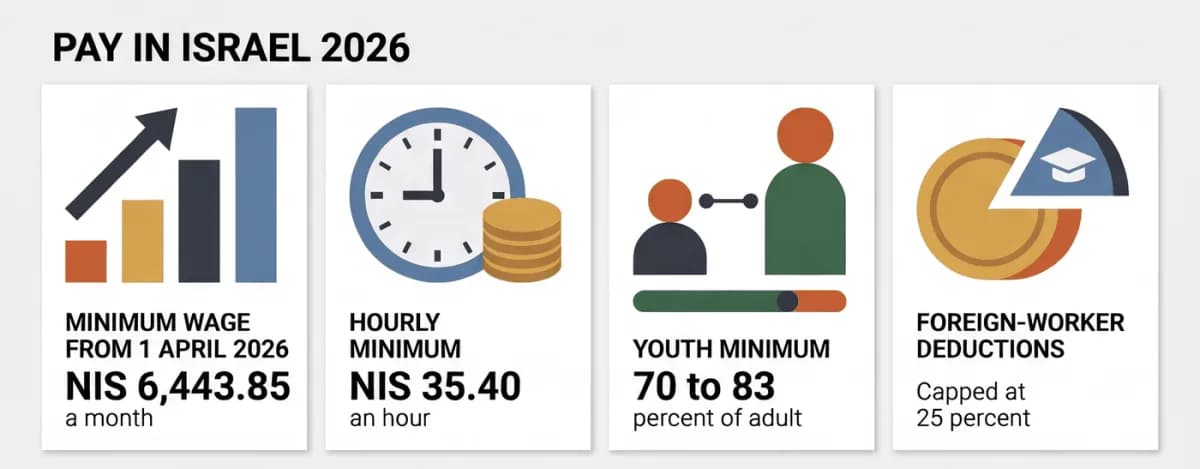
The National Insurance Institute (BTL) publishes the statutory minimum wage. From 1 April 2026 it is NIS 6,443.85 a month for full-time work (about US$2,067 / JPY 325,000), up about 3.1% from NIS 6,247.67 (about US$2,004 / JPY 315,000) a year earlier.[^24]
| Floor or benchmark | Amount (NIS) | US$ | JPY | Valid |
|---|---|---|---|---|
| Minimum wage per month | 6,443.85 | about 2,067 | about 325,000 | From 1 April 2026[^24] |
| Minimum wage per hour, 182-hour month | 35.40 | about 11.35 | about 1,786 | From 1 April 2026[^24][^11] |
| Average wage per employee job, June 2026 | 15,223 (up 7.7%) | about 4,882 | about 768,000 | CBS estimate, reported by Globes[^25] |
| Average wage in high-tech, May 2026 | 35,760 | about 11,469 | about 1,804,000 | CBS, reported by Globes[^25] |
| Average wage as defined in the National Insurance Law, January 2026 | 13,566 | about 4,351 | about 684,000 | BTL[^26] |
BTL also lists NIS 34.64 an hour on a 186-hour basis.[^24] The NIS 13,566 figure is the statutory average wage used for benefits and visa thresholds, not a survey result, so do not compare it with the CBS average.
Youth rates. The youth minimum is reported at 70% of the adult wage up to age 16, 75% at 16 to 17 and 83% at 17 to 18, set by regulation. We read these percentages in secondary sources (the Chamber of Commerce and Bizportal), not in a primary one, so confirm with the Ministry of Labor.[^27]
Foreign workers: permitted deductions. According to the PIBA Foreign Workers' Rights Handbook 2026, an employer may deduct only tax and Bituach Leumi, a capped amount for housing, a capped share of private medical insurance, and debts agreed in writing. Insurance, housing and debts together may not exceed 25% of the salary, and only actual expenses count. The insurance share is the lower of half the premium or NIS 168.80 for caregivers (about US$54 / JPY 8,500), and the lower of one third of the premium or NIS 147.11 for other sectors (about US$47 / JPY 7,400). Employer-side fees and levies may never be deducted.[^11]
Caregivers' recruitment fee. For caregivers whose visa was issued from 15 October 2025, a licensed placement bureau may charge no more than one month's gross minimum wage at entry (NIS 6,443.85), and only against a Letter of Commitment on the PIBA form: NIS 3,943.85 within 3 days after arrival (about US$1,265 / JPY 199,000), then NIS 1,250 at month 26 and again at month 38 (about US$401 / JPY 63,000 each). Bureaus may not charge a worker for finding a new placement.[^11]
Israel's economy in numbers
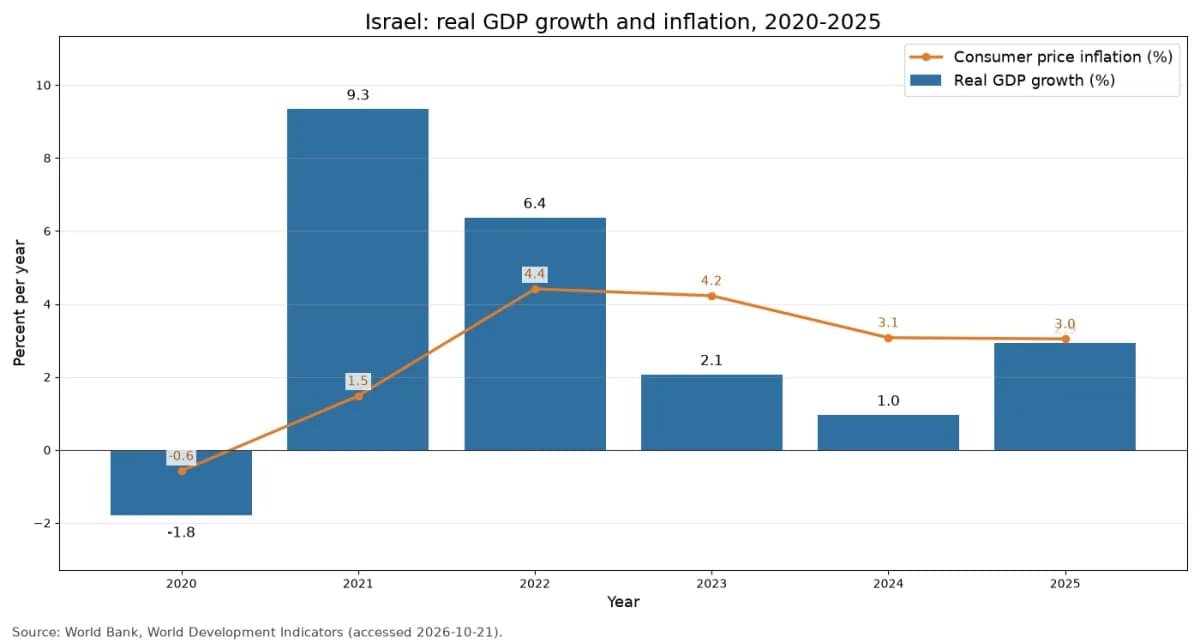
| Indicator | 2020 | 2021 | 2022 | 2023 | 2024 | 2025 |
|---|---|---|---|---|---|---|
| GDP (USD billion) | 410.9 | 489.7 | 525.2 | 513.4 | 542.3 | 610.8 |
| GDP per person (USD) | 44,591 | 52,258 | 54,947 | 52,126 | 54,217 | 60,337 |
| Real GDP growth (%) | -1.8 | 9.3 | 6.4 | 2.1 | 1.0 | 2.9 |
| Inflation (%) | -0.6 | 1.5 | 4.4 | 4.2 | 3.1 | 3.0 |
| Population (million) | 9.22 | 9.37 | 9.56 | 9.85 | 10.00 | 10.12 |
*Source: World Bank, World Development Indicators (accessed 21 October 2026).*[^28]
The World Bank also lists modelled unemployment of 3.5% and youth unemployment (ages 15 to 24) of 6.0% for 2025, and an international migrant stock of 2,091,569 people in 2024.[^28] The national figures below are more recent and use the CBS survey method, so do not mix the two sets.
| Measure | Value | Source |
|---|---|---|
| Unemployment rate, September 2026 (seasonally adjusted, age 15 and over) | 3.0% (August 2.8%); 2.7% for ages 25 to 64 | CBS release 338/2026, 26 October 2026[^29] |
| Labour force participation, September 2026 | 62.2% (August 61.8%) | CBS[^29] |
| Employment rate, September 2026 | 60.3% | CBS[^29] |
| Population, June 2026 | About 10.26 million | CBS, quoted by MOFA[^30] |
The CBS data refer to Israelis only.[^29]
What this means for a job seeker: with unemployment at 3.0%, the market looks open, but the rate does not say which sectors are hiring or how much Hebrew they expect. Use it as background, then read the adverts for your sector.
Visas and rules for foreign workers
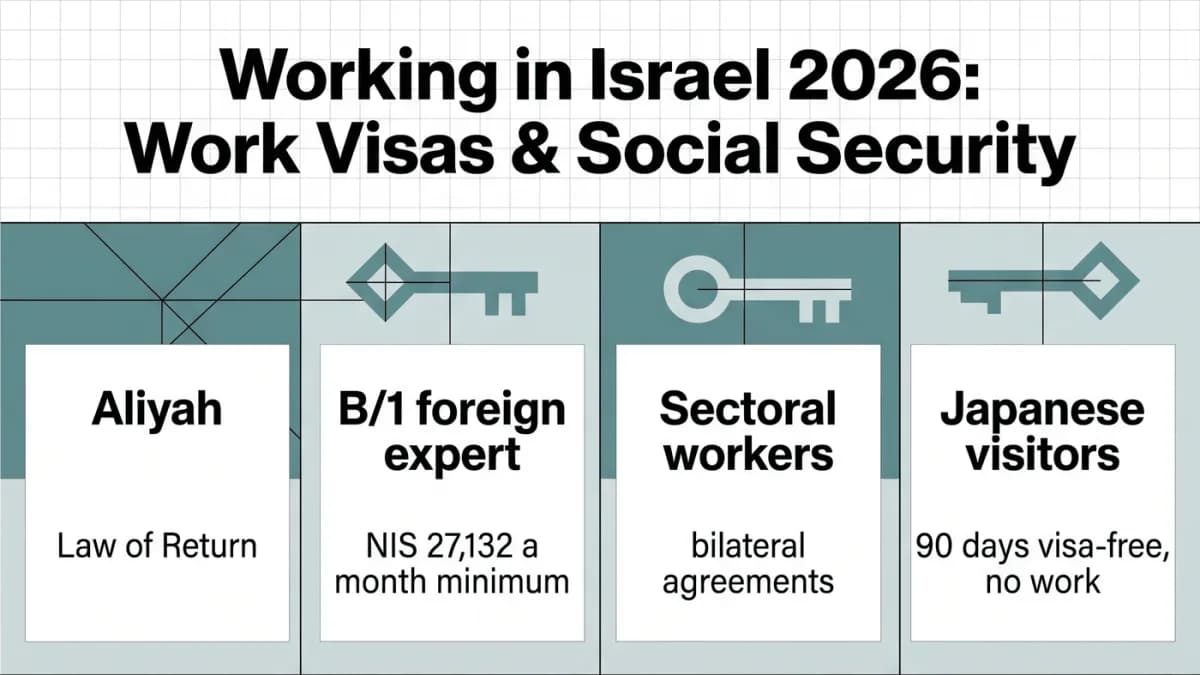
Visa rules change often. The table gives the main routes; confirm current conditions with PIBA before you apply. Our job-board guide covers the permit routes in more detail.
| Route | Who it is for | Key condition |
|---|---|---|
| Aliyah under the Law of Return 1950 | People entitled to immigrate | The right extends to a child and grandchild of a Jew, a spouse of a Jew and a spouse of a child or grandchild (s.4A). "Jew" means born to a Jewish mother or converted and not of another religion (s.4B). Not a work visa: it grants immigrant status[^31] |
| B/1 foreign expert | Specialists with a job offer | Gross base salary of at least NIS 27,132 a month from 1 January 2026 (about US$8,702 / JPY 1.37 million), reported as twice the average wage defined in the National Insurance Law[^32] |
| Expedited high-tech (HIT) track | Employees of recognised high-tech companies | The company must be Israeli and recognised as high-tech; a spouse can apply separately for a work visa of one year, renewable[^32] |
| Sectoral bilateral workers | Construction, agriculture, caregiving and similar | Recruited under agreements with source countries; the permit is tied to a sector and employer[^33] |
B/1 experts. Law firms report that the threshold applies to stays over 3 months and to staff of Innovation-Authority-recognised high-tech companies whatever the length. "Foreign expert salary" means gross monthly base pay. Reported 2026 fees are NIS 1,420 for the application (about US$455 / JPY 71,600) and NIS 11,525 for the annual employer fee (about US$3,696 / JPY 581,000). A tourist visa cannot normally be converted to B/1 inside Israel (reported by one law firm). Check all figures with PIBA.[^32][^34]
Numbers. The State Comptroller gives a ceiling of 3.3% of the population for foreign workers (Government Resolution 1752, May 2024). PIBA data reported by the press show 227,044 foreign workers and almost 61,000 new permits in 2025, and Globes reports about 250,000 legal and illegal foreign workers in August 2026.[^33][^35]
Foreign Workers Law: employer duties
The Foreign Workers Law (Prohibition of Unlawful Employment and Guarantee of Fair Conditions) 1991 and the PIBA handbook set duties for employers of workers on sectoral permits.[^36][^11]
- a written contract in a language the worker understands (s.1ג);
- private medical insurance, because non-residents are outside the National Health Insurance Law (s.1ד);
- suitable housing, with at least 4 square metres of sleeping space and no more than six people to a room (s.1ה);
- no withholding of the passport, which is a criminal offence;
- no recruitment fee from the worker: under the Employment Service Law a licensed placement bureau may not charge a job seeker (s.69C, see below).
A worker who wants to change employer must register the change with PIBA.
Japanese nationals
- Short visits. Japanese citizens can enter Israel without a visa for up to 90 days. An electronic travel authorisation (ETA-IL) has been compulsory since January 2025, and paid work needs a work visa even on a short stay.[^34] Employing a visitor is an offence for the employer under the Foreign Workers Law (s.2(a)).[^36]
- Work visas. A Japanese expert follows the B/1 route above. At the Israeli embassy in Tokyo the B/1 interview is personal, and you bring your criminal-record certificate to it (see the documents section).[^23]
- Social security. There is no Japan–Israel social security agreement: Japan's list of 24 agreements in force does not include Israel, and Israel's list of conventions does not include Japan.[^37]
- Japanese residents. MOFA counts 1,010 Japanese residents in Israel as of October 2025, excluding East Jerusalem and the Golan Heights.[^30]
Labour law: hours, leave, notice and dismissal
Most rules below come from the law texts and the PIBA handbook. Your contract may be better than these minimums.
| Topic | Rule | Law |
|---|---|---|
| Working week | The 1951 law says a day is at most 8 hours and a week at most 45 hours. A 42-hour week applies under a 2017 general collective agreement extended by order from 1 April 2018 | Hours of Work and Rest Law ss.2-3; extension order[^38] |
| Overtime | 125% for the first 2 hours a day and 150% after that | s.16(a)[^11] |
| Weekly rest | 36 consecutive hours. Jews: Saturday; others: Friday, Saturday or Sunday by custom. Work on the rest day pays at least 150% | ss.7, 17(a)[^11] |
| Annual leave | Calendar days: 16 for each of years 1 to 5, 18 in year 6, 21 in year 7, then +1 a year up to 28. For a 5-day week, years 1 to 5 equal 12 working days (14 for a 6-day week) | Annual Leave Law s.3[^39][^11] |
| Sick pay | 1.5 days per month, up to 90 days. Day 1 unpaid, days 2 and 3 at 50%, day 4 onwards at 100% | Sick Pay Law ss.2, 4(a)[^11] |
| Recuperation pay | NIS 418 a day in the 2026 handbook (about US$134 / JPY 21,100), for 5, 6 or 7 days by seniority | Extension order[^11] |
| Pay date | Monthly wages are due by the 9th of the following month | Handbook s.9[^11] |
| Notice | See the prior-notice table above | Prior Notice Law 2001 ss.3-4 |
| Pension | Employee 6%, employer 6.5% plus 6% towards severance (since 2017) | Pension Extension Order[^40] |
| Severance | One month's pay per year of service. Pension deposits can replace it under s.14 where approval or an agreement says so; 8.33% a month gives a full release and 6% only a partial one | Severance Pay Law[^11] |
| Dismissal hearing | The duty to hold a hearing (shimua) before dismissal comes from National Labour Court case law, not from a statute | Case law |
Nine paid religious-holiday days a year and the recuperation payment come from extension orders, not from the 1951 law.[^11]
2026 public holidays
Monthly-paid workers receive pay for up to 9 religious-holiday days a year that do not fall on the weekly rest day. They may choose the holidays of their own religion or the Jewish holidays; the basis is an extension order.[^11] Jewish holidays begin at sundown the evening before the dates below.
| Holiday | Date in 2026 |
|---|---|
| Passover, first day | Thursday 2 April |
| Passover, seventh day | Wednesday 8 April |
| Independence Day | Wednesday 22 April |
| Shavuot | Friday 22 May |
| Rosh Hashanah | Saturday 12 and Sunday 13 September |
| Yom Kippur | Monday 21 September |
| Sukkot, first day | Saturday 26 September |
| Shemini Atzeret / Simchat Torah | Saturday 3 October |
Rosh Hashanah day 1, Sukkot and Simchat Torah fall on a Saturday, the weekly rest day, so they add no extra paid day off. The dates for Passover, Independence Day, Shavuot, Rosh Hashanah and Yom Kippur follow the Bank of Israel list, and Sukkot and Simchat Torah are computed from the Hebrew calendar.[^41]
Social security: Bituach Leumi and what you get
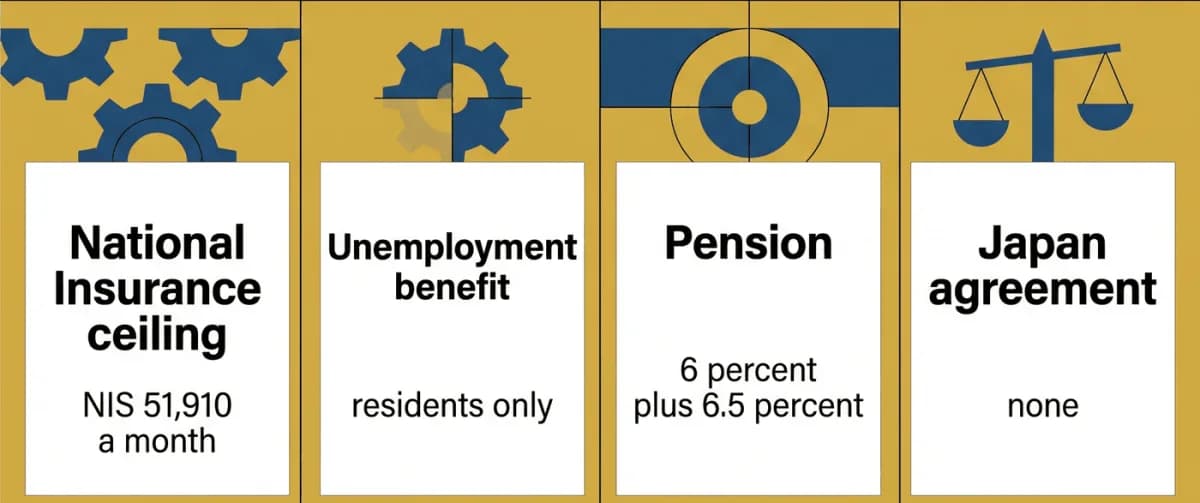
National Insurance (NI) and health tax are deducted from pay together. BTL gives these rates as of 1 January 2026:[^42]
| Monthly wage | Employee | Employer |
|---|---|---|
| Up to NIS 7,703 (about US$2,470 / JPY 389,000) | 4.27% (NI 1.04% + health 3.23%) | 4.51% |
| NIS 7,703 to NIS 51,910 (about US$16,648 / JPY 2.62 million) | 12.17% (NI 7% + health 5.17%) | 7.6% |
| Above NIS 51,910 | nothing | nothing |
- Unemployment benefit (dmei avtala). You must be a resident or temporary resident aged 20 to 67 with 12 of the last 18 months of work, and you register with the Employment Service. The benefit lasts 50 to 175 days depending on age and dependants.[^43] Foreign workers are non-residents and are not covered by it. The handbook lists work injury, maternity and wages or severance on employer bankruptcy as their insured risks, with a reduced deduction of 0.04% of the first NIS 7,703 and 0.87% above.[^11]
- Mandatory pension. Under the extension order, employee 6% and employer 6.5% plus 6% towards severance.[^40]
- Pikadon (deposit scheme). Foreign Workers Law Chapter 4 covers workers in construction, hotels, restaurants, industry, commerce and services, institutional care, special technology and caregiving companies. It does not apply to B/1 experts. The employer deposits at least 12.5% of regular salary on top of pay. On permanent departure the worker receives the fund less bank fees and 15% tax; for an overstayer the tax is 25% and 75% is forfeited after 12 months.[^11]
- Health insurance. Residents are insured under the National Health Insurance Law through the health tax above. Non-residents are not, so the employer of a foreign worker must buy private insurance (s.1ד), and may deduct up to the caps in the pay section.[^44]
What this means for a job seeker: a typical salaried employee pays 12.17% on the part of pay between NIS 7,703 and NIS 51,910, plus 6% towards pension. Unemployment benefit needs resident status, so keep a cash buffer if you are on a work visa.
Taxes on employees
Israel taxes salaries progressively. The Ministry of Finance wage department lists these 2026 monthly brackets for residents.[^40]
| Monthly taxable income (NIS) | Rate |
|---|---|
| Up to 7,010 | 10% |
| 7,011 to 10,060 | 14% |
| 10,061 to 19,000 | 20% |
| 19,001 to 25,100 (annual 301,200) | 31% |
| 25,101 to 46,690 | 35% |
| 46,691 to 60,130 | 47% |
| Above 60,130 (annual 721,560) | 50%, which includes a 3% surtax |
- Credit points. Each credit point is worth NIS 242 a month (NIS 2,904 a year, about US$78 / JPY 12,200 a month), and residents receive at least 2.25 points. Women receive an extra half point. Non-residents are not entitled to personal credits.[^40][^45]
- Capital income. From 2025 an extra 2% surtax applies to capital income above NIS 721,560, on top of the existing 3%.[^45]
- Olim. New immigrants get a 10-year exemption on foreign income. Confirm any other olim relief with the Israel Tax Authority.[^45]
- VAT. The rate is 18% since 1 January 2025 (reported).[^45]
Arnona vs Japan's 住民税
Israel has no separate local income tax like Japan's resident tax (住民税, juminzei). Your income tax goes to the national tax authority, with Bituach Leumi and health tax on top. Arnona is something different: a municipal property tax paid by the occupant of a property, including tenants. It is the local charge Israelis usually mean, but it is not an income tax and does not appear on your payslip.
Where to find jobs, recruitment agencies and job scams
For job boards, English-language channels and agency names, see our Israel job-board guide. The channels confirmed open to us are the Civil Service Commission's recruitment sites and the Nefesh B'Nefesh job board for English speakers.[^14][^46]
- Employment Service. To claim unemployment benefit you register with the Israeli Employment Service. BTL advises registering close to the end of work, because the first registration fixes the entitlement date, and you then report to the local office within 14 days.[^43]
- Licensed private placement bureaus. Under the Employment Service Law 1959 a private bureau needs a licence (s.63). Section 69C bars it from charging a job seeker any payment, directly or indirectly, in Israel or abroad, apart from payments the regulations allow, and a job seeker can sue to recover a payment (s.69F). The penalty where the job seeker is a foreign worker is up to 3 years' imprisonment (s.80(b)). The fee ban is in this law, not in the Manpower Contractors Law (Wikisource copy).[^47]
- Manpower contractors. The Manpower Contractors Law 1996 requires a licence, and a contractor's worker may not be placed with the same actual employer for more than 9 consecutive months (s.12A, extendable to 15 months).[^48]
Scams. Never pay for a job offer, an interview or a "registration". Report suspected scams to the National Cyber Directorate hotline 119 (24 hours) or [email protected]. The Directorate said phishing made up 52% of the incidents reported in its 2025 report.[^49] The press has reported Directorate warnings about phishing campaigns that imitate job sites to steal data and photos.[^50] Check the company name and address against its own career page, send passport and ID copies only after you accept an offer, and refuse any task that involves receiving and forwarding money.
Final checks before you apply
- [ ] My CV is one or two pages, with the same dates in Hebrew and English versions.
- [ ] I left off the ID number and anything a form can collect later.
- [ ] I decided whether to list military or national service as experience.
- [ ] I know what a screening institute may do with my results, and I will not sign a blanket waiver.
- [ ] The offer is at or above NIS 6,443.85 a month (NIS 35.40 an hour on a 182-hour month).
- [ ] If I need a work route, I know which one fits and its key condition.
- [ ] My foreign degree has been evaluated, or I have started the process, and any licence is in progress.
- [ ] Japanese documents: the diploma has gone through notary and MOFA, and the criminal-record certificate is under 6 months old.
- [ ] No agency or employer has asked me for a fee.
FAQ
What is the standard Israeli CV format?
There is no legal template. One to two pages in reverse chronological order, in Hebrew or English according to the advert, is the common practice.
Should an Israeli CV include a photo, age or ID number?
Practice, not law: no statute requires or bans a photo or an ID number. Age is a protected ground under the Equal Employment Opportunities Law, so many applicants omit age, marital status and children.[^1]
Can an interviewer ask about my family or army service?
The law bans discrimination, not questions as such, but if the employer asked about a protected ground it must prove it did not discriminate (s.9(c)). The Commission's guide lists "Do you have children?" and "What did you do in the army?" as questions to avoid.[^1][^2]
Can I see the assessment institute's report?
Yes. The PPA guideline says a candidate may receive the opinion as given to the employer, and a blanket waiver of that right is invalid.[^5]
What is the minimum wage in Israel in 2026?
NIS 6,443.85 a month from 1 April 2026 (about US$2,067 / JPY 325,000), or NIS 35.40 an hour on a 182-hour month.[^24]
How much notice must an employer give?
For monthly-paid staff, one day per month of service in the first 6 months, then 6 days plus 2.5 days per month in months 7 to 12, and one month after the first year. Hourly- and daily-paid staff have a different scale. There is no statutory probation period.[^11]
Which visa should a foreign professional apply for?
With a job offer, the B/1 foreign expert route needs a gross salary of at least NIS 27,132 a month from 1 January 2026. People entitled under the Law of Return immigrate as olim instead.[^32][^31]
Can Japanese citizens visit and work in Israel?
Japanese citizens can enter without a visa for up to 90 days with the ETA-IL, but paid work needs a work visa. There is no Japan–Israel social security agreement.[^34][^37]
Is there unemployment insurance or a local income tax like Japan's 住民税?
Unemployment benefit exists for residents with 12 of the last 18 months of work, but foreign workers are generally not covered. There is no local income tax; arnona is a municipal property tax.[^43]
Can I apostille my Japanese diploma directly?
If it comes from a private or national university corporation, not directly: it needs a notary and a Legal Affairs Bureau certificate before MOFA's free Apostille.[^20]
How to use AIResume
Keep one master CV in AIResume and cut a Hebrew and an English version for each advert: lead with your strongest numbers, add a right-to-work line if you need a visa, and leave off your ID number. Export one PDF and check it against our ATS-friendly CV guide.
Related AIResume guides
- Israel job-board guide
- Jordan CV format guide
- United Arab Emirates CV format guide
- Egypt CV format guide
- Japan job-board guide
- How to write an ATS-friendly CV
Sources
[^1]: Equal Employment Opportunities Law 1988, Hebrew Wikisource copy
[^2]: Equal Employment Opportunities Commission, guide for employees (Hebrew PDF, 2010)
[^3]: Bank of Israel, representative exchange rates (30 October 2026)
[^4]: IAPP, Israel marks a new era in privacy law: Amendment 13
[^6]: Pearl Cohen, Israeli privacy regulator issues draft guidelines on privacy in AI
[^7]: Notice to Employee and Job Applicant Law 2002, Hebrew Wikisource copy
[^8]: Prevention of Employment of Sex Offenders in Certain Institutions Law 2001, Hebrew Wikisource copy; gov.il, request for police employment approval
[^9]: Make it in Rheinland-Pfalz, tips on job applications in Germany
[^10]: UAE Legislation portal, Federal Decree-Law 33/2021 on the Regulation of Labour Relations
[^11]: Population and Immigration Authority, Foreign Workers' Rights Handbook 2026
[^12]: TheMarker, maximum deposits and amounts (financial site); Harel, training-fund deposit amounts 2026 (PDF)
[^13]: Olam Haavoda, travel allowance (secondary)
[^14]: Civil Service Commission recruitment site; Civil Service Commission, applying
[^15]: gov.il, affirmative action in the civil service
[^16]: gov.il, foreign degree evaluation for new olim; Nefesh B'Nefesh, degree recognition
[^17]: gov.il, regulated professions; gov.il, Electricians Licensure Department
[^18]: MOFA Japan, Apostille Convention contracting states (11 September 2026)
[^19]: MOFA Japan, documents that can receive an Apostille
[^20]: MOFA Japan, Apostille questions and answers
[^21]: MOFA Japan, how to apply for an Apostille
[^22]: MOFA Japan, criminal-record certificate
[^23]: Embassy of Israel in Japan, B/1 visa requirements
[^24]: BTL, minimum wage
[^25]: Globes, average wage rises, tech wages jump (4 August 2026)
[^26]: BTL, average wage
[^27]: Israel Chamber of Commerce, minimum wage table (secondary); Bizportal, youth minimum wage (secondary)
[^28]: World Bank, World Development Indicators: Israel (accessed 21 October 2026)
[^29]: CBS, labour force survey, September 2026 (release 338/2026, 26 October 2026)
[^30]: Ministry of Foreign Affairs of Japan, Israel basic data
[^31]: Law of Return 1950, Hebrew Wikisource copy
[^32]: Meitar, Israeli Immigration Law Update, January 2026; EY, increased salary requirements for B/1 visas
[^33]: State Comptroller, non-Israeli workers (April 2026)
[^34]: Embassy of Israel, visa to Israel Q&A
[^35]: Globes, foreign workers (23 August 2026)
[^36]: Knesset, Foreign Workers Law 1991 (PDF)
[^37]: Japan Pension Service, social security agreements; BTL, existing conventions
[^38]: Gornitzky, working-hours extension order note (2018)
[^39]: Annual Leave Law, Hebrew Wikisource copy
[^40]: Ministry of Finance Wage Department, tax brackets 2026 (April 2026)
[^41]: Bank of Israel, list of holidays affecting activity, 2026
[^42]: BTL, rates for salaried employees (as of 1 January 2026)
[^43]: BTL, unemployment benefit; BTL, conditions of eligibility; BTL, period of entitlement
[^44]: BTL, foreign workers, health services
[^45]: PwC, Israel individual taxes on personal income (29 June 2026); PwC, other tax credits and incentives
[^46]: Nefesh B'Nefesh, job board
[^47]: Employment Service Law 1959, Hebrew Wikisource copy
[^48]: Manpower Contractors Law 1996, Hebrew Wikisource copy
[^49]: gov.il, National Cyber Directorate hotline 119; gov.il, National Cyber Directorate 2025 report
[^50]: Ynetnews, cyber directorate warning on phishing campaigns (press)
Your next step
- DeelFor employers hiring across borders: contracts, payroll and visas handled.See how Deel works
Affiliate links: we may earn a commission at no cost to you. Affiliate link