

Denmark CV Format 2026: Ansøgning Norms, Agreement Pay Floors, Permits and Tax
A Danish CV is a short, factual, vacancy-specific document with the latest job first and a personal profile at the top. The engineers' union IDA found that the vast majority of employers prefer one to two pages, while the unions Ase and Djøf allow two to three.[^1][^2][^3] Work in Denmark, the publi
By AIResume Editorial Team
Last updated: 29 October 2026
A Danish CV is a short, factual, vacancy-specific document with the latest job first and a personal profile at the top. The engineers' union IDA found that the vast majority of employers prefer one to two pages, while the unions Ase and Djøf allow two to three.[^1][^2][^3] Work in Denmark, the public service for international job seekers, says it is normal to include your age, whether you are married and have children, and what you do in your spare time, and the photo is optional.[^4] None of this is law: we found no official page that fixes a length, a template or a file format. What the law does regulate is what an employer may ask and keep, what a contract must say, and what the job pays once the collective agreement and the tax rules are applied.
This guide covers the Danish CV and cover letter (ansøgning), equal-treatment and data rules, an annotated fictional CV, documents and recognition of foreign qualifications, agreement pay floors, the economy, work permits, labour law, social security, taxes and job scams. For the list of job boards, see our Denmark job-board guide. It is written for EU/EEA and Nordic nationals (Ukraine, Poland, Romania and Germany are among the largest immigrant groups in Denmark), for UK nationals, for non-EU specialists, for international students and graduates, for Working Holiday makers and for Japanese nationals.
Editorial boundary: This is practical job-search guidance, not legal, immigration or tax advice. Our references are the law texts on retsinformation.dk, borger.dk and lifeindenmark, Work in Denmark (run by STAR, the Danish Agency for Labour Market and Recruitment), nyidanmark.dk (SIRI, the Danish Agency for International Recruitment and Integration), Skattestyrelsen and the Ministry of Taxation, Danmarks Statistik (Statistics Denmark), Danmarks Nationalbank, Datatilsynet (the Data Protection Agency), politi.dk, and the collective agreements of DI/CO-industri, HORESTA/3F and Dansk Erhverv/HK. We only list figures we could read in an official or primary source, and we mark the rest as "reported" or "likely". Some sources could not be opened normally: the retsinformation.dk pages are a JavaScript application, so we read law texts through its XML and PDF versions, and the text of the health-information act came from a mirror site; the Japanese foreign ministry (MOFA) and embassy sites refused automated access, so the Japanese figures and apostille points rest on earlier readings or search summaries; and the municipal-tax table on the Ministry of Taxation's site could not be re-read on 29 October. Several recruitment sites, among them michaelpage.dk and adecco.dk, did not respond, and we do not list them.
Exchange rates move daily. This guide uses the Danmarks Nationalbank rates of 28 October 2026: USD 1 = DKK 6.7135; EUR 1 = DKK 7.4741; JPY 100 = DKK 4.25, so DKK 1 is about JPY 23.5. At those rates DKK 10,000 is about US$1,490 / JPY 235,300.[^5]
Before you apply
- SafetyWing Nomad InsuranceHealth insurance that works in your new country from day one.Get a quote
Affiliate links: we may earn a commission at no cost to you. Affiliate link
Danish CV format at a glance
| Topic | Practice in 2026 | Law or official guidance |
|---|---|---|
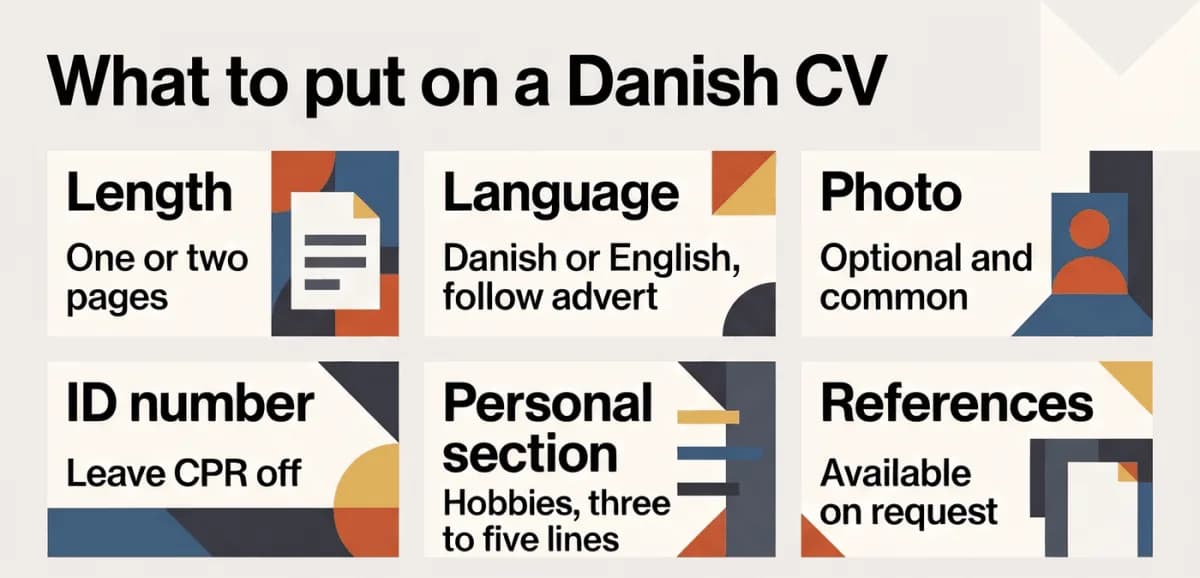
| Length | IDA's survey found most employers prefer 1 to 2 pages; Ase and Djøf say up to 2 to 3 pages. Work in Denmark: "Keep it short - but include all that is relevant" | No official rule[^1][^2][^3][^6] |
| Language | Write in the language of the advert. International firms advertise in English, and Danish is usually needed in the public sector, health care and customer-facing jobs | Editorial advice and Work in Denmark guidance; no law[^6] |
| Photo | Optional and common. Ase: "there is no longer a fixed rule", and a CV without a photo is fine; IDA's survey found 73% of companies see a photo as positive, and some HR systems hide photos | No law requires or bans a photo[^2][^1] |
| Personal details | Name, address, e-mail, phone and LinkedIn are standard; Ase also lists an optional birth year. Work in Denmark says it is normal to add age, marital status, children and hobbies, so treat them as optional | The law bars employers from asking for your age when the application is submitted (see the next section)[^4][^2][^3][^7] |
| CPR number | Not needed to apply; leave it off. You give it to the employer after you are hired | Editorial advice; no source tells applicants to include it |
| Work authorisation | A single line such as "Residence permit valid to June 2027" can save a screener a question; EU/EEA and Nordic citizens need no line | Editorial tip only |
| Personal section | "Fritid og personligt": 3 to 5 lines at the end according to Djøf | Djøf; IDA calls it "a little about yourself as a private person"[^3][^1] |
| References | End with "Referencer kan indhentes efter aftale" (references can be provided on request) and do not print contact details unless asked | Ase and Djøf[^2][^3] |
| Cover letter (ansøgning) | One page, forward-looking, tied to the advert | Work in Denmark, Djøf; HK advises 1 to 1½ pages[^8][^9][^10] |
| File format | A PDF, so that nothing can be altered | Ase's advice; no official rule[^2] |
| Public-sector applications | Public employers must post all vacancies on Jobnet | Circular CIR 9603/2012, § 1[^11] |
If you receive unemployment benefit, borger.dk says you must register on Jobnet and have a complete and approved CV there no later than two weeks after registering, and record your job search in a "joblog".[^12] Work in Denmark also notes that you can create a Europass CV and export it to the EURES portal to become visible to recruiters.[^13]
Equal treatment, personal data and fair hiring
What employers may not ask or advertise
Forskelsbehandlingsloven (the Act on prohibition of discrimination in the labour market, LBK 399 of 5 April 2024) protects against discrimination on race, colour, religion or belief, political opinion, sexual orientation, gender identity, gender expression, gender characteristics, age, disability, and national, social or ethnic origin (§ 1). Three sections matter for applicants. Section 4 bars an employer from requesting, obtaining or using information on race, colour, religion or belief, political opinion, sexual orientation, gender identity, expression and characteristics, and national, social or ethnic origin in connection with employment; age and disability are not in that list. Section 5 stk. 1 bans job adverts that state a preference for a person of a given age or with a disability, or that exclude such a person. Section 5 stk. 2, in force since 1 July 2022, bars an employer from asking for your age when you submit, upload or type in a job application.[^7] The Equal Treatment Board (Ligebehandlingsnævnet) held in 2024 that the act contains no ban on asking about age at the interview itself, according to a Dansk Erhverv report, so treat that as reported rather than settled.[^14]
Ligebehandlingsloven (the Equal Treatment Act, LBK 942 of 19 July 2024) requires equal treatment of women and men in hiring (§ 2) and bans gender-specific adverts (§ 6). Section 9 bars dismissal or other less favourable treatment because of leave, pregnancy, maternity or adoption. No section literally bans the question "are you pregnant?", so the safe reading is narrower: an answer about pregnancy or family plans may not be used against you. In September 2025 the Board found that a municipality that withdrew a job offer after the applicant said she was pregnant had breached the act, with compensation of DKK 25,000 (about US$3,720 / JPY 588,000), according to Dansk Erhverv.[^15][^16]
Helbredsoplysningsloven (law no. 286 of 24 April 1996 on the use of health information in the labour market) lets an employer request health information only where an illness has substantial significance for your ability to do that particular job (§ 2 stk. 1). The employer must say which illnesses or symptoms it means (stk. 3) and may not request or use information to assess your risk of falling ill in the future (stk. 4).[^17]
Personal data and references
The current data-protection act is databeskyttelsesloven, LBK 289 of 8 March 2024, which sits beside the GDPR.[^18] Datatilsynet has no fixed retention period for a rejected application, but says it will accept keeping the data for up to three years after the recruitment process ends, and longer only for very special reasons; the employer may keep it for less if it does not need it. You are asked for consent only if the employer wants to keep your application for a different vacancy later, and it must say how long it will do so.[^19][^20] On references, Datatilsynet's employment guide says consent will normally not be the legal basis, because it is rarely freely given in recruitment; the employer must instead be transparent, for example by saying in the advert that references are taken, or by contacting someone you named, and must tell you whom it contacts, when and what it asks. The same guide says a routine criminal-record check of every applicant is not in line with the GDPR; it has to be assessed per position and only for candidates under real consideration.[^21]
Straffeattest and børneattest
A private criminal-record certificate (straffeattest) is free and ordered digitally on politi.dk or borger.dk with MitID; it is delivered to your Digital Post, in up to five working days but usually the same or the next day, and can be ordered from abroad with MitID. An employer may order one about you only with your consent. We found no published validity period, so do not assume one.[^22] A børneattest (child certificate) is a different document. Under børneattestloven (LBK 362 of 2 April 2014, § 2) the competent minister may require one before hiring for permanent roles with direct contact with children under 15; the duty comes from ministerial orders, not from the act itself, and it applies to those roles, not to every employer. The employer orders it on its own account on politi.dk with your consent.[^23][^22]
Public-sector hiring
Public employers must post all vacancies on Jobnet (CIR 9603 of 14 December 2012, § 1), and state vacancies pass automatically to the state portal job-i-staten.dk, which needs a MitID login, so search on Jobnet.[^11]
Structure of a Danish CV
This section is editorial advice built on the union and Work in Denmark guidance cited above. A clean order helps both a human reader and an applicant tracking system (ATS):
- Kontaktoplysninger (contact details). Name, city or address, e-mail, phone and LinkedIn. Djøf adds that you should anonymise the CV if the company asks you to.[^3]
- Profil (profile). Work in Denmark describes a profile "typically between 4-8 lines", sometimes next to the photo, and says recruiters expect you to change it for each application; IDA suggests 5 to 7 lines.[^24][^1]
- Kernekompetencer (core competences). Skills in point form: a Ballisager survey cited by IDA found that 92% of companies see bulleted skills as positive.[^1]
- Erhvervserfaring (work experience). In reverse chronological order. Work in Denmark says all experience counts, including student jobs, volunteering and internships, that you should explain employers readers will not know (what they produce, their size, where they are) and that results with numbers help.[^6]
- Uddannelse (education). Also latest first; give the official award name and, if you have one, the outcome of a recognition assessment (see below).
- Sprog og IT (languages and IT). Show levels, not adjectives (for example "Danish B1, English C1"), and name the tools the advert asks for.
- Fritid og personligt (leisure and personal). Three to five lines, as the last part.[^3]
- Referencer. "Referencer kan indhentes efter aftale."[^2]
Mirror the advert's keywords honestly, use plain headings, a single column and standard fonts, and send a PDF; our ATS-friendly CV guide explains how.
Annotated fictional Danish CV
The sample is entirely fictional: person, employer, contacts and numbers. It sets no legal rule, and employers are described generically on purpose. Replace every item with truthful information.
Mette Eksempel, Supply Chain Coordinator · Aarhus · [email protected] · +45 XX XX XX XX · linkedin.com/in/mette-eksempel-example
*Annotation: fictional contacts. City or street address is normal; no CPR number. Add a birth year only if you want to.*
Profil: Supply chain coordinator with five years of experience planning inbound shipments for a Copenhagen-based medtech firm and a food producer near Aarhus. Holds a Danish professional bachelor's degree and works in Danish and English. Looking for a planning role in Aarhus or Odense, with a permanent contract and a hybrid week.
*Annotation: four to six lines, rewritten for each vacancy. If you need a permit, add one factual line here ("Residence permit valid to June 2027").*
Kernekompetencer: Demand planning · SAP (daily user) · Excel (pivot tables, lookups) · supplier negotiation · customer reporting
*Annotation: lead with what the advert asks for, in point form.*
Erhvervserfaring: Planning Coordinator, a Copenhagen-based medtech firm (fictional) · Copenhagen · August 2022 to present
- Cut late deliveries on a weekly shipment route from 12% to 4% by moving the booking deadline.
- Wrote 20 shipping instructions in Danish and English.
- Trained three new colleagues on the planning system.
*Annotation: employer and figures are fictional. If readers will not know the firm, say what it makes and roughly how big it is, then use numbers you can defend at interview.*
Erhvervserfaring: Warehouse Assistant, an Odense-based food wholesaler (fictional) · Odense · June 2020 to July 2022
- Built a spreadsheet that cut stock-count time from three hours to one.
*Annotation: one strong bullet beats a list of duties.*
Uddannelse: Professional bachelor's degree in logistics management, Example University College (fictional), Aarhus, 2020.
*Annotation: keep the official name of the award.*
Sprog og IT: Danish (native) · English (C1) · Polish (B2) · SAP · Excel · Power BI (basic)
Fritid og personligt: Handball coach for a youth team in Aarhus, long-distance cycling and cooking for friends. Volunteers one evening a month at a local food bank.
*Annotation: three to five lines, as the last part of the CV, about you as a private person.*
Referencer: Referencer kan indhentes efter aftale.
*Annotation: do not print referees' contact details, and ask them before you name them.*
Cover letter (ansøgning), references and documents
The ansøgning. Work in Denmark says the letter should be no more than one A4 page, start with your hard skills and then give soft skills with examples, and focus on what the company gains from hiring you, not on what you gain; Djøf asks for exactly one page and says a good application points forward.[^8][^9] HK's leaflet for its members allows 1 to 1½ pages.[^10] There is no legal requirement for a letter.
Unsolicited applications. Work in Denmark says many openings are never advertised, that approaching an employer unsolicited is common, and that you should call ahead first and find the right contact on LinkedIn. Djøf has a full guide with three approaches: call first, send a CV with a short e-mail and then call, or use your network.[^25][^26]
Selection and tests. Djøf calls personality tests, skills tests and case interviews "completely normal on the Danish labour market". Vendors are often reported by candidates, but we found no source that verifies which ones employers use, so we name none.[^27]
Written terms of employment. Under ansættelsesbevisloven (law no. 501 of 16 May 2023), § 3, the employer must give you the essentials in writing within 7 calendar days of the start (parties, workplace, job description, start date, expected duration, probation, pay and working hours), and the rest, including notice periods, paid leave, training, collective agreements and social security, within one month. Section 6 caps probation at six months.[^28]
Probation and notice. For salaried employees under funktionærloven (LBK 1002 of 24 August 2017), § 2, the employer's notice is at least one month to the end of a month in the first six months and three months after that, plus one month for every third year of service up to a maximum of six months; your own notice is one month. If you are hired on probation and the job lasts no longer than three months, the employer's notice is at least 14 days (§ 2 stk. 5). That is a notice rule, and the general probation cap in the contract act is six months.[^29]
CPR, tax card, NemKonto and MitID. You need a CPR number and a tax card (skattekort) so the employer can withhold the right tax. The International Citizen Service (ICS) handles CPR registration and MitID but does not issue tax cards. NemKonto is the account to which public payments are made.[^30][^31][^32][^33]
Foreign qualifications, languages and regulated professions
- Assessment of degrees. The agency Uddannelses- og Forskningsstyrelsen (site ufsn.dk, under the ministry at fudm.dk; the old ufm.dk address redirects there) assesses foreign qualifications. The assessment is free but does not cover translation of documents; it normally takes at most two months from receiving the application and documents, and employers can ask for a "turbo assessment" delivered within five working days. An assessment is not an authorisation to practise.[^34][^35]
- Health professions. Doctors, nurses, dentists and midwives are authorised by the Danish Patient Safety Authority (STPS).[^36] Doctors from outside the EU/EEA must pass Prøve i Dansk 3 (minimum 10 for oral, 7 for reading and 7 for writing) before the medical tests; nurses from outside the EU/EEA need it again from 1 July 2025. Prøve i Dansk 3 is level B2, not C1.[^37][^38] Work in Denmark reports that the quota for non-EU nurse and doctor applications is zero until 31 December 2026.[^39]
- Language. Check each advert. Work in Denmark lists English-language vacancies, but Danish is usually needed in the public sector, in health care and in customer-facing jobs. Subsidised Danish lessons under danskuddannelsesloven (LBK 448/2026) are for adults with residence permits or lawful stay who are registered in a municipality, and for EU residents living there; not every CPR holder qualifies.[^40]
Apostille and documents for Japanese applicants
Denmark and Japan are both parties to the Apostille Convention (Denmark acceded on 20 October 2006, in force from 30 October 2006; Japan in 1970, in force from 28 May 1970), so a Japanese public document can be legalised with an apostille instead of consular legalisation.[^41] In Japan the apostille is issued by MOFA, according to a Tokyo Metropolitan Police page and search summaries of the MOFA site, which we could not open (likely). A Japanese criminal-record certificate (犯罪経歴証明書) from the Tokyo police is free, taken in person with fingerprints, takes about two weeks and is not mailed; the police do not apostille it, so take it to MOFA.[^42] Private-school documents may need notarisation first, which we did not verify.
Pay: no minimum wage law, agreement floors and take-home pay
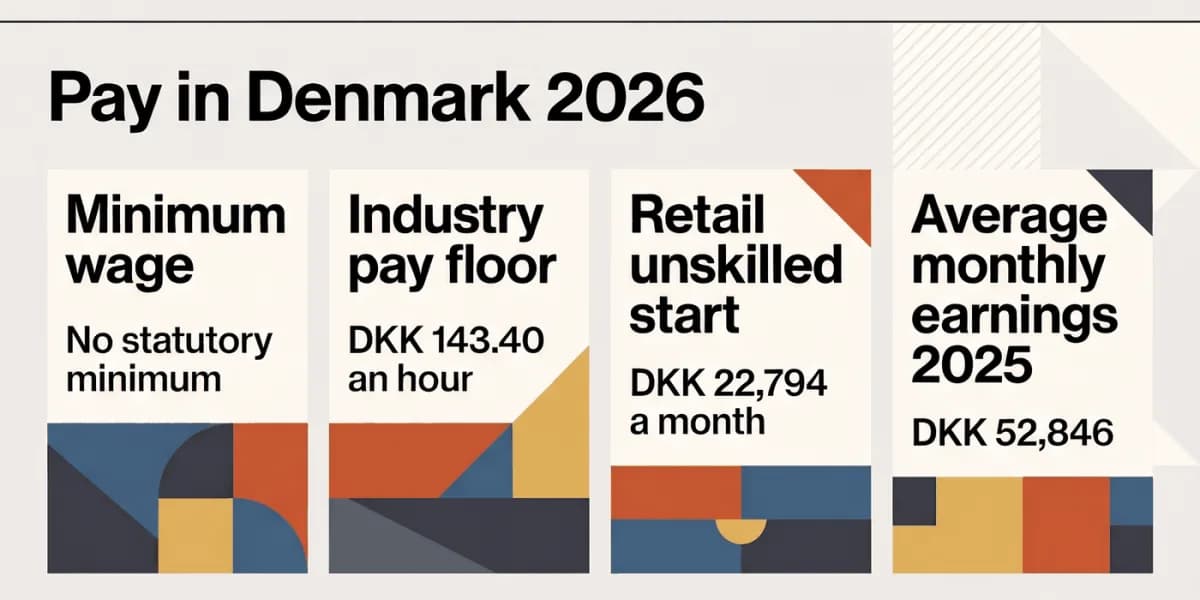
Denmark does not have a statutory minimum wage. Pay and conditions are regulated by collective agreements or negotiated individually.[^43] Eurofound reports that collective agreements cover roughly 80% of employees, with estimates varying by method.[^44] On 11 November 2025 the Court of Justice of the EU (Grand Chamber, case C-19/23, Denmark v Parliament and Council) annulled Article 5(2) of the Minimum Wage Directive 2022/2041 in full, the words "including the elements referred to in paragraph 2" in Article 5(1), and a proviso in Article 5(3), and dismissed the rest of Denmark's action; the directive otherwise stands.[^45]
Pay floors valid from 1 March 2026 (the next step is 1 March 2027):
| Agreement and position | 2026 minimum (DKK) | About |
|---|---|---|
| Industriens Overenskomst (DI / CO-industri), adults, minimum hourly rate (§ 22) | 143.40 an hour (146.90 from 1 March 2027)[^46] | US$21.4 / JPY 3,370 an hour |
| HORESTA / 3F hotel agreement, lowest adult (helper) | 148.49 an hour[^47] | US$22.1 / JPY 3,490 an hour |
| HORESTA / 3F café agreement | 160.93 an hour[^47] | US$24.0 / JPY 3,790 an hour |
| Retail, Dansk Erhverv / HK, unskilled | 22,794 a month[^48] | US$3,400 / JPY 536,000 a month |
| Retail, skilled | 24,294 a month[^48] | US$3,620 / JPY 572,000 a month |
These are minimum payment rates; actual pay is agreed individually, and pension is paid on top under the agreements. Average earnings. Danmarks Statistik reports standardised monthly earnings of DKK 52,846 for full-time employees in all sectors in 2025 (about US$7,870 / JPY 1.24 million), up from DKK 50,652 in 2024; the median standardised hourly figure is DKK 299.78 (about US$44.7 / JPY 7,050). The private sector averages DKK 54,894 (about US$8,180 / JPY 1.29 million) and general government DKK 48,746 (about US$7,260 / JPY 1.15 million). These figures include employer pension and ATP, so they are not payslip amounts.[^49][^50] By occupation in 2025, all sectors, full time:
| Occupation | Monthly earnings 2025 (DKK) | About |
|---|---|---|
| Software developers | 69,686 | US$10,380 / JPY 1.64 million |
| Civil engineers | 68,241 | US$10,170 / JPY 1.61 million |
| Accountants | 68,112 | US$10,150 / JPY 1.60 million |
| Primary school teachers | 51,799 | US$7,720 / JPY 1.22 million |
| Nursing professionals | 51,754 | US$7,710 / JPY 1.22 million |
| Electricians (building) | 48,682 | US$7,250 / JPY 1.15 million |
| Chefs | 45,125 | US$6,720 / JPY 1.06 million |
| Receptionists | 36,829 | US$5,490 / JPY 867,000 |
| Cleaners and helpers in offices and hotels | 35,252 | US$5,250 / JPY 830,000 |
| Shop sales assistants | 32,260 | US$4,810 / JPY 759,000 |
Statistics Denmark's table LONS20 holds roughly 600 occupations; unions such as Djøf, IDA and HK also publish wage statistics for negotiation.[^51]
Take-home pay. We do not give a worked payslip example, because we could not verify an end-to-end calculation. The building blocks are in the tax and social-security sections below: ATP, AM-bidrag at 8%, then state and municipal income tax after the personal allowance.
What this means: there is no national floor to quote, so ask which agreement covers the job and which rate or grade applies. An industrial offer below DKK 143.40 an hour or a skilled retail offer below DKK 24,294 a month would sit under the 2026 agreement minimum. Average earnings are not a floor or a starting salary.
Denmark's economy in numbers
| Indicator | 2020 | 2021 | 2022 | 2023 | 2024 | 2025 |
|---|---|---|---|---|---|---|
| GDP (USD billion) | 355.6 | 406.1 | 400.1 | 404.7 | 424.5 | 462.5 |
| GDP per person (USD) | 60,985 | 69,341 | 67,781 | 68,044 | 71,026 | 76,970 |
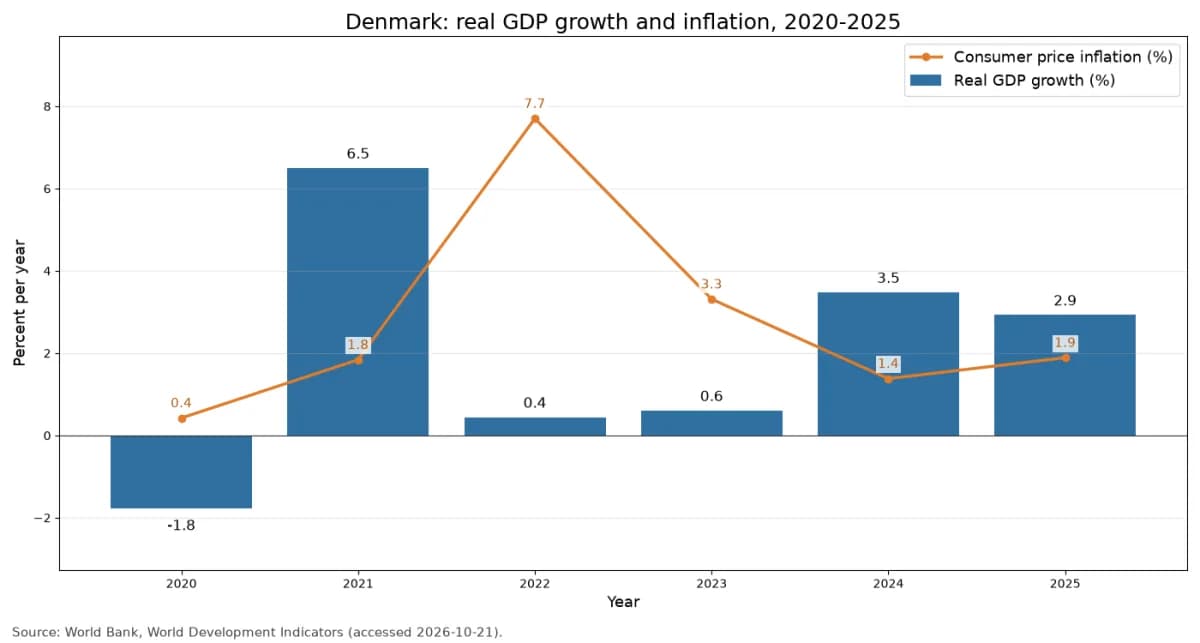
| Real GDP growth (%) | -1.8 | 6.5 | 0.4 | 0.6 | 3.5 | 2.9 |
| Inflation (%) | 0.4 | 1.8 | 7.7 | 3.3 | 1.4 | 1.9 |
| Population (million) | 5.83 | 5.86 | 5.90 | 5.95 | 5.98 | 6.01 |
*Source: World Bank, World Development Indicators (accessed 21 October 2026).*[^52]
The World Bank's ILO-modelled unemployment rate for 2025 is 5.5%, and 11.7% for ages 15 to 24; its estimate of the international migrant stock for 2024 is 847,475 people.[^52] Denmark's own statistics are more recent and use different definitions. Registered gross unemployment was 3.1% seasonally adjusted in August 2026 (about 93,900 people; 3.0% to 3.1% in every month from January to August). The labour-force-survey (ILO) rate was 6.6% unadjusted in the second quarter of 2026 (7.3% in the first quarter), and 13.8% for ages 15 to 24. Keep the two measures apart: one counts registered job seekers, the other everyone without work who is looking.[^53][^54] There were 3,079,461 employees in January 2026, and the population was 6,031,699 on 1 July 2026, of whom immigrants and descendants were 16.8% on 1 January 2026.[^55][^56][^57]
The krone is pegged to the euro: Denmark participates in ERM II at a central rate of DKK 7.46038 per euro with a narrower fluctuation band of plus or minus 2.25%.[^58] That is why EUR 1 = DKK 7.4741 above barely moves.
What this means: with registered unemployment near 3%, employers in many fields compete for staff, but the survey rate of 6.6% and the youth rate of 13.8% show that entry-level roles are harder to win. A tight market rewards a CV that shows results in the first half page.
Work permits and rules for foreign workers
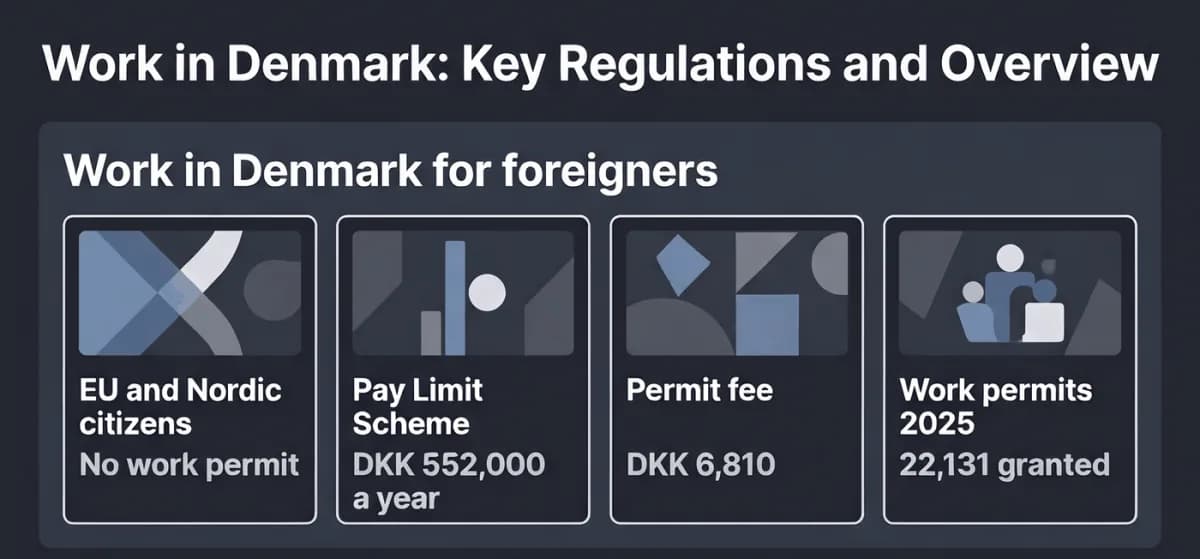
This is a summary; our job-board guide has the fuller permit and tax sections.
Nordic citizens. Nordic citizens do not need a permit, and may stay up to six months without a CPR number.[^30]
EU/EEA citizens. No work permit is needed. If you stay more than three consecutive months you need CPR registration, and EU/EEA/Swiss citizens obtain an EU residence document (earlier called a registration certificate) from SIRI's International Citizen Service.[^30]
UK nationals. We did not find a verified special route for UK citizens. They are the second-largest nationality among work-track residence permits in 2025 (2,432), which shows that many now use the non-EU schemes below; ask SIRI which route applies to you.[^59]
Non-EU schemes (2026 amounts). Applications go to SIRI, usually through the employer, and you may not start before the permit is granted.
- Pay Limit Scheme. The job must pay at least DKK 552,000 a year, DKK 46,000 a month (about US$82,200 / JPY 13.0 million a year), regulated every 1 January; processing is normally one month, up to three.[^60]
- Supplementary Pay Limit Scheme. DKK 446,000 a year (about US$66,400 / JPY 10.5 million). Extra conditions include a Jobnet and EURES advert for at least two weeks beforehand and a seasonally adjusted unemployment rate not above 3.75% (three-month average); processing is two months, up to five.[^61]
- Positive Lists. From 1 January 2026: 183 higher-education titles and 57 skilled-work titles. The skilled list is updated on 1 January and 1 July, and the higher-education list also around 1 April and 1 October. Processing is one month (up to three) for higher education and three months (up to four) for skilled work.[^62]
- Fast-track. A certified employer can use five tracks: pay limit, supplementary pay limit, short-term, researcher and educational; processing is one month, up to two.[^63]
- Collective Agreement Scheme. Announced by SIRI from 1 January 2027: a minimum of DKK 322,000 a year at the 2026 level (about US$48,000 / JPY 7.6 million), a job covered by a collective agreement, nationals of 16 listed countries and a certified employer.[^64]
- Fees from 1 January 2026. DKK 6,810 (about US$1,010 / JPY 160,000) for the Pay Limit, Supplementary, Positive List, Fast-track, certification and researcher routes; DKK 3,060 for study and Start-up Denmark; DKK 3,080 for accompanying family; DKK 7,570 for a permanent permit on work grounds. Working Holiday has no fee.[^65]
- No Blue Card, no Establishment Card. Denmark does not take part in the EU Blue Card Directive (EU) 2021/1883; the Establishment Card ended on 1 April 2023.[^66]
- Researchers. The fast-track researcher route and the separate researcher tax scheme are described in the tax section.
For most permits granted since 1 January 2021, your salary must be paid into a Danish bank account in your own name, opened within 180 days.[^67] We did not verify any rule on how long after a change of job or employer you must report to SIRI, nor the limits on student work hours, so ask SIRI or your university.
Japanese nationals
Japan is on the EU visa-exempt list, so Japanese citizens may stay 90 days in any 180 without a work right; the Commission reported the Entry/Exit System fully operational from 10 April 2026 and ETIAS scheduled for the last quarter of 2026, date to be announced (as of 28 April 2026).[^68] For the Working Holiday agreement, which dates from 1 October 2007, MOFA lists no annual quota and an age of 18 to 30; SIRI words it as at least 18 and not older than 31 at application. The stay is up to one year with work "to a limited extent" (up to six months), you must show DKK 15,000 (about US$2,230 / JPY 353,000) plus a return ticket, there is no fee and processing takes about three months, up to four.[^69] Japan and Denmark have no social security agreement, so ask your employer how pension periods are treated (see below). The Japan-Denmark tax convention was signed on 11 October 2017 and entered into force on 27 December 2018, replacing the 1968 convention; withholding rules apply from 1 January 2019.[^70][^71]
MOFA counted 2,129 Japanese nationals in Denmark on 1 October 2025; Danmarks Statistik counts 2,078 people born in Japan on 1 July 2026, a different basis.[^72] In 2025, Denmark granted Japanese nationals 32 permits under "special individual qualifications", 10 researcher permits and 474 study permits (308 of them for folk high schools).[^59]
Foreign workers in numbers
| Measure | Value |
|---|---|
| Immigrants and descendants, 1 January 2026 | 780,954 + 230,082 = 1,011,036, or 16.8%[^57] |
| Largest immigrant groups, 1 July 2026 | Ukraine 57,574; Poland 47,662; Romania 40,532; Germany 39,922; Turkey 36,383; Syria 34,826[^57] |
| Immigrants among full-time employees, Q2 2026 | 384,582 of 2,574,114, or 14.9% (by origin, not citizenship); descendants add 64,559[^73] |
| Work-track residence permits granted | 22,131 in 2025 (22,424 in 2024)[^59] |
| By scheme, 2025 | Fast-track 7,247; family of work-track holders 5,764; Supplementary Pay Limit 2,236; Pay Limit 1,801; Positive List higher education 302, skilled 258; researchers 188; Start-up Denmark 71[^59] |
| Top nationalities for work-track permits, 2025 | India 3,895; UK 2,432; Philippines 1,846; China 1,509; USA 1,341[^59][^74] |
| EU/EEA wage earners, 2025 | 18,145 (Romania 5,170; Poland 2,715; Italy 1,985)[^74] |
| Ukrainians under the Special Act, 31 July 2026 | 71,294 permits; 48,997 registered in municipalities[^75] |
Permit counts for 2026 so far were not published, so we quote none.
Labour law: hours, leave, notice and dismissal
| Topic | Rule | Law |
|---|---|---|
| Working time | The 37-hour week is the norm in collective agreements. By law, at most 48 hours a week on average, including overtime, averaged over 7 days and calculated over 4 months[^76] | Working-time act, LBK 982/2024, § 4 |
| Overtime | No statutory premium found in § 4; pay is set by agreements (likely)[^76] | Collective agreements |
| Rest | 11 consecutive hours per 24, and a weekly rest day[^77] | Arbejdsmiljøloven, LBK 442/2026, §§ 50 and 51 |
| Written terms | Essentials within 7 days, the rest within 1 month; probation up to 6 months[^28] | Ansættelsesbevisloven, law 501/2023, §§ 3 and 6 |
| Annual leave | 25 days a year (2.08 days a month)[^78] | Ferieloven, LBK 152/2024, § 5 |
| Holiday pay | Monthly-paid staff: pay plus a 1% supplement; others 12.5% holiday pay[^78] | Ferieloven § 16 |
| Sick pay | The employer pays the first 30 calendar days; 8 weeks of employment is a condition[^79] | Sygedagpengeloven, LBK 1221/2025, § 30 |
| Parental leave | See the social-security section[^80] | Barselsloven, LBK 206/2026 |
| Notice and probation (salaried staff) | Employer: 1 month (first 6 months), 3 months after, +1 month per third year, max 6; employee: 1 month; probation of up to 3 months: 14 days[^29] | Funktionærloven § 2 |
| Severance | 1 month's pay after 12 years of service, 3 months after 17 years[^29] | Funktionærloven § 2 a |
| Unfair dismissal | After at least one year: compensation up to half the notice period, up to 3 months if you are 30 or older, 4 months after 10 years and 6 after 15[^29] | Funktionærloven § 2 b |
| 120 sick days | Dismissal on 1 month's notice after 120 days of paid sickness in 12 months, only if agreed in a written contract[^29] | Funktionærloven § 5 stk. 2 |
Manual and other non-salaried workers are covered by their collective agreement, which you should read. Discrimination complaints go to the Equal Treatment Board (Ligebehandlingsnævnet). The Labour Court (Arbejdsretten) deals with breaches of collective agreements. Arbejdstilsynet is the Working Environment Authority, an inspectorate, not a court (general description; we did not re-source it).
2026 public holidays
Dates follow the Easter calculation (Easter Sunday is 5 April 2026) and the weekdays are computed from them. Store bededag (Great Prayer Day) was abolished as a public holiday from 1 January 2024 (law no. 214 of 6 March 2023).[^81]
| Holiday | 2026 date |
|---|---|
| New Year's Day | Thursday 1 January |
| Maundy Thursday | Thursday 2 April |
| Good Friday | Friday 3 April |
| Easter Sunday | Sunday 5 April |
| Easter Monday | Monday 6 April |
| Ascension Day | Thursday 14 May |
| Whit Sunday | Sunday 24 May |
| Whit Monday | Monday 25 May |
| Christmas Day | Friday 25 December |
| Boxing Day (2nd Christmas Day) | Saturday 26 December |
5 June (Constitution Day), 24 December and 31 December are not statutory holidays; many employers give time off under agreements, so check yours. By our count only seven of the ten days fall on a weekday in 2026.
Social security: what you pay and what you get
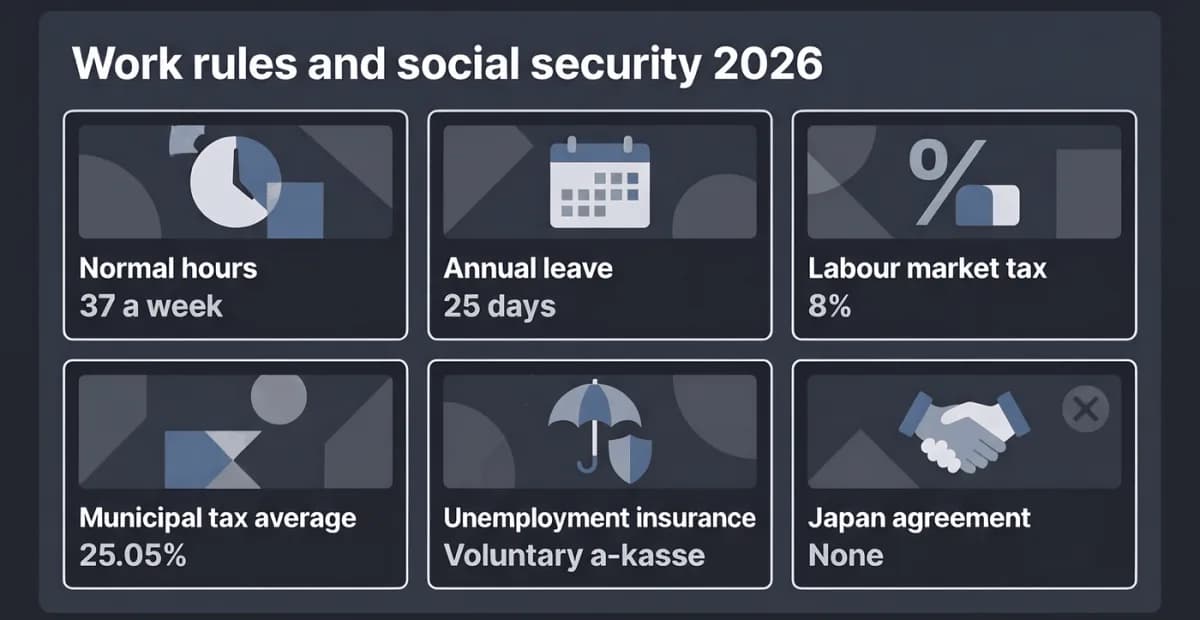
Denmark has no employee social-insurance contribution like Japan's employees' pension or health insurance premiums, and health care is tax-funded. The statutory deductions are income tax (A-skat), the labour market contribution and the employee share of ATP. Everything else, such as an a-kasse, a union and your share of an occupational pension, is voluntary or set by an agreement.
| Item | 2026 rule |
|---|---|
| AM-bidrag (labour market contribution) | "An 8% tax that you pay on all salary income", from the year you turn 18; withheld after ATP. It is a tax, not an insurance premium[^82] |
| ATP (supplementary pension), private sector, monthly paid | 117 or more hours a month: DKK 297 in total, of which employee DKK 99 (about US$14.7 / JPY 2,330) and employer DKK 198; 78 to 116 hours: 66 + 132; 39 to 77 hours: 33 + 66; under 39 hours: none[^83] |
| Occupational pension | Set by each collective agreement; there is no statutory percentage. Ask your employer for the split |
| Sickness benefit | Employer pays the first 30 calendar days[^79] |
| Parental leave and benefit | By our arithmetic from barselsloven §§ 7, 9 and 21: about 24 weeks of benefit each after the birth (mother 2 + 8 weeks of leave then 14 benefit weeks; father or co-mother 2 weeks then 22), of which 11 weeks cannot be transferred. Mothers also have 4 weeks before the birth[^80] |
| Folkepension (state pension) | Age 67 if born 1 July 1955 to 1962, 68 if born 1963 to 1966, 69 if later. At least 3 years of residence from age 15, a full pension needs residence for 9/10 of that period, and nothing is paid for under 12 months[^84] |
- Unemployment insurance is voluntary. You are not insured automatically: you must join an a-kasse (unemployment insurance fund). Dagpenge (unemployment benefit) is at most DKK 22,041 a month for a full-time insured person (about US$3,280 / JPY 519,000) and DKK 14,694 part time in 2026. It runs for 2 years within 3 (§ 55, arbejdsløshedsforsikringsloven, LBK 808/2026); graduates have 1 year within 2 (§ 54).[^85][^86]
- Japan. No Japan-Denmark social security agreement is in force: Japan had 24 agreements in force and Denmark is not among them. Ask your employer how pension periods are treated.[^87]
What this means: the first deductions are small, but income protection is your choice. If you want dagpenge, join an a-kasse early, since membership is the condition.
Taxes on employees
Danish income tax is withheld monthly through your tax card. Rates for 2026:[^88][^89]
| Element | 2026 |
|---|---|
| AM-bidrag | 8%, taken first (a tax)[^82] |
| Bundskat (basic state tax) | 12.01% |
| Municipal tax (kommuneskat) | 25.05% on average; range 23.39% to 26.30% according to the Ministry of Taxation's 2026 table |
| Church tax (kirkeskat) | Members of the Folkekirke only: 0.87% on average for members (0.64% averaged over all taxpayers) |
| Mellemskat (middle bracket) | 7.5% above DKK 641,200 a year (about US$95,500 / JPY 15.1 million) |
| Topskat (top bracket) | 7.5% above DKK 777,900 (about US$115,900 / JPY 18.3 million); with mellemskat the two add to 15% |
| Toptopskat (additional top bracket) | 5% above DKK 2,592,700 (about US$386,200 / JPY 61.0 million) |
| Tax ceiling (skatteloft) | 44.57% for personal income |
The bracket thresholds are applied after AM-bidrag. The kommuneskat is the nearest thing to Japan's resident tax (住民税, juminzei), because both are local income taxes. In Denmark it is withheld every month together with the state tax through your tax card and settled in the annual statement (årsopgørelse), not billed separately; Japan's resident tax is assessed on the previous year's income and billed from June (a general description, not from a Danish source). On the first slice of income an average taxpayer pays 8% AM-bidrag, then about 37.06% in bundskat plus average kommuneskat (our addition), plus church tax if a member. The lowest municipal rate is Copenhagen's 23.39%, reported by the press; check your own municipality's rate.
- Allowances. The personal allowance (personfradrag) is DKK 54,100 in 2026 (about US$8,060 / JPY 1.27 million); a figure of DKK 55,700 is listed for 2027, which we treat as proposed until confirmed. The employment deduction (beskæftigelsesfradrag) is 12.75% of earned income, up to DKK 63,300 in 2026 (about US$9,430 / JPY 1.49 million).[^89]
- Researcher and key-employee scheme. Eligible foreign employees pay 27% plus AM-bidrag, 32.84% in all, for up to 7 years in total, once in a lifetime, if they earn at least DKK 65,400 a month in 2026 (about US$9,740 / JPY 1.54 million; DKK 67,300 in 2027). Check with Skattestyrelsen.[^90]
- VAT (moms) is 25%, with no reduced rate.[^91]
What this means: compare offers on net pay and ask your employer how your municipality affects it. Anything listed for 2027 is not yet settled for your budget.
Where to find jobs, recruitment agencies and job scams
- Job boards. Start with Jobnet and Work in Denmark (part of EURES), then Jobindex (which took over Ofir, now closed)[^92], StepStone, The Hub for start-ups, JobTeaser (Graduateland now redirects there) and LinkedIn. The full comparison is in our Denmark job-board guide.
- Unions and a-kasser. IDA, Djøf, HK, Ase (an a-kasse that also offers union membership), Akademikernes a-kasse (aka.dk) and Krifa have working sites and are useful for CV sparring, contract advice and wage statistics; their "job" pages are mostly their own vacancies.[^93]
- Agencies. Hays, Randstad, ManpowerGroup, Moment, Muusmann and Ballisager have working Danish sites.[^94] We found no statute we could cite on agency fees, so we state no legal rule; as practical advice, a legitimate agency is paid by the employer.
- Scams. Never pay for a job, an interview or a permit. SIRI says fees are paid only through the payment solution on newtodenmark.dk, which requires a case order ID, and that it does not ask for payment by e-mail. Its notice of 31 July 2026 warns about fake e-mails and calls that ask for money to a bank account, with spelling errors in the agency name and private-domain senders as red flags. Work in Denmark says it uses only @workindenmark.dk addresses and never asks for money or personal information.[^95][^96][^97] A Danish embassy page says Danish companies do not charge for a job offer.[^98] On 5 October 2026 the Danish government's sikkerdigital.dk reported unauthorised access to citizens' CPR data, so expect targeted phishing; never share MitID details, codes or passwords.[^99][^100] You can report online fraud to the police.[^101]
Final checks before you apply
- [ ] The CV is one to two pages (three at most for senior roles), latest job first, in the language of the advert, with a profile written for this vacancy.
- [ ] No CPR number on the CV or the cover letter, and I know the law bars employers from asking my age when I submit the application.
- [ ] One line on work authorisation if I need a permit.
- [ ] The ansøgning is one page and answers the advert; it does not list referees' contact details unless asked.
- [ ] I know which collective agreement covers the job, and the offer is at or above the 2026 minimum (for example DKK 143.40 an hour in industry).
- [ ] If I need a non-EU permit, the salary meets the scheme limit and I will not start before it is granted.
- [ ] I will get the essentials of my contract in writing within 7 days and the rest within a month, and I know my notice period.
- [ ] I know that 8% AM-bidrag and income tax are deducted, I have a plan for CPR, tax card and MitID, and I have decided about an a-kasse.
- [ ] Nobody has asked me for a fee for a job or a permit.
FAQ
What is the standard Danish CV format?
There is no legal template. A clear CV of one to two pages (up to three for senior candidates according to Ase and Djøf), latest job first, with a profile of four to eight lines at the top and a short "Fritid og personligt" at the end, in the language of the advert, is the safe default.
Should a Danish CV include a photo and my age?
Both are optional and common. Ase says there is no longer a fixed rule on photos, and Work in Denmark says it is normal to include age, marital status, children and hobbies. The law bars an employer from asking for your age when you submit the application, so include a birth year only if you choose to.
Do I put my CPR number on the CV?
No. You do not need it to apply. You give it to the employer after you are hired, so that pay and tax can be set up.
Does Denmark have a minimum wage?
There is no statutory minimum wage. Collective agreements set the floors: from 1 March 2026 the industry agreement minimum is DKK 143.40 an hour (about US$21.4 / JPY 3,370) and the unskilled retail minimum is DKK 22,794 a month (about US$3,400 / JPY 536,000).
When must I get a written contract?
The essentials must be given to you in writing within 7 calendar days of starting, and the rest, including notice periods, within one month. Probation can last up to six months.
Do I need a work permit?
EU/EEA and Nordic citizens do not. Non-EU nationals need a permit through SIRI, normally applied for with the employer: the Pay Limit Scheme needs DKK 552,000 a year, the Supplementary Pay Limit Scheme DKK 446,000, and the fee is DKK 6,810 (about US$1,010 / JPY 160,000). Do not start before it is granted.
Can Japanese citizens work in Denmark on a Working Holiday?
Yes. The agreement dates from 2007: MOFA lists no annual quota and an age of 18 to 30 (SIRI says not older than 31 at application), the stay is up to a year with limited work, up to six months, there is no fee and processing takes about three months.
How much income tax will I pay?
In 2026, AM-bidrag is 8%, bundskat 12.01% and kommuneskat averages 25.05% (23.39% to 26.30%), with the middle and top brackets above DKK 641,200 and DKK 777,900, and a personal allowance of DKK 54,100. Kommuneskat is withheld through your tax card each month.
Is there unemployment benefit in Denmark?
Only if you join an a-kasse, since membership is voluntary. Dagpenge is at most DKK 22,041 a month for a full-time insured person (about US$3,280 / JPY 519,000), for two years within three.
Can a recruitment agency charge me?
We found no statute we could cite, but a legitimate agency is paid by the employer. If anyone asks you to pay for a job, an interview or a permit, walk away.
How to use AIResume
Keep one master CV in AIResume and cut a Danish and an English version for each vacancy: use the advert's keywords, lead with your strongest result, and add the right-to-work line if you need it. Leave out your CPR number, export a PDF and check it with our ATS-friendly CV guide before you apply.
Related AIResume guides
- Job boards in Denmark
- Job boards in Norway
- Job boards in Sweden
- Job boards in Germany
- Job boards in the Netherlands
- Switzerland CV format
- How to write an ATS-friendly CV
Sources
[^1]: IDA, how to make a good CV
[^2]: Ase, opbygning af CV
[^3]: Djøf, skriv et godt CV
[^4]: Work in Denmark, personal details in your CV
[^5]: Danmarks Nationalbank, exchange rates (28 October 2026)
[^6]: Work in Denmark, work experience in your CV
[^7]: Retsinformation, forskelsbehandlingsloven, LBK 399 of 5 April 2024
[^8]: Work in Denmark, your cover letter
[^9]: Djøf, skriv en god ansøgning
[^10]: HK a-kasse, tips og tricks til jobsøgning (2021)
[^11]: Retsinformation, circular CIR nr 9603 of 14 December 2012
[^12]: Borger.dk, unemployment benefit (dagpenge)
[^13]: Work in Denmark, become visible to recruiters
[^14]: Dansk Erhverv, question about age at a job interview was not discrimination (2024)
[^15]: Retsinformation, ligebehandlingsloven, LBK 942 of 19 July 2024
[^17]: Retsinformation, lov nr 286 of 24 April 1996 on health information (text mirror: danskelove.dk)
[^18]: Retsinformation, databeskyttelsesloven, LBK 289 of 8 March 2024
[^19]: Datatilsynet, data protection in employment
[^20]: Datatilsynet, questions and answers on retention in recruitment (May 2021)
[^21]: Datatilsynet, guide on data protection in employment (March 2023)
[^22]: Borger.dk, private straffeattest and Politi.dk, straffeattest
[^23]: Retsinformation, børneattestloven, LBK 362 of 2 April 2014
[^24]: Work in Denmark, a good personal profile counts
[^25]: Work in Denmark, unsolicited application
[^26]: Djøf, guide til uopfordret ansøgning
[^27]: Djøf, personlighedstest, færdighedstest og case-interview
[^28]: Retsinformation, ansættelsesbevisloven, lov nr 501 of 16 May 2023
[^29]: Retsinformation, funktionærloven, LBK 1002 of 24 August 2017
[^30]: Life in Denmark, International Citizen Service
[^31]: Life in Denmark, the Danish tax system
[^32]: Life in Denmark, MitID
[^33]: NemKonto
[^34]: Uddannelses- og Forskningsstyrelsen, få en vurdering
[^35]: Uddannelses- og Forskningsstyrelsen, annual report 2025 on assessment and recognition
[^36]: STPS, registration of healthcare professionals
[^37]: STPS, medical doctor, non-EU countries: language test and STPS, nurse, non-EU countries: language test
[^38]: SIRI, list of approved language tests and Studieskolen, Prøve i Dansk 3
[^39]: Work in Denmark, healthcare: non-EU citizens
[^40]: Retsinformation, danskuddannelsesloven, LBK 448/2026
[^41]: HCCH, Apostille Convention status table
[^42]: Tokyo Metropolitan Police, certificates for submission abroad
[^43]: Life in Denmark, pay
[^44]: Eurofound, minimum wage in Denmark
[^45]: Court of Justice of the EU, case C-19/23 (judgment of 11 November 2025)
[^46]: Industriens Overenskomst 2025-2028, § 22
[^47]: HORESTA hotel agreement 2025-2028 (fixed pay) and HORESTA café agreement 2025-2028
[^48]: Dansk Erhverv, retail agreement rate increases from 1 March 2026
[^49]: Danmarks Statistik, earnings, table LONS50 (updated 29 September 2026)
[^50]: Danmarks Statistik, earnings by occupation, table LONS20
[^51]: Work in Denmark, the Danish labour market
[^52]: World Bank, World Development Indicators: Denmark (accessed 21 October 2026)
[^53]: Danmarks Statistik, registered unemployment, table AUS08
[^54]: Danmarks Statistik, labour force survey, table AKU111K
[^55]: Danmarks Statistik, employees, table LBESK03
[^56]: Danmarks Statistik, population, table FOLK1A
[^57]: Danmarks Statistik, immigrants and descendants, table FOLK1C
[^58]: Danmarks Nationalbank, questions on the fixed exchange rate policy
[^59]: Udlændinge- og Integrationsministeriet, Tal og fakta 2025
[^60]: SIRI, Pay Limit Scheme minimum amount
[^61]: SIRI, Supplementary Pay Limit scheme
[^62]: SIRI, Positive Lists updated
[^63]: SIRI, Fast-track
[^64]: SIRI, work permit schemes (news of 13 October 2026 on the Collective Agreement Scheme)
[^65]: SIRI, fee overview
[^66]: Directive (EU) 2021/1883, recital 69
[^67]: SIRI, salary to a Danish bank account
[^68]: Regulation (EU) 2018/1806, consolidated 30 December 2025 and European Commission, EES and ETIAS (28 April 2026)
[^69]: SIRI, Working Holiday Japan and MOFA, working holiday
[^70]: National Tax Agency of Japan, withholding tax pamphlet (Japan-Denmark convention)
[^71]: Retsinformation, lov nr 1292 of 21 November 2018 implementing the Japan-Denmark convention
[^72]: MOFA, Denmark data page (1 October 2025 survey)
[^73]: Danmarks Statistik, full-time employees by origin, table LBESK355
[^74]: Danmarks Statistik, table VAN66
[^75]: Integrationsbarometer, Ukrainians
[^76]: Retsinformation, working-time act, LBK 982/2024
[^77]: Retsinformation, arbejdsmiljøloven, LBK 442/2026
[^78]: Retsinformation, ferieloven, LBK 152/2024
[^79]: Retsinformation, sygedagpengeloven, LBK 1221/2025
[^80]: Retsinformation, barselsloven, LBK 206/2026
[^81]: Retsinformation, law no. 214 of 6 March 2023 (abolition of store bededag)
[^82]: Skat.dk, labour market contribution
[^83]: Borger.dk, ATP rates for private employers
[^84]: Retsinformation, lov om social pension, LBK 1123/2024
[^85]: A-kasser.dk, dagpenge rates
[^86]: Ministry of Employment, rates for 2026 and Retsinformation, arbejdsløshedsforsikringsloven, LBK 808/2026
[^87]: Japan Pension Service, social security agreement status
[^88]: Skat.dk, bottom, middle, top and additional top bracket tax
[^89]: Ministry of Taxation, tax rates
[^90]: Skat.dk, tax scheme for researchers
[^91]: Skat.dk, VAT
[^92]: Jobindex, Ofir taken over by Jobindex
[^93]: IDA, Djøf, HK, Ase, Akademikernes a-kasse and Krifa (all loaded on 29 October 2026)
[^94]: Hays, Randstad, ManpowerGroup, Moment, Muusmann and Ballisager (all loaded on 29 October 2026)
[^95]: SIRI, warning against fraudulent e-mails (2019)
[^96]: SIRI and Udlændingestyrelsen, warning against phone fraud and fake e-mails (31 July 2026)
[^97]: Work in Denmark, contact information
[^98]: Denmark in India, fraudulent job offers in Denmark
[^99]: Sikkerdigital.dk, notice on unauthorised access to CPR data (5 October 2026)
[^100]: Sikkerdigital.dk, spot fraud
[^101]: Politiet, report online fraud
Your next step
- DeelFor employers hiring across borders: contracts, payroll and visas handled.See how Deel works
Affiliate links: we may earn a commission at no cost to you. Affiliate link