
Belgium Job Sites 2026: Official and Private Boards
By the AIResume Editorial Team · Last reviewed 20 August 2026

By the AIResume Editorial Team · Last reviewed 20 August 2026
Belgium Job Sites 2026: Official and Private Boards
The best Belgium job site depends on what you are trying to do. Start with the public employment service for the region where you want to work—VDAB for Flanders, Actiris for Brussels, Le Forem for Wallonia or Arbeitsamt for the German-speaking Community. Add Workingfor.be for federal public jobs, EURES for cross-border mobility, and private boards such as Jobat, Stepstone and LinkedIn for broader employer discovery.
No single board covers every route. A useful search therefore has two stages: discover vacancies through the right channel, then confirm the role, requirements and application route on the employer's own page before submitting.
Editorial boundary: This is job-search guidance, not legal or immigration advice. Service eligibility, vacancy details and application rules can change. The live vacancy and the competent authority take priority. Private job boards are included as market examples, not as evidence of national law or guaranteed coverage.
The 60-second answer: which Belgium job site should you use?
| Your goal | Start here | Add next | Why |
|---|---|---|---|
| Private-sector work in Flanders | VDAB | Employer sites, Jobat, Stepstone, LinkedIn | VDAB offers detailed vacancy filters, alerts and profile tools for the Flemish labour market. |
| Work in Brussels | Actiris / MyActiris | Employer sites and private boards | MyActiris combines search, saved vacancies, alerts, suggestions and application tracking. Some vacancies use Actiris preselection. |
| Work in Wallonia | Le Forem | Employer sites and private boards | Le Forem combines vacancy search, job events, a professional profile and personalised opportunities. |
| Work in the German-speaking Community or nearby | Arbeitsamt Ostbelgien | EURES and neighbouring regional services | The official portal includes local and nearby vacancies, agency filters and links to cross-border support. |
| Belgian federal public service | Workingfor.be | The recruiting body's own notice | Federal selections use their own deadlines, eligibility criteria, tests and structured application process. |
| Cross-border or EU/EEA mobility | EURES | The relevant regional public service | EURES adds mobility advisers, events and living-and-working information to its vacancy database. |
| Corporate, specialist or networking-led search | Jobat, Stepstone, LinkedIn and employer sites | The relevant public service | Private boards broaden discovery, while the employer page confirms the current application contract. |
Belgium.be identifies the four regional public placement services and explains that they help jobseekers build a profile and find work. That is the clearest official starting point for the regional split. Belgium.be: Jobs and training.
Why Belgium has several official job-search routes
Belgium does not operate one universal national job board for all employment. Public employment support is organised regionally:
- VDAB serves the Flemish labour market.
- Actiris is the Brussels public employment service.
- Le Forem serves Wallonia.
- Arbeitsamt serves the German-speaking Community.
These are not interchangeable brand names for the same database. Their profiles, filters, matching tools and service eligibility reflect different regions. If you can work in more than one region, use more than one service—but keep your dates, job titles, language levels and availability consistent across profiles.
Federal recruitment is a separate route. Workingfor.be publishes federal vacancies with the selection steps and admissibility rules attached to each notice. EURES is another distinct route: it is designed for European labour mobility and cross-border support rather than replacing regional services.
Belgium job-site comparison: what each channel actually does
| Channel | Best use | Useful features established by the source | What it does not prove | Application action |
|---|---|---|---|---|
| VDAB | Flanders-focused search and matching | Filters for location, contract, schedule, job domain, experience, diploma, language and licences; alerts; structured profile and application tracking | That every Flemish employer posts there, or that one uploaded CV fits every vacancy | Save the vacancy, compare required evidence, tailor the CV and record the application status. |
| Actiris / MyActiris | Brussels search, matching and guided applications | Saved searches, alerts, suggested vacancies, a virtual CV and application tracking; some vacancies involve Actiris preselection | That every Brussels role accepts the same language or application file | Keep the profile current; follow any preselection instruction and mirror the vacancy's terminology honestly. |
| Le Forem | Wallonia search, events and profile visibility | Vacancies, jobdays, personalised opportunities, online professional profile and optional employer visibility | That publishing a profile replaces a vacancy-specific application | Complete the profile, keep contact data current and create a targeted CV for priority roles. |
| Arbeitsamt Ostbelgien | German-speaking Community and nearby areas | Keyword, area, qualification and occupational filters; agency/intermediary labels; links to other services and cross-border help | That a nearby foreign vacancy follows Belgian employment or permit rules | Check the location and employer jurisdiction, then follow the named authority and vacancy. |
| Workingfor.be | Federal public-sector recruitment | Official vacancy notices and a structured federal application process | That its workflow represents private-sector recruitment | Treat each notice as a separate selection contract; complete required fields and documents before the deadline. |
| EURES | Cross-border and EU/EEA mobility | Vacancy database, advisers, events, CV support and living-and-working information | That it grants work authorisation or overrides national eligibility rules | Verify mobility eligibility and the employer's route; search by occupation and location as well as keywords. |
| Jobat | Private-market discovery | Search by region, function, contract and advertisement language; alerts and CV tools | National coverage, legal requirements or hiring outcomes | Use filters to map demand, then verify the live role with the employer. |
| Stepstone Belgium | Private-market and employer discovery | Vacancy search, categories, cities, alerts/apps and platform application tools | That a listing is exclusive or that platform advice is an official Belgium rule | Check duplicates, dates and the employer's preferred application route. |
| LinkedIn Belgium | Professional and network-led discovery | Jobs, internships, employer pages, network signals and Open to Work tools | That every visible role is active, complete or posted by the direct employer | Align the public profile with the submitted CV and verify the recruiter and company page. |
The source ledger records exactly which page supports each feature. We do not use private boards to establish legal duties, work-permit eligibility, national CV conventions or claims such as “Belgium's largest job site.”
A four-lane search is more reliable than a longer site list
Lane 1: regional public service
Choose the service for the work location, not merely your home address. Create the profile only if you are eligible and intend to maintain it. A stale public profile can conflict with a newer CV.
VDAB's profile can contain work experience, studies and skills, produce personalised suggestions, and—when you choose to publish it—become visible to employers. VDAB also lets users save external vacancies and record application status. VDAB profile and VDAB vacancy FAQ.
MyActiris functions as a virtual CV and application workspace. Actiris advises candidates to compare vacancy requirements with their own experience and to keep the profile complete and current. Actiris personal profile.
Le Forem similarly connects a completed professional profile with tailored opportunities and, when the user chooses publication, employer or preselector visibility. It stresses coherent information and current contact details. Le Forem: publish my profile.
Lane 2: the employer's own site
Use boards for discovery; use the employer page to resolve ambiguity. Before applying, compare:
- exact job title and reference number;
- publication and closing dates;
- location, work pattern and contract;
- required application language;
- required documents and file limits;
- recruiter or agency identity;
- whether the role still exists on the employer site.
This is not a promise that an employer-site listing is error-free. It is a practical way to identify duplicates, expired reposts and different application instructions before you create another candidate record.
Lane 3: federal or cross-border route
Use Workingfor.be when the employer is part of the Belgian federal administration. Do not assume that an emailed private-sector CV is enough: follow the exact online fields, document rules, tests and deadline in the notice. Workingfor.be jobs.
Use EURES when the search crosses borders or involves European mobility. EURES explains that its database is updated daily but also warns that notice titles and bodies may not be translated. A keyword in one language can therefore miss vacancies; occupation and location filters can recover results across language versions. EURES help.
EURES support does not itself establish a non-EU applicant's right to work. Check immigration and work-authorisation questions with the competent Belgian or destination-country authority.
Lane 4: private boards and networks
Jobat, Stepstone and LinkedIn can expose employers, job-title variants and recurring skill terms that a single regional search misses. Use them to build a market map—not to make unsupported rankings.
Run the same core search in several forms:
- exact target title;
- adjacent title used by employers;
- one high-value skill plus location;
- occupation category plus contract type;
- relevant title terms in the vacancy languages you can genuinely work in.
If a vacancy is syndicated across sites, treat it as one opportunity, not three. Track the canonical employer, reference number and the version you submitted.
What the latest official vacancy data can—and cannot—tell you
Statbel reported 140,462 vacancies in Belgium in Q1 2026. Five sector groups accounted for 75.7%: non-profit (24.1%), sciences and services (17.4%), industry (13.3%), wholesale and retail (12.1%), and construction (8.8%). Statbel Job Vacancy Survey.
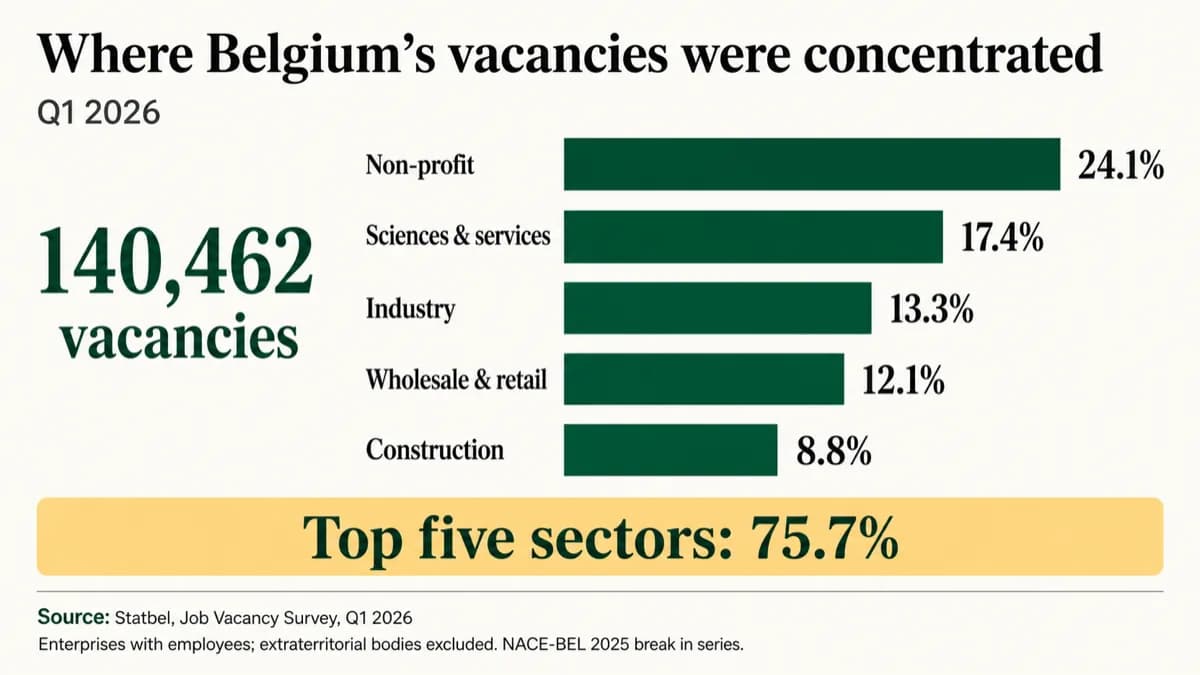
These are survey estimates for enterprises with employees. The release excludes extraterritorial bodies such as EU institutions and NATO, and Statbel warns of a break in the series following the move to NACE-BEL 2025. The chart therefore helps prioritise sector searches; it does not rank job boards, predict an individual's chances or prove that 75.7% of online advertisements appear on any named site.
Build one vacancy-evidence record before tailoring your CV
A job board finds a vacancy. It does not decide which evidence belongs in your application. For each priority role, create a compact record:
| Field | Example | Why record it |
|---|---|---|
| Canonical employer and vacancy URL | Employer careers page | Prevents duplicate applications to syndicated copies. |
| Reference and closing date | `OPS-BRU-026` · 12 Sep 2026 | Lets you verify status and identify the application later. |
| Required evidence | CRM triage, three working languages, SLA reporting | Gives the CV a defensible content target. |
| Source of each claim | Monthly support report, training log, certificate | Stops invented metrics and inflated skill levels. |
| Application channel | MyActiris preselection / employer portal / Workingfor.be | Determines which profile fields and documents must be complete. |
| Submitted version and date | `Samira_El_Amrani_CV_OPS-BRU-026.pdf` | Keeps follow-up and interview answers consistent. |
The evidence should then appear consistently in your regional profile, private-board profile and submitted CV, without forcing identical wording into every field. For the CV itself, see How to tailor your CV to a job description.
Annotated sample CV for a Belgium job-site workflow
The person, employer, contact details and metrics below are entirely fictional. Replace every item with evidence you can substantiate.
Samira El Amrani
Brussels, Belgium · +32 470 00 00 00 · [email protected]
linkedin.com/in/samira-elamrani-example
MULTILINGUAL CUSTOMER OPERATIONS COORDINATOR
Profile
Customer-operations coordinator with four years of fictional B2B service experience. Uses CRM triage, knowledge-base writing and service reporting across French-, Dutch- and English-language cases.
Experience
Customer Operations Coordinator — Northstar Services SRL, Brussels
*2022–present · fictional employer*
- Resolved an average of 45 B2B cases per month in French, Dutch and English while maintaining a fictional 96% service-level result.
- Wrote 18 fictional knowledge-base guides; internal reporting showed a 14% reduction in repeat questions over six months.
- Trained six fictional colleagues to classify and escalate CRM cases using a documented triage workflow.
Skills
CRM case management · SLA reporting · knowledge-base documentation · Excel pivot tables
Languages
French C1 · Dutch B2 · English C1 — fictional self-assessment
Why each section is there
- Target title: lets regional and private-board matching connect the profile to the intended occupation. Add genuine title variants to search terms, not to the CV headline.
- Location: helps the reader understand availability without publishing a full street address.
- Profile: states the operating context and languages without claiming legal eligibility or “native” ability.
- Bullets: turn requirements into evidence. Every number is labelled fictional here; a real applicant should be able to explain its source.
- Language levels: stay consistent across the CV, MyActiris/VDAB/Le Forem profile and LinkedIn. Do not upgrade a level to match the vacancy.
- File and fields: upload a targeted version where allowed, but complete any required structured fields separately. Do not assume the PDF replaces them.
For public-profile consistency, use LinkedIn profile and CV alignment. For a Belgium-specific CV format check, see Belgium CV Format 2026.
A seven-day Belgium job-search workflow
Day 1 — define region, role and eligibility
Choose one or two work regions, the target occupation and realistic title variants. Separate work-authorisation questions from CV editing and verify them through the relevant official authority.
Day 2 — map official channels
Search the relevant regional service. Add Workingfor.be only for federal work and EURES for cross-border mobility. Save searches and alerts where useful.
Day 3 — sample 20 live vacancies
Record requirements from live notices. Deduplicate syndicated advertisements. Note language, contract, schedule, experience and qualification filters instead of relying on a general “Belgium jobs” query.
Day 4 — build the evidence sheet
For each recurring requirement, record a real example, scope, tool and defensible result. Mark gaps honestly. Do not invent qualifications, language levels or performance numbers.
Day 5 — align profiles and CV
Update the relevant public-service profile and any private profile you actively use. Tailor the CV to the vacancy while preserving factual consistency. If remote or hybrid terms matter, review remote-job CV keywords without presenting remote work as an entitlement.
Day 6 — apply through the confirmed route
Use the employer site, public-service preselection or named portal required by the vacancy. Save the final file, reference, date and submitted answers.
Day 7 — review channel quality
Measure useful signals: relevant vacancies found, duplicates removed, completed applications and employer responses. Do not judge a channel by raw listing count alone. Pause alerts that repeatedly surface stale or irrelevant roles.
Red flags before you submit
- The company or recruiter cannot be independently identified.
- The job-board copy and employer page disagree on title, location or deadline.
- You are asked for payment, banking credentials or identity documents before a legitimate hiring need is established.
- The contact uses an unrelated domain or pressures you to move immediately to an unverifiable channel.
- The role is reposted under several identities with no canonical employer.
- Your CV, public profile and application form contain conflicting dates or language levels.
A platform badge or familiar logo is not enough by itself. Verify the employer, the route and the data requested. If you use an automated tool to assess formatting, understand the difference between checking and creating a document in ATS checker vs resume builder.
Frequently asked questions
What is the best job site in Belgium?
There is no single best site for every search. Start with VDAB, Actiris, Le Forem or Arbeitsamt according to the intended work region. Add Workingfor.be for federal jobs, EURES for cross-border mobility, and relevant employer/private sites for broader discovery.
Can I use VDAB if I want a job in Brussels or Wallonia?
Search coverage and eligibility can overlap, but VDAB is the public service for the Flemish labour market. Use Actiris for Brussels and Le Forem for Wallonia as primary regional routes, then follow each service's current account and eligibility rules.
Are Jobat, Stepstone and LinkedIn official Belgian employment services?
No. They are private market channels. They can help you discover employers and vacancies, but they do not establish Belgian law, public-service eligibility, work authorisation or a universal application format.
Should I apply on the job board or on the employer's website?
Follow the route named in the live vacancy. If the same job appears on several sites, use the employer page to confirm the reference, deadline and instructions. Do not submit duplicates unless the employer asks you to reapply.
Is EURES only a job board?
No. EURES also provides advisers, events and living-and-working information for European mobility. Its vacancy database does not by itself grant work permission, and keyword searches in only one language may miss untranslated notices.
Do I need a different CV for every Belgium job site?
Keep one evidence-based master CV, then tailor the headline, summary and strongest proof to each vacancy. Profile dates, job titles, qualifications and language levels should remain factually consistent across services.
Which language should I use when searching Belgium job sites?
Use the vacancy language and the languages you can genuinely work in. For broader discovery, search relevant occupation terms in multiple languages; EURES specifically warns that notices may not have translated titles or descriptions. Never claim a language level you cannot demonstrate.
How often should I update a public employment-service profile?
Update it whenever your availability, contact details, experience, skills or target role changes, and review it before a new application campaign. Actiris and Le Forem explicitly stress complete, coherent and current profile information.
Final checklist
- Region and target occupation are defined.
- The correct regional public service is included.
- Federal and cross-border routes are used only when relevant.
- Private boards support discovery rather than unsupported rankings.
- Each priority vacancy is confirmed against the employer or competent route.
- Duplicate listings share one tracking record.
- CV and public profiles use consistent facts.
- Every metric, qualification and language level is verifiable.
- The submitted file, reference and date are recorded.
- Sensitive information is provided only through a legitimate, necessary channel.
The practical goal is not to be present on every platform. It is to use each channel for the job it actually performs, keep your evidence consistent, and submit through the route the employer or public authority has specified.