

Germany CV Format 2026: Lebenslauf, Anschreiben, Minimum Wage, Permits and Tax
A German application is built around a tabular, reverse-chronological Lebenslauf (CV) of ideally two A4 pages at most, a cover letter (Anschreiben) of a single page, and copies of your certificates and work references. The state portal Make it in Rheinland-Pfalz says that many businesses prefer a ta
By AIResume Editorial Team
Last updated: 31 October 2026
A German application is built around a tabular, reverse-chronological Lebenslauf (CV) of ideally two A4 pages at most, a cover letter (Anschreiben) of a single page, and copies of your certificates and work references. The state portal Make it in Rheinland-Pfalz says that many businesses prefer a table-style CV starting with the most recent entry, and that a handwritten signature and a professional portrait photo are common.[^1] None of this is law. What the law does regulate is what an employer may say in an advert, what it may ask and keep, what a work reference must look like, and what you are paid and charged once you are hired.
This guide covers the CV and the Anschreiben, anti-discrimination and data rules, an annotated fictional Lebenslauf, recognition of foreign qualifications, the statutory minimum wage and sector floors, the economy, work permits, labour law, social security, taxes and job scams. It is written for EU/EEA nationals, for Swiss and UK nationals, for non-EU skilled workers (EU Blue Card, sections 18a and 18b of the Residence Act, Chancenkarte), for international graduates, for Working Holiday makers and for Japanese nationals. For job boards, see our Germany job-board guide; this article summarises its permit and tax sections and does not repeat its board lists.
Editorial boundary: This is practical job-search guidance, not legal, immigration or tax advice. Our references are the law texts on gesetze-im-internet.de, the Bundesagentur für Arbeit (BA, the Federal Employment Agency), the Make it in Germany network, the BAMF (Federal Office for Migration and Refugees), the Auswärtiges Amt (Foreign Office), the Bundesfinanzministerium (BMF), the Deutsche Rentenversicherung, Destatis (the Federal Statistical Office), the Antidiskriminierungsstelle des Bundes (ADS), the Bundesamt für Justiz and the European Central Bank. We only list figures we could read in an official or primary source, and we mark the rest as "commonly advised", "reported" or "likely". Some sites blocked ordinary access: make-it-in-germany.com returns a bot-check page, so we cite its Rhineland-Palatinate partner portal instead; the website of Japan's Ministry of Foreign Affairs (MOFA) refused automated requests, so we read it in a browser; and the BMF website did not load, so the tax-treaty date comes from a professional summary of BMF information.
Exchange rates move daily. This guide uses the European Central Bank reference rates of 30 October 2026: EUR 1 = USD 1.1172 = JPY 175.68. At those rates EUR 2,000 a month is about US$2,230 / JPY 351,000.[^2][^3]
Before you apply
- SafetyWing Nomad InsuranceHealth insurance that works in your new country from day one.Get a quote
Affiliate links: we may earn a commission at no cost to you. Affiliate link
German CV format at a glance
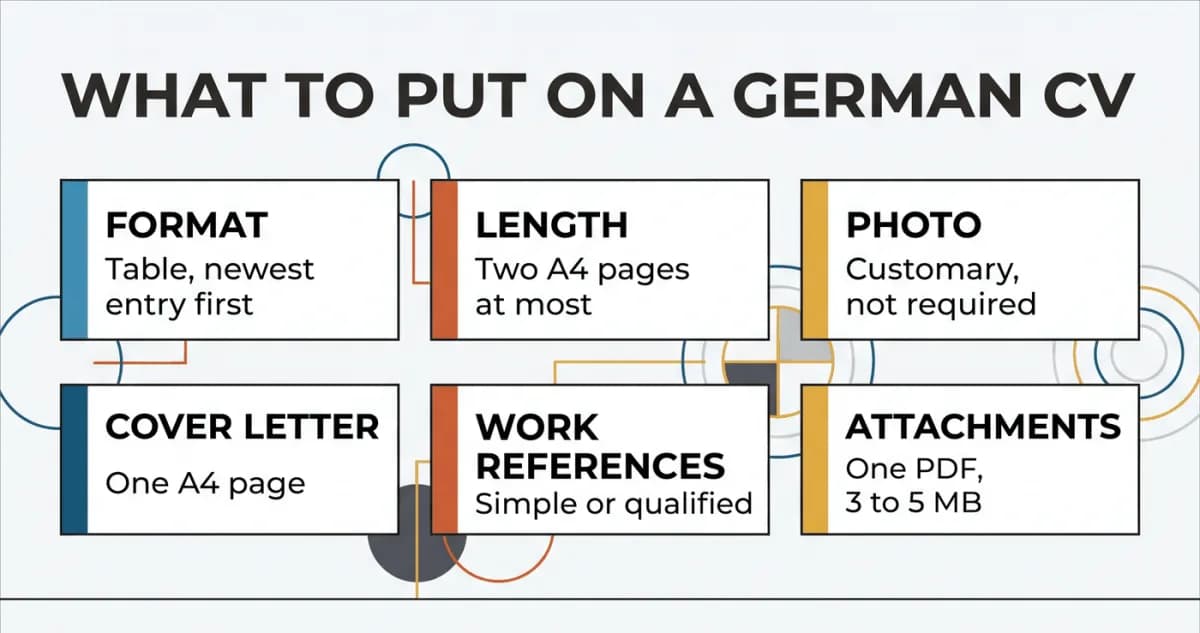
| Topic | Practice in 2026 | Law or official guidance |
|---|---|---|
| Format | Tabellarischer Lebenslauf (a table with dates on the left), most recent entry first. Europass templates are accepted | Make it in Rheinland-Pfalz[^1] |
| Length | "Ideally two A4 pages at most" | Make it in Rheinland-Pfalz[^1] |
| Language | Write in the language of the advert. German is the default for most employers; English is common in technology and international firms. Documents that are neither German nor English should come with a translation | Editorial advice; translation tip from the state portal[^1] |
| Photo | Customary, not required. The portal lists a professional portrait photo among normal CV items. The General Equal Treatment Act (AGG, § 1) contains no photo requirement, and Austria's public employment service says an employer may not insist on one there | Practice, not law[^1][^4][^5] |
| Personal data | Contact details, date of birth and nationality are normal CV content in Germany. Age, ethnic origin, sex, religion, disability and sexual identity are protected grounds, so including them is your choice | State portal; ADS[^1][^6] |
| Signature and date | The portal calls it common to sign the cover letter and CV by hand. For an e-mail application a typed name and date are the usual substitute (editorial advice) | Practice[^1] |
| Work authorisation (non-EU) | If you already hold a residence permit, put it in your application documents. State your actual status instead of vague wording such as "Blue Card eligible" | State portal[^1] |
| Certificates and Arbeitszeugnisse | Send copies, never originals; notarised copies only if requested | State portal[^1] |
| Anschreiben | "Shouldn't be longer than a single A4 page": your interest, strengths, languages and why you want to work in Germany | State portal[^1] |
| File format | One PDF containing letter, CV and certificates; if the advert gives no limit, the BA advises 3 to 5 MB. If the advert says otherwise, follow it | BA mail-application sheet[^7] |
Discrimination law, personal data and fair hiring
The General Equal Treatment Act (AGG)
Grounds and job adverts. The AGG protects against discrimination on grounds of race or ethnic origin, gender, religion or belief, disability, age and sexual identity (§ 1).[^4] Section 7 bans such discrimination in employment, and § 11 is a single sentence: a job may not be advertised in breach of § 7(1).[^8] Courts have applied it to the wording of adverts, but the statute itself lists no wording.
Claiming after a rejection. An applicant who thinks they were discriminated against must claim in writing within two months of receiving the rejection (§ 15(4) AGG), and must then sue within three months of the written claim (§ 61b ArbGG).[^9][^10] Compensation is capped at three monthly salaries if the applicant would not have been hired anyway (§ 15(2)), and there is no right to be hired (§ 15(6)). Under § 22 the burden of proof shifts to the employer once the applicant shows indications of discrimination.[^11] According to the ADS, an employer need not justify a rejection.[^6]
Questions in interviews. Pregnancy questions are always unlawful, according to the ADS summary and AGG § 3(1).[^12] Questions about union membership are unlawful on the prevailing view, and questions about religion are generally not allowed (church employers have more room). Convictions may be asked about only if relevant to the job, and debts only for positions of trust. Questions about health are allowed only if they matter for the job.[^13] Previous salary is not banned per se in current German law: the IHK says it is permissible if relevant to the job or if you named it as a minimum yourself.[^13] For unlawful questions, the ADS and the IHK confirm that the applicant may answer untruthfully without consequences.[^13][^12]
Pay transparency. The EU Pay Transparency Directive (2023/970) had to be transposed by 7 June 2026, and Germany has not done so. A Bundestag answer of 8 July 2026 says the ministry was still clarifying details, and we found no draft bill by 31 October 2026.[^14] Pay ranges in adverts and a ban on asking about pay history are directive content, not yet German law. Today only the individual information right under the Entgelttransparenzgesetz applies.
Personal data and how long employers keep applications
Employers process applicant data under the GDPR and § 26 of the Federal Data Protection Act (BDSG), which allows processing for the decision to hire.[^15] After the CJEU judgment of 30 March 2023 (case C-34/21, a Hessian school-teacher case), data protection authorities say § 26(1) sentence 1 BDSG should not be relied on alone and Article 6 GDPR must be checked in parallel.[^16] A federal employee data protection act is still not adopted (a draft dates from October 2024, according to secondary sources). For rejected applications we found no nationwide rule of the Datenschutzkonferenz. Data protection authorities such as Berlin's consider up to six months after a rejection justifiable because of the AGG and labour-court deadlines; if no claim is made, the file must be deleted (Article 17 GDPR), and some authorities are stricter.[^17] Ask your former employers before naming them as references.
Certificate of good conduct (Führungszeugnis)
A Führungszeugnis costs EUR 13 (about US$14.50 / JPY 2,280) for both the printed and the digital version.[^18] Since 1 October 2026 there is a digital Führungszeugnis: a PDF delivered to your BundID mailbox with a QR code and a qualified seal, normally within a few hours. It is online only and needs an eID, an NFC phone and a credit card. The printed version still exists; the Bundesamt für Justiz warns of longer processing at high volume, and a European certificate or a request from abroad takes several weeks.[^19][^20] The digital version cannot receive an Apostille or Überbeglaubigung, so request the paper version for use abroad. No law sets a validity period, and employers usually accept a certificate of about three months.[^20] An erweitertes Führungszeugnis is issued only on the written request of the body that demands it, confirming that the work involves minors (§ 30a BZRG).[^21] Ask for a certificate only when an employer requests it.
Arbeitszeugnis and Zeugnissprache
You have a right to a written Zeugnis when the job ends (§ 109 GewO). A simple Zeugnis states the type and duration of the work; on request, a qualified Zeugnis also covers performance and conduct. It must be "klar und verständlich" and may contain no hidden meaning, and electronic form needs your consent.[^22] A Zwischenzeugnis (interim reference) is not in § 109; it rests on case law and practice. The coded grade phrases are practice, not statute. As commonly described:
| Grade | Typical closing formula | Meaning |
|---|---|---|
| 1 | "stets zur vollsten Zufriedenheit" | very good |
| 2 | "stets zur vollen Zufriedenheit" | good |
| 3 | "zur vollen Zufriedenheit" | satisfactory (average) |
| 4 | "zur Zufriedenheit" | sufficient |
| 5 | wording such as "hat sich bemüht" | poor |
The Federal Labour Court held on 18 November 2014 (9 AZR 584/13) that "zur vollen Zufriedenheit" means "befriedigend", an average grade; whoever wants a better grade must prove they earned it.[^23] Read each sentence for what it says and ask for a correction in writing if the wording does not match your performance.
Structure of a German Lebenslauf
The state portal lists what a German CV normally contains: contact details, date of birth and nationality, a professional portrait photograph, work experience, education from secondary school with grades, internships, language skills, IT skills and volunteer work.[^1] The order below is editorial advice built on that list.
- Persönliche Daten (personal data). Name, address, e-mail and phone. Date of birth and nationality are customary; a photo is your choice. Non-EU applicants add residence status as its own line.
- Berufserfahrung (work experience). Latest job first, with dates in the left column, employer, city, job title and two to four bullets with results you can defend at interview. Write numbers instead of superlatives.
- Ausbildung (education). Highest degree first, with the official name of the award and, if you have one, a ZAB statement for a foreign degree (see below). Grades are customary in Germany.
- Praktika, Ehrenamt (internships and volunteer work). Short and only if relevant.
- Sprachen und IT-Kenntnisse (languages and IT skills). Use CEFR levels ("German B2, English C1"), not adjectives.
- Ort, Datum, Unterschrift (place, date, signature). Common on a printed CV; for e-mail, a typed name is enough.
Gaps. Explain a gap with one factual line (for example "parental leave" or "language course"). We found no official rule on gap length. Achievements. Lead with what changed because of you. ATS. For applicant tracking systems use plain headings, one column and standard fonts, and mirror the advert's keywords honestly; our ATS-friendly CV guide explains how.
Germany vs Austria vs Switzerland
Reusing a CV across the German-speaking countries works only if you know where the rules differ. See our Switzerland CV format guide and Austria job-board guide for the neighbouring markets.
| Point | Germany | Austria | Switzerland |
|---|---|---|---|
| Photo | Customary, not required[^1] | Customary; an employer may not insist[^5] | Rules differ; check the Swiss guide |
| CV length | Ideally two A4 pages at most[^1] | About two pages (AMS guidance)[^5] | Check the Swiss guide |
| Work reference | Simple or qualified Zeugnis, § 109 GewO[^22] | Only a simple Dienstzeugnis (duration and kind of work); a qualified one "in the German sense" is foreign to Austrian law[^24] | Arbeitszeugnis lists start and end, function, work percentage, assessment of work and conduct, and the reason for leaving[^25] |
Annotated fictional German Lebenslauf
The sample is entirely fictional: person, employers, contacts and numbers. It sets no legal rule, and employers are described generically on purpose. Replace every item with truthful information.
Mika Beispiel, Data Analyst · Berlin · [email protected] · +49 170 0000000
*Annotation: fictional contacts. City is enough; a full street address is normal on a printed CV. A recent professional portrait photo would sit at the top right if you choose one.*
Geburtsdatum: 12.03.1996 · Staatsangehörigkeit: Japanese · Aufenthaltstitel: EU Blue Card (§ 18g AufenthG), valid until June 2029 (fictional)
*Annotation: date of birth and nationality are customary; the permit line states the actual status. EU/EEA applicants leave the permit out.*
Berufserfahrung
| Dates | Role and employer | Detail |
|---|---|---|
| 04/2023 to present | Data Analyst, a Munich-based automotive supplier (fictional) | Cut monthly reporting time from 6 to 2 working days by automating the data pipeline. Trained five colleagues on the dashboard tool. |
| 09/2020 to 03/2023 | Business Analyst, a Hamburg-based logistics company (fictional) | Built a forecasting model that reduced stock-outs by 11%. |
| 07/2019 to 08/2020 | Intern, then working student, a Frankfurt-based bank (fictional) | Supported risk reporting; wrote SQL queries for weekly management reports. |
*Annotation: tabular, latest job first, one result per role. If readers will not know the firm, say what it does and roughly how large it is.*
Ausbildung
| Dates | Qualification | Detail |
|---|---|---|
| 2014 to 2019 | Master of Science in statistics, Example University (fictional), Tokyo | ZAB statement of comparability attached (fictional); final grade given in the original scale and explained in one line |
*Annotation: give the official name of the award. School certificates in Japanese should come with a translation if the employer asks.*
Sprachen: Japanese (native) · English (C1) · German (B2) · IT: SQL, Python, Tableau
Ehrenamt: Volunteer tutor for a refugee education project in Berlin, since 2022.
*Annotation: one line, only if relevant. Add "Arbeitszeugnisse liegen bei" only if you attach them.*
Berlin, 31.10.2026 · *(signature)*
*Annotation: place, date and a signature are customary on a printed CV; on a PDF sent by e-mail a scanned signature or typed name is enough (editorial advice).*
Anschreiben, references and documents
The Anschreiben. The state portal says the letter should not be longer than a single A4 page and should explain your interest, strengths, languages and why you want to work in Germany.[^1] Commonly advised: one sentence naming the job and where you saw it, one paragraph on why this employer, one or two paragraphs of evidence from your experience, and a closing line on availability and notice period. DIN 5008 layout and the formal "Sie" are style norms, not law. No law requires a letter, but most German advertisers expect one unless the portal form replaces it.
Open application (Initiativbewerbung). Many employers accept unsolicited applications. Commonly advised: name the team and the type of role, and attach the same CV and a short letter.
Selection flow. Screening of documents, one or more interviews, and for some employers a test or assessment centre are commonly reported; we found no official standard. Send copies and keep your originals.[^1]
Written terms of employment. Under the Nachweisgesetz (§ 2) the employer must give you a signed written record of the key terms: parties, place, duties, probation, pay components, hours, leave, training, notice procedure and applicable collective agreements. After the 2022 reform and the BEG IV amendment, the record may be sent in text form (§ 126b BGB) if you can store and print it and the employer asks for an acknowledgement of receipt; you can ask for it on paper. Text form is not allowed in the sectors listed in § 2a SchwarzArbG, such as construction, hospitality, logistics and cleaning. The deadlines are staggered: some items on the first working day, others within seven days and the rest within one month.[^26]
Probation. An agreed probation may last at most six months, with two weeks' notice (§ 622(3) BGB). In a fixed-term contract it must be proportionate to the expected duration and the kind of work (§ 15(3) TzBfG).[^27][^28]
Foreign qualifications, languages and regulated professions
Recognition. The portal Anerkennung in Deutschland explains the recognition procedure and has a finder for the competent authority. Recognition is mandatory for regulated professions such as physicians and nurses and optional for most others.[^29]
Statement of Comparability (ZAB). The Zentralstelle für ausländisches Bildungswesen (ZAB) evaluates foreign degrees in a voluntary procedure that employers and the public service often ask for. The fee is EUR 208 (about US$232 / JPY 36,500); EUR 104 (about US$116 / JPY 18,300) is the fee for a replacement copy only. Processing takes three months from complete documents and full payment. For an EU Blue Card or the accelerated skilled-worker procedure the ZAB aims at two weeks and needs the signed employment contract or job offer.[^30][^31][^32] The database anabin helps you see how Germany rates a foreign institution.[^33]
Regulated professions and language. Doctors need at least general German at B2 in all Länder, plus usually a medical-language test oriented to C1, which most Landesärztekammern run and some approbation authorities run themselves (likely, from a search summary of the official page). The competent authority is the Land approbation authority, which you find through the Anerkennungsfinder.[^29] For other jobs we found no legal language level, so read the advert.
Apostille and documents for Japanese applicants
Germany and Japan are both parties to the Hague Apostille Convention. MOFA issues the Apostille and the 公印確認 (official-seal confirmation) only when the foreign recipient asks for it, and it advises checking first, because even Hague states may ask for further legalisation.[^34] A Japanese criminal-record certificate (犯罪経歴証明書) is issued free of charge by the prefectural police in person with fingerprints, only if a foreign public body requests it. It comes sealed in five languages including English and German, and it is invalid once opened; the Apostille is added separately at MOFA.[^35] German employers will usually ask for a German Führungszeugnis once you live in Germany, not a Japanese certificate.
Pay: statutory minimum wage and sector minimums
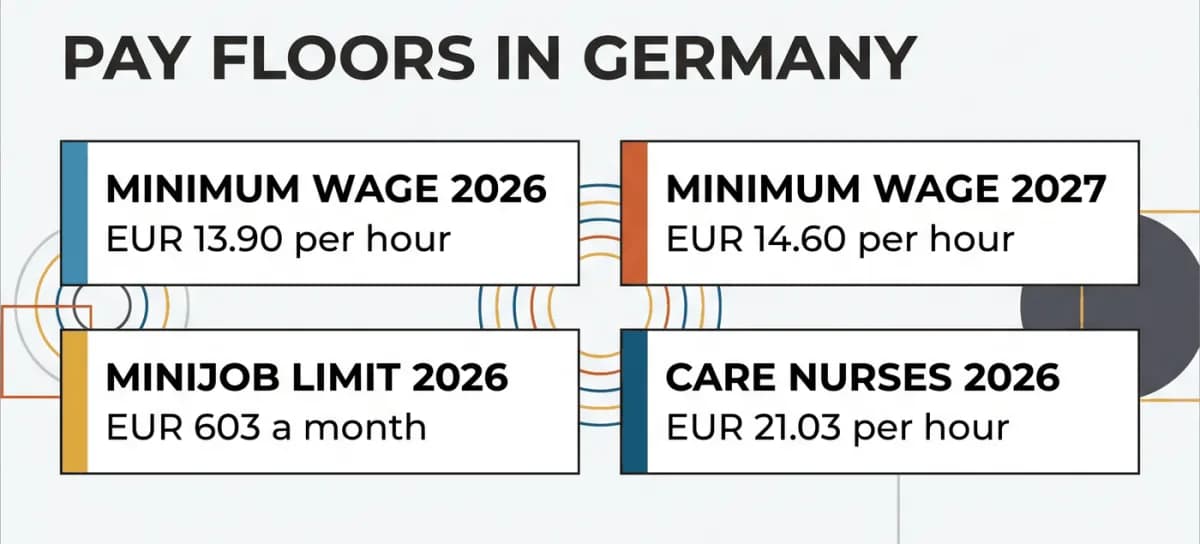
Germany has a statutory minimum wage. The Fifth Minimum Wage Adjustment Regulation (BGBl. 2025 I Nr. 268) sets EUR 13.90 gross per hour from 1 January 2026 (about US$15.53 / JPY 2,442) and EUR 14.60 from 1 January 2027 (about US$16.31 / JPY 2,565).[^36] At 40 hours a week that is EUR 2,409.33 a month in 2026 (about US$2,692 / JPY 423,000) and EUR 2,530.67 in 2027 (about US$2,827 / JPY 445,000), or EUR 28,912 (about US$32,300 / JPY 5.08 million) and EUR 30,368 (about US$33,900 / JPY 5.34 million) a year, by our arithmetic.
| Floor | Amount | In US$ / JPY | Valid |
|---|---|---|---|
| Statutory minimum wage per hour | EUR 13.90 / EUR 14.60 | about US$15.53 / JPY 2,442; US$16.31 / JPY 2,565 | 1 January 2026 / 1 January 2027[^36] |
| Minijob earnings limit per month | EUR 603 / EUR 633 | about US$674 / JPY 105,900; US$707 / JPY 111,200 | 2026 / 2027[^37] |
| Midijob range (Übergangsbereich) | up to EUR 2,000 a month | about US$2,230 / JPY 351,000 | 2026[^37] |
| Minimum training pay, year 1 / 2 / 3 / 4 | EUR 724 / 854 / 977 / 1,014 a month | about US$809 / 954 / 1,092 / 1,133 | Training starting in 2026[^38] |
Mini-job and midijob. The minijob limit is the minimum wage times 130 divided by 3, rounded up (§ 8(1a) SGB IV). In the midijob range, employee contributions rise gradually (§ 20(2) SGB IV).[^37]
Sector minimum wages. Where a sector floor exists, it replaces the statutory minimum for that sector. The Customs administration (Zoll) lists them:[^39]
| Sector | Minimum per hour, 2026 | In US$ / JPY | Later steps |
|---|---|---|---|
| Electrical trades | EUR 14.93 | about US$16.68 / JPY 2,623 | EUR 15.49 (2027), EUR 16.10 (2028) |
| Scaffolding | EUR 14.35 | about US$16.03 / JPY 2,521 | EUR 14.90 (2027) |
| Roofing, wage group 1 / group 2 | EUR 14.96 / EUR 16.60 | about US$16.71 / JPY 2,628; US$18.55 / JPY 2,916 | |
| Care assistants / qualified assistants / nurses, from 1 July 2026 | EUR 16.52 / 17.80 / 21.03 | about US$18.46 / 19.89 / 23.50; JPY 2,902 / 3,127 / 3,694 | EUR 16.95 / 18.26 / 21.58 from 1 July 2027 |
| Temporary agency work, lowest group | EUR 14.96 from 1 July 2026 | about US$16.71 / JPY 2,628 |
Who is not covered. Under § 22 MiLoG, the minimum wage does not apply to people under 18 without completed vocational training, to training pay, to volunteers, to the long-term unemployed in the first six months of a job, and to certain internships, among them compulsory internships, orientation and accompanying internships of up to three months, and the Einstiegsqualifizierung.[^40]
Records and controls. For minijobbers and employees in the sectors listed in § 2a SchwarzArbG, the employer must record the start, end and length of daily work by the end of the seventh day after the day worked and keep the record for two years (§ 17 MiLoG).[^41] The Finanzkontrolle Schwarzarbeit (FKS), part of Zoll, checks compliance.[^42] Under § 21 MiLoG a fine of up to EUR 500,000 (about US$558,600 / JPY 87.8 million) can follow if the minimum wage is not paid or not paid on time, up to EUR 50,000 (about US$55,900 / JPY 8.78 million) for missing or late time records, and up to EUR 30,000 for other offences.[^43]
Pay transparency. As explained above, the EU Pay Transparency Directive is not yet German law, so do not expect a salary range in every advert.[^14] We give no net-pay example, because the result depends on your tax class, health fund and church membership.
What this means for a job seeker: the entry floor is EUR 13.90 an hour in 2026, and many sectors pay more by collective agreement. Check whether a sector floor applies before you accept an offer, and ask whether an internship falls under the exceptions.
Germany's economy in numbers
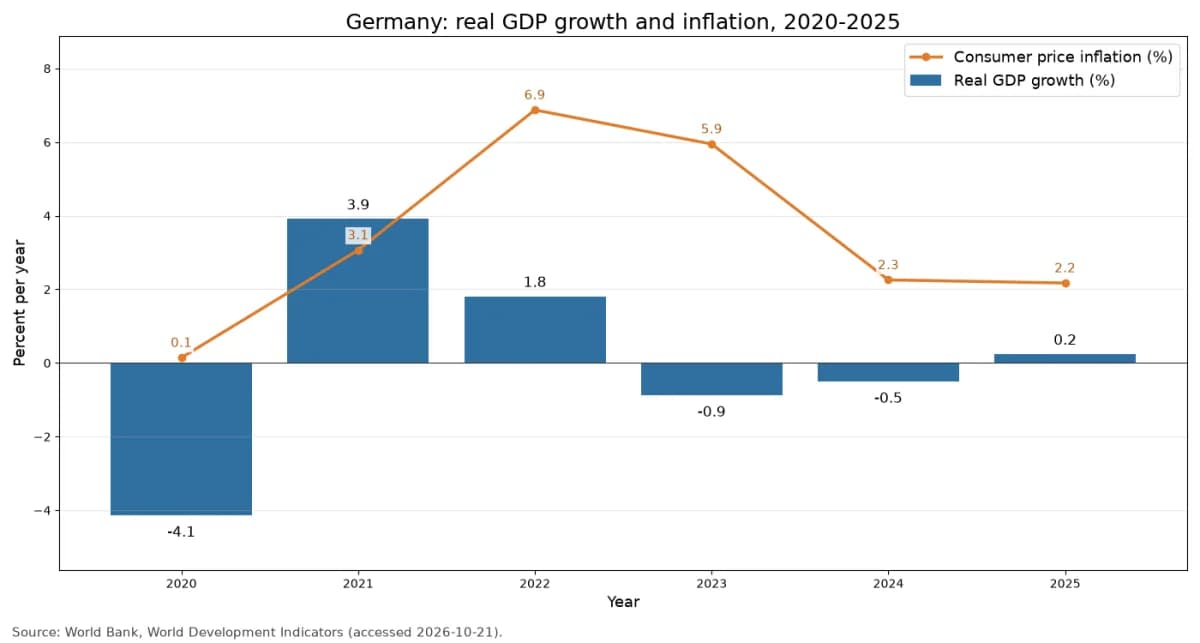
| Indicator | 2020 | 2021 | 2022 | 2023 | 2024 | 2025 |
|---|---|---|---|---|---|---|
| GDP (USD billion) | 3,941.4 | 4,355.3 | 4,201.0 | 4,562.2 | 4,685.6 | 5,050.9 |
| GDP per person (USD) | 47,395 | 52,349 | 50,507 | 54,777 | 56,104 | 60,496 |
| Real GDP growth (%) | -4.1 | 3.9 | 1.8 | -0.9 | -0.5 | 0.2 |
| Inflation (%) | 0.1 | 3.1 | 6.9 | 5.9 | 2.3 | 2.2 |
| Population (million) | 83.16 | 83.20 | 83.18 | 83.29 | 83.52 | 83.49 |
*Source: World Bank, World Development Indicators (accessed 21 October 2026).*[^44]
World Bank (ILO-modelled) unemployment for 2025 is 3.7%, with youth (ages 15 to 24) at 6.9%, and the World Bank counts an international migrant stock of 16,750,084 for 2024.[^44] The national figures are more recent:
| Measure | Value | Source |
|---|---|---|
| Registered unemployment, October 2026 | 2,955,000 people, rate 6.3% (seasonally adjusted 6.4%) | BA monthly report[^45] |
| Registered rate by group, October 2026 | Foreigners 13.4%; Germans 4.9%; ages 15 to under 25: 6.0% | BA monthly report[^45] |
| Registered vacancies, October 2026 | 654,000 (down 6,000 from September) | BA monthly report[^45] |
| ILO unemployment, September 2026 | 1.79 million, 4.1% | Destatis, quoted by the BA[^45] |
| Employees subject to social insurance, August 2026 (provisional) | 34.87 million, of whom 6.07 million without German citizenship (17.4% by our calculation) | BA monthly report[^45] |
| Government forecast of October 2026 | Real GDP +1.3% in 2026, +1.1% in 2027, +0.6% in 2028; consumer prices +2.7% in 2026. Third-quarter GDP was +0.2% on the previous quarter (flash estimate of 30 October) | Federal government; Destatis[^46][^47] |
| Consumer prices | September +3.3%, October flash +2.8% on a year earlier (core 2.1%) | Destatis[^48] |
| ECB deposit facility rate | 2.50% since 16 September 2026 | ECB[^49] |
| Population | 83.5 million at end-2025; 83.3 million on 30 June 2026; 12.4 million foreign nationals at end-2025 | Destatis[^50] |
The BA counts people registered as unemployed, while the ILO measure comes from a labour force survey, so the two rates are not comparable. Non-German employment still grew: the BA reports 225,000 more non-German employees than a year earlier, while German employees fell by 270,000 to 28.81 million. Manufacturing lost 163,000 jobs over the year, while health added 68,000 and care and social work 66,000.[^45]
What this means for a job seeker: with nearly three million registered unemployed and a foreigner rate (13.4%) almost three times the German rate (4.9%), competition is real even where employers complain of shortages. Health, care and social work are growing, manufacturing is shrinking, and language skills and recognised qualifications decide many hiring decisions.
Work permits and rules for foreign workers
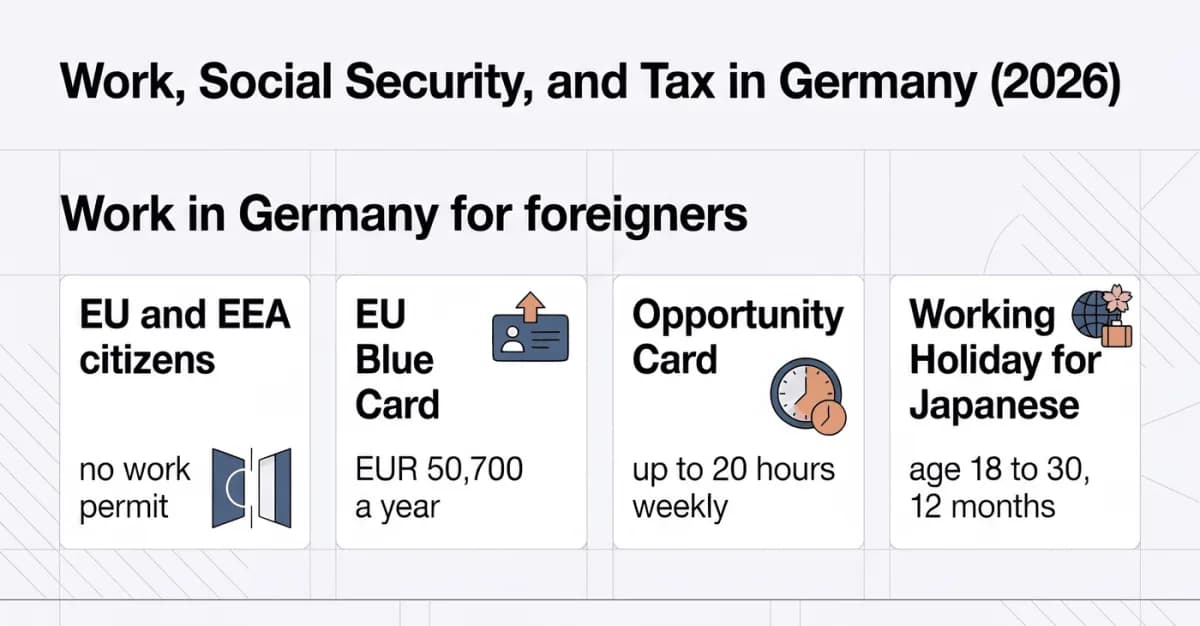
EU/EEA and Swiss citizens need no work permit. You register your address within two weeks of moving in (§ 17 BMG; see the registration section below). UK nationals are outside free movement; § 41 AufenthV lets them, like Japanese nationals, enter without a visa and apply for a needed title in Germany.[^51]
Non-EU nationals normally need a title that allows work before they start. The main routes in 2026:
- EU Blue Card (§ 18g AufenthG). The standard salary threshold is EUR 50,700 gross a year (about US$56,640 / JPY 8.91 million), which is 50% of the pension ceiling of EUR 101,400. A reduced threshold of EUR 45,934.20 (about US$51,320 / JPY 8.07 million), 45.3% of the ceiling, applies to listed shortage occupations (ISCO list) and to graduates whose degree is at most three years old; IT specialists without a degree also use § 18g(2), not § 19c(2). For the reduced threshold the BA must consent.[^52]
- Skilled-worker permits (§§ 18a and 18b AufenthG). § 18a covers people with vocational training and § 18b academics. The permit is not tied to one employer. For a first § 18a or § 18b permit after your 45th birthday, the salary must be at least 55% of the pension ceiling, EUR 55,770 (about US$62,310 / JPY 9.80 million), unless you show adequate old-age provision (§ 18(2) no. 5).[^53]
- Experience route (§ 19c(2) AufenthG with § 6 BeschV). For people with strong practical skills where the Employment Ordinance allows it: two years of experience in the last five, a recognised qualification and a salary of at least 45% of the ceiling, EUR 45,630 (about US$50,980 / JPY 8.02 million), unless the employer is bound by a collective agreement.[^54][^55]
- Chancenkarte (§ 20a AufenthG). Skilled workers can get it without points. Others need a state-recognised qualification of at least two years or a degree, at least A1 German or B2 English, and six points under § 20b (German level, English C1, age up to 35 or 36 to 40, five years of experience in the last seven, a previous stay in Germany). Funds of EUR 1,091 a month (about US$1,219 / JPY 191,700), or EUR 13,092 for twelve months (about US$14,630 / JPY 2.30 million), must be shown. It is valid for up to one year. You may work up to 20 hours a week on average, and you may also do trial employment of up to two weeks per job, which is a separate allowance. An extension of up to two more years is possible with a job offer and BA consent. Officially, 11,497 Chancenkarte visas were issued between 1 June 2024 and 15 June 2025.[^56][^57][^58]
- Western Balkans rule. Up to 50,000 consents a year (§ 26(2) BeschV).[^59]
- Fees and speed. The national visa costs EUR 75 (about US$84 / JPY 13,200), issuing a residence permit or Blue Card costs EUR 100 (about US$112 / JPY 17,600), and the accelerated skilled-worker procedure under § 81a costs EUR 411 (about US$459 / JPY 72,200). The employer can apply on your behalf under a power of attorney.[^60][^61][^62]
- Employer duties and job changes. The employer must check that you hold a title that permits the work, keep a copy for the duration of the job and notify the Ausländerbehörde if a skilled-worker job ends early (§ 4a(5) AufenthG). For the Blue Card, the authority may suspend a change of job in the first twelve months.[^63][^52]
- Naturalisation. The normal period is five years (§ 10(1) StAG). The three-year fast track was abolished by BGBl. 2025 I Nr. 256.[^64][^65]
Not in force. The planned Work-and-Stay-Agentur is not operating: the cabinet adopted only key points on 5 November 2025, and we found no bill by 31 October 2026.[^66] The EU's ETIAS travel authorisation has no fixed start date; the Entry/Exit System has been running since October 2025 and has been fully operational at Schengen borders since 10 April 2026.[^67]
Illegal employment. Employing a foreigner without the right permit can cost the employer a fine of up to EUR 500,000 (about US$558,600 / JPY 87.8 million) under § 404(3) SGB III.[^68] Under the Act against illegal work, § 10 SchwarzArbG sets up to three years in prison or a fine (up to five years in severe cases) where the foreigner works under strikingly poor conditions, and § 11 up to one year, or three years where it is done from gross self-interest.[^69][^70] Employers therefore ask for proof of the right to work.
Foreign workers in Germany in numbers
About 134,500 first-time residence permits for employment were issued in 2025: around 34,500 EU Blue Cards, 23,300 under § 18a, 18,200 under § 18b, 17,400 under the Western Balkans rule and 14,200 job-search titles. India accounted for about 10%, Kosovo 9% and Turkey 8%.[^71] The BA counts 6.07 million employees without German citizenship in August 2026, 225,000 more than a year earlier; the rise comes from third countries (+257,000) and Ukraine (+62,000), while EEA and Swiss workers fell by 32,000.[^45]
Japanese nationals
Under § 41(1) AufenthV, Japanese citizens may enter without a visa and apply in Germany for the title they need, within 90 days of entry (§ 41(3)); this does not apply to the ICT card (§ 41(4)). Start work only when the title you hold allows it.[^51]
The Working Holiday scheme has run since 2000 with no annual quota, according to MOFA's list; the Foreign Office gives the age range as 18 to 30 and the stay as up to 12 months, with holiday jobs allowed. Japanese nationals can apply at any German mission or at the Ausländerbehörde in Germany. The embassy leaflet of September 2025 asks you to register your address within two weeks, notes that social insurance depends on the job, allows freelance work for Japanese participants and requires liability insurance; the Schengen 90/180 rule applies to travel.[^72][^73][^74]
The Japan-Germany social security agreement was signed on 20 April 1998 and has been in force since 1 February 2000. It covers pensions only, lets insurance periods be added together, and exempts workers posted by a Japanese employer from German pension contributions for a limited period on a certificate of coverage.[^75] The Japan-Germany tax treaty, according to BMF information quoted by Deloitte, was signed on 17 December 2015 and entered into force on 28 October 2016, applying to withholding taxes from 1 January 2017 and to other taxes for periods from 1 January 2017.[^76][^77] MOFA counted 44,648 Japanese nationals in Germany on 1 October 2025, 57.4% long-term residents and 42.6% permanent residents.[^78]
What this means for a job seeker: an EU/EEA or Swiss citizen can start at once. A non-EU applicant should compare the offer with EUR 50,700 (or the reduced figure if the occupation or degree qualifies), have the qualification recognised first, and not resign or travel until the title is secured.
Labour law: hours, leave, notice and dismissal
Collective agreements and works agreements often add to or vary these rules, so check your contract.
| Topic | Rule | Law |
|---|---|---|
| Working time | 8 hours a day; up to 10 if the average over 6 months or 24 weeks is 8 hours. The act has no explicit weekly maximum, and a reform to a weekly maximum is only a draft | § 3 ArbZG[^79][^80] |
| Recording working time | The Federal Labour Court ruled on 13 September 2022 (1 ABR 22/21) that employers must record working time; no statutory format exists yet | Case law |
| Breaks and rest | 30 minutes after 6 hours (45 after 9 hours); 11 hours of rest between shifts | §§ 4, 5 ArbZG[^81] |
| Annual leave | 24 Werktage (all days except Sundays and holidays), which is 20 days on a five-day week | § 3 BUrlG[^82] |
| Sick pay | Employer continues pay for 6 weeks; then Krankengeld at 70% of gross (at most 90% of net) for up to 78 weeks | § 3 EntgFG; §§ 47, 48 SGB V[^83][^84] |
| Probation | At most 6 months, 2 weeks' notice | § 622(3) BGB[^27] |
| Notice, your own | 4 weeks to the 15th or the end of a month, unless the contract differs | § 622(1) BGB[^27] |
| Notice, employer | Lengthens with service: one month after two years, rising to seven months after 20 years | § 622(2) BGB[^27] |
| Fixed-term contracts | Up to 2 years without a reason, with up to 3 extensions; not allowed if you worked for the same employer before | § 14(2) TzBfG[^85] |
| Dismissal protection | After more than 6 months in a business with more than 10 employees (part-timers count 0.5 up to 20 hours a week, 0.75 up to 30 hours) | §§ 1, 23 KSchG[^86] |
| Challenging a dismissal | Sue within 3 weeks of receiving it, in every firm | § 4 KSchG[^87] |
| Works council | Possible from 5 permanent eligible employees; it must be heard before every dismissal | §§ 1, 102 BetrVG[^88] |
| Maternity | Protection 6 weeks before and 8 weeks after birth; dismissal ban during pregnancy and at least 4 months after birth | §§ 3, 17 MuSchG[^89][^90] |
What this means for a job seeker: expect an 8-hour day, at least 20 days of leave on a five-day week plus public holidays, and notice that depends on your contract. Check the offer for overtime pay, because there is no general statutory rate.
2026 public holidays
Nationwide, Germany has nine public holidays in 2026. They are computed from Easter Sunday, 5 April 2026:
| Holiday | Date in 2026 |
|---|---|
| New Year's Day | Thursday 1 January |
| Good Friday | Friday 3 April |
| Easter Monday | Monday 6 April |
| Labour Day | Friday 1 May |
| Ascension Day | Thursday 14 May |
| Whit Monday | Monday 25 May |
| Day of German Unity | Saturday 3 October |
| Christmas Day | Friday 25 December |
| Second day of Christmas | Saturday 26 December |
Further holidays apply only in some Länder:
| Holiday | Date in 2026 | Where |
|---|---|---|
| Epiphany | Tuesday 6 January | Baden-Württemberg, Bavaria, Saxony-Anhalt |
| International Women's Day | Sunday 8 March | Berlin, Mecklenburg-Vorpommern |
| Corpus Christi | Thursday 4 June | Baden-Württemberg, Bavaria, Hesse, North Rhine-Westphalia, Rhineland-Palatinate, Saarland; parts of Saxony and Thuringia |
| Assumption Day | Saturday 15 August | Saarland; in Bavaria only in communities with a Catholic majority |
| World Children's Day | Sunday 20 September | Thuringia |
| Reformation Day | Saturday 31 October | Brandenburg, Mecklenburg-Vorpommern, Saxony, Saxony-Anhalt, Thuringia, Bremen, Hamburg, Lower Saxony, Schleswig-Holstein |
| All Saints' Day | Sunday 1 November | Baden-Württemberg, Bavaria, North Rhine-Westphalia, Rhineland-Palatinate, Saarland |
| Day of Repentance and Prayer | Wednesday 18 November | Saxony |
We read the Bavarian list on the Bavarian interior ministry's site; Bavaria changed its Assumption Day list for eight municipalities after the 2022 census.[^91] Confirm your own Land's holiday law before you plan leave.
Social security: what you pay and what you get
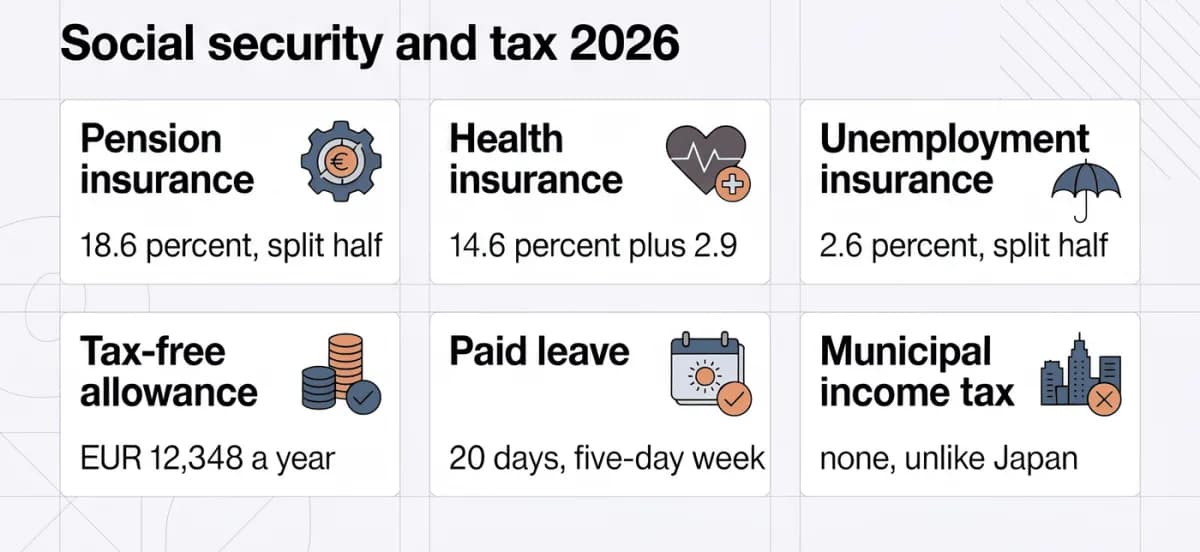
Most employees pay social contributions through payroll. The 2026 rates and ceilings:
| Insurance | Rate | Who pays | Monthly ceiling (2026) |
|---|---|---|---|
| Pension | 18.6% | Half each (9.3%) | EUR 8,450 (about US$9,440 / JPY 1.48 million) |
| Unemployment | 2.6% | Half each | EUR 8,450 |
| Health, general rate | 14.6% | Half each (7.3%) | EUR 5,812.50 (about US$6,490 / JPY 1.02 million) |
| Health, average additional contribution | 2.9% | Split equally; each fund sets its own | EUR 5,812.50 |
| Long-term care | 3.6% (childless: 4.2%) | Split equally; the 0.6-point surcharge for childless people is paid by the employee alone | EUR 5,812.50 |
The annual ceilings are EUR 101,400 for pension and unemployment (about US$113,280 / JPY 17.81 million) and EUR 69,750 for health and care (about US$77,930 / JPY 12.25 million). The mandatory-insurance income limit (Versicherungspflichtgrenze) is EUR 77,400 a year (EUR 6,450 a month, about US$7,210 / JPY 1.13 million), and the reference figure (Bezugsgröße) is EUR 3,955 a month. Saxony splits care contributions differently, with the employee paying more.[^92][^93][^94]
- Pension. The retirement age is 66 years and 4 months for people born in 1960, rising to 67 from the 1964 cohort (§ 235 SGB VI).[^95] A refund of contributions (§ 210 SGB VI) is possible only if you are not compulsorily insured and have no right to voluntary insurance, 24 calendar months after leaving the system, and only the employee's share is refunded. EU/EEA nationals normally have the voluntary right and are excluded; bilateral agreements can change this, and Japanese eligibility is unconfirmed, so ask the pension insurer. The Aktivrente exempts up to EUR 24,000 a year (EUR 2,000 a month, about US$2,230 / JPY 351,000) of wage income from tax for employees past the statutory retirement age (§ 3 no. 21 EStG).[^96][^97]
- Unemployment benefit (Arbeitslosengeld I). 60% of reference pay, or 67% with a child; you need 12 months of insured work in the previous 30 months, and the duration runs from 6 to 24 months depending on insured time and age (§§ 142, 143, 147, 149 SGB III).[^98]
- Basic support. The Grundsicherungsgeld replaced the Bürgergeld on 1 July 2026 under the Thirteenth Act amending SGB II (BGBl. 2026 I Nr. 107). In October 2026, 3,659,000 people received Grundsicherung for jobseekers and 1,065,000 received ALG I. Claims for basic support can affect residence permits, so ask your Ausländerbehörde first.[^99][^45]
- Family benefits. Kindergeld is EUR 259 a month per child (about US$289 / JPY 45,500) in 2026. Elterngeld is between EUR 300 and EUR 1,800 a month (about US$335 to US$2,010 / JPY 52,700 to JPY 316,000), with no claim above an income of EUR 175,000.[^100][^101]
- Japan agreement. The Japan-Germany agreement covers pensions only and has been in force since 1 February 2000 (see above).[^75]
First weeks: registration, tax ID, health fund and bank account
Register your address within two weeks of moving in (§ 17(1) BMG); your landlord must confirm the move-in (§ 19 BMG).[^102][^103] Your tax identification number (Steuer-ID) is an 11-digit permanent number that you receive by letter; it does not decide your tax class, which depends on your family situation (§ 38b EStG).[^104][^105] Your social security number (SV-Nummer) is assigned by the Datenstelle der Rentenversicherung after your employer registers you, not by your health insurer, and the proof is free.[^106] You choose a statutory health fund (Krankenkasse), which sets its own additional contribution. Every consumer with lawful residence in the EU has a right to a basic payment account (Basiskonto), and the bank must offer the contract within ten business days of a complete application (§ 31 ZKG).[^107] Keep your Steuer-ID and SV-Nummer off the CV and give them to a verified employer only when you onboard.
What this means for a job seeker: compare salaries on gross pay and expect roughly your half of the contributions above to come out of it; the employer pays the matching half on top. If you move between Japan and Germany, keep your insurance records.
Taxes on employees
Germany taxes wages through payroll withholding (Lohnsteuer). The figures below are for 2026 under § 32a of the Income Tax Act (EStG):[^108]
| Item | 2026 value | In US$ / JPY |
|---|---|---|
| Basic allowance (Grundfreibetrag) | EUR 12,348 | about US$13,800 / JPY 2.17 million |
| Rising rate 14% to 24% | Taxable income EUR 12,349 to EUR 17,799 | |
| Rising rate 24% to 42% | EUR 17,800 to EUR 69,878 | |
| Rate 42% | From EUR 69,879 to EUR 277,825 | from about US$78,070 / JPY 12.28 million |
| Rate 45% | From EUR 277,826 | from about US$310,400 / JPY 48.8 million |
| Employee lump sum (Arbeitnehmer-Pauschbetrag) | EUR 1,230 | about US$1,374 / JPY 216,000 |
| Solidarity surcharge | 5.5% of income tax, but only if income tax exceeds EUR 20,350 (single) or EUR 40,700 (joint) | about US$22,740 / JPY 3.58 million; US$45,470 / JPY 7.15 million |
- Tax classes. Employees are placed in Steuerklasse I to VI (§ 38b EStG). The plan to abolish classes III and V is not law: the current text of § 38b still lists them, and press reports name 2030 as a target.[^105]
- Church tax. It applies to members of the churches that levy it, at 8% of income tax in Baden-Württemberg and Bavaria and 9% elsewhere (set by Land law).
- VAT. The standard rate is 19% and the reduced rate 7%. Since 1 January 2026, restaurant and catering services other than drinks are taxed at 7% (§ 12(2) no. 15 UStG); drinks stay at 19%.[^109]
No municipal income tax: Germany vs Japan's 住民税
Japanese readers may expect a bill like the resident tax (住民税, juminzei), which is charged by your municipality on the previous year's income. Germany has no separate local income tax on employees. Your income tax and Solidarity surcharge are withheld by your employer, and the municipalities instead receive a 15% share of the wage tax and assessed income tax collected (the Gemeindeanteil, § 1 GemFinRefG), which is not an extra levy on you.[^110] Local costs show up elsewhere:
- Rundfunkbeitrag. A public-broadcasting fee of EUR 18.36 per dwelling per month (about US$20.51 / JPY 3,225), EUR 55.08 a quarter.[^111]
- Grundsteuer. Property tax on owners, with reformed values applying from 1 January 2025; a landlord may pass it on to tenants as an operating cost under § 556 BGB and the operating costs ordinance.[^112]
- Zweitwohnungsteuer. Many municipalities levy a second-home tax.
What this means for a job seeker: work out net pay from your tax class, the contribution rates above and, if you are a church member, church tax, not from the gross salary in the advert.
Where to find jobs, recruitment agencies and job scams
Where to search. The BA Jobbörse is the public employment service's national vacancy database, and the BA's ZAV helps with international placement. EURES covers EEA-wide search, Interamt lists public-sector posts, and XING, Arbeitnow and Berlin Startup Jobs loaded when we tested them. The BA's Entgeltatlas shows typical pay by occupation.[^113] JAC Recruitment Germany, a Japanese-language recruiter, lists offices in Düsseldorf, Frankfurt and Munich.[^114] Our Germany job-board guide compares the channels in full.
Recruitment and temporary agencies. Under the Temporary Agency Work Act (AÜG), a worker may be assigned to the same user company for at most 18 consecutive months (§ 1(1b)), and a collective agreement may deviate from equal pay only for the first nine months, or longer only with a stepped rise to equivalent pay after 15 months (§ 8(4)).[^115] A private placement agency may charge a job seeker only under a written contract, only after a successful placement, and never in advance (§ 296 SGB III); the total may not exceed EUR 2,000 (about US$2,230 / JPY 351,000).[^116]
Scams. Never pay for a job, a permit or a placement. The police's crime-prevention site, the consumer advice centres (Verbraucherzentrale) and the Fair Mobility advice network publish warnings. Offers that ask you to receive and forward money for someone else are a classic money-mule scheme and can be criminal (money laundering); the police page on Finanzagenten explains it.[^117] Check the company name, address and imprint against its own career page, and never send passport scans, a tax ID or bank details before a contract exists.
Final checks before you apply
- [ ] The CV is a table, latest entry first, about two A4 pages, in the language of the advert.
- [ ] I decided about the photo (customary, not required) and about date of birth and nationality (customary, my choice).
- [ ] If I need a permit, my residence status is a separate, truthful line.
- [ ] The Anschreiben is one A4 page, names the job and does not repeat the CV.
- [ ] I attach copies in one PDF within the size the advert allows, and I know the minimum wage (EUR 13.90 in 2026) and whether a sector floor applies.
- [ ] For a non-EU permit, my gross pay meets the threshold of my route (EUR 50,700 for the Blue Card).
- [ ] I will get written terms of employment and I know my probation, notice and leave.
- [ ] I can ask for a qualified Arbeitszeugnis when the job ends.
- [ ] No one has asked me for a fee for a job or a permit.
FAQ
What is the standard German CV format?
There is no legal template. A tabular, reverse-chronological Lebenslauf of ideally two A4 pages at most, with a single-page Anschreiben, is the norm described by the state portal Make it in Rheinland-Pfalz.
Should a German CV include a photo?
A professional photo is customary but not required. The AGG lists protected grounds and contains no photo requirement, so leaving it out is lawful.
Do I have to give my date of birth, nationality or marital status?
Date of birth and nationality are normal CV content in Germany, but because age, ethnic origin and religion are protected grounds, including them is your choice. Employers may not ask about pregnancy, and you may answer unlawful questions untruthfully without consequences.
Is there a minimum wage in Germany?
Yes. EUR 13.90 gross per hour from 1 January 2026 (about US$15.53 / JPY 2,442) and EUR 14.60 from 1 January 2027. Some sectors have higher floors, for example EUR 16.52 for care assistants from 1 July 2026.
What salary do I need for the EU Blue Card in 2026?
EUR 50,700 gross a year (about US$56,640 / JPY 8.91 million) in the standard case, and EUR 45,934.20 (about US$51,320 / JPY 8.07 million) for listed shortage occupations, recent graduates and IT specialists without a degree who meet the conditions.
What can I do with the Chancenkarte?
It lets qualified people look for work for up to one year. You need six points, funds of EUR 1,091 a month and basic language skills, and you may work up to 20 hours a week plus trial employment of up to two weeks per job.
Can Japanese citizens work in Germany on a Working Holiday?
Yes, if aged 18 to 30. The scheme has run since 2000 with no annual quota, allows stays of up to 12 months and requires liability insurance for Japanese participants. Japanese nationals may also enter without a visa and apply for a needed title in Germany within 90 days (§ 41 AufenthV).
How long can an employer keep my rejected application?
There is no nationwide fixed rule. Data protection authorities such as Berlin's consider up to six months justifiable because of the two-month claim and three-month court deadlines under the AGG and ArbGG, after which the file should be deleted.
What is in a German Arbeitszeugnis?
A simple Zeugnis states the type and duration of the work; a qualified one also covers performance and conduct (§ 109 GewO). The grade is coded in set phrases: "stets zur vollsten Zufriedenheit" is a 1 and "zur vollen Zufriedenheit" an average 3.
Is there a local income tax like Japan's 住民税?
No. Employees pay no separate municipal income tax; municipalities receive 15% of the wage tax and assessed income tax. The 2026 tax-free allowance is EUR 12,348, the rate reaches 42% from EUR 69,879, and the Solidarity surcharge applies only above EUR 20,350 of income tax for a single person.
How to use AIResume
Keep one master CV in AIResume and cut a German and an English version for each advert: use the advert's keywords, lead with your strongest result and add your residence status as its own line if you need a permit. Leave out your tax ID and social security number, export one PDF and check it with our ATS-friendly CV guide before you apply.
Related AIResume guides
- Germany job-board guide
- Austria job-board guide
- Switzerland CV format guide
- France CV format guide
- Belgium CV format guide
- Netherlands job-board guide
- How to write an ATS-friendly CV
Sources
[^1]: Make it in Rheinland-Pfalz, tips on job applications in Germany
[^2]: ECB, euro foreign exchange reference rates
[^3]: ECB data portal, EUR/USD and EUR/JPY reference rates to 30 October 2026
[^4]: AGG § 1
[^5]: AMS Austria, writing an appealing CV
[^6]: Antidiskriminierungsstelle des Bundes, discrimination in working life
[^7]: Bundesagentur für Arbeit, mail applications (PDF)
[^8]: AGG § 11
[^9]: AGG § 15
[^10]: ArbGG § 61b
[^11]: AGG § 22
[^12]: Antidiskriminierungsstelle des Bundes, what employers may ask
[^13]: IHK Pfalz, employers' right to ask questions in interviews
[^14]: Bundestag, Drucksache 21/7026 (8 July 2026, pay transparency)
[^15]: BDSG § 26
[^16]: Hessian data protection commissioner, guidance on employee data after the CJEU judgment (PDF)
[^18]: Bundesamt für Justiz, Führungszeugnis
[^19]: Bundesamt für Justiz, Digitales Führungszeugnis
[^20]: Bundesamt für Justiz, Führungszeugnis FAQ
[^21]: BZRG § 30a
[^22]: GewO § 109
[^23]: Federal Labour Court, judgment 9 AZR 584/13 (PDF)
[^24]: RIS, ABGB § 1163
[^25]: ch.ch, Arbeitszeugnis
[^26]: NachwG § 2
[^27]: BGB § 622
[^28]: TzBfG § 15
[^29]: Anerkennung in Deutschland, recognition finder
[^30]: ZAB, fees for Zeugnisbewertung
[^31]: ZAB, application and processing
[^32]: ZAB, EU Blue Card
[^33]: anabin database
[^34]: MOFA, Apostille and official-seal confirmation (page22_000548)
[^35]: Tokyo Metropolitan Police Department, criminal record certificate for use abroad
[^36]: Fifth Minimum Wage Adjustment Regulation (MiLoV5)
[^37]: SGB IV § 8 (minijob and midijob limits)
[^38]: BIBB, minimum training pay 2026 (13 October 2025)
[^39]: Zoll, overview of sector minimum wages
[^40]: MiLoG § 22
[^41]: MiLoG § 17
[^42]: Zoll, press release on FKS construction checks 2026
[^43]: MiLoG § 21
[^44]: World Bank, World Development Indicators: Germany (accessed 21 October 2026)
[^45]: Bundesagentur für Arbeit, Monatsbericht Oktober 2026
[^46]: Bundesregierung, Herbstprojektion 2026
[^47]: Destatis, press release on third-quarter GDP (30 October 2026)
[^48]: Destatis, press release on October 2026 consumer prices
[^49]: ECB, key ECB interest rates
[^50]: Destatis, press release on population and foreign nationals (June 2026)
[^51]: AufenthV § 41
[^52]: AufenthG § 18g (EU Blue Card)
[^53]: AufenthG § 18
[^54]: AufenthG § 19c
[^55]: BeschV § 6
[^56]: AufenthG § 20a (Chancenkarte)
[^57]: AufenthG § 20b
[^58]: Bundestag, Drucksache 21/692 (Chancenkarte figures)
[^59]: BeschV § 26
[^60]: AufenthV § 45
[^61]: AufenthV § 47
[^62]: AufenthG § 81a
[^63]: AufenthG § 4a
[^64]: StAG § 10
[^65]: Bundesgesetzblatt 2025 I Nr. 256
[^66]: Bundesregierung, cabinet decision on the Work-and-Stay-Agentur
[^67]: European Commission, main differences between EES and ETIAS (28 April 2026)
[^68]: SGB III § 404
[^69]: SchwarzArbG § 10
[^70]: SchwarzArbG § 11
[^71]: BAMF, Monitoring Bildungs- und Erwerbsmigration, Jahresbericht 2025 (PDF)
[^72]: MOFA, working holiday system
[^73]: Auswärtiges Amt, Working Holiday visa FAQ
[^74]: German Embassy Tokyo, Working Holiday leaflet (PDF)
[^75]: Japan Pension Service, Japan-Germany social security agreement
[^76]: Deloitte Tax News, new double taxation agreement with Japan
[^77]: Bundestag, Drucksache 18/8516 (PDF)
[^78]: MOFA, survey of Japanese nationals overseas, 1 October 2025 (PDF)
[^79]: ArbZG § 3
[^80]: Bundestag, short report hib 260/2026 on working-time reform
[^81]: ArbZG § 4
[^82]: BUrlG § 3
[^83]: EntgFG § 3
[^84]: SGB V § 47
[^85]: TzBfG § 14
[^86]: KSchG § 23
[^87]: KSchG § 4
[^88]: BetrVG § 1
[^89]: MuSchG § 3
[^90]: MuSchG § 17
[^91]: Bavarian State Ministry of the Interior, public holidays
[^92]: Deutsche Rentenversicherung, social-insurance values for 2026
[^93]: SGB III § 341
[^94]: Federal Ministry of Health, long-term care financing
[^95]: SGB VI § 235
[^96]: SGB VI § 210
[^97]: EStG § 3
[^98]: SGB III § 147
[^99]: Bundesgesetzblatt 2026 I Nr. 107
[^100]: EStG § 66
[^101]: BEEG § 2
[^102]: BMG § 17
[^103]: BMG § 19
[^104]: Bundeszentralamt für Steuern, tax identification number
[^105]: EStG § 38b
[^106]: Deutsche Rentenversicherung, social security card
[^107]: ZKG § 31
[^108]: EStG § 32a
[^109]: UStG § 12
[^110]: GemFinRefG § 1
[^111]: Rundfunkbeitrag
[^112]: BGB § 556
[^113]: Bundesagentur für Arbeit, Jobsuche
[^114]: JAC Recruitment Germany
[^115]: AÜG § 8
[^116]: SGB III § 296
Your next step
- DeelFor employers hiring across borders: contracts, payroll and visas handled.See how Deel works
Affiliate links: we may earn a commission at no cost to you. Affiliate link