
Belgium CV Format 2026: Official Regional Advice Compared
Build a Belgium CV using official VDAB, Actiris, Le Forem and Arbeitsamt guidance on length, photo, personal data, language, PDF and public jobs.

The safest Belgium CV format is a clear, vacancy-specific document of one or two A4 pages, normally with your most recent experience first. Use the language of the vacancy, describe language ability precisely, and send a PDF when you apply by email unless the employer or portal asks for another format.
There is no single statutory “Belgian CV template.” Belgium's public employment services publish different advice—especially about photos and personal details. This guide compares the current guidance from VDAB (Flanders), Actiris (Brussels), Le Forem (Wallonia) and the Arbeitsamt of the German-speaking Community, then separates it from privacy law, private-market practice and federal recruitment rules.
Editorial boundary: This is application guidance, not legal advice. A live vacancy and its application portal take priority. We cite a rule as law only where a Belgian authority says it is a legal or regulatory requirement.
The 60-second Belgium CV setup
| Decision | Practical default | Why this is a defensible starting point |
|---|---|---|
| Length | 1 page for a concise early-career profile; up to 2 pages when relevant evidence needs it | VDAB recommends 1–2 pages; Actiris caps its guidance at 2 pages; the German-speaking Arbeitsamt says ideally 1, at most 2 when page two matters. |
| Order | Reverse chronological | VDAB begins with the latest job; Actiris recommends the *antéchronologique* format when recent experience is the strongest evidence. |
| Photo | Omit by default; add only when requested or when you make a considered choice | Actiris advises against a photo unless requested. VDAB, Le Forem and Arbeitsamt describe it as optional, not mandatory. |
| Personal data | Name, professional email, phone and useful location/contact details | Belgium's Data Protection Authority says employers should collect only data strictly necessary for selection. |
| Language | Match the vacancy or portal; do not infer it from geography alone | Belgium has Dutch, French and German as official languages, but a specific employer controls its application language. Federal portals may reject information entered in the wrong language. |
| Language level | Use CEFR (A1–C2) or a precise, defensible description | The German-speaking Arbeitsamt recommends precise reporting and points candidates to CEFR; Europass provides the official self-assessment grid. |
| File | PDF for email; portal-specified format for online applications | VDAB and Actiris recommend PDF to preserve layout. Actiris also notes that PDF or DOCX may be read by recruitment software. |
| Design | Clear headings, simple typography and real text—not an image of text | Regional guidance consistently prioritises clarity. Actiris explicitly warns against complex columns and graphics for ATS use. |
Primary guidance: VDAB, Actiris, Le Forem, Arbeitsamt, and the Belgian Data Protection Authority.
Why official Belgian advice appears to conflict
The regional services are career-guidance bodies, not four versions of one national CV law. Their wording reflects different audiences and application contexts.
| Source | Length | Photo | Personal details | What the source actually establishes |
|---|---|---|---|---|
| VDAB — Flanders | Try to fit 1–2 pages | Add a professional photo if requested or if you choose | Lists name, date of birth, place of residence, phone and email | Practical Flemish job-search guidance; it does not make every listed field legally mandatory. |
| Actiris — Brussels | Maximum 2 A4 pages | Not recommended unless the employer asks | Lists contact information, but separately warns against information that is not useful | Brussels career guidance; its photo advice is explicitly anti-bias oriented. |
| Le Forem — Wallonia | Keep the application tools concise and targeted | Add if requested or if you want to personalise the application | Its April 2026 sample shows contact details including address | Walloon example and guidance, not a national legal template. |
| Arbeitsamt — German-speaking Community | Ideally 1 page; no more than 2 if page two is important | A quality photo may be included; it is not compulsory in Belgium | Says birth details, marital status and nationality are not obligatory where they could be disadvantageous | German-language application guidance expressly written for applications in Belgium. |
This comparison leads to a more useful rule than “Belgian CVs always include a photo” or “photos are forbidden”: a photo is not a general requirement. If a vacancy does not request one, leaving it out is the lower-data, lower-bias default. If you include one, use a current professional image and understand that regional guidance differs. Actiris' CV evaluation page explains its reason: a photo can introduce subjective discrimination.
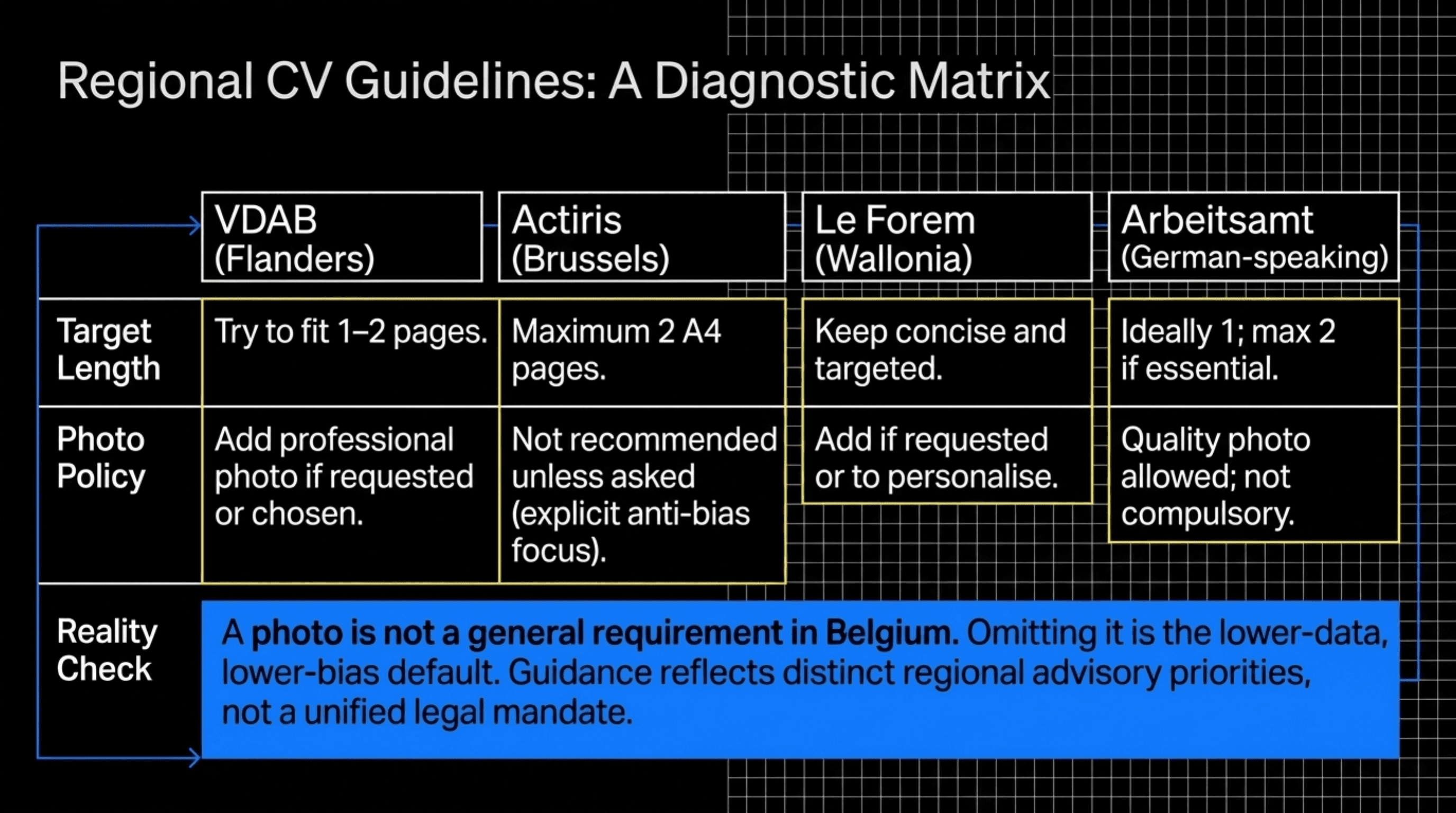
*Visual summary based on the four regional sources linked in the table above. These are guidance differences, not four legal regimes.*
What personal information should you put on a Belgium CV?
Start with information that lets the employer identify and contact you:
- full name;
- professional email address;
- telephone number with country code if applying from abroad;
- city or current location when it affects availability or commuting;
- a relevant professional profile or portfolio link.
Treat date of birth, place of birth, nationality, marital status, health, religion, political views, union membership and similar details as a separate decision—not as a standard header checklist.
Belgium's Data Protection Authority says recruitment questions may relate only to the nature and conditions of the role and that only personal data strictly necessary for selection may be collected. It identifies health, political opinion, religious or philosophical belief, trade-union membership and sexual life among sensitive categories whose processing is generally prohibited, subject to limited exceptions. It also says a current address can be relevant while a history of private addresses is not. Read the regulator's recruitment guidance.
That rule governs employers' collection and processing; it does not turn every voluntary CV field into an offence. The practical lesson for an applicant is data minimisation: do not volunteer information that does not help assess you for the role. If a regulated job, security-sensitive position or public portal requires a field, follow the stated process and provide it through the designated channel rather than decorating the CV with extra identifiers.
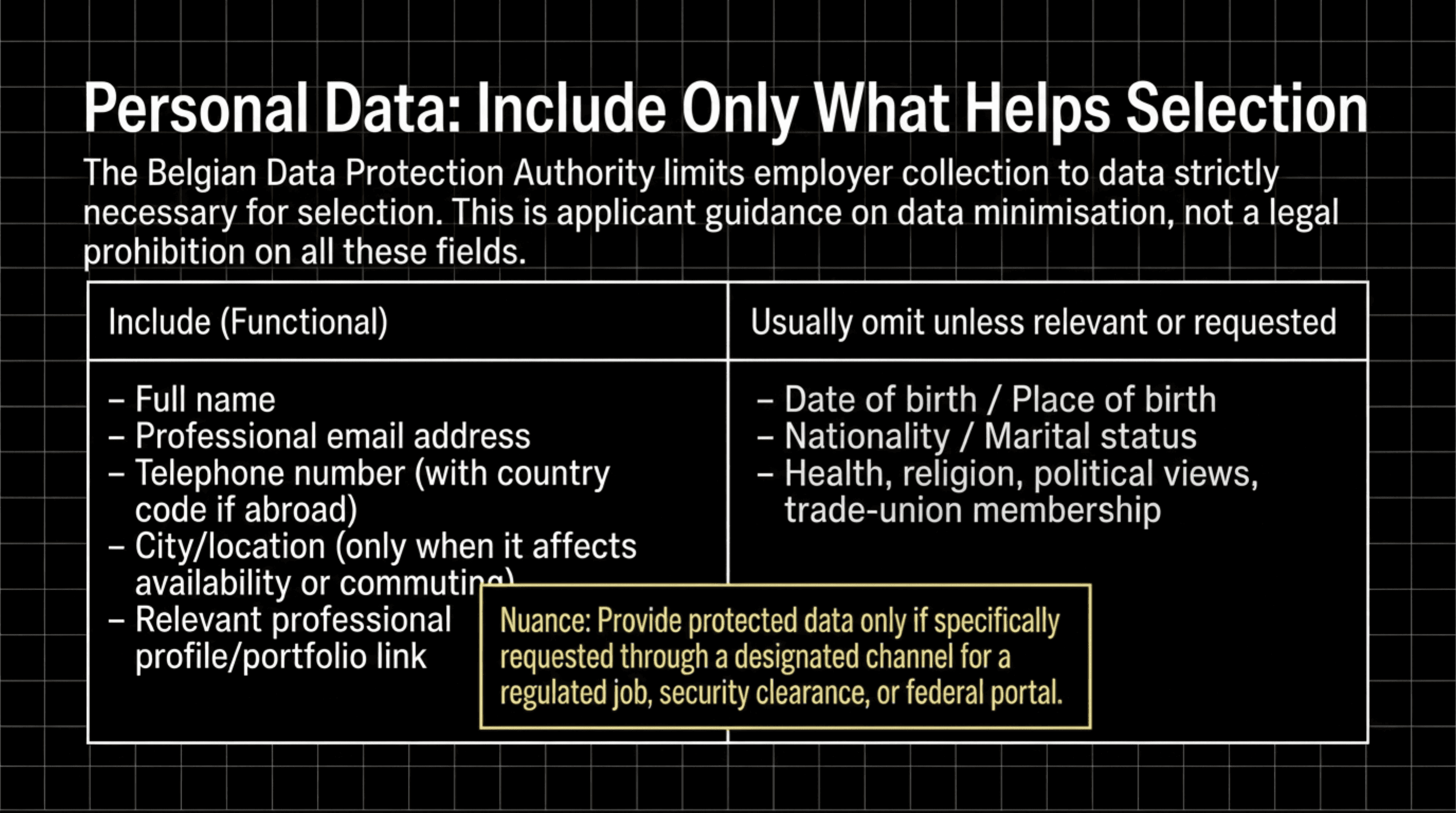
*Applicant guidance derived from the Belgian Data Protection Authority boundary above; it is not a claim that every omitted field is illegal.*
References are a consent decision, not filler
The same regulator says candidate data should normally be obtained from the candidate. An employer seeking information from third parties must inform the candidate and address consent requirements. It also notes that naming a reference in a CV can serve as the candidate's consent to contact that person. Ask the referee first; otherwise write “references available on request” or omit the section until requested.
Which language should your Belgium CV use?
Belgium has three official languages: Dutch, French and German. That constitutional fact does not tell you which language a private employer wants. Use this order of evidence:
- the language explicitly required in the vacancy or portal;
- the language used for the vacancy and recruiter communication;
- the employer's instruction when the first two are ambiguous;
- only then, regional context.
An English vacancy from an international employer can justify an English CV. A Dutch or French vacancy that asks for applications in that language should receive that language. Do not send two language versions unless the employer asks; duplicates can create inconsistent dates, skill levels or wording.
For federal jobs, language is procedural rather than cosmetic. A Workingfor.be vacancy can require candidates to complete online work-experience fields in the selection language and may say that other-language entries will not be screened. Some roles require a language test when the diploma language differs. This is why a generic “English works in Brussels” rule is unsafe. Check the exact vacancy and the federal recruitment process.
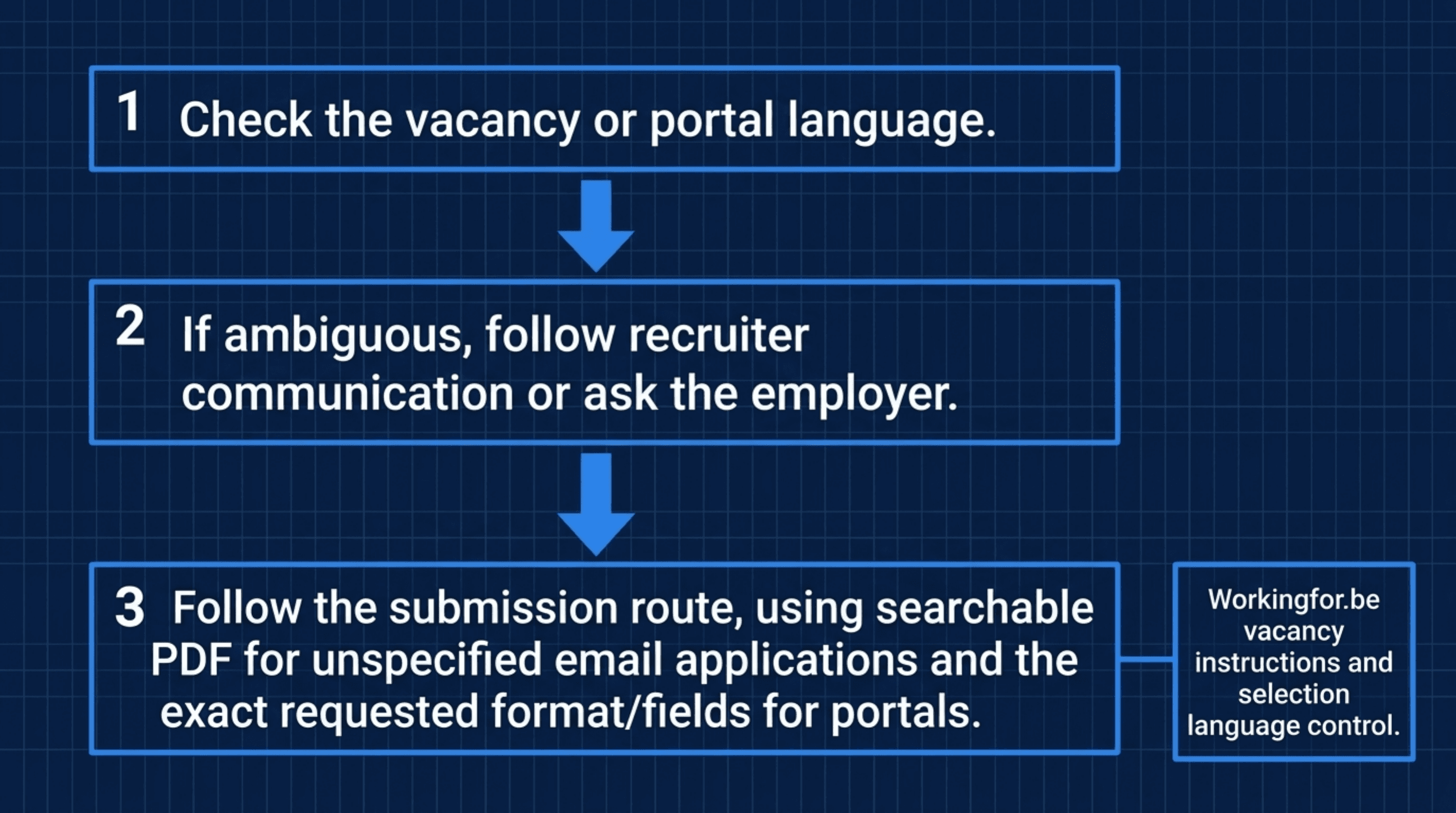
*The vacancy or portal comes first; recruiter communication and regional context are secondary evidence.*
Report language ability so it can be tested
Avoid bars, stars and “fluent” without context. Use CEFR where you can assess it honestly:
Dutch — B2 speaking, B2 reading, B1 writing (self-assessed)
Europass explains that CEFR self-assessment covers listening, reading, spoken interaction, spoken production and writing. A single level can hide an important difference, so split the skills when the vacancy depends on them. Keep certificates separate and never imply that self-assessment is formal certification. Europass CEFR guidance.
Structure: make every section answer a hiring question
1. Header and target
Give contact details, then name the role or professional direction. Actiris recommends making the professional objective visible at first glance; VDAB recommends putting your strongest relevant asset immediately after contact details.
2. Profile: three to five lines
Use the profile to connect your evidence to the target, not to list adjectives.
Weak: “Dynamic team player looking for a challenging opportunity.”
Stronger: “Customer-operations coordinator with four years in B2B SaaS onboarding. Handles Dutch-, French- and English-language cases and turns repeated support issues into documented workflows.”
3. Experience in reverse chronology
For each relevant role, include title, employer, location, dates and two to five evidence bullets. VDAB asks for function, tasks, employer and period, starting with the latest job. Actiris recommends reverse chronology where recent experience best supports the objective.
Build a bullet from four parts:
action + object + operating context + verifiable result or scope
“Resolved onboarding cases” is a duty. “Resolved an average of 38 weekly onboarding cases across email and chat; documented recurring issues for monthly product review” is assessable evidence—provided the number is true and you can explain its source.
4. Education and qualifications
List the most relevant qualification, institution, country and completion year. Do not translate a foreign award into a Belgian degree title unless an authority has granted that equivalence. If recognition matters, name the original award and add the recognition decision or status separately.
Belgium.be directs people with foreign qualifications to the competent Community and NARIC services. It does not say every private-sector applicant needs recognition before applying; requirements vary by qualification, profession and use. Start with the official diploma-equivalence overview. For regulated healthcare professions, for example, the federal process has specific recognition, visa and language-evidence steps. FPS Public Health is the relevant authority, not a CV blog.
5. Skills and languages with evidence
Group tools, methods and languages so they can be scanned. VDAB recommends substantiating skills with examples. Replace “Excel — expert” with the work you actually performed: “Excel — monthly reconciliation using pivot tables and lookup formulas.”
PDF, DOCX and ATS: follow the submission route
For an emailed application, VDAB recommends converting the CV and letter to PDF so the layout does not change. Actiris also advises saving the CV as PDF, while its ATS guidance says both PDF and DOCX are widely compatible and warns against non-standard formats, multiple columns and complex graphics. Those statements are compatible: PDF is a strong email default, but the receiving system's instruction is decisive.
Use this rule:
- Email with no format specified: searchable PDF with a clear filename such as `Noor_Janssens_CV.pdf`.
- Portal specifies DOCX, PDF or a size limit: obey it exactly.
- Portal asks you to type work history: complete the fields; do not assume the uploaded CV replaces them.
- Design-heavy portfolio role: keep a readable CV and link a separate portfolio unless the vacancy asks for another package.
Before submission, copy text from the final PDF into a plain-text window. If headings, dates and bullets disappear or read out of order, an ATS or screen reader may face the same problem. See our ATS-friendly CV guide for the technical checklist.
Private-sector CV versus federal online CV
| Application route | What is screened | Candidate action |
|---|---|---|
| Private employer by email | The files and message requested in the vacancy | Send the requested CV/letter format; keep the CV concise and targeted. |
| Private employer portal | Uploaded file plus any required portal fields | Complete both; confirm dates, titles and language levels match. |
| VDAB/Actiris/Le Forem profile | Structured profile data used for services such as matching, publication or application tracking | Keep the profile current and consistent with the submitted CV. |
| Workingfor.be federal selection | The online CV and documents present at the vacancy deadline, according to that notice | Enter experience in the required language and detail; upload required diploma evidence; do not rely on a later correction. |
Federal vacancies can screen exact experience duration, tasks and diploma evidence from structured fields. This is not proof that all Belgian employers prefer a federal-style online CV. It is a separate selection contract. Read each vacancy's admissibility conditions and deadline literally.
Annotated fictional Belgium CV
The sample below is entirely fictional. The person, employers, contact details and numbers do not identify a real individual or organisation.
Noor Janssens
Brussels · +32 470 00 00 00 · [email protected] · linkedin.com/in/noor-janssens-example
Customer Operations Coordinator · B2B SaaS onboarding
Profile
Customer-operations coordinator with four years of experience handling B2B onboarding and support workflows. Works across Dutch, French and English and translates recurring customer issues into product-ready documentation.
Experience
Customer Support Specialist — ExampleCloud SRL, Brussels · 2023–2026
- Resolved an average of 38 weekly onboarding cases across email and chat; categorised recurring issues for monthly product review.
- Rewrote 12 help-centre articles with product and sales colleagues; recorded the change in the fictional team's editorial log.
- Prepared concise escalation notes for technical cases, including reproduction steps, account context and customer impact.
Support Assistant — Northstar Services SA, Brussels · 2022–2023
- Maintained the knowledge-base change log and summarised weekly case themes for the team lead.
- Coordinated customer follow-ups after hand-offs between support and sales.
Education
Professional Bachelor in Office Management — Example Institute, Belgium · 2022
Languages
Dutch — B2 professional use · French — B2 professional use · English — C1 professional use *(fictional self-assessment)*
Tools
CRM case management · help-centre publishing · spreadsheet reporting
| Annotation | Why it matters |
|---|---|
| Role-specific heading | Makes the target clear without claiming a protected title or invented credential. |
| Profile grounded in work | Replaces generic adjectives with experience, operating context and languages. |
| Reverse chronology | Matches the most consistent regional guidance. |
| Evidence bullets | Shows action and scope; real applicants must replace every fictional figure with verifiable evidence. |
| CEFR-labelled languages | More precise than progress bars; “self-assessed” avoids presenting a certificate that does not exist. |
| Minimal personal data | Provides contactability without age, marital status, nationality, ID number or a photo. |
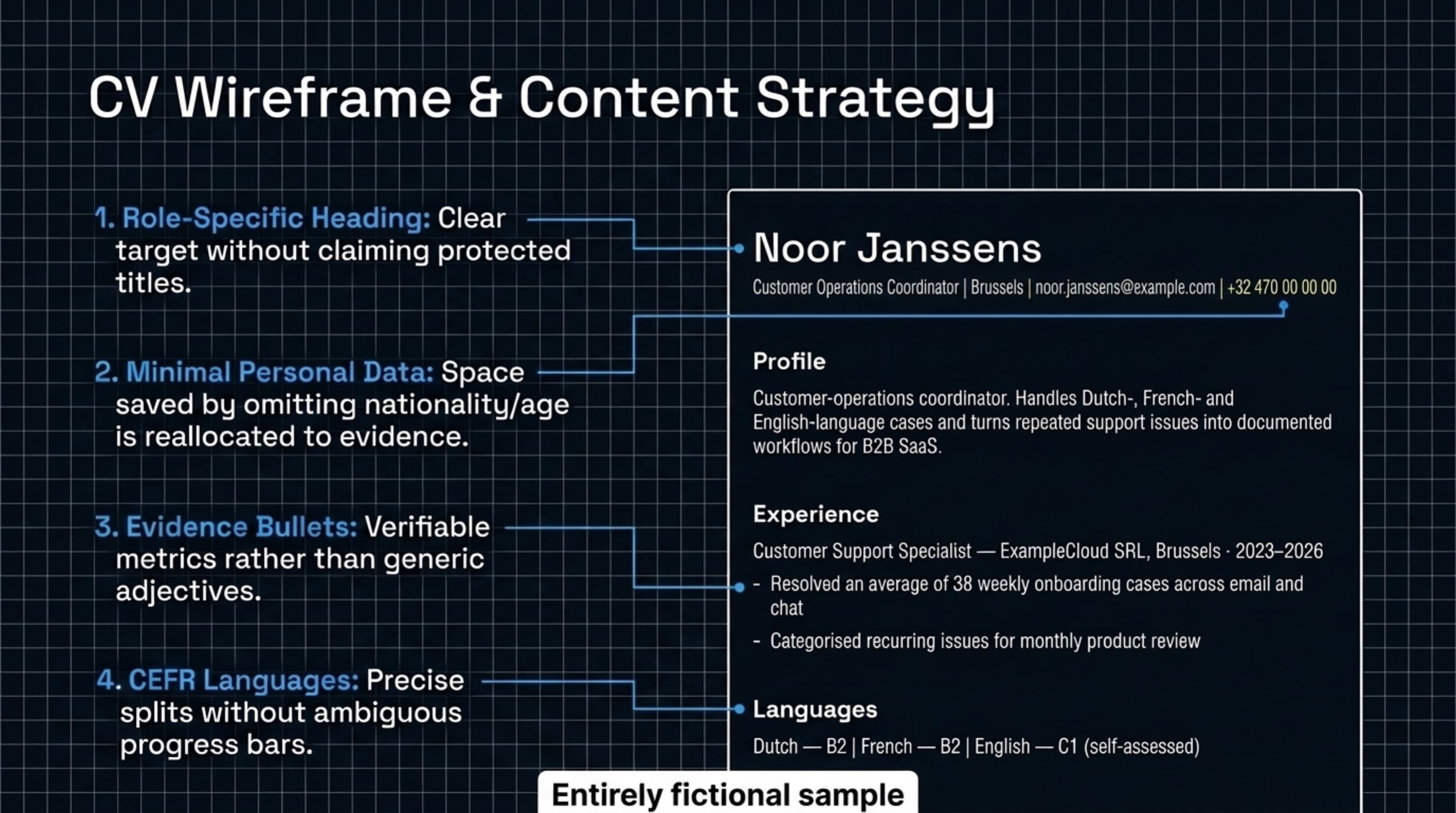
*The sample person, contact details, employer and metrics are entirely fictional.*
A five-step vacancy evidence check
Actiris advises applicants to compare the organisation, function, candidate profile and working conditions with their own knowledge, training, experience, skills, personal strengths and motivation. Turn that comparison into a small ledger before editing:
| Vacancy requirement | Your evidence | CV location | Verification |
|---|---|---|---|
| “Coordinate multilingual customer onboarding” | 4 years of onboarding cases in three named languages | Profile + current role | Case records, manager feedback or work sample you may discuss without breaching confidentiality |
| “Document recurring product issues” | 12 help-centre articles and monthly issue categorisation | Current role | Editorial log or portfolio where disclosure is permitted |
| “Advanced Excel” | Pivot-table reconciliation used monthly | Skills + relevant bullet | Explain the workflow in interview; do not write “advanced” if you cannot demonstrate it |
| “Professional Dutch and French” | CEFR self-assessment plus actual work use | Languages + relevant bullet | Certificate if you have one; otherwise label self-assessment accurately |
Tailoring means choosing and explaining relevant truth. It does not mean changing employers, dates, qualifications, work authorisation or language ability to resemble the vacancy.
Where Belgium's vacancies were in Q1 2026
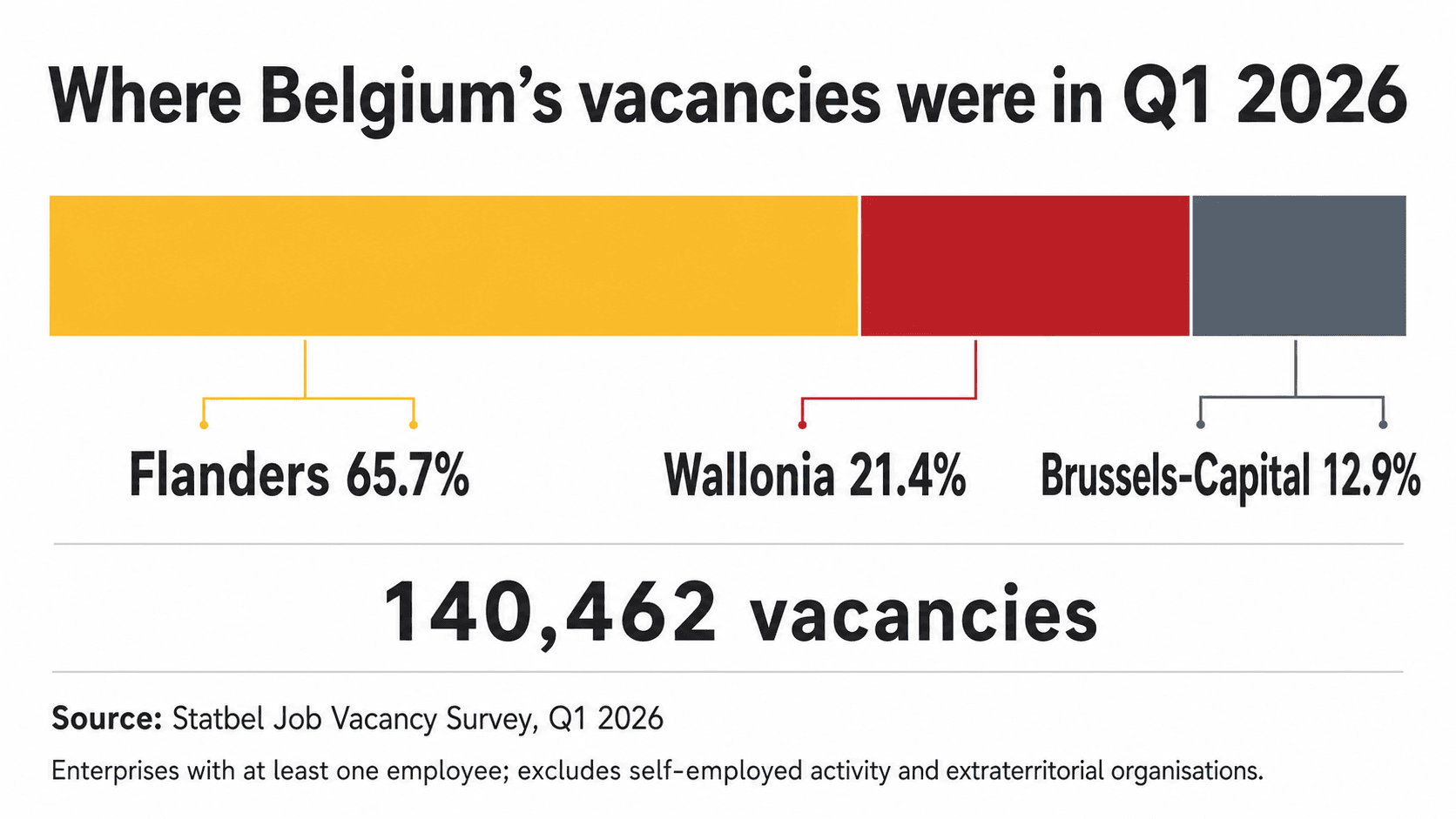
Statbel counted 140,462 vacancies in Belgian enterprises in Q1 2026: 65.73% in Flanders, 21.39% in Wallonia and 12.88% in Brussels-Capital. The survey covers enterprises with at least one employee but excludes households, self-employed activity and extraterritorial organisations such as EU institutions and NATO. The shares describe where surveyed vacancies were located; they do not measure your chance of being hired, remote work, application language or the quality of any regional service. Statbel job-vacancy survey.
Final submission checklist
- Does the language match the vacancy or portal instruction?
- Is the CV one or two pages, with only role-relevant evidence?
- Are recent experience and strongest evidence easy to find?
- Is every date, qualification, language level and result defensible?
- Have you removed sensitive or unnecessary personal details?
- If a photo is requested, is that request clear and is the image professional?
- Does the PDF contain selectable text in a logical reading order?
- Do portal fields match the uploaded CV?
- Have you checked foreign-degree or regulated-profession requirements with the competent authority?
- Have you saved the exact version submitted and the vacancy text?
For a broader workflow, compare CV and LinkedIn alignment, remote-job CV keywords, ATS checker versus resume builder, and CV formats for fresh graduates.
Research method and limits
This article was rebuilt from a Gemini Deep Research dossier and then independently checked against Belgian and EU primary sources by the Airesume editorial workflow. We compared current Dutch, French, German and English guidance rather than translating one region's convention into a national rule. Major job boards and recruiter pages were used only as market context. We do not claim first-hand recruiting experience, legal advice or guaranteed hiring outcomes.
FAQ
What is the standard Belgium CV format?
There is no single statutory national template. A practical default supported across regional guidance is a clear, vacancy-specific CV of one or two A4 pages, usually in reverse chronological order. Follow the live employer or portal instructions when they differ.
Should a Belgium CV include a photo?
A photo is not generally mandatory. Actiris advises against adding one unless the employer requests it; VDAB, Le Forem and the German-speaking Arbeitsamt describe a photo as optional. Omitting it is the lower-data, lower-bias default when the vacancy is silent.
Should I include date of birth, nationality or marital status?
Do not assume these are standard requirements. Regional examples differ, while Belgium's Data Protection Authority says employers should collect only data strictly necessary for selection. Add a field only when the vacancy, portal or a legitimate role-specific process requires it; do not include sensitive data merely because an old template contains a box for it.
Which language should I use for a Belgium CV?
Use the language requested in the vacancy or application portal. If none is stated, use the vacancy and recruiter communication as evidence, then ask the employer if ambiguity remains. Belgium's three official languages do not create one automatic language rule for every private employer.
Is one page or two pages better?
One page is useful when it contains all relevant evidence without compression. Two pages are acceptable when experience, education or skills genuinely need the space. VDAB recommends 1–2 pages, Actiris says no more than 2, and the German-speaking Arbeitsamt says ideally 1 and at most 2 when the second page is important.
Should I send PDF or DOCX?
For email, PDF is the strongest default in VDAB and Actiris guidance because it preserves layout. For a portal, use the format it specifies. Actiris' ATS guidance recognises both PDF and DOCX but warns against complex layouts and non-standard files.
Do I need a cover letter?
Only when the vacancy or portal requests one, or when a concise letter adds evidence the CV cannot show—such as a specific motivation, relocation context or career change. Regional services publish cover-letter guidance, but that does not make a letter mandatory for every Belgian application.
Do foreign degrees need Belgian recognition before I apply?
Not in every case. Recognition depends on the qualification, competent Community, profession and intended use. Check Belgium.be and the relevant recognition authority. Regulated professions can have separate procedures; do not present a self-translated degree title as an official Belgian equivalence.