
Switzerland CV Format: Official Guidance and Example
Build a Switzerland-ready CV using SECO, privacy and qualification guidance: format, photo, personal details, languages, permits and a fictional example.

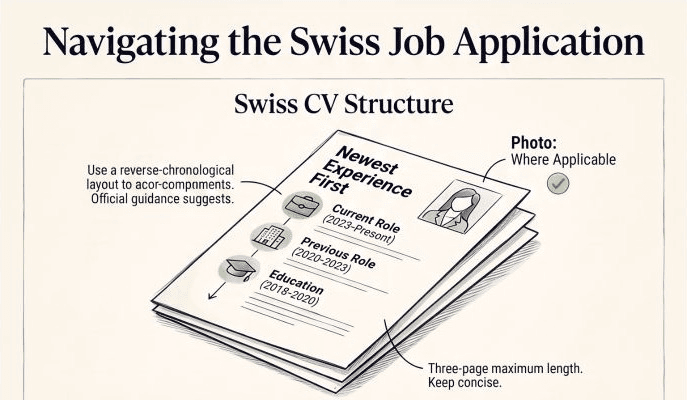
A practical Switzerland CV is complete, easy to scan and ordered with the newest experience first. Switzerland's federal employment portal says the CV is the core of the application dossier, should not exceed three pages and normally includes personal details, experience, education, languages and relevant additional knowledge.[^1] That is public-employment guidance—not a law creating one compulsory Swiss template.
For most private-sector applications, start with one or two focused pages when that is enough to prove fit. Use a third page only when relevant senior, technical or academic evidence genuinely needs the space. Follow the vacancy and application portal whenever they specify a language, document set or file type.
This article is editorial guidance, not legal advice and not a promise of interviews. The sources were reviewed in German and English; claims from apprenticeship guidance are labelled so they are not broadened into adult-hiring rules.
Switzerland CV format at a glance
| Decision | Evidence-based default | Important boundary |
|---|---|---|
| Length | Keep it as short as the evidence allows; SECO sets an upper guidance limit of three pages | “Maximum three pages” is not a reason to fill three pages.[^1] |
| Order | Reverse chronological: most recent role or education first | Keep dates visible even if you add a skills summary.[^1] |
| Photo | Optional unless the vacancy or trusted portal requires it | SECO says personal data may include a photo “where applicable”; it does not make photos mandatory.[^1] |
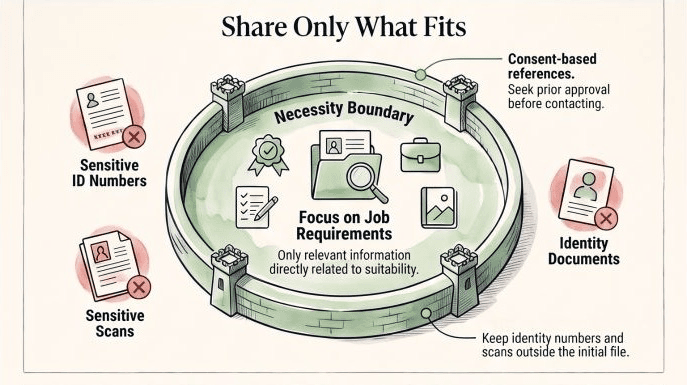
| Personal details | Name, professional contact details and useful location context | Add only information relevant to suitability or the application route; avoid identity numbers and document scans in a general CV.[^3] |
| Language | Use the vacancy language when possible and state levels honestly | Switzerland is multilingual; geography alone does not prove the employer's preferred application language.[^2] |
| Work status | State a concise, truthful status only when it helps the employer assess the application | A permit is not automatically a universal CV field. The official process varies by nationality and route.[^2] |
| References | “Available on request” is a safe default unless the advert requests names | Employers need consent before seeking information from third parties.[^3] |
| Certificates | Prepare relevant employment certificates, diplomas and credentials | Follow the portal's upload instructions; do not attach every document by default.[^1] |
| File format | Use the requested format; otherwise a tested PDF is a strong email default | SECO recommends PDF files, but a structured portal may require separate fields.[^1] |
What is actually “Swiss” about the CV?
The useful distinction is not a decorative national template. It is the combination of a documented application dossier, reverse chronology, multilingual context, employment certificates and a clear boundary between useful candidate information and unnecessary personal data.
SECO describes a typical dossier as a motivation letter, CV, employment certificates, diplomas and certificates.[^1] The same page says the CV should be complete and clearly arranged. “Complete” does not mean disclosing every personal fact. It means that the reader can understand your relevant education and work history without unexplained contradictions.
Recommended section order
- Name, professional contact details and location context.
- Target role or two-line professional profile.
- Relevant skills and languages.
- Work experience, newest first.
- Education and role-relevant training.
- Certifications, selected projects or publications where useful.
- References on request, unless the vacancy asks for named referees.
Use the employer's vocabulary only when it truthfully matches your experience. Tailoring a CV to a job description means selecting and ordering real evidence—not copying qualifications you do not have.
Photo and personal information: separate convention from necessity
Official sources do not support a universal statement that every Swiss CV must include a photograph. SECO lists personal data “where applicable with an application photo”.[^1] An SDBB page gives detailed photo and personal-data instructions, but it is written for apprenticeship applications and school-age candidates.[^4] It should not be presented as a nationwide rule for every adult applicant.
The safer decision process is:
- If the vacancy or verified portal explicitly requests a photo, decide whether to follow that instruction and use a current professional image.
- If it does not, the CV can focus on job evidence. Do not claim that including or omitting a photo guarantees fair evaluation.
- Do not include passport, national ID, social-security, bank or full document numbers in a general CV.
- Do not attach identity scans to an unknown contact. SECO's EURES guidance warns jobseekers not to send personal documents to unknown contacts or pay administrative advances.[^2]
The Swiss data-protection authority says employers may request information that shows whether a candidate fits the company and meets a position's requirements. It also gives examples of questions that require a role-specific reason.[^3] That supports a necessity boundary; it does not create a candidate-side checklist of information that is always illegal to mention.
Language choice and language levels
Switzerland has German, French, Italian and Romansh national-language contexts, plus many roles advertised in English. Use the vacancy language as the working default. If the advert is bilingual, choose the version that best matches the role and prepare a second accurate version when useful.
Do not translate a job title, degree or licence into a stronger credential. For language levels, use a framework such as CEFR only when you can explain the level. Separate speaking and writing when the job depends on the difference.
| Vacancy signal | CV action | Avoid |
|---|---|---|
| Advert entirely in German, French or Italian | Submit in that language if you can do so accurately | Machine-translated claims you cannot defend in interview |
| English advert with local-language requirement | English CV plus a precise local-language level | “Fluent” without a defensible basis |
| Bilingual advert | Pick the primary working language and keep a second reviewed version | Mixing languages section by section without a reason |
| Public or structured portal | Follow the portal labels and required fields | Assuming an emailed PDF replaces structured fields |
Permit, location and cross-border candidates
Work authorisation matters, but the CV is not the permit application. State only a concise, accurate fact that helps the employer understand your availability—for example, “Based in Basel”, “Cross-border applicant based in Mulhouse”, or a verified permit status. Never imply that an application, nationality or residence automatically creates work permission.
SECO's mobility guidance distinguishes EU/EFTA mobility, Swiss employment, qualification recognition and cross-border permits. It says cross-border workers generally need a cross-border permit, with the application based on an employment contract and identity document.[^2] That sequence matters: a candidate should not convert an administrative rule into a fabricated CV status.
The Federal Statistical Office reported that 58.0% of foreign cross-border commuters in Q2 2025 lived in France.[^5] This explains why location and commute feasibility can be useful context in some vacancies. It does not mean that 58% of Swiss vacancies are open to French residents or that cross-border applicants have a particular hiring probability.
Foreign qualifications and regulated professions
Do not write “Swiss equivalent” beside a foreign degree unless an authorised source supports that wording. Start with the official award name, institution, country and completion year. Add a verified recognition or evaluation only when it exists and is relevant.
SECO directs applicants to `anerkennung.swiss` to check whether a profession requires recognition and which body is competent.[^2] Swiss ENIC provides information about foreign higher-education qualifications, while regulated professions can follow separate authorities and procedures.[^6] Recognition is therefore conditional, not a universal pre-application requirement.
Annotated fictional Switzerland CV
Everything below is fictional: the person, employers, address, contact details and results. Replace every item with truthful evidence.
Léa Martin — Customer Operations Coordinator
Basel, Switzerland · [email protected] · +41 00 000 00 00
French C2 · German B2 · English C1
Annotation: city-level context and defensible language levels are useful; no identity or permit number is shown.
Profile
Customer operations coordinator with four years of experience managing multilingual service cases, maintaining CRM records and improving hand-offs between support and logistics teams.
Annotation: the profile names the target work and evidence themes. It avoids unsupported adjectives such as “world-class”.
Experience
Customer Operations Coordinator — Rhine Example AG, Basel | 2023–present
- Managed 35–45 weekly customer cases in French, German and English, recording owners and next actions in the CRM.
- Built an exception tracker that reduced unresolved hand-off checks from two hours to 50 minutes per week.
- Coordinated support and logistics on recurring delivery-status errors and documented a shared escalation checklist.
Annotation: all figures are fictional. Real metrics need a record, work sample or referee who can verify them.
Service Assistant — Lake Example Association, Lausanne | 2021–2023
- Scheduled appointments, updated service records and prepared a weekly unresolved-case list for the coordinator.
Annotation: one relevant bullet is stronger than a long duty list.
Education
Bachelor of Business Administration — Example University, France, 2021
Annotation: preserve the real award name. Add recognition information only after checking the competent route.
References
Available on request.
Annotation: employers should seek third-party information with the candidate's prior consent; provide names when the vacancy or process requires them.[^3]
Application route comparison
| Route | CV emphasis | Additional evidence | Main risk |
|---|---|---|---|
| Private employer | Vacancy-matched experience, tools and outcomes | Cover letter, certificates or portfolio when requested | Generic CV sent to every role |
| Public employment / RAV process | Current, complete CV and documented applications | Records of applications and responses may be required for benefits administration | Confusing benefit evidence with a private employer's hiring rule[^7] |
| Cross-border application | Location, commute feasibility and truthful status context | Permit process follows the official route | Claiming a permit or eligibility before it exists |
| Regulated profession | Exact qualification and verified recognition status | Competent authority's decision or required documents | Calling a foreign award “equivalent” without evidence |
For a broader cross-border search-channel comparison, see job-board comparison for global candidates. It is a market-research aid; the vacancy and official route remain the authority for this application.
Final checks before submitting
- Does the first half page identify the target role and strongest relevant evidence?
- Are roles and education newest first, with readable dates?
- Is every language level and result defensible?
- Did you remove unnecessary identity numbers and sensitive document scans?
- Did you follow the vacancy's language and file instructions?
- Can text be selected from the PDF, and do links work? See PDF versus DOCX.
- Does the structure keep the most relevant evidence near the top? See how to write an ATS-friendly CV.
- Did you remove generic claims and unverified additions? See common CV mistakes that cost interviews.
- Are requested certificates current, correctly named and placed in the required order?
- Does the submitted version match any structured portal fields?
- Did you save the exact version and application date?
Frequently Asked Questions
How long should a Switzerland CV be?
SECO says a CV should not exceed three pages. Treat that as an upper guidance limit. One or two focused pages are often enough when they contain the relevant evidence; use more space only when the role warrants it.[^1]
Is a photo mandatory on a Swiss CV?
No reviewed official source establishes a universal legal requirement. SECO lists a photo only “where applicable”. A more prescriptive SDBB example is for apprenticeship applicants, so it should not be generalised to every adult role.[^1][^4]
Should I include nationality, date of birth or marital status?
Do not copy every field from a template automatically. Include information only when it is useful and appropriate for the vacancy or verified portal. The FDPIC says employer questions and documents should be tied to suitability and job requirements.[^3]
Should I state my Swiss permit?
A concise, truthful permit or work-status note can help when it is relevant. It is not automatically required in every CV, and you should never include a permit number or claim a status you do not hold. Check the official route for your nationality and application type.[^2]
Which language should I use?
Use the vacancy language when you can do so accurately. For bilingual or English-language roles, follow the employer's instructions and report local-language ability at a level you can defend.
Do I need Swiss recognition for a foreign degree?
Not for every profession or every application. Use `anerkennung.swiss` to check whether the profession is regulated and which authority is responsible. Describe the original qualification accurately unless a verified recognition or evaluation exists.[^2][^6]
Should references appear in the CV?
“Available on request” is a safe default unless the vacancy asks for named referees. Ask each referee before sharing their details; employers also need prior consent before seeking information from third parties.[^3]
Is PDF always the right format?
SECO recommends PDF files for application documents, but the vacancy and portal override the default. Test copy-and-paste, links and file names before uploading.[^1]
Research method
This guide was prepared by reviewing current primary sources from Swiss federal and cantonal authorities, employment services, qualification-recognition bodies and data-protection guidance. Material claims were checked against the cited source, translated claims were narrowed to the source's meaning, and commercial job-board examples were not treated as legal or official evidence. The FSO cross-border figure is context, not a hiring forecast. Guidance can change, so verify the live vacancy and relevant authority before applying. The article's fictional example does not represent a real applicant.