

Norway Job Search in 2026: Job Boards, Pay Without a Minimum Wage, Permits, Labour Law
Norway is a high-wage, highly regulated Nordic labour market with strong unions and a large public sector. Energy, seafood, shipping and maritime industries, health care, ICT and construction are the sectors most readers will meet. International firms often work in English, but outside them Norwegia
By AIResume Editorial Team
Last updated: 21 October 2026
Norway is a high-wage, highly regulated Nordic labour market with strong unions and a large public sector. Energy, seafood, shipping and maritime industries, health care, ICT and construction are the sectors most readers will meet. International firms often work in English, but outside them Norwegian matters, and in health care and the public sector it is usually required.
This guide covers the economy in numbers, where to search, how pay is set when there is no statutory minimum wage (generally applicable agreements, called allmenngjøring), permits for non-EEA nationals, labour law, holidays, social security and income tax, including the municipal share. For other markets, see our guides to job boards in the United Kingdom, Ireland and Switzerland.
Editorial boundary: This is practical job-search guidance, not legal, immigration or tax advice. We only list figures we could read in an official or primary source, and we mark those that come from press reports, search-index excerpts or professional summaries. Confirm details with Nav (the labour and welfare administration), UDI (the Directorate of Immigration), Skatteetaten (the Tax Administration), Arbeidstilsynet (the Labour Inspection Authority), SSB (Statistics Norway), Norges Bank, Lovdata (the legal database) or your employer before you sign.
Before you apply
- SafetyWing Nomad InsuranceHealth insurance that works in your new country from day one.Get a quote
Affiliate links: we may earn a commission at no cost to you. Affiliate link
Norway's economy in numbers
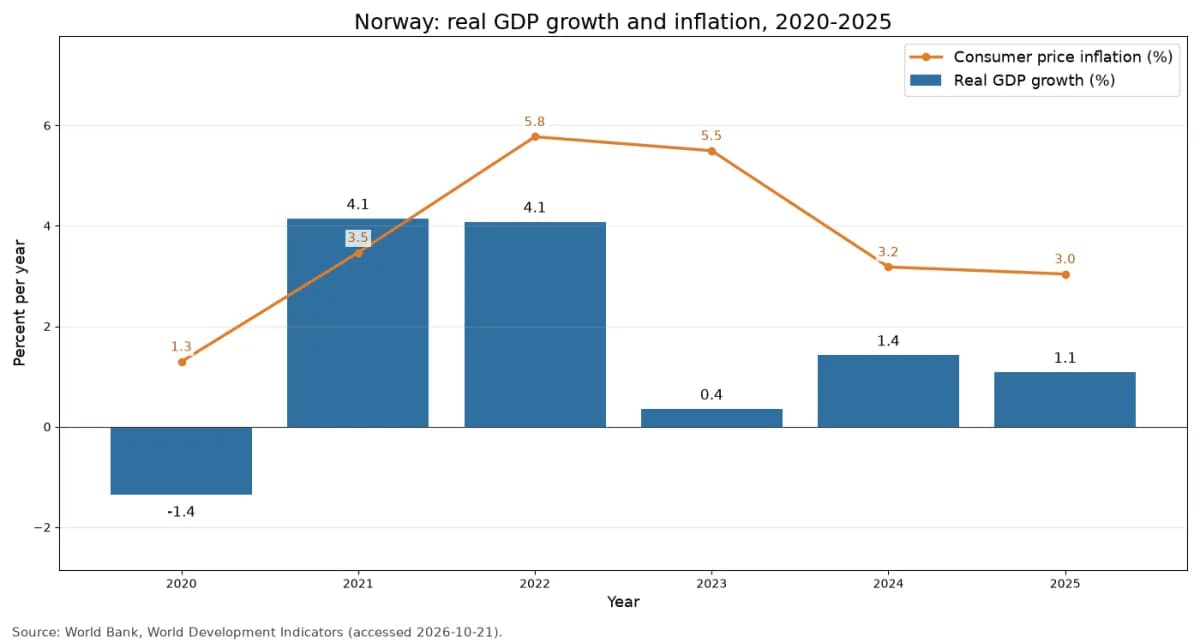
| Indicator | 2020 | 2021 | 2022 | 2023 | 2024 | 2025 |
|---|---|---|---|---|---|---|
| GDP (USD billion) | 382.3 | 521.6 | 617.3 | 502.2 | 500.9 | 530.8 |
| GDP per person (USD) | 71,058 | 96,443 | 113,122 | 90,984 | 89,889 | 94,594 |
| Real GDP growth (%) | -1.4 | 4.1 | 4.1 | 0.4 | 1.4 | 1.1 |
| Inflation (%) | 1.3 | 3.5 | 5.8 | 5.5 | 3.2 | 3.0 |
| Population (million) | 5.38 | 5.41 | 5.46 | 5.52 | 5.57 | 5.61 |
*Source: World Bank, World Development Indicators (accessed 21 October 2026).*[^1]
Labour-market measures:
| Measure | Value | Source |
|---|---|---|
| Registered unemployment, September 2026 | 59,400 fully unemployed, 2.0% of the labour force (22,900 partly unemployed and 12,800 on programmes; 95,200 registered job seekers, 3.2%) | Nav[^2] |
| Unemployment, Labour Force Survey, August 2026 (trend, ages 15 to 74) | 4.5%, or 136,000 people | SSB[^3] |
| Youth unemployment (ages 15 to 24), August 2026 | 13.4% (trend); 13.6% seasonally adjusted | SSB table 13760[^4] |
| Consumer prices, September 2026 | +3.4% over 12 months | SSB[^5] |
| Norges Bank policy rate | 4.50% since 25 September 2026 (raised from 4.25%) | Norges Bank[^6] |
| Population, 1 January 2026 | 5,627,400 | SSB[^7] |
| Immigrants, 1 January 2026 | 987,120 (17.5%), plus 238,507 (4.2%) born in Norway to immigrant parents | SSB[^8] |
| Employed immigrants, Q4 2025 (ages 20 to 66) | 545,068, employment rate 67.5% (non-immigrants 79.5%) | SSB[^9] |
| Non-resident short-term wage earners, Q4 2025 | 88,429 | SSB table 14358[^10] |
The registered rate (Nav) counts people who registered as unemployed and is lower than the survey rate (SSB), which counts everyone who is without work and looking for it. Do not compare the two directly.
What this means for a job seeker: unemployment is low at 4.5% in the survey measure, but it is 13.4% for ages 15 to 24, and 88,429 non-resident workers hold wage jobs, so you compete with a wide regional pool of candidates. The policy rate rose to 4.50% in September 2026, which affects loan costs if you plan to buy a home.
Norway job search in one table
| Channel | What it is | Use it for | Limit |
|---|---|---|---|
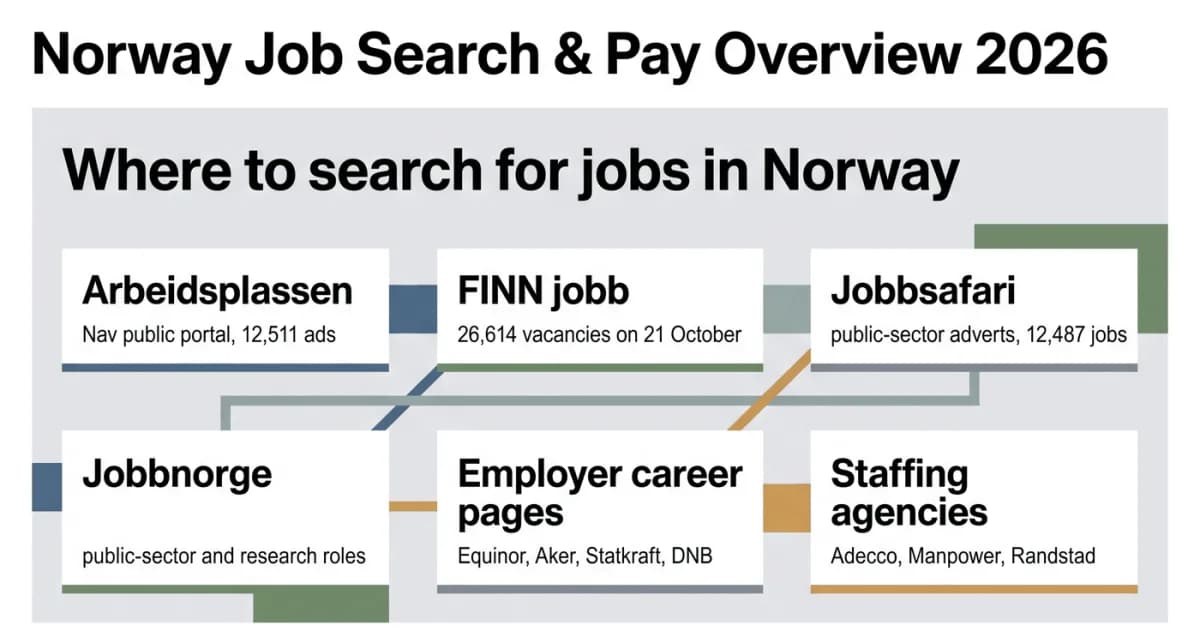
| Arbeidsplassen (Nav) | Nav's public job portal; advertising is free for employers | Public and private vacancies across Norway | On 21 October 2026 the site showed 12,511 ads (25,765 positions)[^11] |
| FINN jobb | Largest commercial job board we checked | Private-sector and public roles | On 21 October 2026: 26,614 vacancies in 13,157 ads[^12] |
| Jobbsafari | Aggregator of public-sector adverts | Municipal and health-trust posts | On 21 October 2026: 12,487 jobs; includes some Finnish places[^13] |
| Jobbnorge | Job portal that loads in a browser | Public-sector and research roles | The page is dynamic and we could not read a count[^14] |
| EURES | EU job portal | EU/EEA-wide search | We did not verify a Norway count. Nav's own EU/EEA page is for people in Norway looking for work abroad, not for foreigners coming to Norway[^15] |
| LinkedIn, Indeed, Karrierestart | International and graduate boards | Alerts, professional and graduate roles | We could not read their listings; no counts |
| Employer career pages: Equinor, Aker Solutions, Aker BP, Statkraft, Kongsberg, Yara, Mowi, Schibsted, DNB | Large employers in energy, industry, seafood, media and banking | Direct applications | We did not count roles |
| Public employers: health trusts Helse Sør-Øst, Helse Vest, Helse Midt-Norge, Helse Nord; municipalities Oslo, Bergen, Trondheim, Stavanger | Homepages only | Hospitals, care, schools | We did not verify their careers pages |
| Agencies: Adecco, Manpower, Randstad, Jobzone, Experis | Staffing and recruitment | Temporary and specialist roles | Never pay a fee (see below) |
Other employers you will meet include Norsk Hydro, Orkla, SalMar, Telenor, Bring, Cognite and Kahoot (homepages only, we could not confirm careers links). Webcruiter is an employer recruitment system (Talentech), not a job board.
What this means for a job seeker: start with Arbeidsplassen and FINN jobb, add Jobbsafari if you want public-sector work, and apply directly to the large employers in your sector. Treat the counts as a snapshot of 21 October 2026, not a trend.
Nav and vacancy notification
Employers must notify vacancies to Nav (arbeidsmarkedsloven § 7), and they can do this free of charge by posting on Arbeidsplassen or through Nav. The duty is to notify Nav, not to use Arbeidsplassen itself, so a job can also appear only on FINN or on the employer's page.[^16] Arbeidsplassen's terms say an employer who offers a job may not demand any fee or other payment from the job seeker.[^17]
Staffing agencies and the no-fee rule
A staffing agency (bemanningsforetak) must be approved by Arbeidstilsynet, and since 1 January 2024 it is illegal to hire from an unapproved agency. Arbeidstilsynet publishes the list of approved agencies.[^18][^19] Hiring labour from an agency is allowed only on the legal grounds in the Working Environment Act § 14-12 and related rules: for example where the client has a collective agreement with a union that has nomination rights and at least 10,000 members and a written agreement with employee representatives covering a majority of the relevant category, or to cover temporary absence such as sickness, leave or holiday. Hiring labour for construction work on building sites is banned in Oslo, Akershus, Buskerud, Østfold and Vestfold.[^18]
A private placement business may not charge the job seeker for its service. The rule sits in the Labour Market Act (arbeidsmarkedsloven) chapter 8, reported as § 26; we could only read an excerpt of the Lovdata text, so treat the section number as likely.[^20] Never pay anyone for a job offer.
Pay in 2026: no minimum wage, but sector minimums
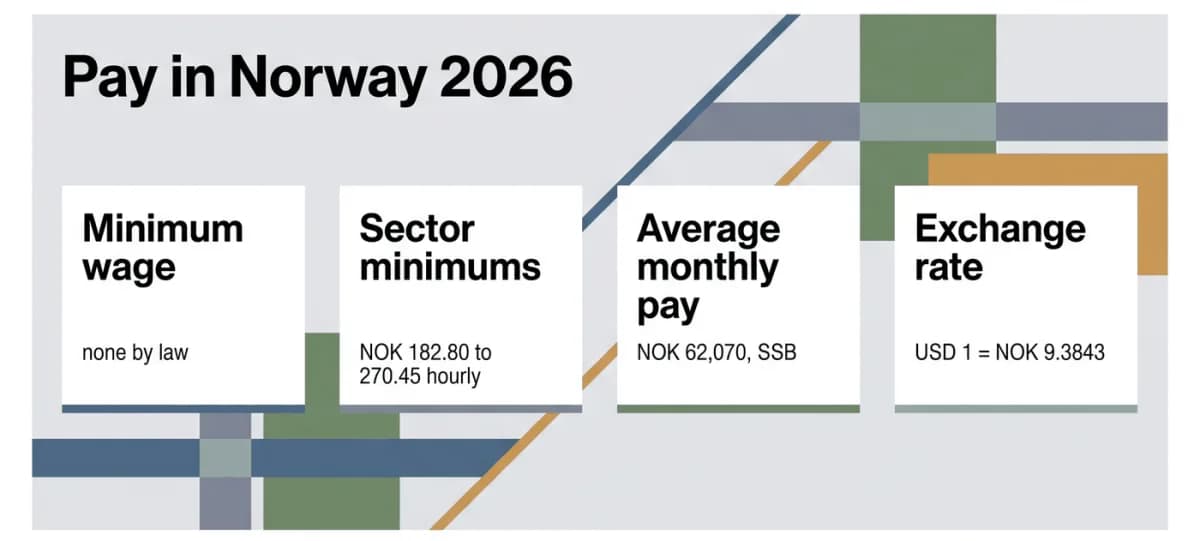
Norway has no statutory minimum wage. Minimum rates exist where the Tariff Board (Tariffnemnda) has made a collective agreement generally applicable, so that every employer in the sector must pay at least the agreed rate. Arbeidstilsynet's page counts nine sectors in force.[^21] The table lists the nine we could confirm in force, with hourly rates in NOK and in USD at the Norges Bank rate of 20 October 2026 (USD 1 = NOK 9.3843).[^26]
| Sector (allmenngjøring) | Minimum hourly rate (NOK) | About USD | In force from |
|---|---|---|---|
| Construction sites: skilled | 264.32 | 28.17 | 15 June 2025 |
| Construction sites: unskilled, no sector experience / one year of experience | 239.61 / 249.00 | 25.53 / 26.53 | 15 June 2025 |
| Electricians: skilled work / other workers (excludes offshore petroleum) | 270.45 / 241.77 | 28.82 / 25.76 | 15 June 2025 |
| Maritime construction (shipbuilding): skilled / semi-skilled / unskilled | 216.79 / 207.14 / 197.61 | 23.10 / 22.07 / 21.06 | 15 June 2025 |
| Agriculture: permanent, unskilled (skilled supplement 14.50; seasonal over 18, up to 12 weeks: 162.90) | 182.80 | 19.48 | 15 June 2025 |
| Cleaning: age 18 and over (night supplement at least 29 an hour, 21:00 to 06:00) | 236.54 | 25.21 | 15 June 2025 |
| Hotels and restaurants: over 20, or over 18 after four months | 204.79 | 21.82 | 15 June 2025 |
| Goods transport, vehicles over 2.5 tonnes | 229.00 | 24.40 | 15 June 2025 |
| Tour bus (turbil), where not subject to licence competition | 218.62 | 23.30 | 15 June 2025 |
| Automotive: skilled with one year / newly qualified / helper 18+ | 237.00 / 223.50 / 208.00 | 25.25 / 23.82 / 22.16 | 15 June 2026 |
Sources: Arbeidstilsynet's minimum-wage page, the construction regulation and the shipbuilding regulation, and for automotive its news item on the new rates.[^21][^22][^23][^24] Under-18 rates are lower in several sectors (for example NOK 162.44 in construction). Arbeidstilsynet reports that the fish-processing regulation was repealed on 3 August 2026, so we do not list a fish-processing rate.
For the wider picture, SSB reports average monthly earnings of NOK 62,070 per full-time equivalent for all employees in November 2025 (published 5 February 2026), about USD 6,614 at 9.3843.[^25] This is an average, not a minimum, and it mixes sectors; do not read it as a typical starting salary. Statutory holiday pay is described in the social security section below.
What this means for a job seeker: in a covered sector, an offer below the table is unlawful, for example below NOK 264.32 an hour for a skilled construction worker (about USD 28.17). Outside these sectors, pay is set by your contract and any collective agreement, so ask whether the employer is bound by one.
Non-EEA applicants: the skilled-worker permit
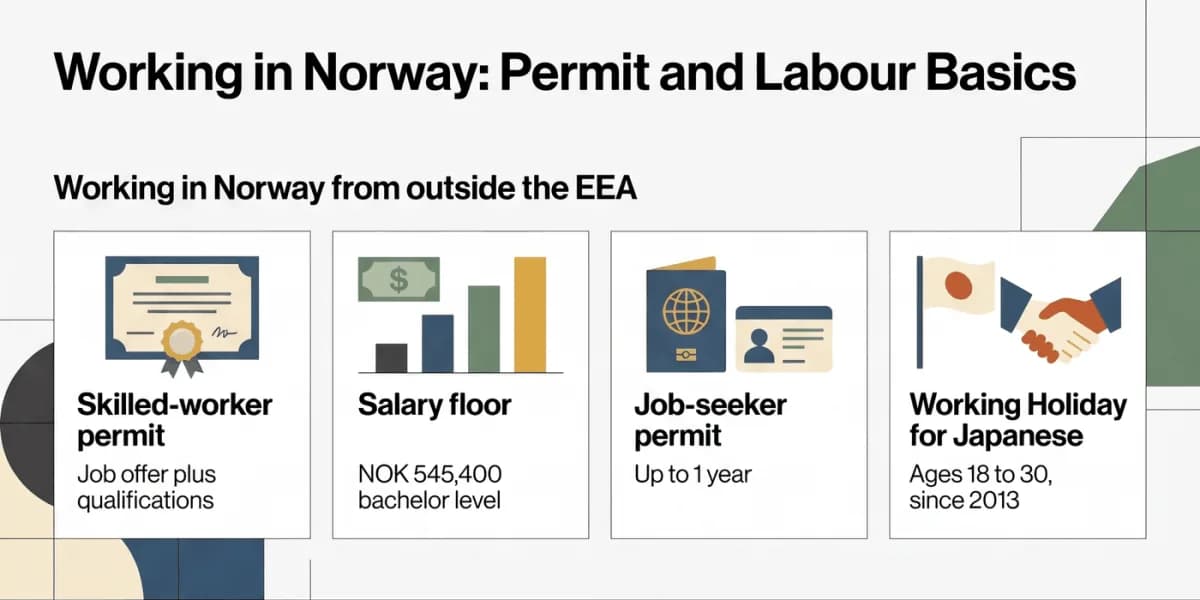
EU/EEA citizens may start work at once. They register in person with the police within three months of arrival; registration is free, and the employer provides an employment certificate or contract.[^31]
Non-EEA nationals usually need a residence permit with work rights. The route most readers use is the skilled-worker permit, which is based on the Immigration Act § 23 and the Immigration Regulations § 6-1 (reported; we could not read Lovdata). UDI's requirements, as surfaced in UDI page text, are:[^27]
- A specific job offer.
- Education or training at the required level.
- Pay not below the collective agreement, or what is normal for the occupation.
- A full-time position (80% in some cases).
Salary floor. UDI's "Pay and working conditions" page currently lists NOK 624,700 a year before tax for a position at master level and NOK 545,400 at bachelor level (about USD 66,569 and USD 58,118 at 9.3843). Check udi.no before applying: the previous floor from 1 September 2025 was NOK 599,200 and NOK 522,600, and we could not confirm the date the newer figures took effect. Vocational jobs have no fixed UDI amount; the collective agreement or normal pay applies.[^27][^28] UDI's pages were blocked to our tools, so these figures are likely rather than verified.
Fee. UDI's fee table is reported to list NOK 6,300 for an adult applying for a work permit (about USD 671).[^30]
Job-seeker permit. UDI's job-seeker page says the permit can last up to one year (older material says six months, so confirm on the page). The applicant must show funds of NOK 341,373 for a year (reported), may work while searching and may not be self-employed.[^29]
Seasonal work. A seasonal permit is reported to allow up to six months in any twelve, then six months outside Norway, with agriculture and forestry within a quota and other sectors needing Nav confirmation that no Norwegian or EEA worker is available (check UDI before relying on this).[^66]
Travel to Schengen. The EU Entry/Exit System (EES) started on 12 October 2025 with a gradual roll-out; ETIAS is "planned for the last quarter of 2026" and no start date has been announced. The official ETIAS site said on 21 October 2026 that it is not yet in operation. When it starts, the fee is reported at EUR 20 and it will apply to visa-exempt travellers such as Japanese citizens.[^32]
Japanese nationals. The Japan-Norway working holiday scheme has existed since 2013 with no annual quota, for ages 18 to 30 at application.[^33] Short visits of up to 90 days in any 180-day period are allowed for visitors (the Norwegian government page states the 90/180 rule; check the current entry rules for Japanese passports on official EU and MOFA pages).[^34] The Foreign Ministry's survey counted 1,769 Japanese residents in Norway in October 2025.[^35]
What this means for a job seeker: a non-EEA applicant needs an employer and a salary at or above the UDI floor, or a collective-agreement rate for vocational roles. Do not resign from your current job or travel until the permit is granted.
Immigrants in Norway in numbers
| Measure | Value |
|---|---|
| Immigrants, 1 January 2026 | 987,120, or 17.5% of 5,627,400[^8] |
| Born in Norway to immigrant parents | 238,507 (4.2%)[^8] |
| Poland | 111,740 (largest group)[^8] |
| Ukraine | 85,461[^8] |
| Lithuania | 43,065[^8] |
| Syria | 42,040[^8] |
| Sweden | 37,732[^8] |
| Employed immigrants, Q4 2025, ages 20 to 66 | 545,068, employment rate 67.5%[^9] |
| Non-resident short-term wage earners, Q4 2025 | 88,429[^10] |
| Japanese residents (MOFA survey, October 2025) | 1,769[^35] |
Labour law: hours, leave, notice and dismissal
The Working Environment Act (arbeidsmiljøloven, AML) is read here in the English translation on Arbeidstilsynet's site; we could not open Lovdata, so confirm section numbers there.
| Topic | Rule | Working Environment Act (arbeidsmiljøloven) |
|---|---|---|
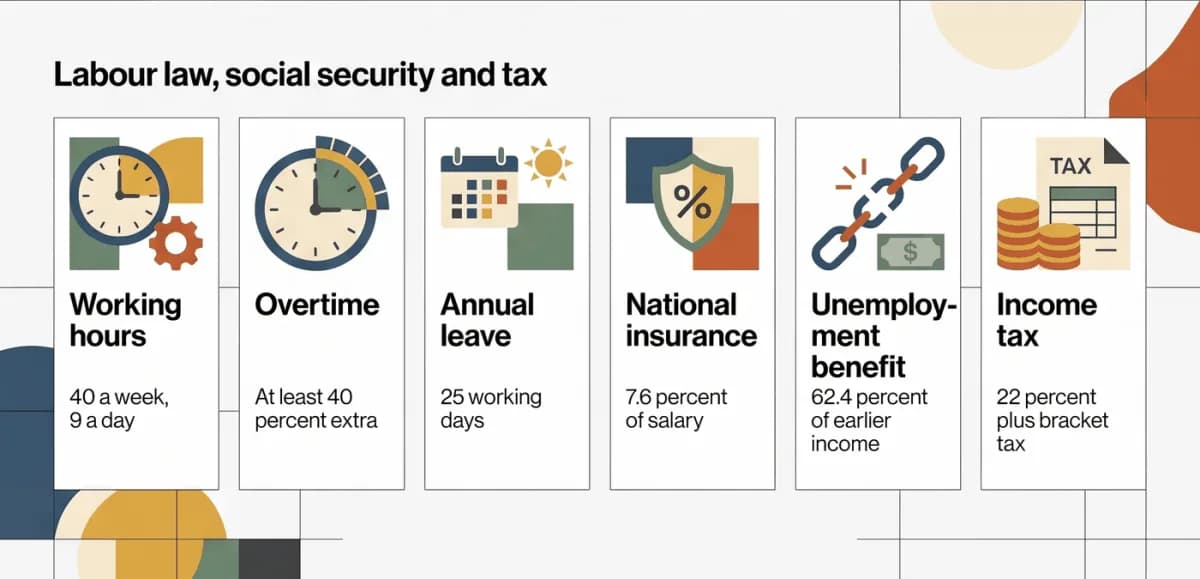
| Normal working time | 9 hours per 24 hours and 40 hours per 7 days (38 or 36 for shift and round-the-clock work)[^38] | § 10-4 |
| Overtime | Only for an exceptional, time-limited need; supplement at least 40% of the hourly rate; limits 10 hours per 7 days, 25 per 4 weeks, 200 per 52 weeks; total working time at most 13 hours per 24 hours and 48 hours a week on average over 8 weeks[^39] | § 10-6 |
| Rest | 11 hours continuous per 24 hours and 35 hours per 7 days; a collective agreement may cut this to 8 and 28 hours with compensation[^38] | § 10-8 |
| Temporary employment | Permanent is the rule; temporary only for listed grounds (temporary work, replacement, trainees, labour-market schemes, athletes); the general ground was removed in 2023; employees temporarily employed for over 3 consecutive years are deemed permanent[^42] | § 14-9 |
| Discussion meeting | Before deciding on dismissal, the employer shall, if practically possible, discuss it with the employee and elected representatives[^43] | § 15-1 |
| Notice | One month; two months after 5 consecutive years; three after 10 years; if dismissed after 10 years' service, four months after age 50, five after 55 and six after 60; the employee's own notice at most 3 months in those cases[^41] | § 15-3 |
| Probation | Up to 6 months; dismissal needs grounds of unsuitability, lack of proficiency or reliability; 14 days' notice during the trial period[^40][^41] | § 15-6 and § 15-3(7) |
| Dismissal grounds | Must be objectively justified by circumstances of the undertaking, the employer or the employee[^43] | § 15-7 |
| Right to remain | The employee may stay in the post while negotiations or court proceedings run, with exceptions (summary dismissal, probation, temporary workers)[^43] | § 15-11 |
| Annual leave (Holidays Act, ferieloven) | At least 25 working days (4 weeks and 1 day; Saturday counts); one extra week for employees who turn 60 in the holiday year; the fifth week for many employees comes from collective agreements, not the Act[^44] | Holidays Act |
Overtime pay is at least 40% on top of the hourly rate, and the notice period runs from the first day of the month after notice is given.
Severance
We found no general severance-pay rule in chapter 15 of the Act, so the Act contains no general severance-pay rule; severance is agreed in collective or individual agreements. This is likely rather than verified, because we could not read Lovdata. A dismissed worker may be able to claim dagpenger (see below).
Sickness absence
Workers employed for at least two months may self-certify (egenmelding) only within the first 16 days of sickness, up to three calendar days at a time and up to four times in 12 months under the minimum scheme; many workplaces allow more. The rule is in the National Insurance Act § 8-23.[^54]
What this means for a job seeker: expect a 40-hour week or less, overtime paid at least 40% extra, 25 working days of leave and at least one month's notice, longer with service. Check your contract and any collective agreement for the rest.
Public holidays in 2026
Norway has 12 public holidays in addition to Sundays; the dates below follow the 2026 calendar (Easter Sunday 5 April, Ascension 14 May and Whit Monday 25 May also appear in the Church of Norway calendar).[^47] We could not read the holidays act on Lovdata, so the legal list is likely, while the dates are verified.
| Holiday | 2026 date |
|---|---|
| New Year | Thursday 1 January |
| Maundy Thursday | Thursday 2 April |
| Good Friday | Friday 3 April |
| Easter Sunday | Sunday 5 April |
| Easter Monday | Monday 6 April |
| Labour Day | Friday 1 May |
| Ascension | Thursday 14 May |
| Constitution Day | Sunday 17 May |
| Whit Sunday | Sunday 24 May |
| Whit Monday | Monday 25 May |
| Christmas Day | Friday 25 December |
| Boxing Day | Saturday 26 December |
Pay on 1 May and 17 May is treated like pay on Sundays. You receive full pay if the day would normally be a working day and you have worked for the employer at least 30 days beforehand (or the job lasts 30 days or more). If you work, you get ordinary pay plus a Sunday-type premium of at least 50% unless otherwise agreed. You receive no pay if the workplace is normally closed that day, and if the day falls in holiday leave you are paid and may ask to extend the leave. Constitution Day falls on a Sunday in 2026, so most people get no extra weekday pay.[^46]
What this means for a job seeker: in 2026 eight of the public holidays fall on weekdays (including 1 May, 14 May and 25 May), and 17 May is a Sunday. Do not assume a "paid holiday" applies to everyone on 1 or 17 May: check the 30-day condition.
Social security: what is deducted and what you get
The basic amount (G) is NOK 136,549 from 1 May 2026 (up 4.9085% from NOK 130,160). Many benefits are set as multiples of G.[^48]
| Item | 2026 rule |
|---|---|
| Employee national insurance contribution (trygdeavgift) | 7.6% of salary; nothing charged below NOK 99,650 of personal income; capped at 25% of income above that[^49][^50] |
| Employer contribution (arbeidsgiveravgift) | Zone I 14.1%, II 10.6%, III 6.4%, IV 5.1%, IVa 7.9%, V 0% (Finnmark and parts of Troms)[^50] |
| Occupational pension (OTP) | At least 2% of pay (up to 12 G); likely, check the employer's scheme[^51] |
| Dagpenger (unemployment benefit) | 62.4% of earlier income up to 6 G (NOK 819,294); need at least NOK 204,824 (1.5 G) in the last 12 months or NOK 409,647 (3 G) over 36 months; 104 weeks if earnings were at least NOK 273,098 (2 G), otherwise 52 weeks[^52] |
| Sickness benefit | Employer pays the first 16 days; Nav then pays up to 6 G, for at most 52 weeks; normally full pay up to 6 G[^53] |
| Parental benefit (one child, birth from 1 July 2024) | 49 weeks at 100% or 61 weeks and 1 day at 80%[^55] |
| Holiday pay | At least 10.2% of the earning-year pay; 12% under typical collective agreements; at least 12.5% for employees over 60[^45] |
- Dagpenger details. You must have lost at least 50% of your working time and be under 67. Nav deducts a first-payment amount (egenandel) equal to three days of dagpenger. A child supplement of NOK 38 per child per day applies, and if you are dismissed for your own fault or quit without good reason there is no dagpenger for the first 18 weeks. Nav states a processing time of six weeks.[^52]
- Parental benefit. At 100%: 3 weeks before birth, the mother's quota of 15 weeks, the father's or co-mother's quota of 15 weeks and 16 shared weeks. Six weeks after birth are the mother's.[^55]
- Japan. No Japan-Norway social security agreement is in force. The Japanese Ministry of Health, Labour and Welfare listed Norway as under intergovernmental negotiation, with a second round in September 2025 (status 2 June 2026).[^56] Japanese employees seconded to Norway should ask their employer how their pension periods are treated.
What this means for a job seeker: 7.6% of salary goes to national insurance, and the employer pays its own contribution on top, which varies by region. Note the 62.4% dagpenger level: it replaces a share of previous income, not all of it.
Taxes on your salary
Ordinary income is taxed at 22%. The Storting's 2026 tax resolution splits it into a state share of 8.25%, a municipal share of up to 11.35% and a county share of up to 2.40%. Councils may set lower rates, so the actual total can be lower, and Finnmark and listed Troms municipalities use 18.5%.[^50][^58] The municipal share plays the role of Japan's resident tax, but it is collected as part of one income tax, not as a separate bill. Bracket tax and the 7.6% trygdeavgift are state-only.
On top of the 22%, bracket tax (trinnskatt) applies to personal income in 2026:[^57]
| Personal income (NOK) | Rate |
|---|---|
| Above 226,100 | 1.7% |
| Above 318,300 | 4.0% |
| Above 725,050 | 13.7% |
| Above 980,100 | 16.8% |
| Above 1,467,200 | 17.8% |
- Allowances. The personal allowance (personfradrag) is NOK 114,540 and the minimum standard deduction (minstefradrag) is 46% of salary up to NOK 95,700, per the Storting resolution.[^50] Skatteetaten's English rate pages still show 2025 values (NOK 108,550 and NOK 92,000), so do not use them for 2026.
- Top marginal rate. 22% + 17.8% + 7.6% = 47.4% on salary, excluding employer contributions (our recomputation).[^57]
- PAYE for short stays. Foreign workers on short stays (under 183 days in 12 months or under 270 days in 36 months) and in their first year of Norwegian tax residence can be taxed at a flat 25% of salary at source (kildeskatt på lønn), including trygdeavgift, if income is below NOK 725,050 in 2026. There is no tax return, and you can opt out.[^59] Full residence rules were not verified here.
- Skattekort and ID check. A tax card is not issued until you have attended an ID check with a passport or national ID; the employer can apply on your behalf. Until it is issued, the employer deducts 50% (reported).[^60]
- VAT. 25% standard; 15% food; 12% passenger transport, accommodation, cinema, sports events and amusement parks.[^61]
What this means for a job seeker: compare offers on net pay, not gross. The 22% rate applies to income after deductions, bracket tax applies from NOK 226,100, and a short-stay worker may be better off with the flat 25% rate, so check with Skatteetaten.
Language and what Norwegian employers expect in a CV
- Language. International firms in ICT and energy often work in English; health care, schools and local government normally require Norwegian. For health personnel educated outside the EU/EEA, Helsedirektoratet requires Norwegian at CEFR B2 (or Swedish or Danish) with no exemption.[^37] Write your CV in the language of the advert.
- Format. One or two clear, ATS-readable pages and a short cover letter are editorial advice, not an official rule. Follow the advert on photos and references.
- Recognition. HK-dir handles recognition of foreign higher education (bachelor, master, PhD); decisions are binding and appealable, and its page gives a processing time of four to six months, so apply early.[^36]
- Health professions. Helsedirektoratet authorises health personnel; applicants from outside the EU/EEA first need confirmation of equivalence, then must meet additional requirements within three years.[^37]
- Privacy. Keep your national ID number and any D-number off the CV, and do not send identity documents before you have verified the employer.
- Guides. See our ATS-friendly CV guide and, as a model for English CVs, the UK CV format guide.
Verify a listing before sharing documents
- UDI warns of fraudulent job offers: an employer must confirm a job offer to UDI by a form and a four-word code, UDI cannot verify offers, and a forged job offer can lead to a five-year Schengen entry ban (reported from UDI page text).[^62]
- EURES warns that scammers exploit company or EURES names through fake email addresses and domains: check the sender's domain.[^63]
- Nav's rule is that employers may not charge job seekers any fee (see above).
- Skatteetaten says it never sends links unprompted by email or text, and it warns about phishing around tax cards (reported).[^64] The police advise caution about job offers used in money-mule schemes that ask you to lend your bank account.[^65]
- Check the employer's legal name and careers page, and never pay for a job or permit.
A seven-day search routine
- Day 1: pick two sectors and save 20 adverts from Arbeidsplassen and FINN jobb.
- Day 2: extract repeated titles, skills and language requirements.
- Day 3: build one master CV and a tailored version for the strongest sector.
- Day 4: set alerts on Arbeidsplassen and FINN jobb, and check employer career pages.
- Day 5: if you are a non-EEA applicant, check the UDI salary floor and whether your credentials need recognition by HK-dir or Helsedirektoratet.
- Day 6: send targeted applications in the advert's language.
- Day 7: review replies, drop weak sources and keep the two channels that produced recruiter contact.
Final checklist before you apply
- [ ] My CV is in the language of the advert and has no national ID number.
- [ ] I know whether the sector has a generally applicable minimum rate and whether the offer is above it.
- [ ] As a non-EEA applicant, the employer's offer meets UDI's current salary floor and I have checked udi.no.
- [ ] I know the hours, overtime, notice period and leave in my contract.
- [ ] I know that 7.6% national insurance and income tax are deducted, and I have asked about my tax card.
- [ ] No one has asked me for a fee for a job or a permit.
FAQ
What are the best job sites in Norway?
Arbeidsplassen (12,511 ads on 21 October 2026) and FINN jobb (26,614 vacancies in 13,157 ads), plus Jobbsafari for public-sector posts, LinkedIn alerts and the career pages of large employers.[^11][^12]
Does Norway have a minimum wage?
No statutory minimum wage exists. Minimum rates apply in sectors with generally applicable agreements, for example NOK 264.32 an hour for skilled work on construction sites (about USD 28.17) and NOK 236.54 for cleaning.[^21]
Can I work in Norway without speaking Norwegian?
In some international firms, yes. Health care, schools and local government normally require Norwegian, and health personnel from outside the EU/EEA need B2 Norwegian for authorisation.[^37]
What is the skilled-worker permit salary floor?
UDI's page currently lists NOK 624,700 a year (master level) and NOK 545,400 (bachelor level); the previous floor from 1 September 2025 was NOK 599,200 and NOK 522,600. Check udi.no before applying.[^27][^28]
Can Japanese citizens use the working holiday scheme?
Yes. The Japan-Norway working holiday has existed since 2013 with no annual quota, for ages 18 to 30 at application.[^33]
How many hours do I work and how is overtime paid?
Normal working time is 9 hours per 24 hours and 40 hours per week (§ 10-4). Overtime carries a supplement of at least 40%, with limits of 10 hours per week, 25 per four weeks and 200 per year (§ 10-6).[^38][^39]
How much holiday do I get, and what is holiday pay?
At least 25 working days a year, plus one extra week from the year you turn 60. Holiday pay is at least 10.2% of earnings, 12% under typical collective agreements.[^44][^45]
What notice and severance apply?
Notice is one month, two after 5 years and three after 10 years (§ 15-3). The Act contains no general severance-pay rule; severance is agreed in collective or individual agreements.[^41]
Can I get unemployment benefit (dagpenger)?
If you earned at least NOK 204,824 in the last 12 months or NOK 409,647 over 36 months, lost at least half your working time and are under 67, dagpenger pays 62.4% of earlier income up to 6 G for 52 or 104 weeks.[^52]
How much income tax will I pay, and what is the municipal share?
Ordinary income is taxed at 22% (state 8.25%, municipal up to 11.35%, county up to 2.40%), plus bracket tax from NOK 226,100 and 7.6% national insurance. The municipal share is part of the single income tax, not a separate bill.[^50][^57]
How to use AIResume
Keep one master CV in AIResume and create a Norwegian and an English version for each advert's language. Use the how to tailor your CV to a job description guide to match each advert.
Related AIResume guides
- Job boards in the United Kingdom
- Job boards in Ireland
- Job boards in Switzerland
- Job boards in Belgium
- Job boards in France
- Job boards in Spain
- Job boards in Portugal
- UK CV format guide
- How to write an ATS-friendly CV
- How to tailor your CV to a job description
- CV vs resume for international applications
Sources
[^1]: World Bank, World Development Indicators: Norway (accessed 21 October 2026)
[^2]: Nav, registered unemployment September 2026
[^3]: SSB, Labour Force Survey
[^4]: SSB, table 13760
[^5]: SSB, consumer price index
[^6]: Norges Bank, policy rate series
[^7]: SSB, table 05803 (population)
[^8]: SSB, immigrants and Norwegian-born to immigrant parents
[^9]: SSB, employment among immigrants (register-based)
[^10]: SSB, table 14358
[^11]: Arbeidsplassen, job search (checked 21 October 2026)
[^12]: FINN jobb, job search (checked 21 October 2026)
[^13]: Jobbsafari (checked 21 October 2026)
[^14]: Jobbnorge
[^15]: EURES, EU job portal and Nav, jobs in the EU/EEA and Switzerland
[^16]: Nav, recruiting (employers' duty to notify vacancies)
[^17]: Arbeidsplassen, terms of use
[^18]: Arbeidstilsynet, hiring labour from staffing enterprises
[^19]: Arbeidstilsynet, approved staffing enterprises
[^20]: Lovdata, Labour Market Act chapter 8 (excerpt only)
[^21]: Arbeidstilsynet, minimum wage and generally applicable agreements
[^22]: Arbeidstilsynet, construction-site regulation
[^23]: Arbeidstilsynet, shipbuilding regulation
[^24]: Arbeidstilsynet, minimum wage in the automotive trade from 15 June
[^25]: SSB, wages
[^26]: Norges Bank, USD/NOK spot rate (20 October 2026)
[^27]: UDI, skilled workers and UDI, pay and working conditions (pages blocked to our tools; read via search index)
[^28]: UDI, new salary levels from 1 September 2025
[^29]: UDI, job seekers
[^30]: UDI, fees
[^31]: UDI, answers for EU/EEA nationals
[^32]: European Commission, EES vs ETIAS and official ETIAS site
[^33]: MOFA, working holiday
[^34]: Norway.no, visitor visas and residence permits (Japan)
[^35]: MOFA, Norway basic data and Japanese residents
[^36]: HK-dir, recognition of foreign higher education
[^37]: Helsedirektoratet, authorisation and licence for health personnel
[^38]: Arbeidstilsynet, working hours
[^39]: Arbeidstilsynet, overtime
[^40]: Arbeidsmiljøloven § 15-6, probation (Arbeidstilsynet translation)
[^41]: Arbeidsmiljøloven § 15-3, notice (Arbeidstilsynet translation)
[^42]: Arbeidsmiljøloven § 14-9, temporary employment (Arbeidstilsynet translation)
[^43]: Arbeidsmiljøloven §§ 15-1, 15-7 and 15-11 (Arbeidstilsynet translation): § 15-1, § 15-7, § 15-11
[^44]: Arbeidstilsynet, holiday
[^45]: Arbeidstilsynet, holiday pay
[^46]: Arbeidstilsynet, pay and minimum rates of pay (section "Pay on 1 May and 17 May")
[^47]: Church of Norway, church-year calendar 2025-2026
[^48]: Nav, basic amount (grunnbeløp)
[^49]: Skatteetaten, national insurance contributions
[^50]: Storting, Innst. 3 S (2025-2026), 2026 tax and duty package
[^51]: Skatteetaten, mandatory occupational pension (OTP)
[^52]: Nav, dagpenger
[^53]: Nav, sickness benefit
[^54]: Nav, self-certification (egenmelding)
[^55]: Nav, parental benefit
[^56]: MHLW, social security agreements overview (status 2 June 2026)
[^57]: Skatteetaten, bracket tax and maximum effective marginal tax rates
[^58]: Skatteetaten, general income
[^59]: Skatteetaten, PAYE for salary (kildeskatt på lønn)
[^60]: Skatteetaten, ID check and tax deduction cards for foreign employers
[^61]: Skatteetaten, value-added tax
[^62]: UDI, fraudulent work offers
[^63]: EURES, how to spot fraudulent job offers
[^64]: Skatteetaten, scam warning
[^65]: Politiet, ID theft and fraud advice
[^66]: UDI, seasonal work answer page (read via search index)
Your next step
- DeelFor employers hiring across borders: contracts, payroll and visas handled.See how Deel works
Affiliate links: we may earn a commission at no cost to you. Affiliate link