

Denmark Job Search in 2026: Job Boards, Union Pay Floors, Work Permits and Labour Law
Denmark is a high-wage, high-trust labour market of about six million people, built on the "flexicurity" model: employers can hire and dismiss with relative ease, and pay and working conditions are set mainly by collective agreements rather than by law. Pharmaceuticals and life science, shipping and
By AIResume Editorial Team
Last updated: 21 October 2026
Denmark is a high-wage, high-trust labour market of about six million people, built on the "flexicurity" model: employers can hire and dismiss with relative ease, and pay and working conditions are set mainly by collective agreements rather than by law. Pharmaceuticals and life science, shipping and logistics, green energy, food and beverages, IT, and the health and public sectors are the areas most readers will meet. English is widely used in international firms, but Danish matters in the public sector, in health care and in customer-facing jobs. Housing in Copenhagen is a real part of any offer, so check rents yourself before you accept.
This guide covers the economy in numbers, where to search, how pay is set without a minimum wage law, work and residence permits for EU/EEA and non-EU applicants, labour law, 2026 public holidays, social security and income tax, including the municipal tax (kommuneskat). For other markets, see our guides to job boards in Norway, Iceland and Luxembourg (all forthcoming), the United Kingdom and Ireland.
Editorial boundary: This is practical job-search guidance, not legal, immigration or tax advice. We only list figures we could read in an official or primary source, and we mark those that come from a single professional or press source as "reported" or "likely". Confirm details with STAR (the Danish Agency for Labour Market and Recruitment, which runs Jobnet), SIRI (the Danish Agency for International Recruitment and Integration), Skattestyrelsen and the Ministry of Taxation, Danmarks Statistik (Statistics Denmark), Danmarks Nationalbank, the law texts on retsinformation.dk, the collective agreements themselves, or your employer before you sign.
Before you apply
- SafetyWing Nomad InsuranceHealth insurance that works in your new country from day one.Get a quote
Affiliate links: we may earn a commission at no cost to you. Affiliate link
Denmark's economy in numbers
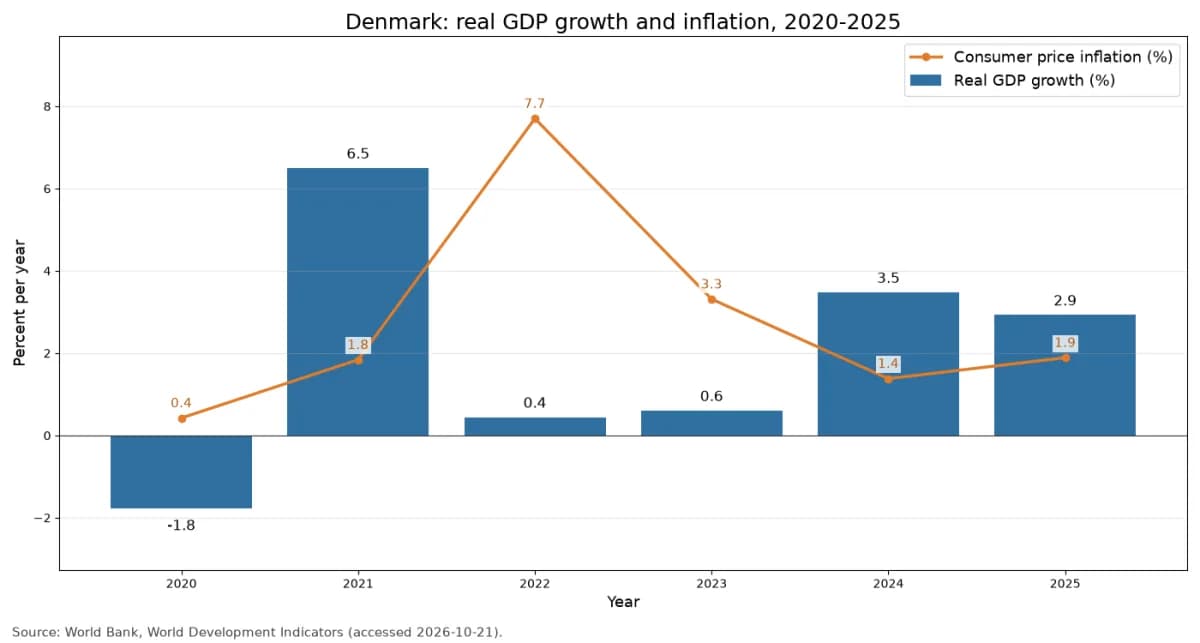
| Indicator | 2020 | 2021 | 2022 | 2023 | 2024 | 2025 |
|---|---|---|---|---|---|---|
| GDP (USD billion) | 355.6 | 406.1 | 400.1 | 404.7 | 424.5 | 462.5 |
| GDP per person (USD) | 60,985 | 69,341 | 67,781 | 68,044 | 71,026 | 76,970 |
| Real GDP growth (%) | -1.8 | 6.5 | 0.4 | 0.6 | 3.5 | 2.9 |
| Inflation (%) | 0.4 | 1.8 | 7.7 | 3.3 | 1.4 | 1.9 |
| Population (million) | 5.83 | 5.86 | 5.90 | 5.95 | 5.98 | 6.01 |
*Source: World Bank, World Development Indicators (accessed 21 October 2026).*[^1]
World Bank modelled unemployment for 2025 is 5.5%, and youth unemployment (ages 15 to 24) is 11.7%. These are modelled series; the national figures below are more recent and use different definitions.
Labour-market measures:
| Measure | Value | Source |
|---|---|---|
| Registered gross unemployment, August 2026 | 3.1% (seasonally adjusted) | Danmarks Statistik[^2] |
| Unemployment, labour force survey (ILO), Q2 2026 | 6.6% unadjusted; 7.1% seasonally adjusted | Danmarks Statistik[^3] |
| Youth unemployment (ages 15 to 24), Q2 2026 | 13.8% | Danmarks Statistik[^3] |
| Nationalbank current-account rate | 2.10% since 11 September 2026 | Danmarks Nationalbank[^4] |
| Population, 1 May 2026 | 6,032,963 | Danmarks Statistik[^5] |
| Immigrants and descendants, 1 January 2026 | 780,954 + 230,082 = 1,011,036, or 16.8% | Danmarks Statistik[^6] |
| Immigrants among full-time employees, Q2 2026 | 384,582 of 2,574,114, or 14.9% (by origin, not citizenship) | Danmarks Statistik[^7] |
| International migrant stock, 2024 | 847,475 (about 14.2% of the population, reported) | World Bank / UN DESA[^1] |
The registered rate counts people who are out of work and registered, the survey rate counts everyone without work who is looking. Do not compare the two directly.
What this means for a job seeker: with registered unemployment at 3.1%, employers in many fields compete for staff, but the survey rate of 6.6% and a youth rate of 13.8% show that entry-level and student roles are harder to win. About one in seven full-time employees is an immigrant, so employers are used to foreign colleagues.
Denmark job search in one table
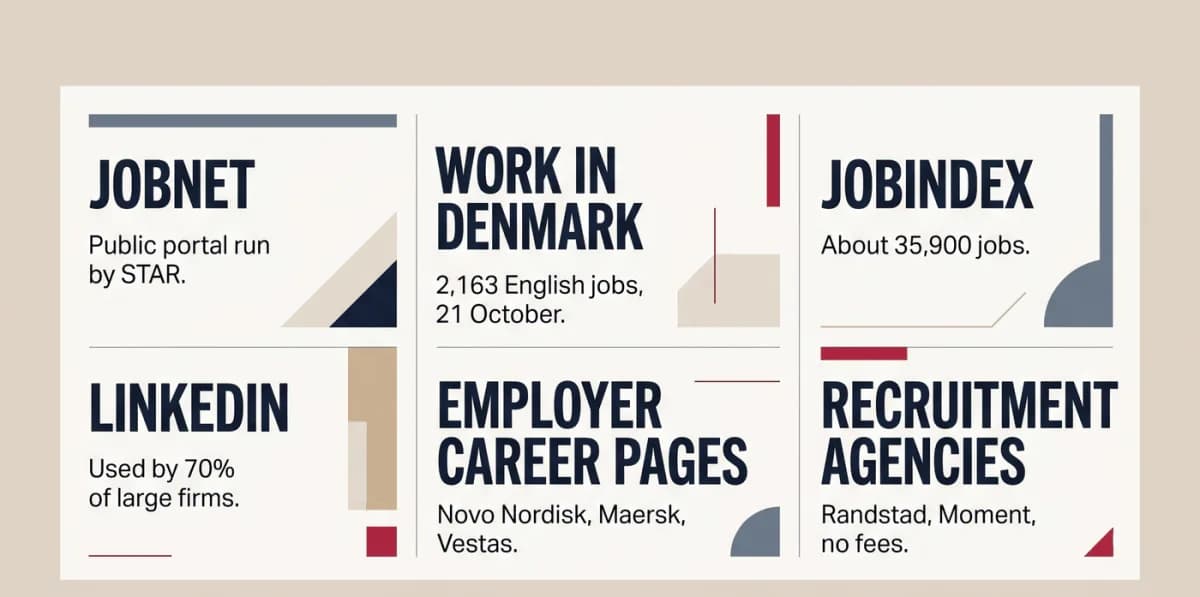
| Channel | What it is | Use it for | Limit |
|---|---|---|---|
| Jobnet | The public job portal run by STAR | Most vacancies from public employers and many private ones | Interface and most adverts are in Danish[^8] |
| Work in Denmark | Public employment service for international job seekers, part of EURES | English-language vacancies; its portal showed 2,163 vacancies on 21 October 2026 | Count is a snapshot, not a trend[^9] |
| Jobindex | Commercial aggregator | Broad search; it showed 35,900 jobs on 21 October 2026 and calls itself Denmark's largest job database | "Largest" is its own claim[^10] |
| StepStone | Commercial board | Specialist and leadership roles | We did not count its listings[^10] |
| The Hub | Nordic start-up board | Start-up roles in Denmark, Finland, Iceland, Norway and Sweden | We did not count its listings[^10] |
| Jobs in Copenhagen, Jobfinder, Excelerate | Other portals listed by Work in Denmark | Cross-checking | We did not open them; names only[^11] |
| LinkedIn, Indeed | International boards | Alerts and international employers | We did not read their listings; no counts[^12] |
| Employer pages: Novo Nordisk, Maersk, Vestas, Ørsted, LEGO, Danske Bank, Netcompany | Large employers | Direct applications | Pages loaded on 21 October 2026; we did not count vacancies[^13] |
Treat the counts as a snapshot of 21 October 2026. Work in Denmark cites a 2021 report that 70% of large private companies and 49% of smaller private and public companies use LinkedIn in recruitment, and that 58% check candidates' profiles.[^12]
What this means for a job seeker: start with Jobnet, add Work in Denmark if you need English-language adverts, build a LinkedIn profile, and apply directly to large employers. Work in Denmark also notes that many jobs are never advertised and that it is common to phone an employer before sending an application, so unsolicited applications are a normal route.[^14] It also says most employers look for candidates who can stay at least two to three years.
Jobnet, jobcentres and Work in Denmark
Jobnet is the public portal operated by STAR. Public employers must post their vacancies on Jobnet under a ministerial circular (CIR nr 9603 of 14 December 2012, section 1), and state vacancies posted there are transferred automatically to the state's own portal, job-i-staten.dk. That portal needs a MitID login, so search on Jobnet instead.[^8] Benefit recipients are reported to be required to keep a CV on Jobnet; we did not read that rule in a statute, so check with your jobcentre.
Work in Denmark describes itself as a public employment service under the Danish Agency for Labour Market and Recruitment and part of EURES, the European job mobility network. It reports more than 1,000 EURES advisers, job fairs and a weekly chat.[^9]
After you arrive, the International Citizen Service (ICS) is a separate service run by SIRI with municipalities, not part of Work in Denmark. There are six centres: Copenhagen (East), Aarhus (West), Odense (South), Aalborg (North), Esbjerg and Sønderborg. ICS handles CPR registration, the EU residence document (for EU/EEA/Swiss citizens only) and MitID. It does not issue tax cards and does not process non-EU work permits, which SIRI handles.[^15]
Recruitment and staffing agencies
Randstad, ManpowerGroup (Manpower, Experis, Talent Solutions) and Moment (a nationwide temporary-staffing and recruitment agency) all have working Danish sites.[^16] We could not verify other agencies' Danish sites, so they are not listed. We did not find a statute we could cite on agency fees, so we do not state a legal rule. As practical advice: a legitimate agency is paid by the employer, and you should be wary of anyone who asks you for a fee.
Unions and a-kasser
IDA (engineers), DJØF (lawyers and economists), HK (commercial and office staff) and Ase (an a-kasse that also offers union membership) have English or Danish websites you can open.[^17] Their "job" pages on hk.dk, djoef.dk and 3f.dk are mostly the unions' own staff vacancies, not member job boards. Unions are mainly useful for pay statistics and contract advice; Work in Denmark's pay guidance says unions publish annual wage statistics for negotiation.[^18]
Pay in 2026: no minimum wage law, but collective-agreement floors

Denmark does not have a statutory minimum wage: "pay and employment conditions are, as a rule, regulated by collective agreements or are negotiated individually."[^18] Work in Denmark adds that minimum requirements exist by law in some areas, for example the Holidays Act, the Employment Contract Act, equal treatment and the illness and parental leave acts. Eurofound reports that collective agreements cover roughly 80% of employees (employer figure 82%, union figure 84%; estimates vary by method).[^19]
On 11 November 2025 the Court of Justice of the EU (Grand Chamber, case C-19/23, Denmark v Parliament and Council) annulled Article 5(2) of the EU Minimum Wage Directive 2022/2041 in full, the words "including the elements referred to in paragraph 2" in Article 5(1), and a proviso in Article 5(3), and dismissed the rest of Denmark's action. The directive otherwise stands, and Denmark still has no statutory minimum wage.[^20]
Pay floors valid from 1 March 2026 (next step 1 March 2027), converted at the Danmarks Nationalbank rate of 20 October 2026 (USD 1 = DKK 6.6648; EUR 1 = DKK 7.4746; JPY 100 = DKK 4.2148):[^21]
| Agreement and position | 2026 minimum (DKK) | About USD |
|---|---|---|
| Industriens Overenskomst (DI / CO-industri), adults, minimum hourly rate (§ 22) | 143.40 an hour (146.90 from 1 March 2027)[^22] | 21.5 an hour |
| HORESTA / 3F hotel agreement, lowest adult (helper, "medhjælper") | 148.49 an hour, or 23,807.91 a month[^23] | 22.3 an hour |
| HORESTA / 3F café agreement | 160.93 an hour, or 25,801.95 a month[^23] | 24.1 an hour |
| Retail, Dansk Erhverv / HK Handel, unskilled | 22,794 a month[^24] | 3,420 a month |
| Retail, skilled | 24,294 a month[^24] | 3,645 a month |
These are minimum payment rates; actual pay is agreed individually (§ 22 of the industry agreement). The retail agreement fixes monthly minimums, and an hourly equivalent of about DKK 142 is our own calculation for a 37-hour week. Hotel under-18 helpers start at DKK 88.96 an hour. For Japanese readers, DKK 143.40 is about 3,400 yen at the rate above (our calculation).
For the wider picture, Danmarks Statistik reports standardised monthly earnings of DKK 52,846 for full-time employees in 2025 (about USD 7,930, or roughly 1.25 million yen), up from DKK 50,652 in 2024. The private sector averages DKK 54,894 (about USD 8,236) and general government DKK 48,746 (about USD 7,314). These figures include employer pension contributions and are averages, not starting salaries.[^25]
Holiday pay is paid on top of the agreement rates; see the labour law and social security sections.
What this means for a job seeker: there is no national floor to quote, so ask which collective agreement covers the job and which rate or grade you are placed in. An industrial offer below DKK 143.40 an hour (about USD 21.5) or a skilled retail offer below DKK 24,294 a month would sit under the 2026 agreement minimum, which you can check in the agreement text.
EU/EEA and non-EU applicants: work and residence permits
EU/EEA and Nordic citizens do not need a work permit. If you stay more than three consecutive months you need CPR registration, and EU/EEA/Swiss citizens get an EU residence document at an ICS centre; Nordic citizens may stay up to six months without a CPR number.[^15]
Non-EU nationals apply through SIRI, usually with an employer. The main routes, with 2026 amounts:
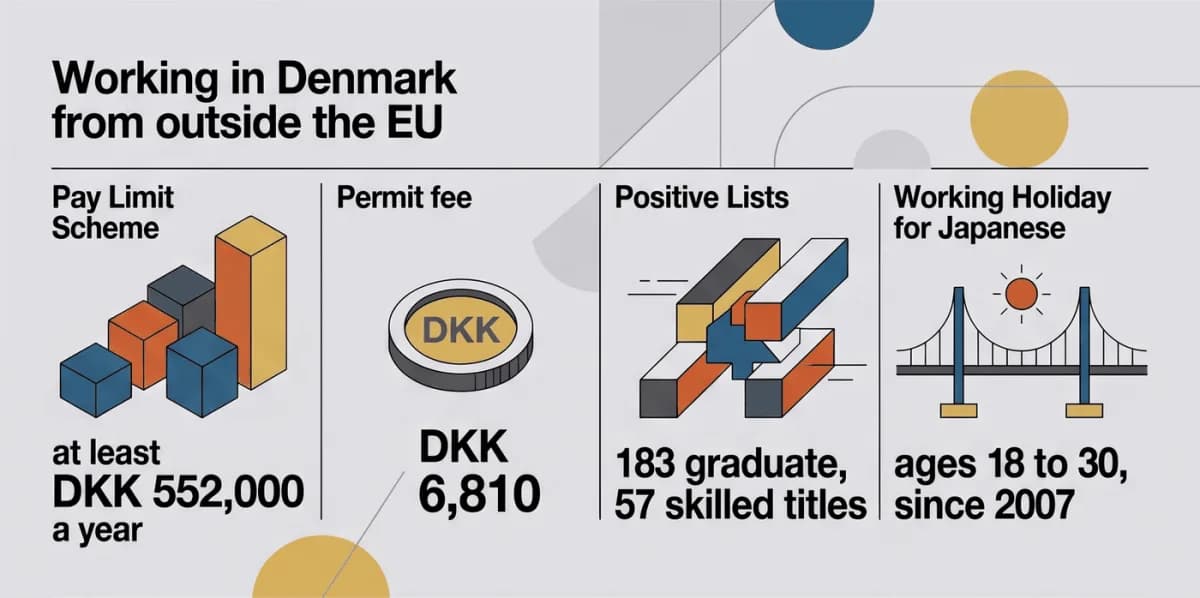
- Pay Limit Scheme. The job must pay at least DKK 552,000 a year (DKK 46,000 a month; about USD 82,800), regulated every 1 January. Normal processing is one month, up to three.[^26]
- Supplementary Pay Limit Scheme. The minimum is DKK 446,000 a year (DKK 37,166.67 a month; about USD 66,900). Extra conditions: the job must have been posted on Jobnet and EURES for at least two weeks (and no more than six months) before applying, the SA gross unemployment rate must not exceed 3.75% on average in the three months before applying, the work must be full time (37 to 40 hours) and the employer must not have a fine of DKK 3,000 or more in the past two years. Processing is two months, up to five.[^27]
- Positive Lists. Since 1 January 2026 there are 183 higher-education titles and 57 skilled-work titles. The skilled list is updated on 1 January and 1 July, and the higher-education list was updated again on 1 October 2026 (reported). Skilled-work processing is reported at three months, up to four.[^28]
- Fast-track. A certified employer can use five tracks (Pay Limit, Supplementary Pay Limit, short-term, researcher and educational); normal processing is one month, up to two.[^29]
- Collective Agreement Scheme. SIRI announced a new scheme from 1 January 2027 with a minimum of DKK 322,000 a year (about USD 48,300), a job covered by a collective agreement, citizenship of one of 16 listed countries and a certified employer. Certification applications are expected from early December 2026.[^30]
- Fees. From 1 January 2026 the fee is DKK 6,810 (about USD 1,022) for the Pay Limit, Positive List, Fast-track and company certification; DKK 3,080 for accompanying family; DKK 3,060 for study and Start-up Denmark; DKK 840 for a work permit in a job-seeking period and DKK 7,570 for a permanent permit on grounds of work or study.[^31]
Only cash pay, pension contributions to labour-market schemes and paid holiday allowance count towards the pay limits; canteen, car, phone and housing do not.[^26] The establishment card ended on 1 April 2023, and Denmark does not take part in the EU Blue Card Directive (EU) 2021/1883 (recital 69), so there is no Danish Blue Card.[^32]
Salary and bank account. For most permits granted from 1 January 2021, salary must be paid into a Danish bank account in the employee's own name, opened within 180 days. Holders of EU-regulation rights and Türkiye Association Agreement holders are exempt.[^33]
Travel for Japanese nationals. Japan is on the EU visa-exempt list (Regulation (EU) 2018/1806, Annex II), so Japanese citizens can stay 90 days in any 180. The Entry/Exit System (EES) started on 12 October 2025 and, per the European Commission, has been fully operational since 10 April 2026. ETIAS is scheduled for the last quarter of 2026, with the exact date to be announced; check the Commission's ETIAS page before you travel.[^34]
Working holiday for Japanese. The agreement dates from 1 October 2007. MOFA lists no annual quota and an age range of 18 to 30; SIRI words it as at least 18 and no older than 31 at the time of application. The stay lasts up to one year, work is limited to six months within that stay, you must show DKK 15,000 in funds plus a return ticket, there is no fee and processing takes about three months (up to four).[^35]
Japanese residents. The Foreign Ministry of Japan (MOFA) counted 2,129 Japanese residents in Denmark on 1 October 2025.[^36]
What this means for a job seeker: an EU/EEA citizen can start without a permit, while a non-EU applicant needs an employer who fits one of the schemes, so compare the offered salary with DKK 552,000 and DKK 446,000 before you apply. Do not resign from your current job or travel to start work before the permit is granted.
Foreign workers in Denmark in numbers
| Measure | Value |
|---|---|
| Population, 1 May 2026 | 6,032,963[^5] |
| Immigrants and descendants, 1 January 2026 | 1,011,036, or 16.8%[^6] |
| Immigrants among full-time employees, Q2 2026 | 384,582 (165,356 Western and 219,226 non-Western), 14.9%; descendants add 64,559[^7] |
| Largest immigrant groups, 1 July 2026 | Ukraine 57,574; Poland 47,662; Romania 40,532; Germany 39,922; Turkey 36,383; Syria 34,826[^6] |
| Work-area permits granted, 2025 | 22,131 (2024: 22,424)[^37] |
| By category, 2025 | Fast-track 7,247; family of permit holders 5,764; Supplementary Pay Limit 2,236; Pay Limit 1,801; Positive List higher education 302; skilled 258; researchers 188; Start-up Denmark 71[^37] |
| Top nationalities for work permits, 2025 | India 3,895; UK 2,431; Philippines 1,846; China 1,500; USA 1,341[^37] |
| EU/EEA wage earners, 2025 | 18,145 (Romania 5,170; Poland 2,715; Italy 1,985)[^37] |
| Ukrainians under the Special Act, 31 July 2026 | 71,294 permits; 48,997 registered in municipalities[^38] |
| Japanese residents (MOFA, 1 October 2025) | 2,129[^36] |
Labour law: hours, leave, notice and dismissal
| Topic | Rule | Law |
|---|---|---|
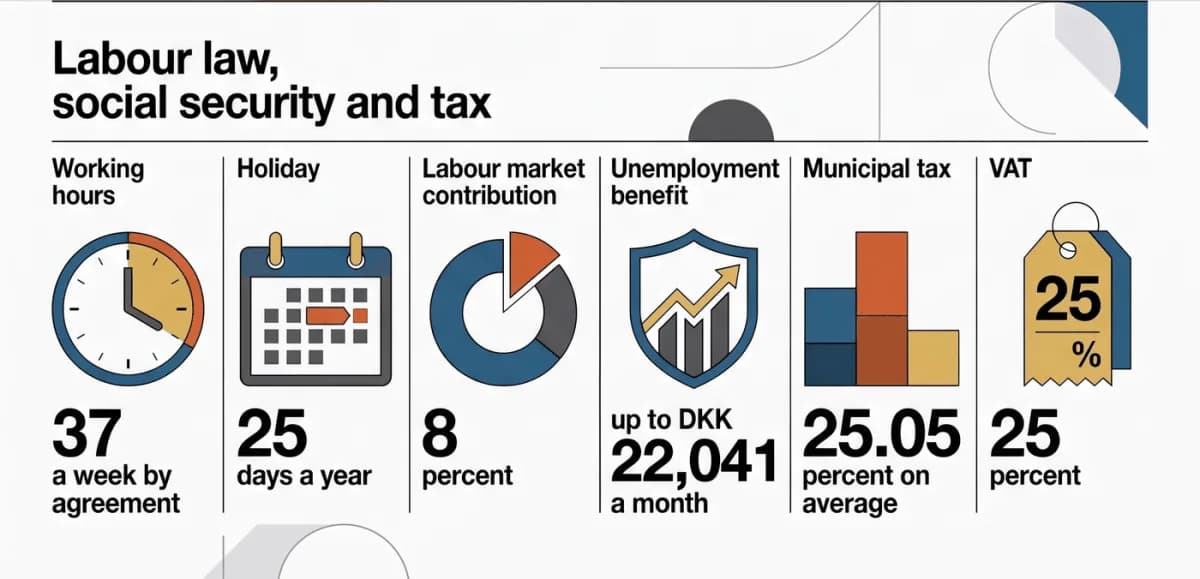
| Working time | Maximum 48 hours a week including overtime, averaged over 7 days and calculated over 4 months. The 37-hour week comes from collective agreements, not from this section[^39] | Arbejdstidsloven (Act implementing parts of the Working Time Directive), LBK 982/2024, § 4 |
| Daily rest | 11 consecutive hours per 24 (8 hours allowed on a shift change)[^40] | Arbejdsmiljøloven, LBK 442/2026, § 50 |
| Weekly rest | A weekly rest day per 7 days[^40] | Arbejdsmiljøloven § 51 |
| Overtime pay | We found no statutory premium in § 4; pay is set by agreements (likely)[^39] | Collective agreements |
| Employment contract | Key terms in writing within 7 calendar days of the start (items 1 to 5, 7 and 10 to 12), the rest within 1 month; changes in writing at the latest when they take effect[^41] | Ansættelsesbevisloven, LOV 501/2023, §§ 3 and 5 |
| Probation | Up to 6 months[^41] | Ansættelsesbevisloven § 6, stk. 1 |
| Annual leave | 25 days a year (2.08 days per month); holiday year 1 September to 31 August[^42] | Ferieloven, LBK 152/2024, § 5 |
| Holiday pay | Monthly-paid staff receive pay plus 1% holiday supplement; others receive 12.5% holiday pay[^42] | Ferieloven § 16 |
| Sickness | Employer pays for the first 30 calendar days; conditions include 8 weeks of unbroken employment before the absence[^43] | Sygedagpengeloven, LBK 1221/2025, § 30 |
Notice and severance for salaried employees
The Salaried Employees Act (funktionærloven, LBK 1002/2017) covers white-collar employees. Notice from the employer is one month to the end of a month in the first six months and three months after that, rising by one month for every third year of service up to six months. The employee's own notice is one month. If you are hired on probation and employment lasts no more than three months, the employer's notice is at least 14 days (§ 2, stk. 5).[^44]
Severance (§ 2 a) is one month's pay after 12 years of service and three months' pay after 17 years. For unreasonable dismissal after at least one year, § 2 b allows compensation of up to half the notice period, up to three months if you are 30 or older, up to four months after 10 years and up to six months after 15 years.[^44] Manual and non-salaried workers are covered by their collective agreement, which we did not read.
What this means for a job seeker: expect a 37-hour week set by an agreement, 25 days of leave, a contract within 7 days of starting and notice that grows with service. Ask whether you are a salaried employee under the Act or covered by an agreement, because notice and severance differ.
Public holidays in 2026
Dates follow the Easter calculation (Easter Sunday is 5 April 2026). Store bededag (Great Prayer Day) was abolished as a public holiday from 1 January 2024 (Act no. 214 of 6 March 2023).[^45]
| Holiday | 2026 date |
|---|---|
| New Year's Day | Thursday 1 January |
| Maundy Thursday | Thursday 2 April |
| Good Friday | Friday 3 April |
| Easter Sunday | Sunday 5 April |
| Easter Monday | Monday 6 April |
| Ascension Day | Thursday 14 May |
| Whit Sunday | Sunday 24 May |
| Whit Monday | Monday 25 May |
| Christmas Day | Friday 25 December |
| Boxing Day | Saturday 26 December |
5 June (Constitution Day), 24 December and 31 December are not statutory holidays; many employers give time off under agreements, so check yours.
What this means for a job seeker: by our count only seven of these ten days fall on a weekday in 2026, because Easter Sunday, Whit Sunday and Boxing Day are on weekends. Ask whether 5 June, Christmas Eve and New Year's Eve are paid days off in your agreement.
Social security: what is deducted and what you get
| Item | 2026 rule |
|---|---|
| Labour market contribution (AM-bidrag) | 8% of the basis (arbejdsmarkedsbidragsloven § 1); from 2026 it applies from the year a person turns 18[^46] |
| ATP (supplementary pension) | DKK 297 a month for monthly-paid private-sector staff working at least 117 hours: employee DKK 99, employer DKK 198[^47] |
| Occupational pension | Set by each collective agreement; there is no statutory percentage. Ask your employer for the split |
| Folkepension (state pension) | Age 67 if born 1 July 1955 to 1962, 68 if born 1963 to 1966, 69 if later. Entitlement needs at least 3 years of residence between age 15 and pension age, a full pension needs residence for 9/10 of that period, and nothing is paid for under 12 months[^48] |
| Sickness benefit | Employer period of 30 calendar days (sygedagpengeloven § 30)[^43] |
| Parental leave and benefit | Governed by the barselslov (LBK 206/2026); the benefit weeks depend on your situation, so check borger.dk |
| Holiday pay | 12.5% or pay plus 1% (ferieloven § 16)[^42] |
- Unemployment insurance is voluntary. You are not insured automatically: you must join an a-kasse (unemployment insurance fund). Dagpenge (unemployment benefit) is at most DKK 22,041 a month for a full-time insured person (DKK 14,694 part time; about USD 3,307) from 1 January 2026. It runs for 2 years within 3 years (§ 55 of the unemployment insurance act, LBK 808/2026); graduates have 1 year within 2 (§ 54).[^49]
- Japan. No social security agreement between Japan and Denmark is in force. Japan had 24 agreements in force and Denmark is not among them.[^50] Japanese employees sent to Denmark should ask their employer how pension periods are treated.
What this means for a job seeker: 8% AM-bidrag is deducted from your gross pay before income tax, and the 99-krone employee share of ATP is small. If you want income protection, join an a-kasse early, because dagpenge does not exist without membership.
Taxes on your salary
Danish income tax is withheld monthly through your tax card. Rates for 2026:[^51]
| Element | 2026 |
|---|---|
| AM-bidrag | 8%, taken first |
| Bundskat (basic state tax) | 12.01% |
| Municipal tax (kommuneskat) | 25.05% on average; range 23.39% to 26.30% |
| Church tax (kirkeskat) | 0.64% average over all taxpayers; 0.87% for church members; optional |
| Mellemskat (middle bracket) | 7.5% above DKK 641,200 a year (about USD 96,200) |
| Topskat (top bracket) | 7.5% above DKK 777,900 (about USD 116,700); with mellemskat the two add to 15% |
| Toptopskat (additional top bracket) | 5% above DKK 2,592,700 (about USD 389,000); the two upper rates then total 20% |
| Tax ceiling (skatteloft) | 44.57% for personal income (personskatteloven § 19) |
The bracket thresholds are applied after AM-bidrag. The municipal tax (kommuneskat) plays the role of Japan's resident tax, but it is withheld every month together with the state taxes through your tax card, not billed separately the next year. On the first slice of income, an average taxpayer pays 8% AM-bidrag, then about 37.06% in bundskat plus average kommuneskat (our addition), plus church tax if a member.
- Allowances. Personfradrag (personal allowance) is DKK 54,100 in 2026 (DKK 55,700 in 2027). Beskæftigelsesfradrag (employment deduction) is 12.75% of earned income, up to DKK 63,300 in 2026 (DKK 65,200 in 2027).[^51]
- Tax card and CPR. You need a CPR number and a tax card (skattekort) so that your employer can withhold the right tax; the application route is on lifeindenmark.borger.dk, and ICS does not issue tax cards. MitID is the digital key to Danish services, and NemKonto is the account to which public payments are made.[^52]
- Researcher and key-employee scheme (forskerskatteordningen). Eligible foreign employees pay 27% gross tax (32.84% with AM-bidrag) for up to 7 years if they earn at least DKK 65,400 a month before AM-bidrag in 2026 (DKK 67,300 in 2027) and were not liable to Danish tax in the previous 10 years. Check with Skattestyrelsen.[^53]
- VAT. The standard rate is 25%.[^54]
What this means for a job seeker: compare offers on net pay. the kommuneskat rate differs by municipality (23.39% to 26.30%), and the personal allowance and employment deduction reduce the tax, so ask your employer or Skattestyrelsen how your own municipality affects your net pay.
Language and what Danish employers expect in a CV
- Language. International firms often work in English, and Work in Denmark lists more than 2,000 English-language vacancies. In the public sector, in health care and in customer-facing jobs, Danish is usually needed. Write your CV in the language of the advert.
- Danish lessons. The right to subsidised lessons comes from the danskuddannelsesloven (LBK 448 of 16 April 2026). Under § 2 it applies to adults with a residence permit or permanent lawful stay who are registered in the municipality, or EU residents living in the municipality; § 2 a covers EU/EEA/Swiss cross-border workers living abroad. Not every CPR holder qualifies.[^55]
- CV norms. Work in Denmark says it is normal to include your age, whether you are married, whether you have children and what you do in your spare time; a photo is common but not required. Only 9% of recruiters look at the picture, according to Work in Denmark's LinkedIn data. It advises keeping the CV short but complete and the cover letter to one page.[^56]
- Recognition of degrees. The Uddannelses- og Forskningsstyrelsen (ufsn.dk) handles recognition of foreign diplomas and lists professions that need authorisation. Health professionals are authorised by the Danish Patient Safety Authority (STPS); temporary or occasional practice needs registration as a service provider rather than Danish authorisation.[^57]
- Privacy. Keep your CPR number off the CV, and do not send identity documents before you have verified the employer.
- Guides. See our ATS-friendly CV guide and the UK CV format guide as a model for English CVs.
Verify a listing before sharing documents
- On 5 October 2026 the Danish government's sikkerdigital.dk reported unauthorised access to the names, addresses and CPR numbers of a very large number of registered citizens. Expect targeted phishing that uses personal details, and read the official notice.[^58]
- Never share MitID details, one-time codes, passwords or card data with anyone who contacts you about a job; sikkerdigital.dk repeats this.[^58]
- A legitimate agency is paid by the employer; be wary of anyone asking you for a fee.
- Check the employer's legal name, its careers page and whether the advert also appears there.
- A non-EU work permit is applied for through SIRI with an employer; be careful with anyone who asks you to pay for a permit or a job.
- Do not send passport scans or your CPR number until you have verified the employer. You can report online fraud to the police.[^58]
A seven-day search routine
- Day 1: pick two sectors and save 20 adverts from Jobnet and Work in Denmark.
- Day 2: extract repeated titles, skills and language requirements, and note which adverts need Danish.
- Day 3: build one master CV and a tailored version for the strongest sector.
- Day 4: set alerts on Jobnet, Jobindex and LinkedIn, and visit employer career pages.
- Day 5: if you are a non-EU applicant, check which SIRI scheme fits the salary, and whether your credentials need recognition.
- Day 6: send targeted applications, and phone one or two employers first.
- Day 7: review replies, drop weak sources and keep the two channels that produced contact.
Final checklist before you apply
- [ ] My CV is in the language of the advert and has no CPR number.
- [ ] I know which collective agreement covers the job and that the offer is at or above its 2026 pay floor.
- [ ] As a non-EU applicant, the salary meets the scheme limit and I will not start before the permit is granted.
- [ ] I know the hours, notice period and leave in my contract, and whether I am covered by the Salaried Employees Act.
- [ ] I know that 8% AM-bidrag and income tax are deducted, and I have a plan for the tax card and CPR.
- [ ] No one has asked me for a fee for a job or a permit.
FAQ
What are the best job sites in Denmark?
Jobnet and Work in Denmark (2,163 English-language vacancies on 21 October 2026), Jobindex (about 35,900 jobs), StepStone for specialist roles, The Hub for start-ups, LinkedIn, and the career pages of large employers.[^8][^9][^10]
Does Denmark have a minimum wage?
No. Denmark has no statutory minimum wage; collective agreements set the floors. From 1 March 2026 the industry agreement minimum is DKK 143.40 an hour (about USD 21.5) and the unskilled retail minimum is DKK 22,794 a month.[^18][^22][^24]
Can I work in Denmark without speaking Danish?
In some international firms and tech roles, yes. Work in Denmark lists vacancies in English, but Danish is usually needed in the public sector, in health care and in customer-facing jobs.[^9]
Do I need a work permit as a non-EU national?
Yes. The main routes are the Pay Limit Scheme (DKK 552,000 a year), the Supplementary Pay Limit Scheme (DKK 446,000) and the Positive Lists (183 higher-education and 57 skilled titles). The fee is DKK 6,810, and you may not start before the permit is granted. EU/EEA citizens need no permit.[^26][^27][^28][^31]
Can Japanese citizens use the working holiday scheme?
Yes. The agreement dates from 2007, MOFA lists no annual quota and an age range of 18 to 30, the stay lasts up to a year with up to six months of work, there is no fee and processing takes about three months.[^35]
How many hours do I work and how is overtime paid?
The legal cap is 48 hours a week on average including overtime, and the usual 37-hour week comes from collective agreements. You are entitled to 11 hours of rest in each 24 hours and a weekly rest day. We found no statutory overtime premium; agreements set it.[^39][^40]
How much holiday do I get, and what is holiday pay?
25 days a year (2.08 days per month). Monthly-paid staff get their pay plus a 1% supplement; others get 12.5% holiday pay.[^42]
What notice period and dismissal rules apply?
For salaried employees, one month in the first six months, three months after that and one more month for every third year, up to six months. Severance is one month after 12 years and three months after 17 years. Employees on an agreement should check it.[^44]
Do I get unemployment insurance (a-kasse)?
Only if you join. Membership in an a-kasse is voluntary, and dagpenge is at most DKK 22,041 a month for two years within three.[^49]
How much income tax will I pay, and what is kommuneskat?
AM-bidrag is 8%, bundskat 12.01% and the municipal tax averages 25.05% (23.39% to 26.30%), with mellemskat, topskat and toptopskat above DKK 641,200, 777,900 and 2,592,700. The kommuneskat is withheld through your tax card each month, with a personal allowance of DKK 54,100.[^51]
How to use AIResume
Keep one master CV in AIResume and create a Danish and an English version for each advert's language. Use the how to tailor your CV to a job description guide to match each advert.
Related AIResume guides
- Job boards in Norway (forthcoming)
- Job boards in Iceland (forthcoming)
- Job boards in Luxembourg (forthcoming)
- Job boards in the United Kingdom
- Job boards in Ireland
- Job boards in Switzerland
- Job boards in Belgium
- Job boards in France
- UK CV format guide
- How to write an ATS-friendly CV
- How to tailor your CV to a job description
- CV vs resume for international applications
Sources
[^2]: Danmarks Statistik, registered unemployment, table AUS08 (updated 30 September 2026)
[^3]: Danmarks Statistik, labour force survey, tables AKU101K and AKU111K
[^4]: Danmarks Nationalbank, interest rate increase of 10 September 2026
[^5]: Danmarks Statistik, population, tables FOLK1AM and FOLK1A
[^6]: Danmarks Statistik, immigrants and descendants, table FOLK1C
[^7]: Danmarks Statistik, full-time employees by origin, table LBESK355
[^8]: Jobnet and Retsinformation, circular CIR nr 9603 of 14 December 2012
[^9]: Work in Denmark, about Workindenmark and EURES, home page and job portal (checked 21 October 2026)
[^10]: Jobindex, StepStone and The Hub (all checked 21 October 2026)
[^11]: Work in Denmark, Danish job portals (updated 19 January 2026)
[^12]: Work in Denmark, Danish recruiters and their use of LinkedIn and Indeed Denmark (loaded in a browser)
[^13]: Employer career pages: Novo Nordisk, Maersk, Vestas, Ørsted, LEGO, Danske Bank, Netcompany
[^14]: Work in Denmark, finding vacancies, job search tutorials and unsolicited applications
[^15]: Life in Denmark, International Citizen Service and ICS East in Copenhagen
[^16]: Randstad Denmark, ManpowerGroup Denmark and Moment
[^18]: Life in Denmark, pay and Work in Denmark, the Danish labour market (updated 22 January 2026)
[^19]: Eurofound, minimum wage in Denmark
[^20]: Court of Justice of the EU, case C-19/23 (judgment of 11 November 2025) and FRA case-law summary
[^21]: Danmarks Nationalbank, exchange rates (20 October 2026)
[^22]: Industriens Overenskomst 2025-2028, § 22
[^23]: HORESTA hotel agreement 2025-2028 (fixed pay) and café agreement 2025-2028
[^24]: Dansk Erhverv, retail agreement rate increases from 1 March 2026 and retail agreement text, § 2
[^25]: Danmarks Statistik, earnings, table LONS50 (updated 29 September 2026)
[^26]: SIRI, Pay Limit Scheme minimum amount and udlændingeloven, LBK 1183/2025
[^27]: SIRI, Supplementary Pay Limit scheme
[^28]: SIRI, Positive Lists updated
[^29]: SIRI, Fast-track
[^31]: SIRI, fee overview
[^32]: Directive (EU) 2021/1883, recital 69 and Udlændinge- og Integrationsministeriet, Tal og fakta 2025
[^33]: SIRI, salary to a Danish bank account
[^34]: Regulation (EU) 2018/1806, consolidated 30 December 2025 and European Commission, EES and ETIAS (28 April 2026)
[^35]: SIRI, Working Holiday Japan and MOFA, working holiday
[^36]: MOFA, Denmark data page (1 October 2025 survey)
[^37]: Udlændinge- og Integrationsministeriet, Tal og fakta 2025, table D.1 and Danmarks Statistik, table VAN66
[^38]: Integrationsbarometer, Ukrainians
[^39]: Retsinformation, arbejdstidsloven, LBK 982/2024
[^40]: Retsinformation, arbejdsmiljøloven, LBK 442/2026
[^41]: Retsinformation, ansættelsesbevisloven, LOV 501/2023
[^42]: Retsinformation, ferieloven, LBK 152/2024
[^43]: Retsinformation, sygedagpengeloven, LBK 1221/2025
[^44]: Retsinformation, funktionærloven, LBK 1002/2017
[^45]: Retsinformation, Act no. 214 of 6 March 2023 (abolition of store bededag)
[^46]: Skat.dk, labour market contribution (arbejdsmarkedsbidragsloven § 1, LBK 121/2020)
[^47]: Life in Denmark, ATP Livslang Pension
[^48]: Retsinformation, lov om social pension, LBK 1123/2024
[^49]: Ministry of Employment, rates for 2026 and arbejdsløshedsforsikringsloven LBK 808 of 22 September 2026 on Retsinformation
[^50]: Japan Pension Service, social security agreement status
[^51]: Skat.dk, bottom, middle, top and additional top bracket tax and Ministry of Taxation, tax rates
[^52]: Life in Denmark, the Danish tax system, MitID and NemKonto
[^53]: Skat.dk, tax scheme for researchers
[^54]: Skat.dk, VAT
[^55]: Retsinformation, danskuddannelsesloven, LBK 448/2026 and Life in Denmark, Danish language training
[^56]: Work in Denmark, personal details in your CV, a good personal profile and work experience
[^57]: Uddannelses- og Forskningsstyrelsen, recognition and documentation and STPS, registration of healthcare professionals
[^58]: Sikkerdigital.dk, notice on unauthorised access to CPR data (5 October 2026) and Politiet, report online fraud
Your next step
- DeelFor employers hiring across borders: contracts, payroll and visas handled.See how Deel works
Affiliate links: we may earn a commission at no cost to you. Affiliate link