

Iceland CV Format 2026: Ferilskrá Norms, Agreement Minimum Pay, Permits and Taxes
A good Icelandic CV (ferilskrá) is a short, factual, vacancy-specific document, usually one to two pages, with your latest job first, written in Icelandic or English as the advert is written. A photo is customary according to VR, the retail and office workers' union, which also advises keeping marit
By AIResume Editorial Team
Last updated: 29 October 2026
A good Icelandic CV (ferilskrá) is a short, factual, vacancy-specific document, usually one to two pages, with your latest job first, written in Icelandic or English as the advert is written. A photo is customary according to VR, the retail and office workers' union, which also advises keeping marital status and children off the CV.[^1] All of this is convention, not law: we found no Icelandic statute or official rule that prescribes a CV template, a length or a file format. What the law does regulate is how an employer may treat applicants, what an employment contract must say, and what a job actually pays once the collective agreement and the tax rules are applied.
This guide covers the ferilskrá and the kynningarbréf (cover letter), equal-treatment law and personal data, an annotated fictional CV, contracts and documents, foreign qualifications, agreement minimum pay and take-home pay, the economy, work permits, labour law, social security, taxes and job scams. For the list of job boards, see our Iceland job-board guide. It is written for Nordic and EU/EEA nationals (Poland and Lithuania are the largest groups of foreign citizens in Iceland), for UK nationals, for non-EEA specialists, for international students and graduates, for Ukrainians, for Working Holiday makers and for Japanese nationals.
Editorial boundary: This is practical job-search guidance, not legal, immigration or tax advice. Our references are Alþingi law texts as quoted on other official pages, island.is (the government portal that now hosts Vinnumálastofnun, Útlendingastofnun and Starfatorg), Skatturinn (Iceland Revenue and Customs), Hagstofa Íslands (Statistics Iceland), Seðlabanki Íslands (the Central Bank), Persónuvernd (the Data Protection Authority), Sjúkratryggingar (Iceland Health), the pension and social-insurance pages, and the agreements and guidance of ASÍ and SA (the confederations of labour and employers). We only list figures we could read in an official or primary source. The Alþingi website refused automated access, so no article number below was read in the statute text itself; article numbers come from island.is, ASÍ or ministry pages that quote the law, and where a point rests on a search-index excerpt or a single professional source we say so. The Japanese foreign ministry site also refused access, so we used a government statistics file for the Japanese figures. A few island.is pages, including the one for the long-term visa for remote workers, could not be loaded, and we did not find a municipality-by-municipality table of útsvar rates.
Exchange rates move daily. This guide uses the Central Bank of Iceland official rates of 28 October 2026: USD 1 = ISK 121.98 and JPY 1 = ISK 0.7722, so ISK 1 is about JPY 1.295. At those rates ISK 500,000 is about US$4,100 / JPY 647,500.[^2]
Before you apply
- SafetyWing Nomad InsuranceHealth insurance that works in your new country from day one.Get a quote
Affiliate links: we may earn a commission at no cost to you. Affiliate link
Iceland CV format at a glance
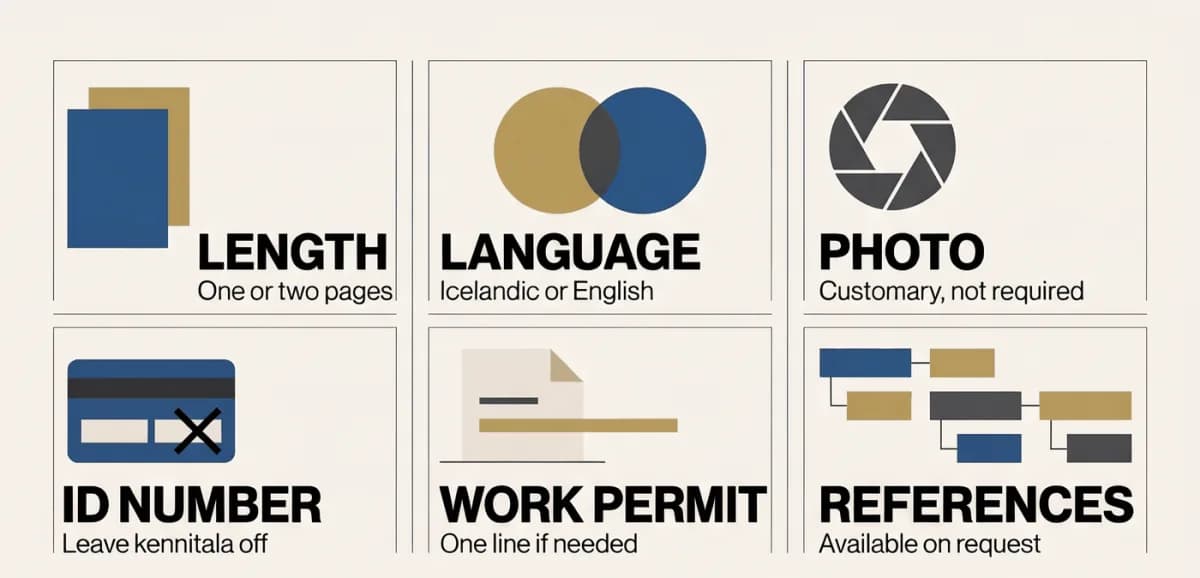
| Topic | Practice in 2026 | Law or official guidance |
|---|---|---|
| Length | One page for early-career candidates, two pages at most for experienced ones | Common advice; no official rule found |
| Language | Icelandic or English as the advert is written; most adverts are in Icelandic unless they are EURES listings, which are in English | Practice. Alfreð has a filter for jobs that do not require Icelandic[^3] |
| Photo | Customary in Iceland; optional if the advert or your sector suggests otherwise | VR calls it customary; we found no law that requires or bans a photo[^1] |
| Kennitala (national ID number) | Leave it off the CV. Give it to the employer once you have the job: it is needed for payroll, tax and a bank account | EEA/EFTA nationals get it from Registers Iceland; non-EEA residents receive it with the residence permit[^4] |
| Personal details you need not give | Marital status, children, family plans, religion, sexual orientation, union membership | VR advises leaving marital status and children off; the equal-treatment rules protect these areas (see the next section)[^1] |
| Work authorisation | One line if you need a permit (for example "Residence permit valid to June 2027"); EEA/EFTA citizens need no line | Practical advice only |
| References | "Available on request", or two named referees who agreed in advance | Practice. Persónuvernd's older findings say contacting a referee needs the applicant's consent[^5] |
| Cover letter (kynningarbréf) | One page, tied to the advert | Practice; no law requires it |
| File format | A plain, text-based PDF unless the advert says otherwise | Editorial advice; no official rule |
| Public-sector applications | Use the portal named in the advert; state vacancies appear on Starfatorg | Act 70/1996 art. 7 sets advertising rules for state vacancies[^6][^7] |
Equal treatment, personal data and fair hiring
Protected grounds
Act 86/2018 is the equal-treatment law for the labour market. Its article 1 lists eleven grounds: race, ethnic origin, religion, belief, disability, reduced working capacity, age, sexual orientation, gender identity, sex characteristics and gender expression. We could not open the Alþingi text, so this list comes from a search-index extract of the Act (likely, not read in full), and we did not confirm which article governs job adverts.
Act 150/2020 is the gender-equality law. Employers with 25 or more employees (annual average) must hold an equal-pay certification (jafnlaunavottun); employers with 25 to 49 employees may use an equal-pay confirmation (jafnlaunastaðfesting) instead; Jafnréttisstofa (the Equality Directorate) supervises, and certificates are renewed every three years according to a bill summary.[^8] State adverts may not signal a preferred sex, according to a 2013 ministry summary of the state employees act.[^6] We could not read the Act 150/2020 text, so we make no claim about what a rejected applicant may ask an employer.
There is no verified list of banned interview questions. The practical line is simple: the equal-treatment and gender-equality rules protect the areas above, so a question about pregnancy, family plans, religion or sexual orientation is a reason to ask Jafnréttisstofa or your union for advice, not a question you must answer.
Personal data in recruitment
Persónuvernd is the authority for personal data, and Act 90/2018 is the Icelandic data-protection act.[^9] We did not find current GDPR-era Persónuvernd guidance on social-media screening or on how long an employer may keep a CV, so we make no claim on either. Persónuvernd's older findings, issued under an act that has since been repealed, say that contacting a referee needs the applicant's consent and that unsuccessful applications were kept for about six months.[^5] Treat these as history, not current rules. Information about criminal records is a special category of personal data.
Criminal-record certificate (sakavottorð)
Only ask for or hand over a sakavottorð when the job needs it. The digital certificate is applied for on island.is with an Icelandic electronic ID, by anyone over 15; the fee is ISK 3,800 (about US$31 / JPY 4,900), paid by card, and the certificate is issued at once and sent to your mailbox. Without an electronic ID, for example soon after arrival, go to a sýslumaður (district commissioner) office with photo ID. The certificate is in Icelandic with an English translation. The digital version cannot be apostilled: for use abroad get the paper version and have the foreign ministry certify it.[^10]
Public-sector hiring
Under Act 70/1996 art. 7, state offices advertise vacancies in the Lögbirtingablaðið (official gazette) with a deadline of at least two weeks; other posts follow the finance ministry's advertising rules. This comes from a 2013 summary, so treat it as likely.[^6] State vacancies are collected on Starfatorg, which is now on island.is and listed 137 vacancies on 21 October 2026. We did not verify that Starfatorg is mandatory for state or municipal employers.[^7]
Structure of an Icelandic CV
This section is editorial advice, not law. A clean order helps both a human reader and an applicant tracking system (ATS):
- Contact details. Name, city, e-mail, phone, LinkedIn. No street address, no kennitala, no date of birth unless the advert asks.
- Profile. Three lines: your role, years of experience, the strongest result, and your right to work if you need a permit.
- Work experience in reverse chronology. Employer (or a description of it), city, dates, then three to five bullets that start with a verb and carry a number you can defend.
- Education and recognition. Official award names, plus a note if your degree has been assessed by ENIC-NARIC Iceland.
- Skills and languages. Show language levels (for example Icelandic B1, English C1), not adjectives. Mirror the advert's keywords honestly.
- Referees. "Available on request" is the safe default.
Use plain headings, one column, standard fonts and a text-based PDF so an ATS can read it; our ATS-friendly CV guide explains how.
Annotated fictional Icelandic CV
The sample is entirely fictional: person, employer, contacts and numbers. It sets no legal rule, and the employer is described generically on purpose. Replace every item with truthful information.
Katrín Dæmi, Logistics Coordinator · Reykjanesbær · [email protected] · +354 XXX XXXX · linkedin.com/in/katrin-daemi-example
*Annotation: fictional contacts. City only, no street address and no kennitala.*
Profile: Logistics coordinator with four years of experience planning container shipments for a seafood exporter. Holds an Icelandic bachelor's degree and works in Icelandic and English. Looking for a supply-chain role in Reykjavík or Reykjanesbær.
*Annotation: if you needed a permit, one factual line here ("Residence permit valid to June 2027") saves the screener a question. State only what your permit shows.*
Work experience: Logistics Coordinator, a Reykjavík-based seafood exporter (fictional) · Reykjavík · August 2022 to present
- Cut late deliveries on a weekly shipment route from 12% to 4% by changing the booking deadline.
- Wrote 20 shipping instructions in Icelandic and English.
- Coordinated a team of five dock staff during the busiest weeks.
*Annotation: employer and figures are fictional. If you cannot name the firm, name the sector and use numbers you can defend at interview.*
Work experience: Warehouse Assistant, an Akureyri-based food wholesaler (fictional) · Akureyri · June 2020 to July 2022
- Built a spreadsheet that cut stock-count time from three hours to one.
*Annotation: one strong bullet beats a list of duties.*
Education: B.Sc. in Logistics, Example University (fictional), Reykjavík, 2022.
*Annotation: keep the official name of the award.*
Skills and languages: Excel · SAP (basic) · Icelandic (B2) · English (C1) · Polish (native)
*Annotation: lead with what the advert asks for.*
References: Available on request.
*Annotation: do not print referees' contact details, and ask them before you name them.*
Cover letter, references and documents
Kynningarbréf (cover letter). Keep it to one page: why this employer, two or three proofs from your CV, and when you can start. It is convention, not law; if the advert asks for a letter, write one in the advert's language.
Contract and statement of terms. For a hire of more than one month and more than eight hours a week, the written employment contract, or the employer's written confirmation of the terms, is due no later than two months after work begins. It covers the parties, the workplace, the job description, the start date, the duration if temporary, holiday entitlement and pay, notice periods, pay and pay dates, normal working time, the pension fund, and the governing collective agreement and union. Items on holiday, pay, hours and notice may refer to the collective agreement.[^11][^12]
Probation and notice. Probation is set by the collective agreement, not by one national rule. ASÍ's table for collective agreements shows no notice in the first month and a one-week notice during a three-month trial period in some agreements, then one month; the SGS–SA agreement gives none in the first two weeks, 12 calendar days afterwards, one month after three months and three months after three years.[^13][^14] Read your own agreement.
Kennitala, personal tax credit and bank. EEA/EFTA nationals apply in person at Registers Iceland; non-EEA residents receive the number with the residence permit. You need it for payroll and a bank account.[^4] There is no separate tax card: you tell your employer how to apply your personal tax credit (persónuafsláttur), which is ISK 72,492 a month in 2026 (about US$594 / JPY 93,900).[^15]
Foreign qualifications and regulated professions
- Academic degrees. ENIC-NARIC Iceland evaluates foreign university qualifications. The service is free; you send a certificate and transcript with an English or Icelandic translation, a decision follows after several weeks, and it is advisory only with no appeal.[^16]
- Health professionals need a licence from Landlæknir (the Directorate of Health). Applications can be in Icelandic or English, originals or certified translations go by post or hand delivery (e-mail is not accepted), EEA applicants follow Directive 2005/36/EC and applicants from outside the agreement countries follow Regulation 483/2023. We could not confirm a general Icelandic-language exam, a fee or a processing time, so ask Landlæknir.[^17]
- Teachers receive one teaching licence for all school levels from the Ministry of Education and Children.[^18]
- Crafts and trades are recognised with professional assessors, and the licence is issued by the District Commissioner (the East Iceland office handles it nationwide).[^19]
- Language. Most adverts are in Icelandic; international firms and EURES listings often use English. Name your Icelandic level honestly, and use the Alfreð filter for jobs that do not require it.[^3]
Pay: agreement minimum rates and take-home pay
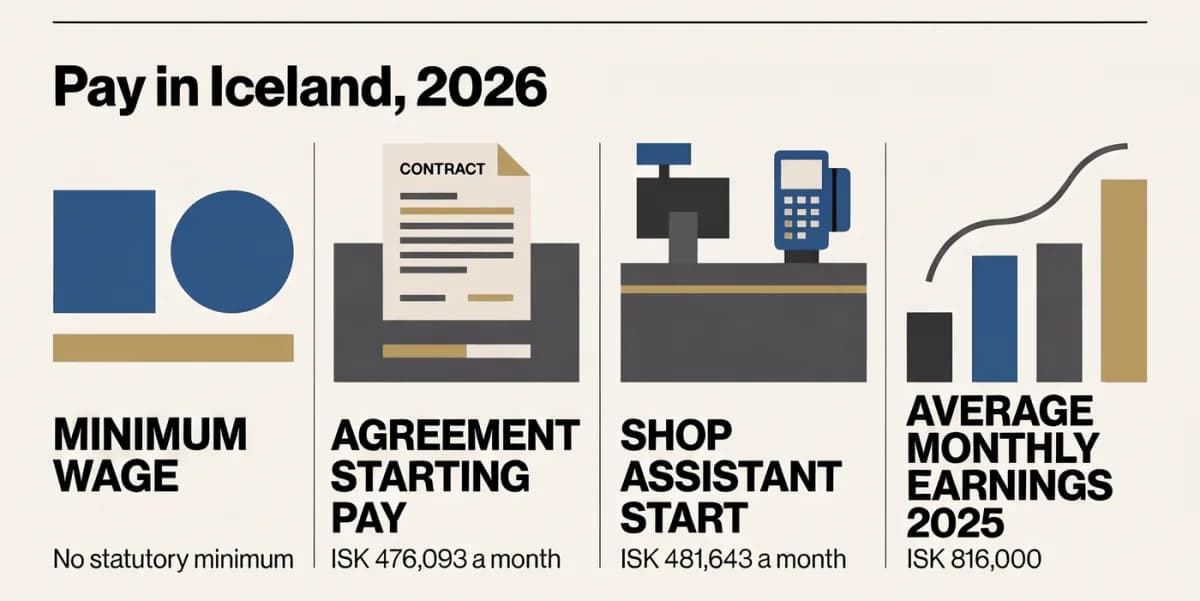
Iceland has no statutory minimum wage. Pay and terms agreed by the social partners are minimum terms for every worker in the occupation and area, whatever their nationality or union membership, and a worse individual contract is void (Act 55/1980, art. 1 as cited by ASÍ; the Act's title is "lög um starfskjör launafólks og skyldutryggingu lífeyrisréttinda").[^20] The 2024 SA agreements raised monthly pay by 3.25% or ISK 23,750 on 1 February 2024 and by 3.50% or ISK 23,750 on 1 January of 2025, 2026 and 2027.[^21] Pay rates rose a further 0.06% from 1 April 2026.[^22] After an inflation dispute in October 2026 the agreements stayed in force but were reported to be shortened, so we do not state an end date.[^23]
| Agreement | Group | Monthly rate (ISK) | About | Valid from |
|---|---|---|---|---|
| SA–Efling/SGS | Grade 4, starting pay | 476,093 | US$3,900 / JPY 616,500 | 1 January 2026 |
| SA–Efling/SGS | Grade 4, after 1 year | 480,854 | US$3,940 / JPY 622,700 | 1 January 2026 |
| SA–Efling/SGS | Grade 4, after 3 years | 488,067 | US$4,000 / JPY 632,000 | 1 January 2026 |
| SA–Efling/SGS | Grade 4, after 5 years | 497,828 | US$4,080 / JPY 644,700 | 1 January 2026 |
| SA–Efling/SGS | Grade 10, starting pay | 492,902 | US$4,040 / JPY 638,300 | 1 January 2026 |
| SA–Efling/SGS | Grade 24, starting pay | 534,471 | US$4,380 / JPY 692,100 | 1 January 2026 |
| VR/LÍV (retail) | Shop assistants, starting pay | 481,643 | US$3,950 / JPY 623,700 | 1 January 2026 |
The SA–Efling/SGS rows come from the pay table in force from 1 January 2026; the 0.06% supplement of 1 April 2026 comes on top, which lifts grade 4 starting pay to about ISK 476,379 by our arithmetic.[^24][^25][^22] The VR/LÍV figure comes from a Labour Court judgment of 12 February 2026.[^21] The same table sets a holiday bonus of ISK 62,000 (about US$508 / JPY 80,300) on 1 June 2026 and a December bonus of ISK 114,000 (about US$935 / JPY 147,600) for full-time staff in 2026.[^24] Young workers are paid a share of starting pay: 89% at 17 years, 84% at 16, 71% at 15 and 62% at 14, and 95% at 18 to 21 during a training period.[^24]
Overtime is paid at 1.0385% of monthly day-work pay for each hour, and work on major public holidays at 1.375%.[^26]
Average pay. Statistics Iceland's preliminary 2025 survey (published 13 May 2026) puts average regular monthly earnings of employees at ISK 816,000 (about US$6,690 / JPY 1.06 million). For full-time staff the regular median is ISK 826,000 (about US$6,770 / JPY 1.07 million), the regular mean ISK 913,000 (about US$7,480 / JPY 1.18 million) and the mean of total earnings ISK 1,058,000 (about US$8,670 / JPY 1.37 million); the median of total earnings is ISK 1,007,000 for men and ISK 902,000 for women. The survey covers firms with ten or more employees.[^27] The average is not a floor.
Illustrative take-home pay
This is a worked example, not a payroll quote. It takes a gross monthly salary of ISK 500,000 (about US$4,100 / JPY 647,500), the 4% employee pension contribution deducted before withholding, the 2026 withholding rate of 31.49% and the personal tax credit. Union dues are left out because we could not verify them, and the real municipal rate depends on where you live.[^28][^15]
| Item | Amount (ISK) | About |
|---|---|---|
| Gross monthly salary | 500,000 | US$4,100 / JPY 647,500 |
| Employee pension, 4% | 20,000 | US$164 / JPY 25,900 |
| Taxable pay | 480,000 | US$3,940 / JPY 621,600 |
| Tax at 31.49% | 151,152 | US$1,240 / JPY 195,700 |
| Personal tax credit | -72,492 | US$594 / JPY 93,900 |
| Withholding | 78,660 | US$645 / JPY 101,900 |
| Net pay after pension and withholding | 401,340 | US$3,290 / JPY 519,700 |
On top of the gross salary the employer pays a pension contribution of 11.5% (ISK 57,500) and the social-insurance levy of 6.35% (ISK 31,750).[^28][^29]
What this means: agreement rates are floors, not typical salaries: grade 4 starting pay is ISK 476,093 a month, and the average regular monthly wage is ISK 816,000. On a salary of ISK 500,000, with a 4% pension and tax, about four-fifths reaches your account. Ask which agreement and grade your job falls under before you compare offers.
Iceland's economy in numbers
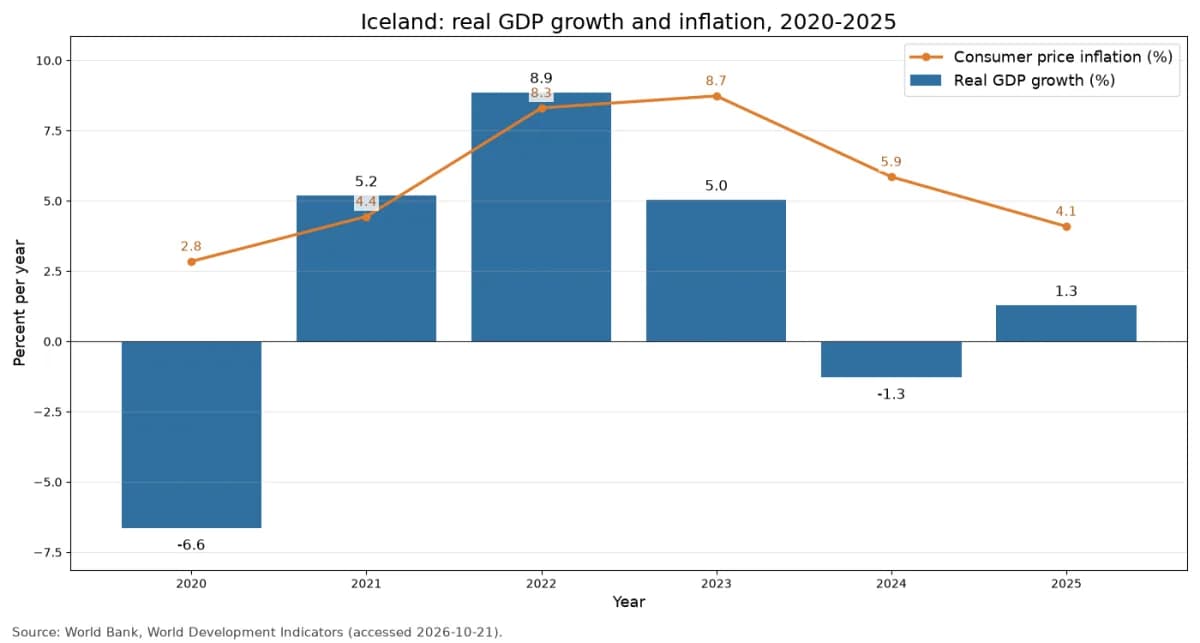
| Indicator | 2020 | 2021 | 2022 | 2023 | 2024 | 2025 |
|---|---|---|---|---|---|---|
| GDP (USD billion) | 22.0 | 26.2 | 29.2 | 31.7 | 33.2 | 38.6 |
| GDP per person (USD) | 60,128 | 70,425 | 76,377 | 82,201 | 85,863 | 98,323 |
| Real GDP growth (%) | -6.6 | 5.2 | 8.9 | 5.0 | -1.3 | 1.3 |
| Inflation (%) | 2.8 | 4.4 | 8.3 | 8.7 | 5.9 | 4.1 |
| Population (million) | 0.37 | 0.37 | 0.38 | 0.39 | 0.39 | 0.39 |
*Source: World Bank, World Development Indicators (accessed 21 October 2026).*[^30]
The World Bank's ILO-modelled unemployment rate for 2025 is 3.6 per cent, and 8.7 per cent for ages 15 to 24; its estimate of the international migrant stock for 2024 is 98,818 people.[^30] Iceland's own statistics give a cooler picture for 2026: Statistics Iceland's labour force survey showed a trend unemployment rate of 5.8 per cent in August 2026 (11.1 per cent for ages 16 to 24), the 2025 annual average was 4.3 per cent, Vinnumálastofnun counted registered unemployment of 4.0 per cent in September 2026, consumer prices rose 5.9 per cent in the year to September 2026, and the Central Bank's key rate has been 8.00 per cent since 7 October 2026.[^31][^32][^33] The figures differ because they use different definitions, ages and years.
What this means: a small, rich economy where unemployment is higher than a year ago (registered unemployment was 3.5 per cent in September 2025)[^32] and inflation is still near 6 per cent. Employers still hire, but expect a competitive process, and compare offers in real terms.
Work permits and rules for foreign workers
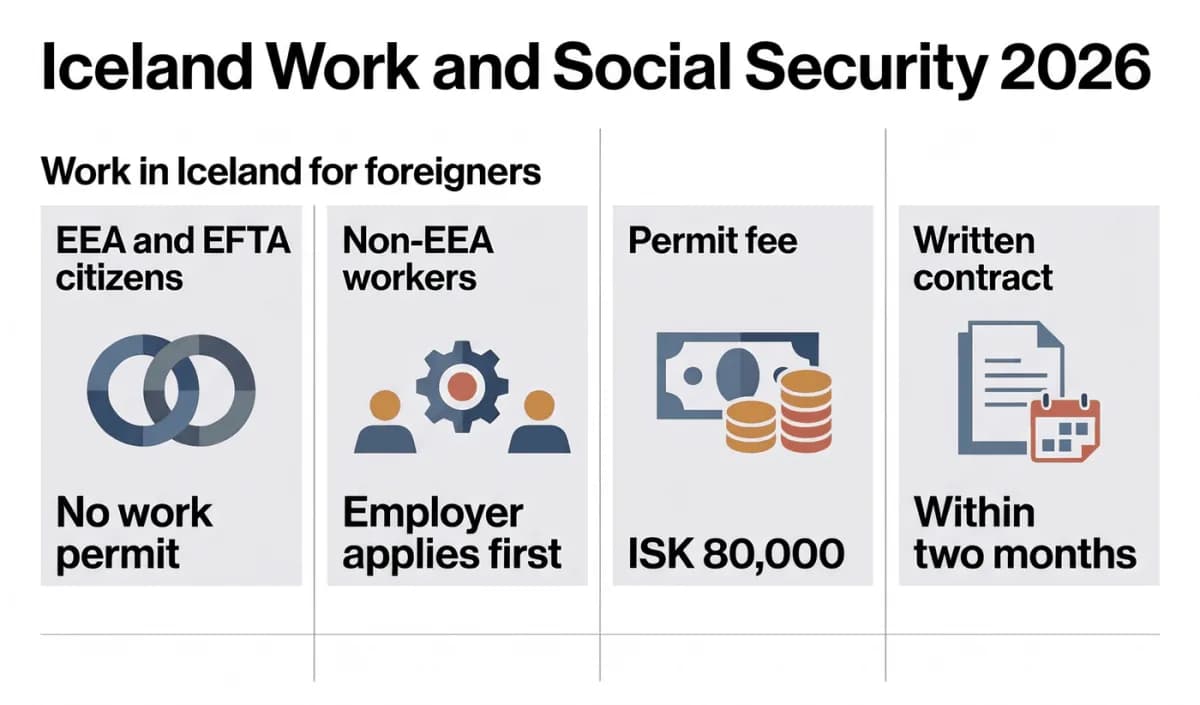
Nordic and EU/EEA/EFTA citizens. Citizens of EEA and EFTA states, which includes the Nordic countries, Poland and Lithuania, need no work permit. They may live and work with or without registering, may register from three months, and registration with Registers Iceland is mandatory if they stay six months or longer. For work under six months an EEA citizen gets a system ID (kennitala-kerfi) through Skatturinn.[^34] The EURES application form states that only EEA citizens can apply through it.[^35]
Non-EEA nationals. A work permit is needed before you start. Act 79/2026, signed on 30 June 2026 and in force from 8 July 2026 according to the authorities, moved the issuing of temporary work permits from Vinnumálastofnun to Útlendingastofnun (the Directorate of Immigration); it amended Act 80/2016 and Act 97/2002, and pending applications went to Útlendingastofnun. The permit categories themselves still rest on Act 97/2002.[^36][^37] The employer applies, you may not start before the permit is granted, and the permit ties you to one employer; starting early can mean fines or up to two years in prison. Short-term work of 90 days or less may be exempt if the employer notifies Vinnumálastofnun beforehand.[^38]
- Specialist permit (Act 97/2002 art. 8). For work that needs recognised university, trade, art or technical education; the employer must first have asked Vinnumálastofnun to help find staff in Iceland and the EEA/EFTA area. It is normally granted for one year and up to four years at a time; the page states no salary requirement. After a job loss a 12-month residence permit lets you look for work.[^39]
- Shortage permit (art. 9). Only exceptionally; the first permit lasts up to one year and up to two years in total, tied to one employer, with a six-month residence permit after a job loss.[^40]
- Fee and waiting time. The fee for a work-based residence permit, first or renewed, is ISK 80,000 (about US$656 / JPY 103,600), and the expedited-service fee has been abolished. On 7 October 2026 Útlendingastofnun said first-time permits averaged two months in 2026 but that it was handling applications received in June, so plan for several months.[^41][^42][^43]
UK nationals. We did not find an official page in our sources that sets out the route for UK citizens, so check with Útlendingastofnun which permit applies to you. The United Kingdom is one of the partner countries on the island.is working-holiday page, with an age limit of 18 to 30.[^44]
Students and graduates. Holders of a residence permit for study may work up to 60% of a full-time post without a separate work permit under the July 2026 changes.[^37] Degrees may need recognition (see above).
Ukrainians. Hagstofa counts 4,636 Ukrainian citizens resident on 1 January 2026; that is a count of citizens, not of people under protection.[^31] We did not verify the work rights of people under collective protection, so ask Útlendingastofnun or Vinnumálastofnun.
Remote workers. The long-term visa for remote workers allows a stay of up to 180 days if applied for before arrival, or 90 days if applied for from inside the Schengen area; it forbids work for Icelandic clients or in the domestic labour market, is allowed once in 12 months, and needs an employer's confirmation or proof of genuine self-employment. This comes from a search extract of the regulation (likely). We could not confirm any income threshold, so check the current requirement with Útlendingastofnun.[^45]
Japanese nationals
Japan is on the Schengen visa-exempt list, so Japanese citizens can visit for up to 90 days in any 180 days.[^46] The Japan-Iceland working-holiday scheme began on 1 September 2018, and the Japanese foreign ministry lists an annual quota of 30.[^47] For Japanese applicants the island.is page says: age 18 to 26 at application, a permit of up to one year that cannot be renewed, no fee, a paper application only (legal basis Act 80/2016 art. 66), and an unrestricted right to work. You must live in Japan, must not have held an Icelandic working-holiday permit and must not intend to settle. You need means of ISK 259,951 a month for three months (about US$2,130 / JPY 336,600; cash is not accepted) and health insurance valid for at least three months with minimum cover of ISK 2,000,000 (about US$16,400 / JPY 2.59 million). Another island.is page lists 18 to 30 for all partner countries, so check with Útlendingastofnun before you apply. Working-holiday permits averaged five months to process in 2026.[^48][^49][^44][^43]
The Japanese foreign ministry's survey counted 191 Japanese nationals in Iceland on 1 October 2025 (98 long-term residents and 93 permanent residents), while Hagstofa registered 99 Japanese citizens on 1 January 2026; the two counts use different definitions.[^50][^31]
Japan and Iceland have no social security agreement: Japan had 24 agreements in force, and Iceland is not among them (status page updated 2 March 2026). The Japan-Iceland tax convention was signed in January 2018, entered into force on 31 October 2018 and applies from 1 January 2019.[^51][^52]
Foreign workers in numbers
| Measure | Value |
|---|---|
| Population, 1 January 2026 | 394,324[^31] |
| Foreign citizens | 70,555, or 17.9% of residents[^31] |
| Immigrants (born abroad) | 77,226, or 19.6% of residents[^31] |
| Immigrants among those in register-based employment, August 2026 | 59,457 of 235,156, or 25.3%[^31] |
| Resident citizens of Poland | 23,329[^31] |
| Resident citizens of Lithuania | 4,725[^31] |
| Resident citizens of Ukraine | 4,636[^31] |
| Resident citizens of Romania | 3,972[^31] |
| Resident citizens of Latvia | 2,535[^31] |
These are counts of residents by citizenship, not of workers by citizenship; we found no official table of employed people by citizenship. The employment row counts people born abroad, which is a different definition from citizenship.
Labour law: hours, leave, notice and dismissal
We could not open the Alþingi law texts, so the article numbers below come from sources that quote the statutes: ASÍ, SA and island.is. Confirm them with your union.
| Topic | Rule | Source or law |
|---|---|---|
| Working time | Act 88/1971 is the 40-hour-week act. Agreements set 8 hours a day and 40 hours a week including paid breaks, with effective hours of 37h05 under the SGS/Efling agreement, 35h30 in office work and 36 hours for craftsmen; do not assume one national figure[^53][^54] | Act 88/1971; agreements |
| Overtime | 1.0385% of monthly pay for each hour; it starts after 8 hours a day for workers and after the full monthly hours for retail and office staff[^55] | SA–ASÍ agreements |
| Rest | 11 hours of continuous rest per 24 hours; at most 48 effective hours a week on average, with a six-month reference period according to SA[^56] | Act 46/1980; agreements |
| Annual leave | 24 working days (two days per month worked); agreements add days by seniority or age; Sundays, public holidays and the first five Saturdays do not count[^57] | Act 30/1987 art. 3 |
| Holiday pay | At least 10.17% of total pay[^58] | Act 30/1987 art. 7 |
| Sick pay | Two days after one month, 6 days after three months, 12 days after six months and one month after one year under the SGS–SA table, more with seniority; employers pay 1% of wages to the union sickness fund[^59] | Act 19/1979; agreements |
| Notice | One month after one year in the trade, two months after three years with the same employer, three months after five years; a shorter period in the contract is void[^14] | Act 19/1979 arts. 1 and 10 |
| Collective redundancy | Over 30 days: at least 10 workers in firms of more than 20 and fewer than 100, 10% in firms of 100 to 299 and at least 30 in firms of 300 or more; consult union representatives and notify Vinnumálastofnun[^60] | Act 63/2000 |
We found no general statutory severance payment in the sources we read, but we did not verify this and we did not verify the statutory grounds for dismissal, so ask your union before relying on either.
2026 public holidays
The dates follow the rules in Act 88/1971 art. 6 and Act 32/1997 art. 2 as described by ASÍ, and the weekdays are computed from them.[^61]
| Holiday | 2026 date |
|---|---|
| New Year's Day | Thursday 1 January |
| Maundy Thursday | Thursday 2 April |
| Good Friday | Friday 3 April |
| Easter Sunday | Sunday 5 April |
| Easter Monday | Monday 6 April |
| First Day of Summer | Thursday 23 April |
| Labour Day | Friday 1 May |
| Ascension Day | Thursday 14 May |
| Whit Sunday | Sunday 24 May |
| Whit Monday | Monday 25 May |
| National Day | Wednesday 17 June |
| Commerce Day | Monday 3 August |
| Christmas Eve | Thursday 24 December (off from 13:00; church holiday from 18:00) |
| Christmas Day | Friday 25 December |
| Boxing Day | Saturday 26 December |
| New Year's Eve | Thursday 31 December (off from 13:00) |
Boxing Day falls on a Saturday, so it gives no weekday off; ask whether the afternoon off on 24 and 31 December is paid under your agreement.
What this means: expect a 40-hour contractual week, overtime at about 1% of monthly pay per hour, 24 days of leave plus agreement extras, and notice that starts at one month after a year of service. In your first year the agreement, not the Act, sets your notice.
Social security: what you pay and what you get
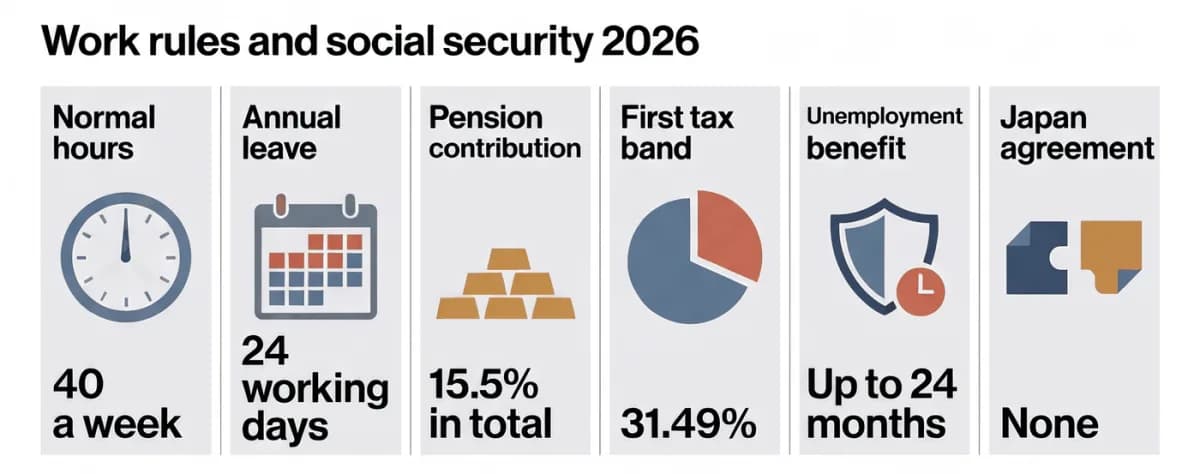
| Item | 2026 rule |
|---|---|
| Social-insurance levy (tryggingagjald) | 6.35% of pay, paid by the employer, not deducted from your salary; fishing-vessel crews carry an extra 0.65%, 7.00% in total[^28] |
| Mandatory pension | At least 15.5% of pay: 4% from the employee and 11.5% from the employer under the agreements; your 4% is deducted before withholding. If you add 2% of voluntary savings the employer matches 2%[^29] |
| Pension refund for people who leave | Act 129/1997 art. 19(4): funds may refund contributions to foreign nationals who leave Iceland if the fund's rules allow and no international agreement forbids it; EEA nationals cannot be refunded[^62] |
| Unemployment benefit | Basic benefit ISK 383,870 a month (about US$3,150 / JPY 497,100) at 100% entitlement; income-linked benefit of 70% of average pay, capped at ISK 605,159 a month (about US$4,960 / JPY 783,700), for 3 months after the first 2 weeks of basic benefit[^63] |
| Sick pay | Employer sick pay under Act 19/1979 and the agreements (see the labour law table) |
| Parental leave | Six months per parent, up to six weeks transferable; 80% of average pay up to ISK 900,000 a month (about US$7,380 / JPY 1.17 million) for leave from 1 January 2026[^64] |
| State pension | Full rights need 40 years of residence between ages 16 and 67; less residence gives a proportional pension[^65] |
| Health insurance | People moving from outside the EEA wait three months after registering legal residence (law approved 1 June 2026, mostly in force 1 August 2026); EEA movers insured in a public scheme abroad are insured once the previous country confirms it[^66] |
| Japan | No Japan-Iceland social security agreement[^51] |
- Unemployment benefit conditions. Iceland does have unemployment benefit (Act 54/2006). It is for ages 18 to 70 who have worked in Iceland, can work and are legally domiciled in Iceland. From 1 September 2026 the minimum qualifying period is seven months at 25% working time or more (it was three months). For claims from 1 July 2026 the maximum benefit period is 24 months (people already claiming keep 30). Newly arrived EEA workers can use the U1 certificate to add insurance periods.[^67][^68][^69]
- Parental leave. You need six months of continuous work in Iceland (at least 25% each month; work in another EEA state can count). The minimum payment is ISK 275,688 a month (about US$2,260 / JPY 357,000) for a 50% to 100% job.[^64]
- Pension refund. The rule above lets a fund refund contributions to a non-EEA worker who leaves, under the fund's own rules; it is not limited to the employee's 4%. Ask the fund before you leave.[^62]
What this means: 4% of your gross pay goes to a pension and the employer pays 11.5% on top, while the 6.35% levy is an employer cost. Because the unemployment rules changed in July and September 2026, check the Vinnumálastofnun pages before you plan around them.
Taxes on employees
Iceland withholds income tax monthly in three bands. The rates below are the 2026 withholding rates and include the average municipal tax (útsvar) of 14.94% used in withholding:[^28]
| Monthly income (ISK) | Withholding rate | Of which state tax |
|---|---|---|
| 0 to 498,122 (about US$4,080 / JPY 645,100) | 31.49% | 16.55% |
| 498,123 to 1,398,450 (about US$11,500 / JPY 1.81 million) | 37.99% | 23.05% |
| Above 1,398,450 | 46.29% | 31.35% |
- Personal tax credit. ISK 72,492 a month in 2026 (ISK 869,898 a year), applied through your employer; unused credit accumulates within the year but does not carry over between years.[^15]
- Útsvar and Japan's resident tax. Útsvar is the municipal income tax and the nearest thing to Japan's resident tax (住民税, juminzei). Unlike juminzei it is not a separate bill: it is withheld together with the state income tax in the same monthly deduction, and the true municipal rate is settled at the annual assessment, with any difference paid or refunded. The legal maximum rate in 2026 is 14.97% (likely), the withholding system uses the average of 14.94%, and we did not verify the lowest rate.[^28][^70][^71]
- Capital income is taxed at 22%, with an exemption of ISK 300,000 per person on interest and listed-share income.[^72]
- Tax residence. You are tax-resident if you are domiciled in Iceland or stay more than 183 days in any 12-month period.[^73]
- Foreign expert relief. Since 1 January 2017, 25% of pay can be excluded from tax for the first three years of employment. It needs an application, and the conditions include no residence in Iceland in the previous 60 months, scarce expertise and an Icelandic employer.[^74]
- VAT. Two rates: 24% standard and 11% reduced, which covers food, restaurant meals, hotel rooms and books.[^75][^76]
- 2027. A budget bill presented on 7 September 2026 is reported to propose indexing the brackets and the credit for 2027. This is a proposal, reported by secondary summaries only, and we found no official 2027 amounts, so do not plan on any.
What this means: compare offers on net pay. The first ISK 498,122 a month is withheld at 31.49%, less the personal credit; the top band of 46.29% applies above ISK 1,398,450 a month. Employer tryggingagjald is never deducted from you.
Where to find jobs, recruitment agencies and job scams
- Job boards. Alfreð showed about 522 jobs on 21 October 2026, Starfatorg 137 state vacancies and the Vinnumálastofnun list on island.is carries EURES vacancies.[^3][^7][^77] The full comparison is in our Iceland job-board guide.
- Agencies and specialist boards. Hagvangur and Intellecta are recruitment firms, and Tvinna and Icejob are specialist and aggregator boards; all loaded on 21 October 2026.
- Temporary-work agencies. Under Act 139/2005 (lög um starfsmannaleigur) agencies must register with Vinnumálastofnun, may not charge their workers a fee and must pay the pay they would get directly from the user company.[^78]
- Scams. We found no current official fraud warning for Iceland; the only police notice on island.is dates from 2006 and concerns fake e-mail job offers used for money-mule transfers.[^79] The points below are editorial advice. Never pay for a job, an interview or a permit: the employer applies for a non-EEA work permit.[^38] Do not lend your bank account or move money for someone else. Do not send passport scans or your kennitala before you have checked the employer's legal name and careers page. Human trafficking is an offence under Penal Code art. 227 a, according to Althingi documents we could not load; if you are pressured or deceived about a job, contact the police or your union.[^80]
Final checks before you apply
- [ ] The CV is one to two pages, in Icelandic or English as the advert is written, latest job first.
- [ ] No kennitala on the CV or the cover letter.
- [ ] One line on work authorisation if I need a permit.
- [ ] The kynningarbréf is one page and answers the advert.
- [ ] I know which collective agreement and grade cover the job, and the offer is at or above the 2026 table (for example ISK 476,093 for grade 4 starting pay).
- [ ] If I need a non-EEA permit, the employer has applied and I will not start work before it is granted.
- [ ] I will get a written contract or confirmation of terms within two months of starting, and I know the notice terms.
- [ ] I have told the employer how to use my personal tax credit and I know 4% of my pay goes to pension.
- [ ] Nobody has asked me for a fee, and any agency is on Vinnumálastofnun's register.
FAQ
What is the standard Icelandic CV format?
There is no legal template. A clear CV of one to two pages in reverse chronological order, in Icelandic or English as the advert is written, without your kennitala, is the safe default. A photo is customary according to VR.
Should an Icelandic CV include a photo?
It is customary, but no law requires or bans one. Follow the advert and the norms of your sector, and keep marital status and children off the CV.
Do I have to give my kennitala when I apply?
No. Leave it off the CV and the cover letter. You need it once you are hired, for payroll, tax and a bank account: EEA/EFTA nationals apply at Registers Iceland, and non-EEA residents receive it with the residence permit.
Does Iceland have a minimum wage?
There is no statutory minimum wage. Collective agreements bind every employer in the trade. In the SA–Efling/SGS table valid from 1 January 2026, grade 4 starting pay is ISK 476,093 a month (about US$3,900 / JPY 616,500) and grade 24 starting pay is ISK 534,471 (about US$4,380 / JPY 692,100).
When must I get a written contract?
For a job of more than one month and more than eight hours a week, the written contract or the employer's written confirmation of the terms is due no later than two months after you start.
Do I need a work permit?
EEA and EFTA citizens do not. Non-EEA nationals need a permit before starting, applied for by the employer; since 8 July 2026 Útlendingastofnun issues temporary work permits. The fee is ISK 80,000 (about US$656 / JPY 103,600) and you should plan for several months.
Can Japanese citizens work in Iceland on a Working Holiday?
Yes. The island.is page for Japanese applicants says age 18 to 26 at application, a permit of up to one year with no renewal, no fee, a paper application and an unrestricted right to work. Another island.is page lists 18 to 30 for partner countries, so confirm with Útlendingastofnun before you apply.
How much income tax will I pay?
In 2026, withholding is 31.49% on monthly income up to ISK 498,122, 37.99% up to ISK 1,398,450 and 46.29% above, including the average municipal tax of 14.94%, less a personal credit of ISK 72,492 a month. On a gross salary of ISK 500,000 with 4% pension, withholding is about ISK 78,660 and net pay about ISK 401,340.
Is there unemployment benefit in Iceland?
Yes. The basic benefit is ISK 383,870 a month at full entitlement, with income-linked benefit of 70% of average pay, capped at ISK 605,159, for three months after the first two weeks. From 1 September 2026 you need seven months of work at 25% or more, and for claims from 1 July 2026 the maximum period is 24 months.
Can a recruitment agency charge me?
No. Temporary-work agencies may not charge their workers a fee and must be on Vinnumálastofnun's register. If anyone asks you to pay for a job, an interview or a permit, walk away.
How to use AIResume
Keep one master CV in AIResume and cut a version for each vacancy: use the advert's keywords, lead with your strongest result and add the right-to-work line if you need it. Leave out your kennitala, export a text-based PDF and check it with our ATS-friendly CV guide before you apply.
Related AIResume guides
- Job boards in Iceland
- Job boards in Norway
- Job boards in Denmark
- Job boards in Sweden
- United Kingdom CV format
- Switzerland CV format
- How to write an ATS-friendly CV
Sources
[^1]: VR, for job seekers
[^2]: Central Bank of Iceland, official exchange rates (28 October 2026)
[^3]: Alfreð, all jobs (checked 21 October 2026)
[^4]: island.is, national ID numbers for immigrants
[^5]: Persónuvernd, audit report of 2004 (historic findings)
[^6]: Ministry of Finance, summary of the state employees act (2013)
[^7]: Starfatorg on island.is (checked 21 October 2026)
[^8]: Government of Iceland, equal-pay certification (2020 news item)
[^9]: Persónuvernd on island.is
[^10]: island.is, criminal record certificate (sakavottorð)
[^11]: ASÍ, written statement or contract of employment
[^12]: island.is, working in Iceland
[^13]: ASÍ, notice periods under collective agreements
[^14]: ASÍ, notice periods (Act 19/1979)
[^15]: island.is, personal tax credit
[^16]: island.is, evaluation of foreign university qualifications (ENIC-NARIC)
[^17]: island.is, health professional licence: documents
[^18]: island.is, teaching licence
[^19]: island.is, recognition of the professional rights of foreign craftsmen
[^20]: ASÍ, wages and working time (Act 55/1980)
[^21]: Labour Court judgment of 12 February 2026 (VR–SA agreement pay steps and retail starting pay)
[^22]: Efling, wage-drift supplement from 1 April
[^23]: Vísir, opinion piece on when to terminate the agreements (October 2026; press report)
[^24]: SA–Efling/SGS pay table from 1 January 2026
[^25]: Efling, contractual pay increases in January
[^26]: VR, overtime and major-holiday work
[^27]: Hagstofa, wage distributions in the Icelandic labour market 2025
[^28]: Skatturinn, withholding 2026
[^29]: SA, pension funds
[^30]: World Bank, World Development Indicators: Iceland (accessed 21 October 2026)
[^32]: Vinnumálastofnun, registered unemployment in September 2026 (published 9 October 2026)
[^33]: Central Bank of Iceland, key rate and inflation
[^34]: Registers Iceland, EEA/EFTA citizen employed, staying more than six months
[^35]: EURES Iceland on island.is
[^36]: island.is Stjórnartíðindi, Act 79/2026 (issuing of residence and work permits)
[^37]: Útlendingastofnun, new rules on residence and work permits take effect
[^38]: island.is, apply for a work permit
[^39]: island.is, work permit for jobs requiring specialist knowledge
[^40]: island.is, work permit for shortage of staff
[^41]: island.is, residence permit based on work
[^42]: Útlendingastofnun, processing fees
[^43]: Útlendingastofnun, waiting time
[^44]: island.is, age requirements for a working-holiday permit
[^45]: Regulation 540/2017 on island.is (long-term visa for remote workers; search extract)
[^46]: island.is, entry requirements: bilateral agreements on extended stay
[^47]: MOFA, working holiday
[^48]: island.is, working-holiday permit
[^49]: island.is, working-holiday permit requirements
[^50]: MOFA, survey of Japanese nationals abroad, 1 October 2025 (e-Stat file)
[^51]: Japan Pension Service, social security agreement status
[^52]: Ministry of Finance Japan, Japan-Iceland tax convention
[^53]: SA, day work
[^54]: VR, working hours
[^55]: SA, overtime
[^56]: SA, rest periods
[^57]: ASÍ, accrual and length of holiday (Act 30/1987)
[^58]: ASÍ, calculation of holiday pay
[^59]: ASÍ, sick pay rights
[^60]: ASÍ, collective redundancies
[^61]: ASÍ, extra days off under the 40-hour-week act
[^62]: Ministry of Finance, foreign parties and pension funds
[^63]: Vinnumálastofnun, unemployment benefit amounts and calculation
[^64]: island.is, parental leave amounts and calculation
[^65]: island.is, residence ratio for the state pension
[^66]: Iceland Health, extensive changes to the law on health insurance (11 June 2026)
[^67]: Vinnumálastofnun, right to unemployment benefit
[^68]: Vinnumálastofnun, changes to the unemployment insurance act
[^69]: Vinnumálastofnun, legal changes from 1 July 2026
[^70]: Skatturinn, income tax and municipal tax
[^71]: Klaustur municipality, 2026 budget overview (útsvar at the legal maximum; secondary evidence)
[^72]: Skatturinn, key figures and percentages 2026
[^73]: Skatturinn, general tax liability
[^74]: Skatturinn, foreign experts
[^75]: Ministry of Finance, value-added tax
[^76]: island.is, VAT guide: sale of accommodation
[^77]: Vinnumálastofnun, vacancies on island.is
[^78]: ASÍ, temporary agency workers
[^79]: Ríkislögreglustjóri, warning about fake job offers (21 December 2006)
[^80]: Althingi, document on Penal Code art. 227 a (search hit, not loaded)
Your next step
- DeelFor employers hiring across borders: contracts, payroll and visas handled.See how Deel works
Affiliate links: we may earn a commission at no cost to you. Affiliate link