

Austria Job Search in 2026: Job Boards, Collective-Agreement Pay, Permits and Labour Law
Austria is a high-wage, social-partnership labour market of about 9.2 million people in which collective agreements (Kollektivverträge) set pay for almost every employee. Industry, tourism, trade, construction, health care and the international organisations in Vienna are the sectors most readers wi
By AIResume Editorial Team
Last updated: 21 October 2026
Austria is a high-wage, social-partnership labour market of about 9.2 million people in which collective agreements (Kollektivverträge) set pay for almost every employee. Industry, tourism, trade, construction, health care and the international organisations in Vienna are the sectors most readers will meet. German is needed for most jobs, and what you earn depends far more on the agreement that covers your employer than on your negotiating skills.
This guide covers the economy in numbers, where to search, how pay floors work when there is no statutory minimum wage, work and residence permits for EU/EEA and non-EU applicants, labour law, public holidays, social security, income tax and what Austrian employers expect in a CV. For other markets, see our guides to job boards in Switzerland, Belgium and France.
Editorial boundary: This is practical job-search guidance, not legal, immigration or tax advice. We only list figures we could read in an official or primary source, and we mark those that come from press reports or a single professional summary as "reported" or "likely". Confirm details with the AMS (Arbeitsmarktservice, the public employment service), migration.gv.at and the Austrian Business Agency (ABA), the Federal Ministry of Finance (BMF), Statistik Austria, the ÖGK and the Dachverband of social insurance, the Austrian National Bank (OeNB) and ECB, the law texts in the RIS legal database, the WKO collective-agreement tables or your employer before you sign.
Before you apply
- SafetyWing Nomad InsuranceHealth insurance that works in your new country from day one.Get a quote
Affiliate links: we may earn a commission at no cost to you. Affiliate link
Austria's economy in numbers
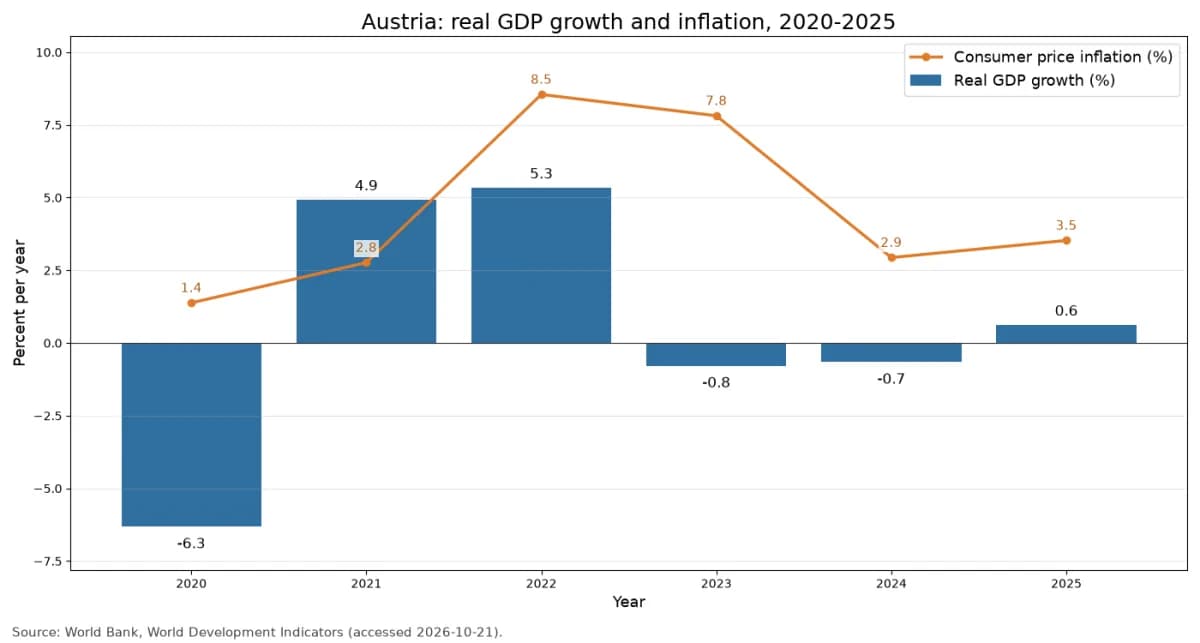
| Indicator | 2020 | 2021 | 2022 | 2023 | 2024 | 2025 |
|---|---|---|---|---|---|---|
| GDP (USD billion) | 434.4 | 480.5 | 473.2 | 516.7 | 534.8 | 579.5 |
| GDP per person (USD) | 48,716 | 53,649 | 52,337 | 56,580 | 58,269 | 62,930 |
| Real GDP growth (%) | -6.3 | 4.9 | 5.3 | -0.8 | -0.7 | 0.6 |
| Inflation (%) | 1.4 | 2.8 | 8.5 | 7.8 | 2.9 | 3.5 |
| Population (million) | 8.92 | 8.96 | 9.04 | 9.13 | 9.18 | 9.21 |
*Source: World Bank, World Development Indicators (accessed 21 October 2026).*[^1]
World Bank unemployment (modelled, 2025) is 5.6%, and youth unemployment (ages 15 to 24) is 11.0%. The World Bank also lists an international migrant stock of 2,327,064 people in 2024 and personal remittances received at 0.7% of GDP in 2025. The national figures below are more recent.
Labour-market and population measures:
| Measure | Value | Source |
|---|---|---|
| AMS registered unemployment, end of September 2026 | 306,624 people, national rate 7.1%; 381,159 including people in training | AMS[^2] |
| Dependent employment, September 2026 | 4,007,000 | AMS[^2] |
| Eurostat (ILO definition) unemployment, August 2026, seasonally adjusted | 6.7%; under 25: 13.1% | Eurostat[^3] |
| Foreign citizens, 1 January 2026 | 1,881,309 (20.4%) | Statistik Austria[^4] |
| Born abroad, 1 January 2026 | 22.9% of residents | Statistik Austria[^4] |
| Population, 1 January 2026 (provisional) | 9,219,113 | Statistik Austria[^5] |
| ECB deposit facility rate | 2.50% since 16 September 2026 | ECB[^6] |
| EUR/USD reference rate, 20 October 2026 | 1.1215 | ECB[^7] |
The AMS counts people registered with it, while Eurostat uses the international survey definition, so the two unemployment rates are not comparable.
What this means for a job seeker: growth of 0.6% in 2025 followed two years of small contractions, and the AMS rate of 7.1% means the market is softer than the high GDP per person suggests. About one in five residents holds a foreign passport, so employers are used to international colleagues. We convert euro amounts to US dollars at the ECB rate of 1.1215 on 20 October 2026; the rate moved between 1.1177 and 1.1652 from 1 September to 20 October, so treat dollar figures as approximate.
Austria job search in one table
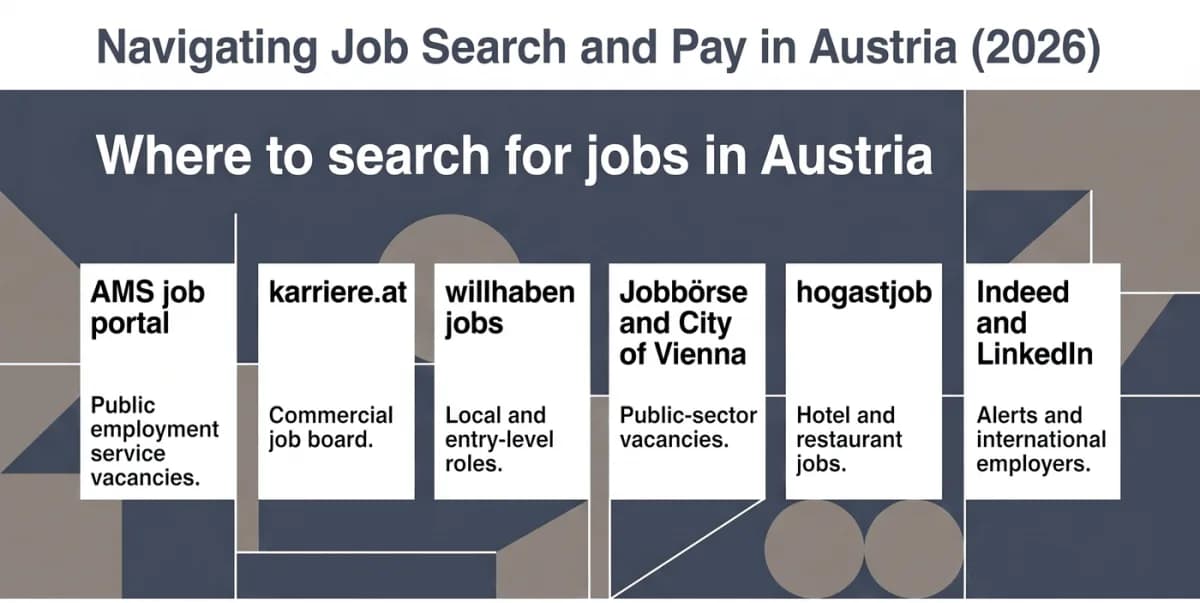
| Channel | What it is | Use it for | Limit |
|---|---|---|---|
| AMS job portal | The public employment service's vacancy database | Vacancies across all sectors and regions | We did not read a total count[^8] |
| Gehaltskompass | AMS salary tool | Checking typical pay for an occupation | A guide, not a contract floor; the agreement binds[^9] |
| Work in Austria (ABA) | Austrian Business Agency portal for skilled workers | Permit and recognition guidance | An information site, not a job board[^10] |
| EURES | EU job mobility service with an Austria labour-market page | EEA-wide search | Aimed at EU/EEA mobility[^11] |
| Jobbörse of the public sector and City of Vienna jobs | Federal and municipal vacancies | Civil service and city roles | Public-sector posts only[^12] |
| karriere.at | Commercial job board | Private-sector roles | We found no verified market-share data, so we do not rank boards[^13] |
| willhaben jobs | Job section of the willhaben marketplace | Local and entry-level roles | No count read[^13] |
| derStandard Karriere | Newspaper job section | Professional and management roles | No count read[^13] |
| jobs.at | Job site run by jobs.at Recruiting GmbH | Cross-checking adverts | No count read[^13] |
| hogastjob | Hotel and restaurant jobs in Austria, Germany and South Tyrol | Tourism and hospitality | Sector-specific[^13] |
| Indeed Austria, LinkedIn, XING, Glassdoor | International and professional networks | Alerts and international employers | We did not read listing counts[^13] |
| StepStone Austria | Commercial board; its imprint names StepStone Deutschland AG as parent | Professional roles | The site returned an access-denied page to our check, so we do not link it[^13] |
| Career Calling | Career fair of WU, TU Wien and BOKU | Graduates and early-career applicants | The 2026 edition was on 14 October and has passed[^14] |
| Employer pages: Andritz, Infineon, Magna, Österreichische Post, ÖBB, Wiener Gesundheitsverbund and UN careers | Large employers | Direct applications | Only pages we loaded are linked; other employers such as OMV, voestalpine, Erste Group and Siemens exist, but we did not verify their career URLs[^15] |
Treat the table as a snapshot of 21 October 2026, not a ranking.
What this means for a job seeker: start with the AMS portal and two commercial boards, add EURES if you are an EEA citizen, and apply directly to large employers. Read the pay statement in every advert (see the pay section): Austrian ads must name the collective-agreement minimum.
AMS and public-sector portals
The AMS portal is free to use, and the Gehaltskompass helps you compare an offer with typical pay. Public-sector vacancies sit on the Jobbörse and, for Vienna, on jobs.wien.gv.at. If you are an EU/EEA citizen, EURES gives access to vacancies and advisers across Europe. Non-EU applicants should read the permit section first, because most employers will ask about your right to work.
Recruitment and staffing agencies
Agencies with Austrian sites that we loaded include Adecco, Randstad, Hays, Michael Page and Iventa. Robert Half's German site loads, but we did not confirm Austria coverage, and Hill International presents itself as an executive search firm.[^16]
- No fees for job seekers. Under § 5 AMFG (Arbeitsmarktförderungsgesetz), placement by the entitled bodies is free, and holders of the placement or personnel-consulting trade licence must also place job seekers free of charge. The exception is artists and sportspeople, for whom a fee is allowed only if a contract is concluded through the placement and it may not exceed 10% of total gross pay. We read the text through a consolidated-law mirror, so check RIS once.[^17]
- Temporary agency work. Under § 10 AÜG (Arbeitskräfteüberlassungsgesetz), an agency worker is owed appropriate pay, and for appropriateness the pay of comparable workers at the user firm under collective agreement or law is taken into account. This does not mean the same pay as permanent staff. We could not load the RIS page and read the rule from a search snippet, so it is "likely".[^18]
- Agency pay floors. The temporary-agency collective agreement sets hourly minimums from 1 January 2026: groups A and B EUR 13.90 (about USD 15.59), group C EUR 15.62, D EUR 17.50, E EUR 20.14 and F EUR 24.82 (about USD 27.84), according to WKO.[^19]
- Pay in adverts. Under § 9 GlBG (Gleichbehandlungsgesetz), in force since 1 March 2011, adverts must state the minimum pay under the applicable collective agreement as an amount per hour, week or month, and say so if the employer will pay more. A first breach brings a warning from the district authority and a repeat breach an administrative fine; we did not confirm the amount.[^20]
Pay in 2026: no minimum wage law, but collective-agreement floors
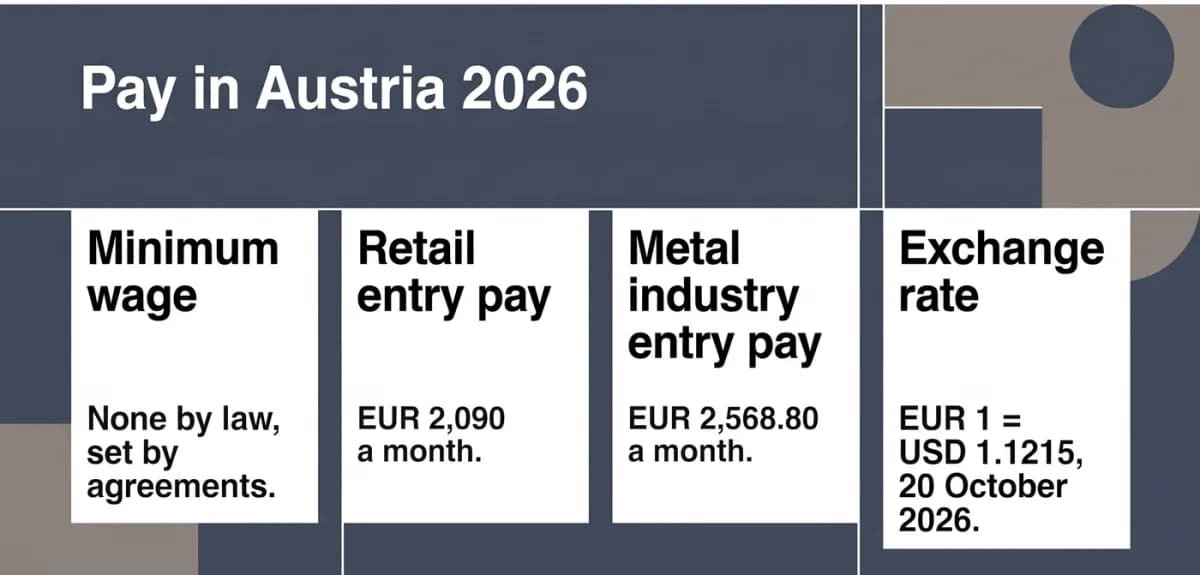
Austria has no general statutory minimum wage. Minimum pay comes from collective agreements, and about 98% of employees are covered, according to WKO (the Chamber of Commerce) and the union GPA; this is not a Statistik Austria figure.[^21] Where no effective agreement exists, the Bundeseinigungsamt can set a Mindestlohntarif under § 22 ArbVG; a recent example is the tariff for building caretakers in force from 1 January 2026 (BGBl. II Nr. 249/2025).[^40]
Agreements usually pay 14 times a year: twelve monthly salaries plus two special payments, often called the 13th and 14th salary. These are set by the agreement, not by a statute.
| Agreement | 2026 minimum (gross per month) | USD at 1.1215 | Valid from |
|---|---|---|---|
| Retail (Handel), salaried staff, group A, years 1 to 3 | EUR 2,090 (groups B, C, D: EUR 2,156, 2,251, 2,362) | about USD 2,344 | 1 January 2026, up 2.55%[^22] |
| Retail (Handel), workers, wage table A, group 1 | EUR 2,146 | about USD 2,407 | 1 January 2026, up 2.55%[^23] |
| Metal-technical industry, salaried, group A | EUR 2,568.80 | about USD 2,881 | 1 November 2025[^24] |
| Metal-technical industry, workers, group A | EUR 2,622.74 | about USD 2,941 | 1 November 2026[^24] |
| Metal trade (Metallgewerbe), workers, lowest group 7 | EUR 2,571.94 (group 1: EUR 3,808.83) | about USD 2,884 | 1 January 2026, minimums up 2.2%[^25] |
| Hotel and restaurant trade, example: group 5 | about EUR 2,096.50 after the rise (EUR 2,026 until 30 September 2026) | about USD 2,351 | 1 October 2026[^26] |
For hotels and restaurants, pay is set by tables that differ by Bundesland. From 1 October 2026 minimums rise by fixed amounts of EUR 65 to 72 per group (group 5: EUR 70.50), and a one-off payment of EUR 275 gross is due by 31 December 2026 (EUR 175 for apprentices). Do not use one number for tourism; open the table for your state.[^26]
At EUR 2,090 a month and 14 payments, the retail entry salary is EUR 29,260 a year, about USD 32,815.[^22]
Targets and earnings. The social partners agreed in 2017 on a EUR 1,500 minimum target for 2020, without sanctions, and retail set EUR 1,700 from January 2022.[^27] Statistik Austria data quoted by the AMS for 2024 show median gross earnings of EUR 38,043 for all employees (about USD 42,665) and EUR 55,678 for employees working full-time all year (about USD 62,443).[^28]
Housing. The average main rent in the first quarter of 2026 was EUR 10.5 per square metre and EUR 695.1 per flat including operating costs (about USD 780), according to Statistik Austria. A rent cap limits increases on Richtwert and Kategorie rents to 1% on 1 April 2026 and 2% on 1 April 2027; it does not cover all rents, and we give no city figures because we found no official source.[^29]
What this means for a job seeker: compare any offer with the agreement for the sector, check whether it is paid 14 times, and ask which group and which years of experience the employer has placed you in. Entry pay in the agreements above is roughly EUR 2,100 to 2,650 per month, and the median figures show how far pay rises with full-year, full-time work.
EU/EEA and non-EU applicants: work and residence permits
EU/EEA citizens may work without a permit. If you stay longer than three months you must report your stay within four months of entry (§ 53 NAG, the Settlement and Residence Act), and the registration certificate (Anmeldebescheinigung) is issued on application by the local authority, which is the MA 35 in Vienna.[^32]
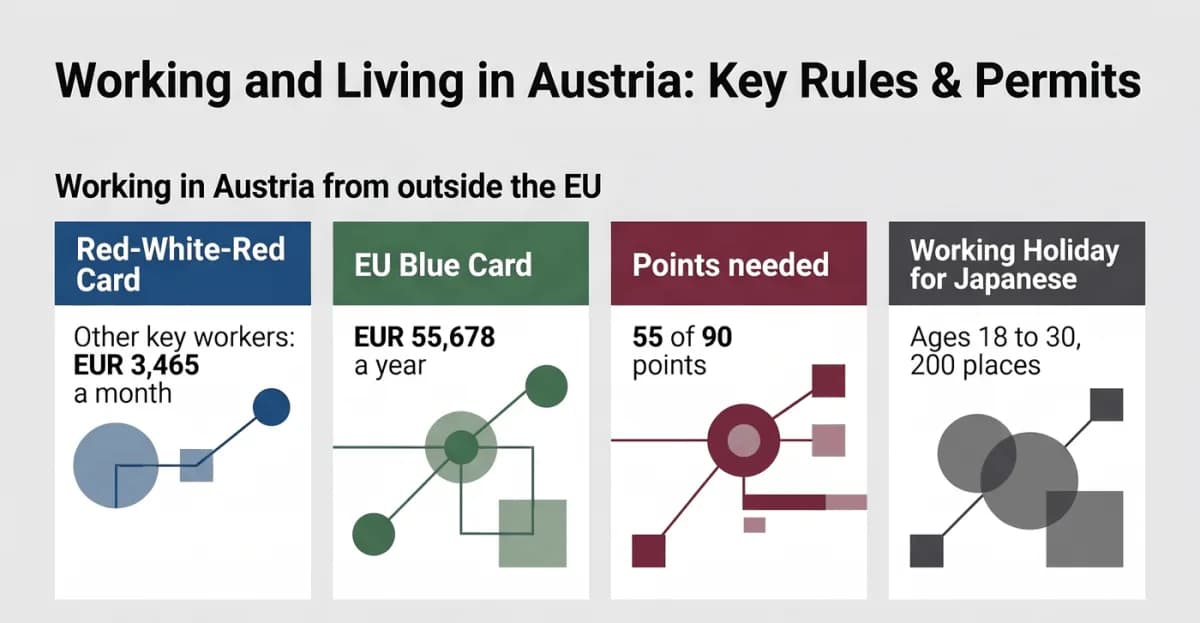
Non-EU nationals usually need a permit tied to a qualification route. The main Red-White-Red (RWR) Card routes in 2026 are:
- Very highly qualified workers. At least 70 of 100 points. There is a six-month job-seeker visa for this route only.[^30]
- Skilled workers in shortage occupations. 55 points and an occupation on the 2026 national list of 64 occupations (BGBl. II Nr. 316/2025, valid 1 January to 31 December 2026), plus regional lists for eight Länder but not Vienna. The list names occupations such as "Techniker/innen für Datenverarbeitung" rather than "software engineer", so match the official title.[^31]
- Other key workers. At least EUR 3,465 gross per month (about USD 3,886) plus the 13th and 14th payments, which is 50% of the monthly Höchstbeitragsgrundlage, and 55 of 90 points, with a labour-market test.[^30]
- Graduates of Austrian universities. Pay at least the customary level for domestic graduates; the labour-market test does not apply (§ 12b Z 2 AuslBG).[^40]
- EU Blue Card. At least EUR 55,678 gross per year including special payments (about USD 62,443) and a three-year degree, with a labour-market test and no points system.[^30]
- Self-employed key workers and start-up founders. Self-employed key workers need no points but an investment transfer of EUR 100,000 or job creation. Start-up founders need EUR 30,000 capital (equity at least 50%) and 50 points.[^30]
- RWR Card Plus. Available after 21 months of qualifying employment in the preceding 24 months; the RWR Card itself is valid for 24 months.[^30]
The fee for a first RWR application is reported as about EUR 218, from a district authority page; check the current amount with the authority that handles your case.[^33] For seasonal work, the 2026 quota regulation (BGBl. II Nr. 218/2025, 1 December 2025 to 30 November 2026) allows 5,500 tourism seasonal workers plus up to 2,500 from the Western Balkans outside the quota, according to WKO.[^39]
Entry rules. Citizens of visa-exempt countries, including Japan, may stay 90 days in any 180. Under § 21 Abs 2 Z 5 to 7 NAG, visa-exempt entrants may file an RWR or Blue Card application in Austria during their lawful stay, which is not Japan-specific. The EU Entry/Exit System (EES) has been operating since October 2025, according to press reports. ETIAS is not yet in operation: the Commission says the date will be announced several months ahead, the fee is EUR 20, and we give no start date.[^34]
Japanese nationals. The Japan-Austria working holiday scheme has existed since 2016. MOFA's table (as of 1 April 2026) lists an annual quota of 200 and the general age range of 18 to 30.[^35] The Japan-Austria social security agreement is covered in the social security section. MOFA counted 3,415 Japanese residents in Austria on 1 October 2025.[^36]
Foreign workers in Austria in numbers
| Measure | Value | Source |
|---|---|---|
| Foreign citizens, 1 January 2026 | 1,881,309 (20.4%), up 25,890 | Statistik Austria[^4] |
| Born abroad, 1 January 2026 | 22.9% | Statistik Austria[^4] |
| Vienna foreign share (provisional) | 37.0% | Statistik Austria[^4] |
| Japanese residents, 1 October 2025 | 3,415: 1,403 long-stay, 2,012 permanent residents | MOFA[^36] |
| Ukrainian displaced persons | Right of residence valid to 4 March 2027 and extended automatically to 4 March 2028 | BFA[^37] |
Family reunification for relatives of asylum and subsidiary-protection holders has been restricted since July 2025. The pause expired on 2 July 2026, after which a quota system applies, and the Interior Minister reportedly said numbers would stay "de facto zero" apart from hardship cases. This does not apply to families of RWR or Blue Card holders.[^38]
What this means for a job seeker: an EU/EEA citizen can start at once and register within four months. A non-EU applicant needs a route with points and a salary floor, so check your pay offer against EUR 3,465 or EUR 55,678 before you apply. Do not give notice or travel to start work until the permit is granted.
Labour law: hours, leave, notice and dismissal
We read the consolidated law texts through the official RIS OGD interface, because the RIS website blocks automated access. Check each section once on RIS before relying on it.[^40]
| Topic | Rule | Law |
|---|---|---|
| Normal working time | 8 hours a day, 40 hours a week | § 3 AZG |
| Maximum working time | 12 hours a day, 60 hours a week; average of 48 hours within 17 weeks | § 9 AZG |
| Daily rest | 11 hours; a collective agreement may shorten it to 8 hours | § 12 AZG |
| Weekend rest | 36 hours including Sunday | § 3 ARG |
| Overtime | 50% surcharge or time off; Sunday and holiday rates of 100% come from collective agreements, not § 10 | § 10 AZG |
| Annual leave | 30 Werktage (Monday to Saturday), which equals 25 working days in a five-day week; 36 Werktage (30 working days) after 25 years | § 2 UrlG |
| Probation | At most one month | § 19 Abs 2 AngG |
| Written contract record | The employer must hand over a Dienstzettel without delay after the start | § 2 AVRAG |
| Sick pay | Full pay for 6 weeks; 8 weeks after 1 year; 10 weeks after 15 years; 12 weeks after 25 years; then 4 weeks at half pay; Krankengeld from the ÖGK afterwards | § 2 EFZG |
| Maternity protection | 8 weeks before and 8 weeks after birth; 12 weeks after premature, multiple or caesarean births; Karenz until about the child's second birthday | §§ 3, 5, 15 MSchG |
| Employer duties on pay documents | Wage-documents duty enforced under the LSD-BG, amended from 1 August 2026 | LSD-BG |
What this means for a job seeker: expect a 40-hour week, leave of 25 working days, and sick pay for at least six weeks. Check the agreement for overtime premiums and for shorter rest periods.
Notice, dismissal and severance (Abfertigung)
Notice by the employer under § 20 AngG and § 1159 ABGB, which have the same text since the harmonisation of white-collar and blue-collar rules, is 6 weeks; 2 months after 2 years of service; 3 months after 5 years; 4 months after 15 years; and 5 months after 25 years. Notice ends at the end of a quarter unless the parties agree the 15th or last day of a month. Employees give one month's notice to the end of a month, which may be extended by agreement up to 6 months.[^40]
Where a works council exists, it must be told before every dismissal and has one week to comment (§ 105 ArbVG); a dismissal can be challenged at the labour court.[^40] We did not verify other grounds of protection, and we found no statute text on chain contracts converting automatically, so ask the Arbeiterkammer or your works council about a dispute.
Under the "Abfertigung neu" system, the employer pays 1.53% of monthly pay including special payments into a staff provision fund (§ 6 BMSVG). You cannot ask for a payout after your own resignation or a justified dismissal, and not before 36 contribution months; the money stays in the fund (§ 14 BMSVG).[^40]
Public holidays in 2026
Section 7 Abs 2 ARG lists 13 public holidays. In 2026 they fall on:[^40]
| Holiday | Date in 2026 |
|---|---|
| New Year's Day | Thursday 1 January |
| Epiphany | Tuesday 6 January |
| Easter Monday | Monday 6 April |
| Labour Day | Friday 1 May |
| Ascension Day | Thursday 14 May |
| Whit Monday | Monday 25 May |
| Corpus Christi | Thursday 4 June |
| Assumption Day | Saturday 15 August |
| National Day | Monday 26 October |
| All Saints' Day | Sunday 1 November |
| Immaculate Conception | Tuesday 8 December |
| Christmas Day | Friday 25 December |
| St Stephen's Day | Saturday 26 December |
Three holidays fall on a weekend (15 August, 1 November and 26 December), so ten fall on a weekday. We computed the Easter date (Easter Sunday is 5 April 2026) and did not read it from an official calendar.
Good Friday is not a public holiday and not a "personal holiday": the rule in § 7 Abs 3 ARG was deleted by BGBl. I 22/2019, so it is a normal working day unless your agreement says otherwise.[^40]
Social security: what is deducted and what you get
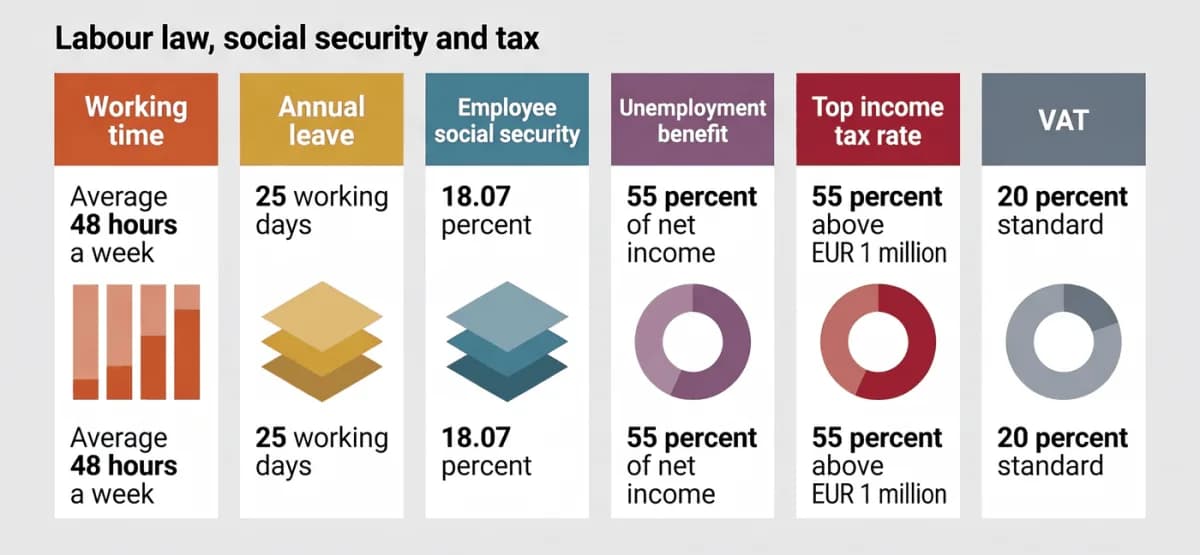
For salaried employees in 2026 the ÖGK table shows an employee share of 18.07% and an employer share of 22.51%:[^41]
| Contribution | Employee | Employer |
|---|---|---|
| Pension | 10.25% | 12.55% |
| Health | 3.87% | 3.78% |
| Accident | none | 1.10% |
| Unemployment | 2.95% | 2.95% |
| Chamber of Labour levy (AK-Umlage) | 0.50% | none |
| Housing subsidy | 0.50% | 0.50% |
| Insolvency fund (IESG) | none | 0.10% |
| Abfertigung neu | none | 1.53% |
| Total | 18.07% | 22.51% |
Other employer-only levies come on top. The unemployment share is lower for low incomes.
- Ceilings. The contribution ceiling (Höchstbeitragsgrundlage) is EUR 6,930 a month (about USD 7,772), and special payments are contributory up to EUR 13,860 a year. The marginal-employment threshold (Geringfügigkeitsgrenze) is EUR 551.10 a month (about USD 618); below it only accident insurance applies.[^41]
- Pension. The retirement age is 65 with at least 180 insurance months, of which at least 84 are from gainful employment (§ 4 APG). The pension account rate is 1.78% (§ 12 Abs 2 APG). Periods abroad can be aggregated under EU rules and the Japan agreement.[^40]
- Unemployment benefit. Arbeitslosengeld is 55% of daily net income (§ 21 Abs 3 AlVG). You need 52 weeks of insured work within 24 months; applicants under 25 need 26 weeks within 12 months. The standard duration is 20 weeks, 30 weeks with 156 weeks of insured work, 39 weeks at age 40 with 312 weeks in 10 years, and 52 weeks at age 50 with 468 weeks in 15 years.[^40]
- 2026 change. Since 1 January 2026, marginal employment alongside unemployment benefit is allowed only in exceptions (§ 12 Abs 2 AlVG), for example for people who had marginal work beside insured work before unemployment, or long-term unemployed people over 50. Ask the AMS for the transition rules in your Land.[^42]
- Family benefits. The child tax credit (Kinderabsetzbetrag) is EUR 70.90 a month, and it and the family allowance are not indexed in 2026 and 2027.[^45]
- Japan agreement. The Japan-Austria social security agreement was signed on 19 January 2024 and entered into force on 1 December 2025. It is Japan's 24th such agreement and covers pensions and, for Austria, also sickness, accident and unemployment insurance.[^43]
What this means for a job seeker: about 18% of your gross salary goes to social security, and the employer pays a further 22.5% on top of your gross pay. We found no rule that refunds contributions when you leave; periods are aggregated under EU rules and the Japan agreement, so keep your insurance records.
Taxes on your salary
Income tax (Lohnsteuer for employees) in 2026 follows these brackets:[^44]
| Annual taxable income | Rate |
|---|---|
| Up to EUR 13,539 | 0% |
| To EUR 21,992 | 20% |
| To EUR 36,458 | 30% |
| To EUR 70,365 | 40% |
| To EUR 104,859 | 48% |
| To EUR 1,000,000 | 50% |
| Above EUR 1,000,000 | 55% (limited to 2016 to 2029, then 50%) |
The thresholds rose by 1.7333% in 2026. For the 13th and 14th salary, the first EUR 620 is tax-free and the next EUR 24,380 is taxed at 6% within the annual sixth (§ 67 EStG).[^40] The transport credit (Verkehrsabsetzbetrag) is EUR 496, and Familienbonus Plus is EUR 2,000.16 per child under 18 (EUR 700.08 for an adult child).[^45]
No local income tax. Austria has no local income tax on wages comparable to Japan's resident tax: employees' wages are taxed federally through Lohnsteuer, and we found no municipal income tax in the EStG. Employers, not employees, pay Kommunalsteuer of 3% on payroll (§ 9 KommStG).[^40]
Relief for researchers. The Zuzugsbegünstigung in § 103 Abs 1a EStG gives a 30% allowance on income from scientific work for five years, on application to the Finanzamt, for people whose move serves science or research. It is not a general expat relief.[^40]
VAT. The standard rate is 20%, and the reduced rate of 10% covers listed goods, restaurant food, residential rent and accommodation. From 1 July 2026 a 4.9% rate applies to a listed set of basic goods (§ 10 Abs 1a UStG), and further reduced rates exist.[^40]
What this means for a job seeker: work out net pay from the brackets above, not from the gross salary in the advert. The 13th and 14th salary is taxed at 6% instead of the bracket rates, up to the limits above, so a 14-payment contract is worth more than the same annual total paid in 12.
Language and what Austrian employers expect in a CV
- Language. German is needed for most jobs. We found no primary source for required German levels, so ask the employer which level it expects. International organisations and some technology firms work in English.
- Format. Photo, date of birth, one to two pages, a Dienstzeugnis (employer reference) and a motivation letter are common practice, not law, and we found no primary source for them. Write the CV in the language of the advert, keep it ATS-readable, and ask for your Dienstzeugnis when you leave a job; Austrian law gives employees a right to a reference (ABGB and AngG), which we did not check on RIS.
- Recognition of qualifications. Recognition matters mainly for regulated professions, of which there are more than 200. Free advice is available from the AST contact points in Vienna, Graz, Linz and Innsbruck at anlaufstelle-anerkennung.at, and berufsanerkennung.at covers regulated professions, authorities and costs.[^46]
- Health professions. Health-care workers must be entered in the Gesundheitsberuferegister; see the explanation on gesundheit.gv.at and check who runs the register before you apply.[^47]
- Residence registration. After you move, you register your address with a Meldezettel, and employees receive an e-card for health insurance; oesterreich.gv.at has the pages.
- Privacy. Keep your social security number and ID scans off the CV, and send documents only after you have verified the employer.
- Guides. See our ATS-friendly CV guide and, as a model for English CVs, the UK CV format guide.
Verify a listing before sharing documents
Watchlist Internet keeps a list of job-offer scams, and the Bundeskriminalamt publishes warnings.[^48] We found no specific 2026 job scam notice, so the points below describe patterns reported by consumer organisations.
- Legitimate agencies cannot charge job seekers (see § 5 AMFG). An employer who asks you to pay for a job, a permit or training is a warning sign.
- Be wary of offers that ask you to open a bank account or move money for someone else, which is a typical money-mule pattern.
- Fake recruiters may use the names of well-known job portals and ask for ID copies or a video identification before any contract.
- Check the employer's legal name, its career page and whether the advert also appears there.
- A genuine advert names the collective-agreement minimum pay (§ 9 GlBG); an advert without any pay statement deserves a question.
A seven-day search routine
- Day 1: pick two sectors and save 20 adverts from the AMS portal and karriere.at.
- Day 2: list repeated job titles, skills and German-language requirements.
- Day 3: build one master CV and a tailored version for the strongest sector.
- Day 4: set alerts, check EURES if you are an EEA citizen, and visit employer career pages.
- Day 5: if you are a non-EU applicant, check your route, the salary floor and whether your credentials need recognition.
- Day 6: send targeted applications in the advert's language.
- Day 7: review replies, drop weak sources and keep the two channels that produced recruiter contact.
Final checklist before you apply
- [ ] My CV is in the language of the advert and shows no social security number.
- [ ] I know which collective agreement covers the job and that the offer is at or above its 2026 minimum, paid 14 times.
- [ ] As a non-EU applicant, my pay meets the floor of my RWR Card or Blue Card route.
- [ ] I know my hours, overtime, notice period and leave.
- [ ] I know that social security and income tax will be deducted, and I have compared net pay.
- [ ] No one has asked me for a fee for a job or a permit.
FAQ
What are the best job sites in Austria?
The AMS job portal, karriere.at, willhaben jobs, derStandard Karriere and jobs.at are the main general channels we could load, with Indeed, LinkedIn and XING for international roles, the Jobbörse and jobs.wien.gv.at for public-sector roles, and EURES for EEA applicants. We found no verified ranking.[^8][^13]
Does Austria have a minimum wage?
There is no statutory minimum wage. Collective agreements set minimum pay, covering about 98% of employees according to WKO and the union GPA, and entry pay in 2026 ranges from EUR 2,090 a month in retail (salaried, group A) to EUR 2,622.74 for metal-industry workers, paid 14 times a year.[^21][^22][^24]
Can I work in Austria without speaking German?
In some international organisations and technology firms, yes, but most jobs need German. We found no primary source for required levels, so ask the employer which level it expects.
What is the Red-White-Red Card?
It is the permit for qualified non-EU workers, with routes for very highly qualified workers (70 points), shortage occupations (55 points, 64 occupations in 2026) and other key workers (EUR 3,465 a month and 55 points). The EU Blue Card requires EUR 55,678 a year.[^30][^31]
Can Japanese citizens use the working holiday scheme?
Yes. The scheme has existed since 2016, MOFA lists an annual quota of 200, and the general age range is 18 to 30. Visa-exempt visitors may also apply for an RWR or Blue Card from inside Austria during their lawful stay.[^35][^40]
How many hours do I work and how is overtime paid?
Normal working time is 8 hours a day and 40 hours a week (§ 3 AZG), with a maximum of 12 hours a day and 60 hours a week. Overtime carries a 50% surcharge or time off; higher Sunday and holiday rates come from collective agreements.[^40]
What are the 13th and 14th salary?
Two special payments, often a holiday bonus and a Christmas bonus, set by the collective agreement. Up to the annual sixth, the first EUR 620 is tax-free and the next EUR 24,380 is taxed at 6%.[^40]
How much holiday and leave do I get?
30 Werktage, which equals 25 working days in a five-day week, rising to 36 Werktage (30 working days) after 25 years. There are 13 public holidays in 2026, and Good Friday is not one of them.[^40]
What notice period and dismissal rules apply?
Employer notice is 6 weeks, rising to 2 months after 2 years, 3 after 5, 4 after 15 and 5 after 25 years; employees give one month. A works council must be told before every dismissal.[^40]
How much income tax will I pay?
In 2026 the rate is 0% up to EUR 13,539, then 20%, 30%, 40%, 48% and 50% up to EUR 1,000,000, and 55% above. There is no local income tax on wages; employers pay Kommunalsteuer of 3%.[^40][^44]
How to use AIResume
Keep one master CV in AIResume and create a German and an English version for each advert's language. Use the how to tailor your CV to a job description guide to match each advert.
Related AIResume guides
- Job boards in Switzerland
- Job boards in Belgium
- Job boards in France
- Job boards in the United Kingdom
- Job boards in Ireland
- UK CV format guide
- How to write an ATS-friendly CV
- How to tailor your CV to a job description
- CV vs resume for international applications
Sources
[^1]: World Bank, World Development Indicators: Austria (accessed 21 October 2026)
[^2]: AMS, Übersicht über den Arbeitsmarkt (September 2026)
[^3]: Eurostat, monthly unemployment (une_rt_m), Austria
[^4]: Statistik Austria, population by citizenship and country of birth
[^5]: Statistik Austria, population on 1 January 2026, press release of 9 February 2026
[^6]: ECB, key interest rates
[^7]: ECB, euro foreign exchange reference rates, 90-day file
[^8]: AMS job portal and AMS (checked 21 October 2026)
[^9]: AMS Gehaltskompass
[^10]: Work in Austria, skilled workers; migration.gv.at, welcome
[^11]: EURES
[^12]: Jobbörse of the public sector; City of Vienna jobs
[^13]: karriere.at, willhaben jobs, derStandard Karriere, jobs.at, hogastjob, Indeed Austria, LinkedIn jobs, XING, Glassdoor Austria (all checked 21 October 2026)
[^14]: Career Calling
[^15]: Andritz careers, Infineon careers, Magna careers, Österreichische Post careers, ÖBB careers, UN careers, Wiener Gesundheitsverbund
[^16]: Adecco Austria, Randstad Austria, Hays Austria, Michael Page Austria, Iventa, Hill International Austria (checked 21 October 2026)
[^17]: AMFG § 5 (consolidated text, mirror; check RIS)
[^18]: RIS, AÜG § 10 (search snippet only)
[^19]: WKO, temporary-agency collective agreement 2026
[^20]: WKO, stating the minimum pay in job adverts (§ 9 GlBG)
[^21]: WKO Steiermark, how collective agreements work
[^22]: WKO, salary tables for salaried staff in retail 2026
[^23]: WKO, wage tables for workers in retail 2026
[^24]: Metal-technical industry, workers' protocol annex 2026; WKO, minimum salary table 2025
[^25]: WKO, Metallgewerbe agreement 2026
[^26]: WKO, hotel and restaurant pay agreement 2026
[^27]: ORF, minimum-wage agreement; vol.at, Arbeitsmarktpakt (press)
[^28]: AMS, average salary in Austria; Statistik Austria, tax data release of 17 December 2025
[^29]: Statistik Austria, housing Q1 2026; WKO, Mietpreisbremse
[^30]: migration.gv.at, other key workers; EU Blue Card; very highly qualified workers; RWR Card Plus; self-employed key workers; start-up founders
[^31]: migration.gv.at, skilled workers in shortage occupations; WKO, Fachkräfteverordnung 2026
[^32]: oesterreich.gv.at, registration certificate for EU citizens
[^33]: Land Oberösterreich, RWR Card fee (district authority page)
[^34]: European Commission, ETIAS
[^35]: MOFA Japan, working holiday
[^36]: MOFA Japan, Japanese nationals abroad (1 October 2025)
[^37]: BFA, information sheet on extension for displaced persons from Ukraine (5 August 2026)
[^38]: Parlament, family reunification suspension; Salzburger Nachrichten (press)
[^39]: WKO, seasonal quota regulation 2026
[^41]: ÖGK, social insurance contributions 2026
[^42]: AMS Burgenland, marginal work alongside benefits from 2026
[^43]: MHLW Japan, Japan-Austria social security agreement
[^44]: USP, income tax brackets 2026
[^45]: USP, tax credits
[^46]: Anlaufstelle Anerkennung; Berufsanerkennung; BMWET, foreign higher-education qualifications; ABA, skills assessment and recognition
Your next step
- DeelFor employers hiring across borders: contracts, payroll and visas handled.See how Deel works
Affiliate links: we may earn a commission at no cost to you. Affiliate link