

Hong Kong Job Search in 2026: Job Boards, Minimum Wage, Talent Visas and Labour Law
Hong Kong is an international finance and trade hub of about 7.5 million people, and its economy is dominated by services. Since 2022 and 2023 the government has run a set of talent-attraction schemes that let graduates and professionals from abroad apply for a visa, in some cases without a job offe
By AIResume Editorial Team
Last updated: 21 October 2026
Hong Kong is an international finance and trade hub of about 7.5 million people, and its economy is dominated by services. Since 2022 and 2023 the government has run a set of talent-attraction schemes that let graduates and professionals from abroad apply for a visa, in some cases without a job offer. English and Chinese are both used at work. Cantonese is the everyday language of most offices, and Mandarin is increasingly useful, so many roles list both.
This guide covers the economy in numbers, where to search, the statutory minimum wage and pay benchmarks, talent and work visas, the Employment Ordinance, public holidays, the Mandatory Provident Fund (MPF), salaries tax and what employers expect in a CV. For other markets, see our guides to job boards in Singapore, Australia and the United Kingdom.
Editorial boundary: This is practical job-search guidance, not legal, immigration or tax advice. We only list figures we could read in an official or primary source, and we mark those that come from press reports or a secondary summary as "reported" or "likely". Confirm details with the Labour Department, the Immigration Department, the Census and Statistics Department, the Hong Kong Monetary Authority (HKMA), the Mandatory Provident Fund Schemes Authority (MPFA), the Inland Revenue Department and Hong Kong e-Legislation before you sign.
Before you apply
- SafetyWing Nomad InsuranceHealth insurance that works in your new country from day one.Get a quote
Affiliate links: we may earn a commission at no cost to you. Affiliate link
Hong Kong's economy in numbers
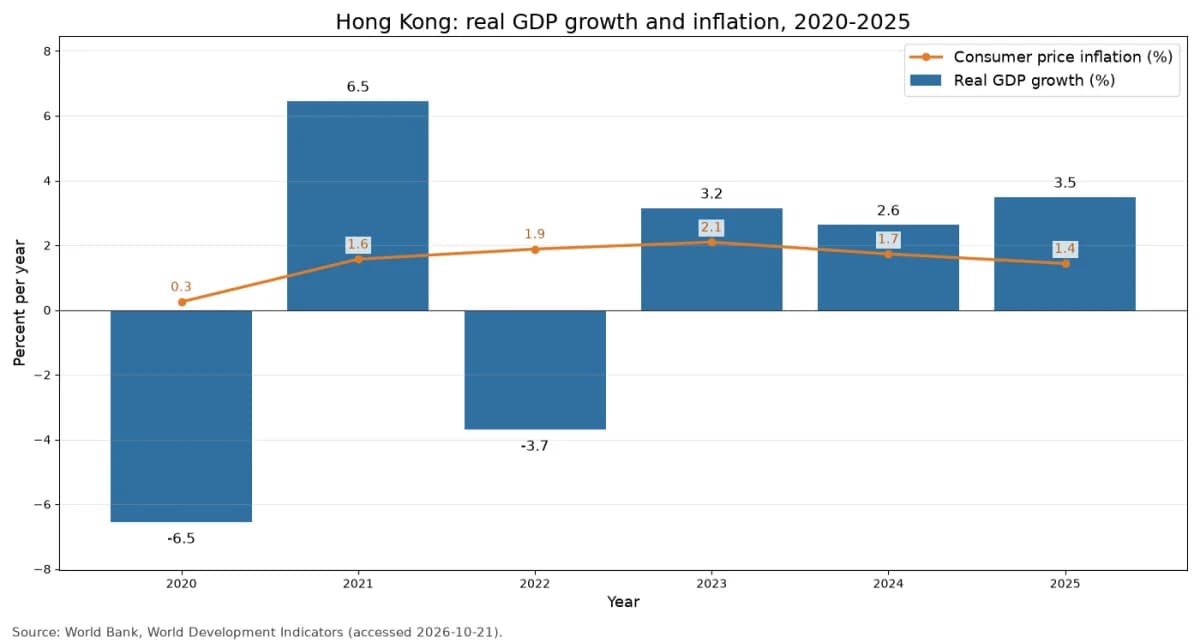
| Indicator | 2020 | 2021 | 2022 | 2023 | 2024 | 2025 |
|---|---|---|---|---|---|---|
| GDP (USD billion) | 344.9 | 369.0 | 358.7 | 380.8 | 408.4 | 427.3 |
| GDP per person (USD) | 46,109 | 49,771 | 48,825 | 50,525 | 54,275 | 56,983 |
| Real GDP growth (%) | -6.5 | 6.5 | -3.7 | 3.2 | 2.6 | 3.5 |
| Inflation (%) | 0.3 | 1.6 | 1.9 | 2.1 | 1.7 | 1.4 |
| Population (million) | 7.48 | 7.41 | 7.35 | 7.54 | 7.52 | 7.50 |
*Source: World Bank, World Development Indicators (accessed 21 October 2026).*[^1]
The World Bank also lists modelled unemployment of 2.8% and youth unemployment (ages 15 to 24) of 9.0% for 2025, an international migrant stock of 3,063,318 people in 2024 and personal remittances received at 0.1% of GDP in 2025.[^1] The government figures below are more recent, and they use a different survey method, so do not mix the two sets.
| Measure | Value | Source |
|---|---|---|
| Unemployment rate, June to August 2026 (seasonally adjusted) | 3.8%, up from 3.7% in May to July | Census and Statistics Department (C&SD)[^2] |
| Underemployment rate, June to August 2026 | 1.9% | C&SD[^2] |
| Labour force, June to August 2026 | 3,805,900; employed 3,652,000; unemployed 153,900 | C&SD[^2] |
| Population, mid-2026 (provisional) | 7,518,300, up 19,400 (0.3%) on mid-2025; 7,252,800 Usual Residents and 265,500 Mobile Residents | C&SD[^3] |
| HKMA Base Rate | 4.25%, set on 17 September 2026 | HKMA[^4] |
| Linked exchange rate band | HKD 7.75 to 7.85 per USD | HKMA[^4] |
| Talent attracted under the admission schemes, to end-February 2026 | More than 280,000; in three years nearly 600,000 applications and over 410,000 approved, about one quarter from outside the Mainland | Government reply to the Legislative Council, 25 March 2026[^5] |
We convert Hong Kong dollars (HKD) to US dollars at HKD 7.8455 per USD, the HKMA daily rate of 30 September 2026. The dollar is kept inside a band of HKD 7.75 to 7.85, so conversions stay stable, and we round them as "about".[^6]
What this means for a job seeker: with unemployment at 3.8% and 3,652,000 people employed, the market is open but not tight. Employers also see the talent schemes at work: the government says more than 280,000 people arrived under them, so expect overseas-educated competition in finance, technology and professional services.[^5]
Hong Kong job search in one table
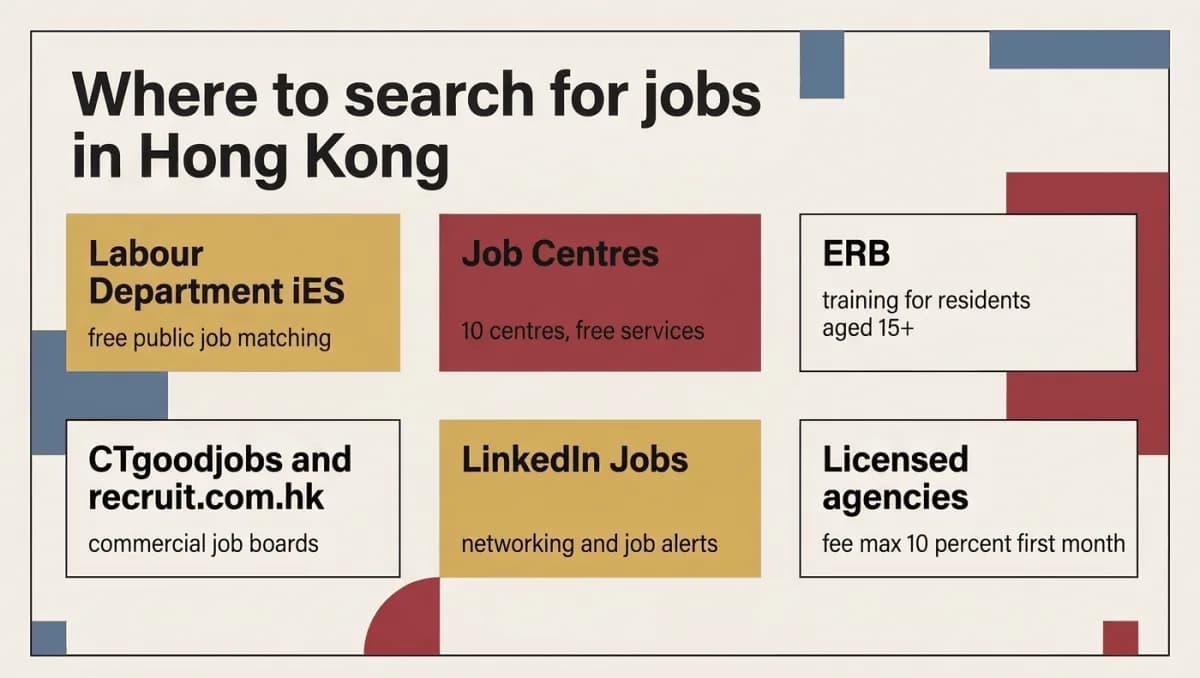
| Channel | What it is | Use it for | Limit |
|---|---|---|---|
| Interactive Employment Service (iES) | The Labour Department's job-matching site; the department runs 10 Job Centres | Vacancies in all sectors, free matching | Public-sector service, free to use[^7] |
| Job fairs list | Fairs listed on iES | Meeting employers in person | Check dates on the page[^7] |
| Employees Retraining Board (ERB) | Training and placement body for residents aged 15 or above who may lawfully be employed | Free placement-tied courses (for unemployed permanent residents, One-way Permit holders and dependants of permanent residents) | Being reformed as "Upskill Hong Kong" (2026 Legislative Council paper)[^8] |
| Youth programmes | Youth Employment and Training Programme and Youth Employment Start (Y.E.S.) | Ages 15 to 29 | Age-limited[^9] |
| Civil Service Bureau | Government posts | Public-sector careers | Permanent residency is needed at appointment; every civil service job needs the Basic Law and National Security Law Test (BLNST)[^10] |
| Hong Kong Talent Engage | An office under the Labour and Welfare Bureau | Job search, Salary Index, scheme-matching tool | Aimed at talent-scheme applicants[^11] |
| CTgoodjobs, recruit.com.hk, efinancialcareers.hk | Commercial boards | Broad and finance searches | They loaded for us; we read no ranking source[^12] |
| LinkedIn Jobs | Professional network | Alerts and networking | We read no ranking source[^12] |
| JobsDB, Indeed, Glassdoor, foundit | Well-known boards | Broad search | They blocked our automated check, so we do not link them or make claims about them; JobsDB is operated by SEEK[^12] |
| Education & Careers Expo (HKTDC) | Fair at the Hong Kong Convention and Exhibition Centre | Students and graduates | The 35th edition ran 22 to 25 January 2026 with free admission; no next date was announced[^13] |
| Licensed employment agencies | See the section below | Mid-level and senior roles | Check the licence first |
| Employer career pages | Large employers' own sites | Direct applications | We did not check individual employer pages |
What this means for a job seeker: start with iES, add two commercial boards and LinkedIn, and set alerts. If you are a graduate, include the youth programmes and the annual expo. Treat the table as a snapshot of 21 October 2026, not a ranking.
Labour Department and public channels
The Labour Department's employment and recruitment services are free.[^7] The ERB is not limited to permanent residents. It targets residents aged 15 or above who are lawfully employable and not subject to conditions of stay, and that includes new arrivals, while the free placement-tied courses go to unemployed permanent residents, One-way Permit holders and dependants of permanent residents.[^8] For the civil service, applicants must hold permanent residency at appointment, and the degree-level BLNST is 20 multiple-choice questions in 30 minutes with 10 correct answers needed to pass; a pass has no expiry. Whether a post also needs the Common Recruitment Examination depends on the grade, so check each advert.[^10]
Employment agencies
Agencies are regulated by Part XII of the Employment Ordinance (Cap. 57) and the Employment Agency Regulations (Cap. 57A). Section 51(1) bars anyone from operating, managing or helping to manage an agency without a licence or an exemption certificate.[^14]
- Commission cap. Cap. 57A regulation 10(2) and Part II of the Second Schedule set the maximum commission from a job seeker at "an amount not exceeding a sum equal to ten per cent of the first month's wages" received after placement in employment.[^14]
- Penalties. Section 57(1)(a) of Cap. 57 bans any reward or payment beyond the prescribed commission. Under section 60(7) the penalty is a fine of HKD 350,000 (about USD 44,600) and imprisonment for 3 years, and section 60(6) sets the same penalty for operating without a licence.[^14]
- Licence check. Search the licensed-agency list of the Labour Department's Employment Agencies Administration. The same site keeps a list of agencies convicted of overcharging or unlicensed operation.[^15]
- Names. The sites of Michael Page, Hays, Randstad, Robert Half, Morgan McKinley, Pasona, Adecco and ManpowerGroup loaded for us. We did not verify what each is hiring for, so check the live advert.[^16]
Pay in 2026: statutory minimum wage and earnings
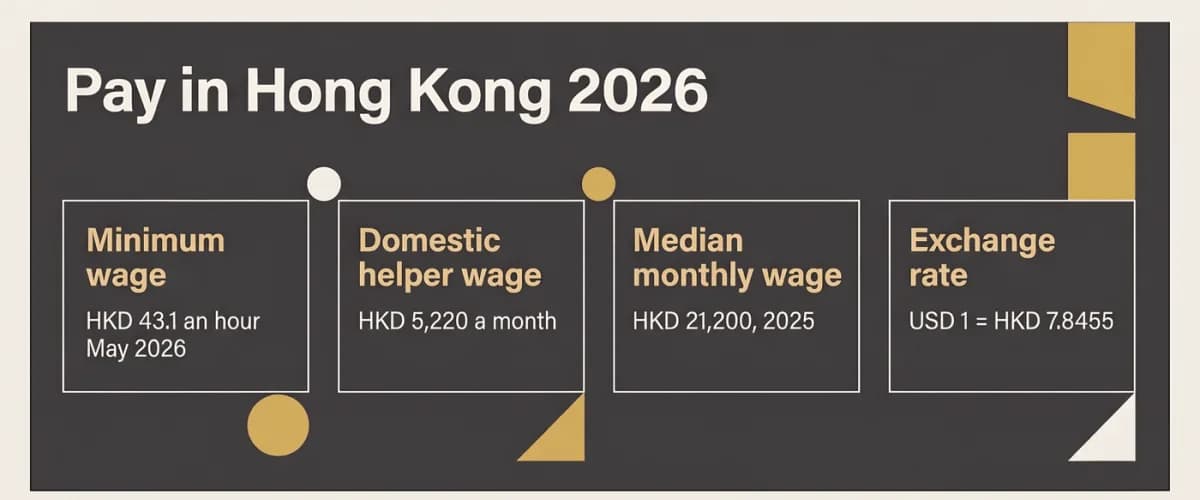
Hong Kong has a Statutory Minimum Wage (SMW) under the Minimum Wage Ordinance (Cap. 608). Schedule 3 sets HKD 42.1 an hour from 1 May 2025 and HKD 43.1 from 1 May 2026. The 2026 increase of HKD 1.0 (2.38%) was accepted by the Executive Council on 10 February 2026, and it was the first review under the annual mechanism approved in April 2024. No later rate has been announced, and the 2027 rate is not yet known.[^17]
| Floor or benchmark | Amount (HKD) | USD at 7.8455 | Valid |
|---|---|---|---|
| Statutory minimum wage per hour | 42.1 | about USD 5.37 | From 1 May 2025[^17] |
| Statutory minimum wage per hour | 43.1 | about USD 5.49 | From 1 May 2026[^17] |
| Foreign domestic helper (FDH) Minimum Allowable Wage | 5,220 a month (from 5,100, up 2.35%) | about USD 665 | Contracts signed on or after 3 October 2026[^18] |
| FDH food allowance | not less than 1,236 a month | about USD 158 | Unchanged; employers must provide free food, and the allowance is the alternative[^18] |
| Median monthly wage of employees, May to June 2025 | 21,200 (up 3.5% from 20,500) | about USD 2,702 | Annual Earnings and Hours Survey[^19] |
| Median monthly employment earnings, Q2 2026 | 21,000 | about USD 2,677 | General Household Survey[^19] |
Who is covered. Cap. 608 section 7 excludes people outside the Employment Ordinance, registered apprentices, live-in domestic workers who dwell in the household free of charge (they fall under the FDH minimum), student interns, and work experience students in "exempt student employment". That means a student enrolled in an accredited programme who is under 26 at the start of the contract and works up to 59 days.[^17] Employers must record hours for staff earning under HKD 17,600 a month (about USD 2,243), up from HKD 17,200.[^20]
Earnings benchmarks. The 2025 Annual Earnings and Hours Survey gives a median monthly wage of HKD 21,200, with the 25th percentile at HKD 15,300, the 75th at HKD 33,000 and the median hourly wage at HKD 85.7. The General Household Survey covers all employed persons, including foreign domestic helpers and part-timers, so the two numbers measure different groups and are two benchmarks, not a trend.[^19]
Rents. The Rating and Valuation Department (RVD) reports average rents for new lettings per square metre per month. For August 2026 (provisional), a Class A flat of under 40 square metres averaged HKD 568 on Hong Kong Island, HKD 525 in Kowloon and HKD 389 in the New Territories.[^21]
What this means for a job seeker: the floor is HKD 43.1 an hour, so a job advertised below that is unlawful for covered staff. For a typical offer, compare it with the median of HKD 21,200 a month, and check the rent for your district per square metre before you accept.
Talent and work visas for non-residents
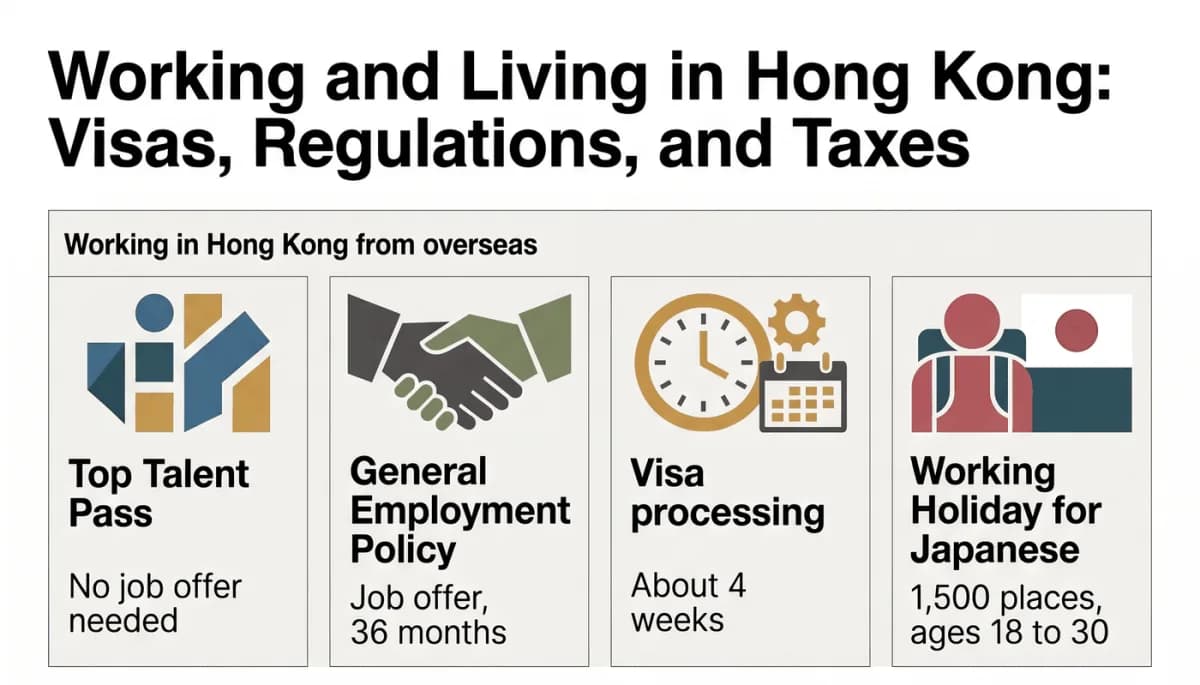
The Immigration Department runs several routes. Most skilled workers use the General Employment Policy (GEP), the Top Talent Pass Scheme (TTPS) or the Immigration Arrangements for Non-local Graduates (IANG).
| Scheme | Who it is for | Key condition | Processing |
|---|---|---|---|
| TTPS | High earners and graduates of listed universities | Category A: income of HKD 2.5 million (about USD 318,700) or above in the preceding year, 36 months initial stay. Category B: eligible-university degree and at least 3 years of work in the past 5 years, 24 months. Category C: eligible-university graduate within 5 years with under 3 years of experience, 10,000 places a year, first come first served, 24 months. No job offer needed at application[^22] | About 4 weeks |
| GEP | Non-Mainland professionals with a job offer | Quota-free; a job relevant to your qualifications that cannot readily be filled locally, with market-level pay; 36 months initial stay or the contract length[^23] | About 4 weeks |
| ASMTP | Mainland residents | The equivalent of the GEP for Mainland residents[^23] | About 4 weeks |
| QMAS | Points-based migrants | No job offer; General Points Test (12 criteria) or Achievement-based Points Test; selection exercises held regularly; 36 months (General) or 8 years (Achievement) initial stay[^24] | Selection exercises |
| IANG | Non-local graduates of Hong Kong and Greater Bay Area campuses | Recent graduates (within 6 months) stay 24 months with no job offer; others need a job offer; quota-free[^25] | About 2 weeks for recent graduates, 4 weeks otherwise |
| TechTAS | Full-time R&D staff of technology companies | The company holds an Innovation and Technology Commission quota; applicant has a STEM degree from a top-100 STEM university[^26] | About 2 weeks |
Universities for the TTPS. The eligible list has 200 institutions from 1 January 2026, after 6 were added and 4 removed. It rests on the top 100 in four world rankings plus specialist lists, and it includes six Japanese universities: Tokyo, Kyoto, the Institute of Science Tokyo (formerly Tokyo Tech), Osaka, Tohoku and Nagoya. Category C is not open to non-local students who studied in Hong Kong.[^27]
Fees and dependants. The application fee is HKD 600 (about USD 76), non-refundable. The visa or extension fee is HKD 600 for a period up to 180 days and HKD 1,300 (about USD 166) for longer.[^28] Dependants are "not prohibited from taking up employment or studies".[^23]
Extension and permanent residence. TTPS extensions require employment with a stable income or a business, and the decision takes about 2 to 3 weeks.[^22] A non-Chinese national who has "ordinarily resided in Hong Kong for a continuous period of not less than 7 years" and has taken Hong Kong as his or her place of permanent residence qualifies for the right of abode (Cap. 115 Schedule 1 paragraph 2(d)). Seven years of work alone is not enough.[^23]
Approvals in 2025. The Immigration Department's 2025 review gives these new applications received and approved (for QMAS, "approved" means passed selection):[^29]
| Scheme | 2025 received | 2025 approved |
|---|---|---|
| TTPS | 35,705 | 31,508 |
| GEP | 33,479 | 31,278 |
| ASMTP | 30,546 | 26,714 |
| QMAS | 18,707 | 7,101 |
| IANG | 28,710 | 27,630 |
| TechTAS | 178 | 161 |
| Enhanced Supplementary Labour Scheme (employer applications) | 41,454 | 40,694 |
Applications approved in a year may have been received in the previous year.[^29]
Employer work-rights checks. Under the Immigration Ordinance (Cap. 115) section 17I(1), employing someone who is not lawfully employable is an employer offence: a fine of HKD 350,000 and 3 years in prison, or HKD 500,000 and 10 years for a prohibited employee. An employer has a defence if it took all practicable steps. The Immigration Department also states HKD 150,000 and 1 year for failing to inspect documents.[^30] All holders of a permanent identity card are lawfully employable, and for other holders the employer must inspect a valid travel document and ask about conditions of stay. A visitor cannot be employed. The symbols on the card (A for right of abode, R, U and C) are not a shortcut: R and U do not by themselves prove unrestricted work rights.[^30] Employers should not copy your ID card before you accept an offer.[^31]
Japanese nationals. Japanese passport holders can visit Hong Kong visa-free for up to 90 days, but visitors may not take any employment, paid or unpaid.[^32] The Japan-Hong Kong Working Holiday scheme has 1,500 places a year for ages 18 to 30. You may work up to six months with the same employer and attend courses for up to six months in total, you need proof of HKD 20,000 and sufficient medical insurance, and the visa is free of charge.[^33] Japanese residents in Hong Kong numbered 23,228 on 1 October 2025 (reported by the Ministry of Foreign Affairs; we could not open the page, so treat it as likely).[^34]
Foreign workers in Hong Kong in numbers
| Measure | Value | Source |
|---|---|---|
| Foreign domestic helpers, 2024 | About 368,000 (peak 399,000); Philippines 55%, Indonesia 42%, others 3% | Legislative Council research paper[^35] |
| TTPS applications, three years | Over 150,000 received and over 120,000 approved | Government reply, 25 March 2026[^5] |
| International migrant stock, 2024 | 3,063,318 | World Bank[^1] |
What this means for a job seeker: decide your route before you apply. If you have a job offer, the GEP fits; if you are a graduate of a listed university, the TTPS or IANG may avoid a job offer entirely. Processing is reported at about 4 weeks for the main schemes, so the Immigration Department decides your case and may ask for more documents.
Labour law: the Employment Ordinance
We read the current Employment Ordinance (Cap. 57, version dated 14 May 2026) and the Labour Department's concise guides. Your contract may be better than these minimums.
| Topic | Rule | Law |
|---|---|---|
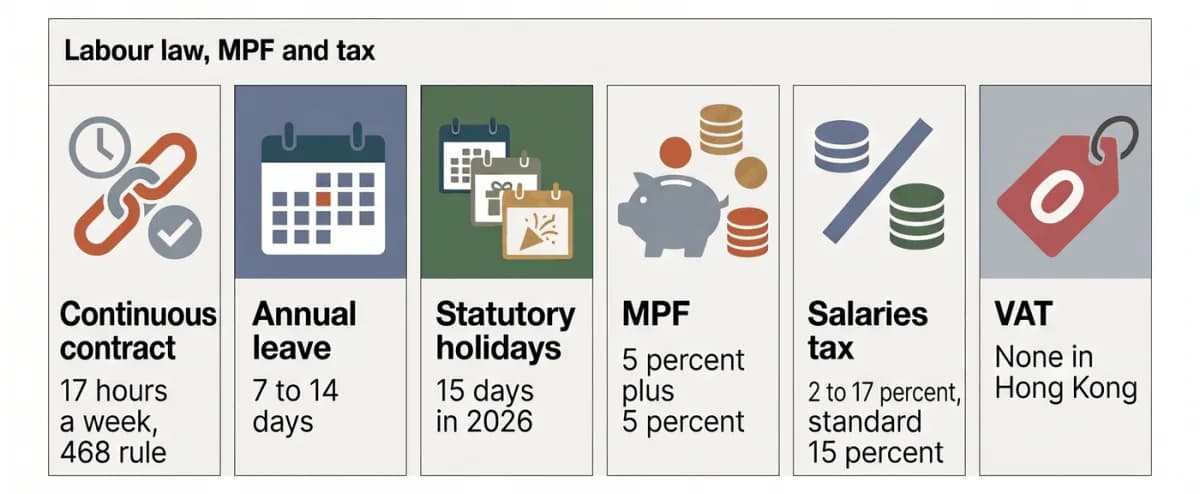
| Continuous contract ('468') | Four weeks or more, with at least 17 hours in each week, or 68 hours or more over a four-week period. Applies from 18 January 2026 | Cap. 57 First Schedule para 2A[^36] |
| Rest day | At least one day in every seven | Cap. 57 s.17[^36] |
| Annual leave | 7 days in years 1 and 2, then 8, 9, 10, 11, 12 and 13 days in years 3 to 8, and 14 days from year 9 | Cap. 57 s.41AA[^37] |
| Sickness allowance | Four-fifths of average daily wage; paid sickness days accrue at 2 a month in the first year and 4 a month after, up to 120; at least 4 consecutive days | Cap. 57; Concise Guide[^38] |
| Maternity leave | 14 weeks at four-fifths of average daily wage; weeks 11 to 14 are capped at HKD 80,000 and reimbursable by the Government | Cap. 57 Schedule 1A[^39] |
| Paternity leave | 5 days at four-fifths; needs 40 weeks of continuous contract | Cap. 57[^39] |
| Notice | The agreed period but not less than 7 days; one month if the contract is silent (continuous contract); no notice in the first month of probation | Cap. 57 s.6[^40] |
| Severance and long service payment | Severance after 24 months of service for redundancy; long service after 5 years; both capped at HKD 390,000 | Cap. 57 s.31V[^41] |
| Employees' Compensation | Employers must insure; temporary incapacity pay is four-fifths of the monthly earnings difference | Cap. 282 ss.40 and 10(1)[^42] |
The '468' rule: the Employment (Amendment) Ordinance 2025 came into operation on 28 December 2025. A three-week transition kept the old 18-hour test, so the new test applies from 18 January 2026.[^36] A week counts if you work at least 17 hours, or if you were employed in the previous three weeks and worked at least 68 hours across that four-week window.[^36]
What this means for a job seeker: if you work 17 hours or more a week for four weeks, you are likely to have a continuous contract with leave, sickness and holiday pay rights. Part-time hours of just under that are the grey area, so ask for the hours in writing.
Notice, dismissal, severance and long service payment
Either side may end a contract by giving the agreed notice, which cannot be less than 7 days, or one month if the contract says nothing.[^40] A severance payment applies after 24 months of continuous service when you are made redundant, and a long service payment applies after 5 years. Both are calculated on two thirds of monthly wages, where the wage is taken at a maximum of HKD 22,500, so two thirds is HKD 15,000 for each year of service, up to a total of HKD 390,000 (about USD 49,700).[^41] Employers can no longer use their mandatory MPF contributions to offset the payment for service from 1 May 2025 (see below).[^43]
Public holidays in 2026
Hong Kong has 15 statutory holidays in 2026, according to the Labour Department. If a holiday falls on a rest day, a holiday is granted on the next day that is not a holiday or a rest day. Holiday pay requires 3 months of continuous contract.[^44]
| Statutory holiday | Date in 2026 |
|---|---|
| The first day of January | Thursday 1 January |
| Lunar New Year (3 days) | Tuesday 17 to Thursday 19 February |
| Ching Ming Festival | Sunday 5 April |
| Easter Monday (new from 2026) | Monday 6 April |
| Labour Day | Friday 1 May |
| Buddha's Birthday | Sunday 24 May |
| Tuen Ng Festival | Friday 19 June |
| HKSAR Establishment Day | Wednesday 1 July |
| Day following the Mid-Autumn Festival | Saturday 26 September |
| National Day | Thursday 1 October |
| Chung Yeung Festival | Sunday 18 October |
| Winter Solstice or Christmas Day, at the employer's option | Tuesday 22 December or Friday 25 December |
| First weekday after Christmas Day | Saturday 26 December |
The count is 15 because Lunar New Year is three days. The number rises: Good Friday becomes a statutory holiday from 2028 (16 days), and the day following Good Friday from 2030 (17 days).[^45] Do not confuse these with general holidays, a separate list on the government calendar. For 2026 it includes Good Friday (3 April), 4 April and substitution days on 6 April, 7 April, 25 May and 19 October, and the Winter Solstice is not a general holiday.[^45]
Social security: MPF and what you get
Most employees join the Mandatory Provident Fund (MPF), a retirement scheme paid through payroll.
- Rates. The employer and the employee each pay 5% of relevant income. Below HKD 7,100 a month (about USD 905) the employee pays nothing and the employer still pays 5%. Above HKD 30,000 (about USD 3,824) the cap is HKD 1,500 each.[^46]
- Who is exempt. Employment-visa entrants allowed to stay no more than 13 months are exempt, as are members of an overseas retirement scheme; people under 18 or over 65 and domestic employees are also outside the system. A normal 24 or 36 month visa holder under the TTPS or GEP is not exempt unless covered by an overseas scheme. After 13 months the employer must enrol you within 60 days, and dependants who enter on a dependant visa are covered if they work.[^47]
- Offsetting. The offsetting of long service and severance payments against the employer's mandatory MPF contributions was abolished from 1 May 2025. It has no retrospective effect, so pre-transition service can still be offset, and the Government runs a 25-year subsidy scheme for employers.[^43]
- Leaving Hong Kong. Permanent departure allows early withdrawal with a statutory declaration and proof of a right to reside elsewhere. It cannot be repeated on the same ground.[^48]
- No unemployment insurance. We found no statutory unemployment insurance. The Comprehensive Social Security Assistance (CSSA) safety net needs Hong Kong resident status for at least one year and residence of at least one year (absences up to 56 days count). Entrants under the TTPS and other talent or investment schemes, imported workers and visitors are not eligible.[^49]
- Japan. Hong Kong is not among the 24 countries with which Japan has a social security agreement, so there is no Japan-Hong Kong social security agreement.[^50]
What this means for a job seeker: the MPF is built up by your own and your employer's 5%, so a salary of HKD 30,000 or more carries a monthly contribution of HKD 1,500 from you. There is no unemployment benefit, so keep a cash buffer.
Taxes on your salary
Hong Kong taxes salaries under the Inland Revenue Ordinance (Cap. 112). The tax payable is the lower of two calculations.[^51]
| Item | Value |
|---|---|
| Progressive rates on net chargeable income | First HKD 50,000: 2%; next 50,000: 6%; next 50,000: 10%; next 50,000: 14%; the remainder: 17% |
| Standard rate on net income | 15% on the first HKD 5,000,000 and 16% above |
| Basic allowance | HKD 132,000 for 2025/26; HKD 145,000 for 2026/27 |
| Married person's allowance | HKD 264,000 for 2025/26; HKD 290,000 for 2026/27 |
| Single parent and child allowances | Single parent 132,000 to 145,000; child 130,000 to 140,000 |
| Dependent parent aged 60 or above | HKD 50,000 to 55,000 |
| One-off reduction for 2025/26 | 100% of salaries tax, capped at HKD 3,000 (legislation passed 13 May 2026) |
[^51][^52]
- No VAT. Hong Kong has no VAT or GST and no municipal income tax; we found no such statute, so we describe this as likely.[^53]
- No resident tax. There is no local income tax like Japan's resident tax (jūminzei). Property is taxed separately: property tax is 15% of the net assessable value, charged on owners, and property rates are a different charge on rateable value.[^53]
What this means for a job seeker: with a basic allowance of HKD 145,000 from 2026/27, check your own bill with the Inland Revenue Department, which applies the lower of the two calculations for you. Note that the 60-day rule applies only to testing whether all services are rendered outside Hong Kong.[^53]
Language and what Hong Kong employers expect in a CV
- Language. English and Chinese are both used at work. Cantonese is common in offices and Mandarin is increasingly useful. We did not verify any language level as a legal rule, so ask the employer what it expects, and write the CV in the language of the advert.
- Format. Keep the CV clear, specific and tailored to each advert. We found no official rule on CV length, photos or whether to list notice period and expected salary. Agencies and blogs suggest conventions, but those are common practice and not rules, so follow the advert's instructions.
- Privacy. Do not put your Hong Kong ID card number on a CV. The Privacy Commissioner's Code of Practice on Human Resource Management says an employer should not collect an ID card copy before you accept an offer, and it may collect the number only under four conditions. Give your ID to a verified employer at onboarding.[^31]
- Qualifications. The Hong Kong Council for Accreditation of Academic and Vocational Qualifications (HKCAAVQ) assesses non-local qualifications against the seven-level Hong Kong Qualifications Framework.[^54]
- Regulated professions. Doctors trained abroad may use special registration, in place since 29 October 2021, and 166 qualifications are recognised after the seventh batch on 17 June 2026. Nurses trained abroad can use special registration or special enrolment, while limited registration cannot convert to full registration. Engineers register with the Engineers Registration Board under Cap. 409, not with the Hong Kong Institution of Engineers. We did not check the rules for lawyers or accountants individually, so ask the Law Society, the Bar Association or the professional body.[^55]
- Guides. See our ATS-friendly CV guide and, as a model for English CVs, the UK CV format guide.
Verify a listing before sharing documents
Use official channels. The Anti-Deception Coordination Centre (ADCC) runs the Anti-Scam Helpline 18222. Scameter is a police search tool, launched in September 2022, that you reach through cyberdefender.hk or the Scameter+ app.[^56]
- An agency that asks for more than 10% of your first month's wages after placement is breaking the rules; check the licence on the Labour Department site first.[^14][^15]
- Never send an ID card copy before you have accepted an offer.[^31]
- Check the company name and address against its own career page.
- Drop any offer that asks you to receive and forward money for someone else.
A seven-day search routine
- Day 1: pick two sectors and save 20 adverts from iES and one commercial board.
- Day 2: list repeated job titles, skills and language requirements.
- Day 3: build one master CV and a tailored version for the strongest sector.
- Day 4: set alerts and visit employer career pages and the job fairs list.
- Day 5: if you need a visa, compare the offer and your profile with the TTPS, GEP and IANG conditions.
- Day 6: send targeted applications.
- Day 7: review replies and keep the channels that produced recruiter contact.
Final checklist before you apply
- [ ] My CV is clear and tailored, and it shows no Hong Kong ID card number.
- [ ] The offer is at or above HKD 43.1 an hour, or HKD 5,220 a month plus food for a live-in domestic helper.
- [ ] If I need a visa, I know which scheme fits and its key condition.
- [ ] I know my hours, notice, leave and the '468' rule.
- [ ] I know that MPF of 5% will be deducted, and I have compared net pay.
- [ ] The agency holds a licence and no one has asked me for more than the 10% commission.
FAQ
What are the best job sites in Hong Kong?
The Labour Department's iES, CTgoodjobs, recruit.com.hk, efinancialcareers.hk and LinkedIn loaded in our checks. JobsDB, Indeed, Glassdoor and foundit are well-known boards that blocked our automated check, and we found no verified ranking. Licensed agencies and employer pages complete the picture.[^7][^12]
What is the minimum wage in Hong Kong in 2026?
HKD 43.1 an hour from 1 May 2026 (about USD 5.49), up from HKD 42.1. Live-in foreign domestic helpers have a separate minimum of HKD 5,220 a month for contracts signed from 3 October 2026, plus food or an allowance of at least HKD 1,236.[^17][^18]
Can I work in Hong Kong without Cantonese?
In international finance, technology and professional services, English may be enough, but many roles list both Chinese and English. Ask the employer which language level it expects.
Which visa should a foreign professional apply for?
If you have a job offer, the GEP is the main route, with about 4 weeks of processing. The TTPS and IANG need no job offer for eligible people. Check the key condition of each scheme first.[^23][^22][^25]
What is the Top Talent Pass Scheme (TTPS)?
A scheme with three categories (income of HKD 2.5 million or more, a listed-university degree with 3 years of experience in the last 5, or a recent listed-university graduate). No job offer is needed, and processing is about 4 weeks.[^22]
Can Japanese citizens use a working holiday or enter without a visa?
Yes. Japanese passport holders can visit without a visa for up to 90 days but may not work. The working holiday scheme has 1,500 places a year for ages 18 to 30, with a maximum of six months with one employer.[^32][^33]
What is the '468' rule?
A contract is continuous if you work four weeks or more with at least 17 hours in each week, or 68 hours or more over a four-week period. It applies from 18 January 2026.[^36]
How much annual leave and how many public holidays do I get?
7 to 14 days of annual leave, rising with service, plus 15 statutory holidays in 2026. Holiday pay needs 3 months of continuous contract.[^37][^44]
Do I pay MPF, and is there unemployment benefit?
Yes, 5% from you and 5% from your employer on relevant income between HKD 7,100 and HKD 30,000 a month, unless you are exempt. There is no statutory unemployment insurance, and talent-scheme entrants cannot claim CSSA.[^46][^49]
How much salaries tax will I pay?
Progressive rates from 2% to 17% on net chargeable income apply, or a standard rate of 15% on the first HKD 5,000,000 and 16% above, whichever gives less tax. The basic allowance is HKD 145,000 from 2026/27, and there is a one-off 2025/26 reduction capped at HKD 3,000.[^51][^52]
How to use AIResume
Keep one master CV in AIResume and create a tailored version for each advert. Use the how to tailor your CV to a job description guide to match each advert.
Related AIResume guides
- Job boards in Singapore
- Job boards in Australia
- Job boards in the United Kingdom
- Job boards in India
- UK CV format guide
- How to write an ATS-friendly CV
- How to tailor your CV to a job description
- CV vs resume for international applications
Sources
[^1]: World Bank, World Development Indicators: Hong Kong SAR, China (accessed 21 October 2026)
[^2]: Census and Statistics Department, labour force statistics, June to August 2026 (17 September 2026)
[^3]: Census and Statistics Department, mid-2026 population (18 August 2026)
[^4]: HKMA, Base Rate (17 September 2026); HKMA, how the Linked Exchange Rate System works
[^5]: Government reply to the Legislative Council on talent admission (25 March 2026)
[^6]: HKMA, Linked Exchange Rate System; HKMA, daily HKD exchange rate (30 September 2026: 7.8455)
[^7]: Labour Department, Interactive Employment Service; Labour Department, employment services; iES job fairs
[^8]: Employees Retraining Board, FAQs; Government press release (4 June 2025)
[^9]: Labour Department, youth employment programmes; Government press release (25 February 2026)
[^10]: Civil Service Bureau, Basic Law and National Security Law Test
[^11]: Hong Kong Talent Engage, About Us
[^12]: CTgoodjobs; recruit.com.hk; efinancialcareers.hk; LinkedIn Jobs; SEEK Asia, about us (JobsDB, Indeed, Glassdoor and foundit blocked our automated check)
[^13]: HKTDC, Education & Careers Expo
[^14]: Employment Ordinance, Cap. 57; Employment Agency Regulations, Cap. 57A
[^15]: Employment Agencies Administration, licensed-agency search; list of convicted agencies
[^16]: Michael Page, Hays, Randstad, Robert Half, Morgan McKinley, Pasona, Adecco, ManpowerGroup (all loaded on 21 October 2026)
[^17]: Minimum Wage Ordinance, Cap. 608; Legislative Council brief on the 2026 review (10 February 2026)
[^18]: Government press release on the FDH Minimum Allowable Wage (2 October 2026)
[^19]: Census and Statistics Department, 2025 Annual Earnings and Hours Survey (23 March 2026); General Household Survey, Q2 2026
[^20]: Labour Department, Statutory Minimum Wage
[^21]: Rating and Valuation Department, property market statistics (October 2026 edition); Government press release on the Basic Housing Units Ordinance
[^22]: Immigration Department, TTPS; TTPS FAQ
[^23]: Immigration Department, GEP; ASMTP; Immigration Ordinance, Cap. 115
[^24]: Immigration Department, QMAS
[^25]: Immigration Department, IANG
[^26]: Immigration Department, TechTAS; Immigration Department press release
[^27]: Immigration Department, list of eligible universities; Government press release (28 December 2025); TTPS FAQ
[^28]: Immigration Department, fee tables
[^29]: Immigration Department, 2025 review press release
[^30]: Immigration Ordinance, Cap. 115, s.17I; Immigration Department, do not employ illegal workers; Hong Kong identity card
[^31]: Privacy Commissioner, Code of Practice on Human Resource Management
[^32]: Immigration Department, visit visa and entry permit
[^33]: Immigration Department, Working Holiday Scheme
[^35]: Legislative Council research paper ISSH02/2025 (24 February 2025)
[^36]: Labour Department, Concise Guide, chapter 1; Employment Ordinance, Cap. 57
[^37]: Labour Department, Concise Guide, chapter 4
[^38]: Labour Department, Concise Guide, chapter 5
[^39]: Labour Department, Concise Guide, chapter 6; chapter 7
[^40]: Employment Ordinance, Cap. 57, s.6
[^41]: Labour Department, Concise Guide, chapter 11; Employment Ordinance, Cap. 57, s.31V
[^42]: Employees' Compensation Ordinance, Cap. 282
[^43]: MPFA, long service and severance payments
[^44]: Labour Department, statutory holidays 2026
[^45]: Labour Department, Concise Guide, chapter 4; GovHK, general holidays 2026
[^46]: MPFA, mandatory contributions for employees
[^47]: MPFA, MPF coverage
[^48]: MPFA, early withdrawal
[^49]: Social Welfare Department, CSSA residence requirements
[^50]: Japan Pension Service, social security agreements
[^51]: Inland Revenue Department, salaries tax rates (PAM 61); Inland Revenue Ordinance, Cap. 112
[^52]: Inland Revenue Department, 2026-27 Budget FAQ
[^53]: Inland Revenue Ordinance, Cap. 112, ss.5 and 8 and Schedule 1
[^54]: HKCAAVQ; Hong Kong Qualifications Framework
[^55]: Government press release on special registration (17 June 2026); Nursing Council of Hong Kong; Engineers Registration Board; Law Society; Bar Association
[^56]: Anti-Deception Coordination Centre; Hong Kong Police Force, Scameter
Your next step
- DeelFor employers hiring across borders: contracts, payroll and visas handled.See how Deel works
Affiliate links: we may earn a commission at no cost to you. Affiliate link