

Italy Job Search in 2026: Job Boards, Pay Rules, Work Permits and Labour Law
Italy is a large European economy built on manufacturing, exports and tourism, with about 58.9 million residents. Employment is often reported at record levels, but participation is low by European standards and conditions differ between the North and the South. The World Bank lists unemployment at
By AIResume Editorial Team
Last updated: 23 October 2026
Italy is a large European economy built on manufacturing, exports and tourism, with about 58.9 million residents. Employment is often reported at record levels, but participation is low by European standards and conditions differ between the North and the South. The World Bank lists unemployment at 6.4% and youth unemployment (ages 15 to 24) at 20.5% for 2025. Italian is the working language of most employers, while English is common mainly in multinationals and some Milan roles. Your route depends on your passport: EU and EEA citizens can work after a registration, while citizens of other countries normally need a permit tied to a job.
This guide covers the economy in numbers, where to search, pay rules, work permits, labour law, public holidays, social security, taxes and what employers expect in a CV. For other markets, see our published job-board guides to Spain, Portugal, France, Switzerland, the United Kingdom and Ireland.
Editorial boundary: This is practical job-search guidance, not legal, immigration or tax advice. We only list figures we could read in an official or primary source, and we mark those that come from press reports or a secondary summary as "reported" or "likely". Confirm details with the Ministry of Labour and Social Policies, inPA, the Ministry of the Interior, INPS, ISTAT, the Agenzia delle Entrate and the law texts on Normattiva before you sign.
Before you apply
- SafetyWing Nomad InsuranceHealth insurance that works in your new country from day one.Get a quote
Affiliate links: we may earn a commission at no cost to you. Affiliate link
Italy's economy in numbers
| Indicator | 2020 | 2021 | 2022 | 2023 | 2024 | 2025 |
|---|---|---|---|---|---|---|
| GDP (USD billion) | 1,907.5 | 2,179.2 | 2,104.1 | 2,316.9 | 2,383.4 | 2,551.6 |
| GDP per person (USD) | 32,091 | 36,853 | 35,654 | 39,280 | 40,430 | 43,309 |
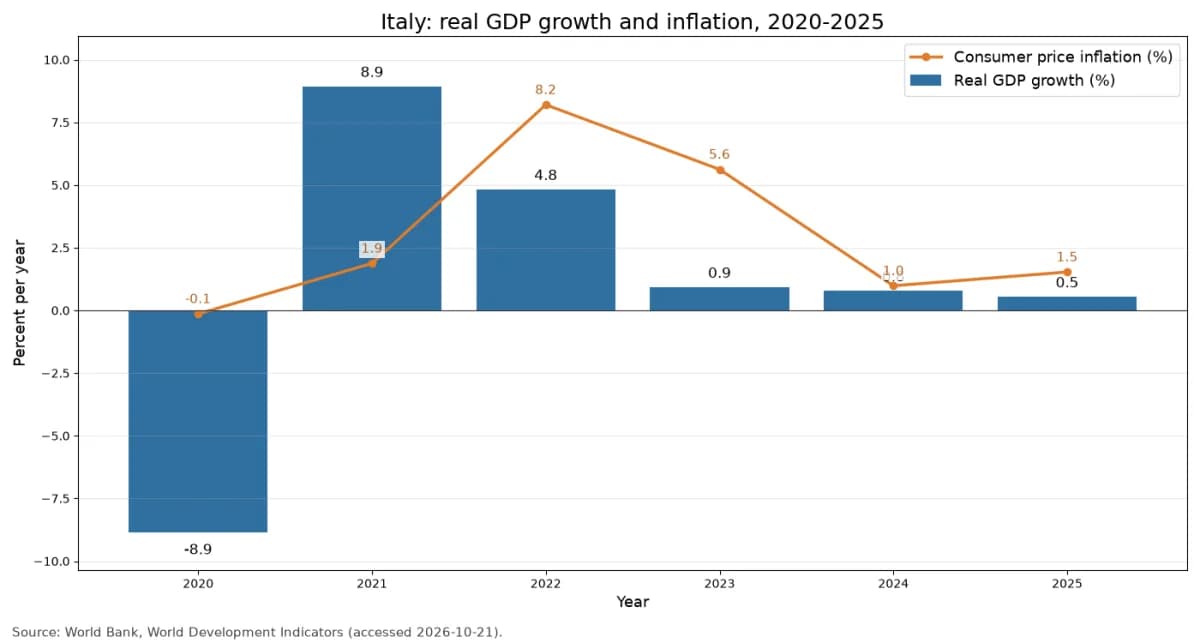
| Real GDP growth (%) | -8.9 | 8.9 | 4.8 | 0.9 | 0.8 | 0.5 |
| Inflation (%) | -0.1 | 1.9 | 8.2 | 5.6 | 1.0 | 1.5 |
| Population (million) | 59.44 | 59.13 | 59.01 | 58.98 | 58.95 | 58.92 |
*Source: World Bank, World Development Indicators (accessed 21 October 2026).*[^1]
The World Bank also lists unemployment of 6.4% and youth unemployment of 20.5% for 2025, and personal remittances received at 0.5% of GDP.[^1] The national figures below come from Italian primary sources.
| Measure | Value | Source |
|---|---|---|
| Foreign residents, 1 January 2026 (provisional) | 5.56 million, 9.4% of 58.943 million residents; up 188,000 (3.5%) on 2025 | ISTAT[^2] |
| Foreign employed people, 2025 | Nearly 2.6 million, 10.7% of employed people | Ministry of Labour, XVI Rapporto, 14 July 2026[^3] |
| Average annual pay, private employees, 2024 | EUR 24,486 (2023: EUR 23,662); excludes agricultural and domestic workers | INPS[^4] |
| Japanese residents in Italy, 1 October 2025 | 12,067 (5,532 long-term, 6,535 permanent) | MOFA Japan[^5] |
| ECB reference rate, 22 October 2026 | EUR 1 = USD 1.1205 = JPY 175.97 | European Central Bank[^6] |
We convert euros to US dollars at USD 1.1205 per EUR 1, the ECB reference rate of 22 October 2026, and write "about" because the rate moves daily.[^6] The INPS average of EUR 24,486 is about USD 27,437.
What this means for a job seeker: a youth unemployment rate of 20.5% and a pay average that covers only private employees say little about your sector or city. Look at adverts in your own field and region before you set an expectation.
Italy job search in one table
| Channel | What it is | Use it for | Limit |
|---|---|---|---|
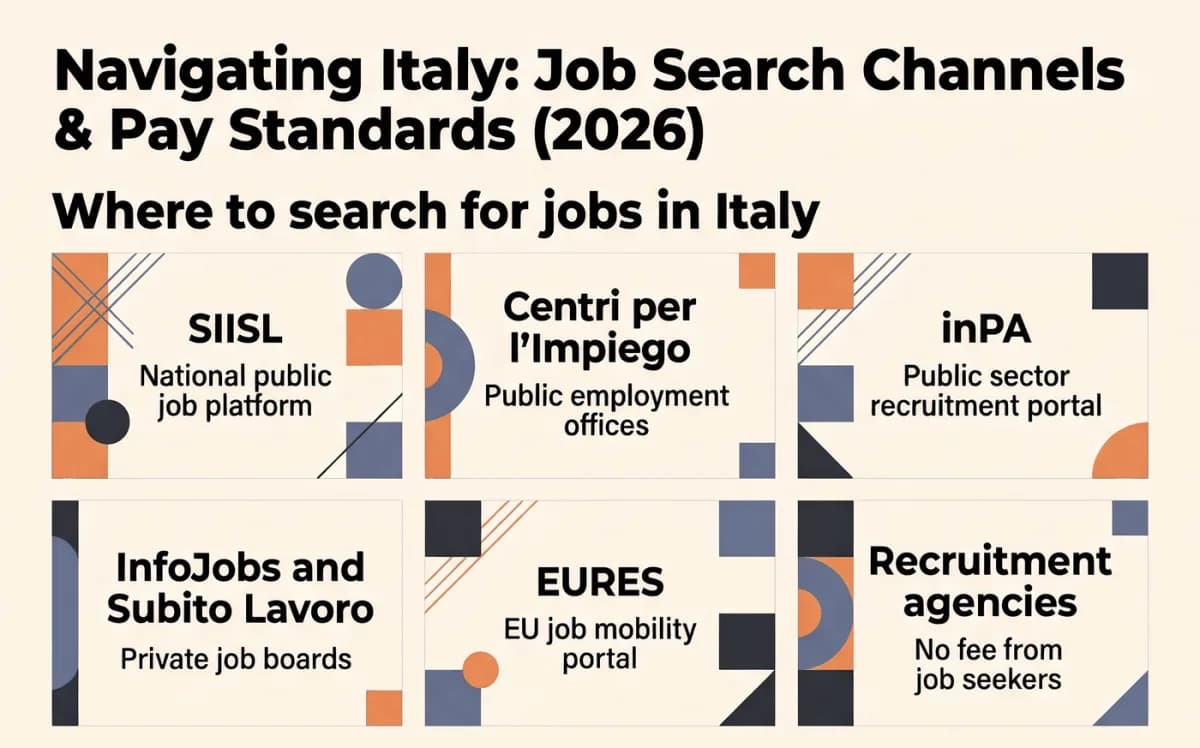
| Centri per l'Impiego (CPI) and SIISL | Public employment offices and the Ministry's national job platform | Registering as unemployed, public vacancies, CVs visible to employers | Log-in needs SPID or CIE (Italian digital identity); foreigners without one should ask the local CPI (likely)[^7] |
| inPA | The single recruitment portal for public administrations | Public-sector competitions and posts | Free, but only via digital identity; many competitions require Italian[^10] |
| ClicLavoro and Lazio regional job pages | Ministry labour portal and a regional example | Regional services and internships | We did not review their vacancy volumes[^12] |
| InfoJobs, LinkedIn Jobs and Subito Lavoro | Private boards and platforms that loaded for us | Broad search and alerts | We read no market-share source and make no size claims[^12] |
| Indeed, Glassdoor, Bakeca, Jobrapido | Private boards | Broad search | They block automated checks, so we could not read them and link none[^12] |
| EURES, JobsInMilan, The Hub | EU job mobility portal; English-language and startup-oriented sites | English-speaking and international roles | We confirmed that the sites load, not their current volumes[^13] |
| AlmaLaurea, Polimi Career Service, Bocconi | University consortium and career services | Students and graduates | Aimed at students and alumni; AlmaLaurea returned an error when we tested[^14] |
| Staffing agencies | See the section below | Temporary and some permanent roles | Never pay a fee[^18] |
| Employer pages | Eni, Enel, Generali, Ferrero and others | Direct applications | Pages change; we did not check individual vacancies[^15] |
What this means for a job seeker: register on SIISL or at the CPI for public services, pick two general boards, add the channel that fits your status and set alerts. Treat the table as a snapshot of 23 October 2026, not a ranking.
Public employment services and public-sector jobs
ANPAL was abolished by art. 3 of D.L. 75/2023 and its functions went to the Ministry of Labour (press: 1 March 2024, likely).[^9] SIISL was created by art. 5 of D.L. 48/2023 and is run for the Ministry by INPS. It opened to all citizens and employers on 18 December 2024; employers can publish vacancies and see CVs whose owners allow it.[^7] From 28 June 2026, when L. 112/2026 converting D.L. 62/2026 took effect, SIISL postings must state the national collective agreement (CCNL) applied, with its code, and the pay linked to the qualification and level (art. 7 c.6).[^8]
inPA is the single recruitment portal under art. 35-ter of D.Lgs 165/2001. Registration is free and only through digital identity. Since 2023, publication on inPA and on the institution's own site exempts administrations from publishing in the Gazzetta Ufficiale (c.2-bis).[^10] The PNRR-funded GOL programme ran to 30 June 2026; the Ministry reports 4.3 million people taken in charge (likely, from a press release).[^11]
Channels in English and for international talent
EURES gives EU citizens information on living and working in Italy, and JobsInMilan and The Hub are English-language or startup-oriented sites that loaded for us.[^13] Eni, Enel, Generali and Ferrero have career pages that loaded.[^15] University career services such as Polimi and Bocconi are the practical entry route for recent graduates.[^14] Expect Italian to be required outside multinationals.
Recruitment and staffing agencies
Under D.Lgs 276/2003 art. 11 c.1, authorised or accredited bodies may not demand or receive fees from the worker, directly or indirectly. Paragraph 2 lets collective agreements lift the ban for highly professionalised categories or specific services. For staffing-agency placement, art. 18 c.4 sets arrest up to one year or a fine of EUR 2,500 to 6,000, plus removal from the register.[^18] The Albo delle agenzie per il lavoro is kept by the Ministry of Labour, so you can check that an agency is authorised.[^17]
Agency work is a different arrangement: under D.Lgs 81/2015 art. 35 c.1, an agency worker is entitled for equal duties to conditions "complessivamente non inferiori" to comparable employees of the user company.[^19] Randstad, Adecco, Manpower, Gi Group, Umana, Openjobmetis, Synergie, Hays, Michael Page and Hunters Group have working sites, and we found no neutral ranking.[^16] Assolavoro is the employer association of temporary-work agencies, but its site blocks automated checks. D.L. 62/2026 also adds rules against "caporalato digitale", including a presumption of subordination when a platform controls the work.[^20]
Internships (tirocini)
Extra-curricular internships rest on L. 92/2012 art. 1 c.34 to 36 and national guidelines of 25 May 2017, which set a minimum of EUR 300 gross a month (about USD 336); regions set their own rules and duration limits. Lazio requires at least EUR 800 gross a month (about USD 896) under DGR 576/2019 and allows a standard maximum of 6 months, with 12 to 24 months for specified categories.[^21] Lombardia and Campania are reported at EUR 500 (likely; we could not load the regional texts), so check your region.
Pay in 2026: no statutory minimum wage
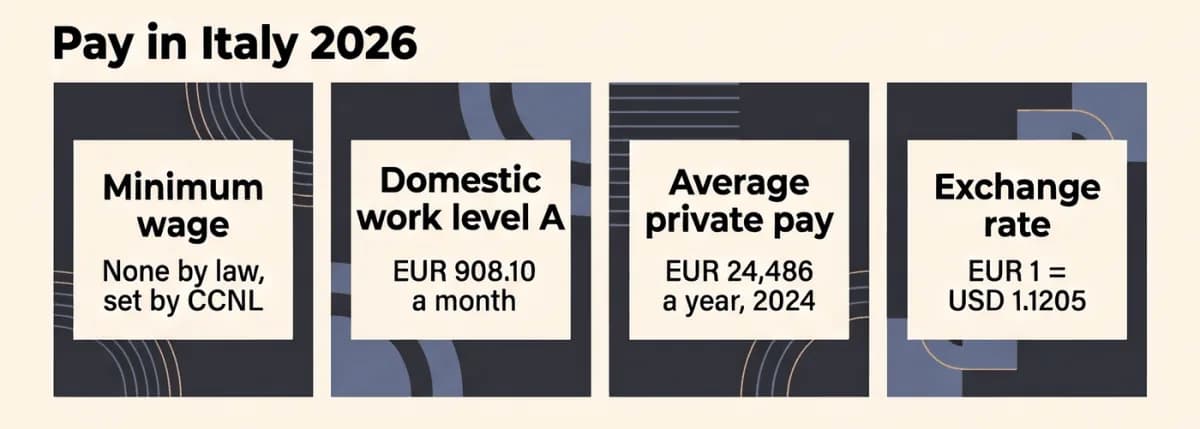
Italy has no general statutory minimum wage. A 2025 delegation law (L. 144/2025) reportedly lapsed in April 2026. D.L. 62/2026 ("salario giusto"), converted by L. 112/2026, now says collective bargaining sets fair pay. Under art. 7, the overall economic treatment (*trattamento economico complessivo*) of the CCNL signed by the comparatively most representative organisations is the benchmark, and other CCNLs may not go below it. That treatment counts fixed pay items, the 13th and 14th instalments and contractual welfare, and excludes discretionary or variable items.[^8] Payslips and employment information must show the CCNL code (art. 11).[^8] The CNEL archive lists the contracts.[^23]
We could not read primary tables for the large sector agreements, and press figures conflict, so we give none. The one official table we could read is the Ministry's domestic-work table from 1 January 2026.[^22]
| Floor or benchmark | EUR | USD at 1.1205 | Valid |
|---|---|---|---|
| Domestic work, live-in, level A, per month | 908.10 | about 1,018 | From 1 January 2026[^22] |
| Domestic work, live-in, level DS, per month | 1,474.73 | about 1,652 | From 1 January 2026[^22] |
| Domestic work, not live-in, level DS, per hour | 9.97 | about 11.17 | From 1 January 2026[^22] |
| Average annual pay, private employees, 2024 | 24,486 | about 27,437 | INPS[^4] |
Most CCNLs provide 13 or 14 monthly payments; these come from the contracts and practice, not from one statute, and the law counts them in the CCNL's overall treatment.[^8] The EU Blue Card has no fixed euro figure in the statute: art. 27-quater TUI requires annual pay not below the CCNL and not below the ISTAT average annual gross wage. We found no confirmed 2026 euro amount, so check the current figure with the authorities.[^27]
Since 7 June 2026, D.Lgs 96/2026 art. 5 requires candidates to be given the starting pay or pay range (in job notices) and the applicable CCNL provisions. Employers may not ask about pay history.[^24]
What this means for a job seeker: ask which CCNL applies, which level your role falls into and how many monthly payments it provides.
Work permits and routes for non-EU citizens
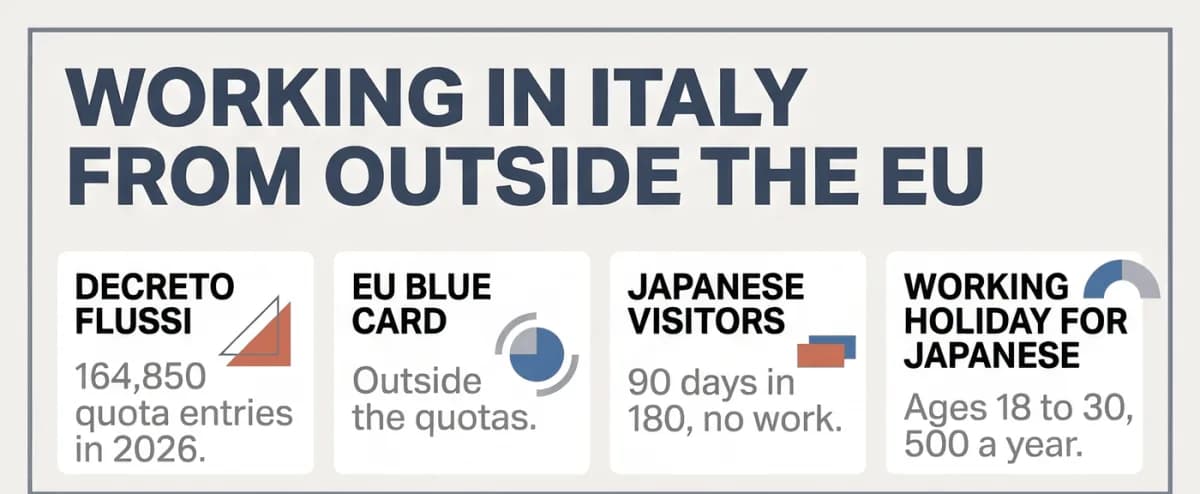
Permit rules change often. Check current conditions with the Ministry of the Interior and your Italian consulate before you apply.
| Route | Who it is for | Key condition | Note |
|---|---|---|---|
| EU and EEA registration | Citizens of EU and EEA countries | Registration at the Comune after three months (likely) | We did not re-read the procedure; check with the Comune |
| Decreto flussi quota route | Non-EU workers with an employer in Italy | Entry within the annual quota, with a nulla osta through the Sportello Unico | 164,850 entries in 2026[^25] |
| EU Blue Card | Highly qualified workers | Pay not below the CCNL and the ISTAT average; degree of 3 years or equivalent, or 5 years' experience (3 for certain ICT roles) | Outside the quotas; contract of at least 6 months (circular)[^27] |
| Remote worker ("digital nomad") | Highly qualified remote workers | No nulla osta; permit up to 1 year; health insurance; income of at least three times the health-cost exemption level; 6 months' prior remote work | Art. 27 c.1 q-bis TUI; euro amount not fixed, so we give none[^28] |
| Working holiday (Japan) | Japanese citizens aged 18 to 30 | See below | Italy start year 2026, cap 500[^32] |
| Study to work | International students | Up to 20 hours a week (1,040 hours a year); study-to-work conversion quotas were abolished by D.L. 20/2023 | Graduates of Italian universities may register as unemployed for up to 12 months[^29] |
The DPCM of 2 October 2025 sets 164,850 entries for 2026 (88,000 seasonal, 76,200 non-seasonal subordinate work and 650 self-employed), 165,850 for 2027 and 166,850 for 2028, 497,550 in total.[^25] Employing a foreign worker without a valid permit is a crime under art. 22 c.12 TUI: prison from six months to three years and a fine of EUR 5,000 for each worker, raised by one third to one half for more than three workers, minors under working age or exploitative conditions.[^26] If you lose a job, art. 22 c.11 TUI lets you keep the permit for its residual validity and at least one year, or the whole period of income support if longer. Seasonal permits are excluded.[^26]
Long-term EU residence under art. 9 TUI needs five years on a valid permit, income at least equal to the annual *assegno sociale*, suitable housing for family members and an Italian language test.[^30] Citizenship still needs 10 years of residence: turnout on the citizenship question in the June 2025 referendum was 29.85%, the quorum was not reached, and the rule stays.[^31]
Japanese nationals. Japanese citizens may reportedly stay visa-free in the Schengen area for up to 90 days in any 180-day period (likely; check with the Italian consulate before travel). A visit does not give a right to work. The Japan-Italy working holiday agreement was signed in Rome on 2 May 2022 and ratified by L. 136/2025 (in force 27 September 2025). The Japanese Ministry of Foreign Affairs lists Italy with a start year of 2026 and an annual cap of 500, with age 18 to 30 as its general rule.[^32] We could not verify the work conditions or application steps, so check with MOFA and the Italian embassy. MOFA counted 12,067 Japanese residents in Italy on 1 October 2025.[^5]
Foreign workers in Italy in numbers
ISTAT counts 5.56 million foreign residents (9.4%) on 1 January 2026, and the Ministry of Labour counts nearly 2.6 million foreign employed people (10.7%) for 2025.[^2][^3] The World Bank lists an international migrant stock of 6,553,671 for 2024.[^1]
What this means for a job seeker: decide your route before you apply. Most non-EU workers need an employer who obtains the nulla osta within the quota, or a route outside the quota such as the Blue Card. A visitor cannot work.
Labour law: hours, leave and dismissal
Your contract may be better than these minimums, and a CCNL can change several of them.
| Topic | Rule | Law |
|---|---|---|
| Normal hours | 40 hours a week; a CCNL may average them over up to a year | D.Lgs 66/2003 art. 3[^34] |
| Maximum hours | 48 hours a week including overtime, averaged over up to 4 months; a CCNL may extend to 6 or 12 months | D.Lgs 66/2003 art. 4[^34] |
| Overtime | The 250-hour annual limit applies only where no CCNL applies; premiums are set by the CCNL | D.Lgs 66/2003 art. 5 c.3[^34] |
| Daily rest | 11 hours in every 24 | D.Lgs 66/2003 art. 7[^34] |
| Weekly rest | 24 hours in every 7 days, averaged over 14 days | D.Lgs 66/2003 art. 9[^34] |
| Annual leave | At least 4 weeks; at least 2 weeks in the year it accrues and the rest within 18 months; no cash in lieu except at termination | D.Lgs 66/2003 art. 10[^34] |
| Sick pay | INPS: 50% of average daily pay from day 4 to 20, 66.66% from day 21 to 180; days 1 to 3 are paid by the employer only if the CCNL provides (reported) | INPS[^35] |
| Probation | Up to 6 months unless the CCNL sets less; for fixed-term contracts, 1 day per 15 calendar days, minimum 2 and maximum 15 days (contracts up to 6 months) or 30 days (6 to 12 months) | D.Lgs 104/2022 art. 7; L. 203/2024 art. 13[^36] |
| Notice | Set by the CCNL; we found no verified general figures | Check your CCNL |
What this means for a job seeker: the 48-hour maximum and the rest rules are averages that a CCNL can stretch, so read the CCNL as well as the contract.
Dismissal, TFR and fixed-term rules
For unjustified dismissal under D.Lgs 23/2015, for people hired from 7 March 2015, the indemnity is two months' pay per year of service, with a minimum of 6 and a maximum of 36 months (art. 3 c.1). Reinstatement applies where the fact alleged is proved not to exist in just-cause and subjective cases and, after Constitutional Court ruling 128/2024, in objective cases.[^37] The 2025 referendum questions on work also missed the quorum (turnout 29.83%).[^31]
The TFR (end-of-service pay) under art. 2120 of the Civil Code accrues each year at annual pay divided by 13.5, and is paid on any termination.[^38] A fixed-term contract can run 12 months without a stated ground. Up to 24 months needs a ground: a CCNL case, grounds agreed in the company's contracts (only until 31 December 2026) or the replacement of workers (art. 19 D.Lgs 81/2015).[^39] Resignation by conclusive acts exists: unjustified absence beyond the CCNL term, or more than 15 days if the CCNL has none, after which the employer notifies the labour inspectorate (art. 19 L. 203/2024, in force 12 January 2025). It has no effect if you prove force majeure or an employer fault that prevented you from communicating.[^40]
Public holidays in 2026
L. 151/2025, in force from 1 January 2026, added 4 October (St Francis of Assisi) to the national holidays. In 2026 it falls on a Sunday.[^41]
| Holiday | Date in 2026 |
|---|---|
| New Year's Day | Thursday 1 January |
| Epiphany | Tuesday 6 January |
| Easter Monday | Monday 6 April |
| Liberation Day | Saturday 25 April |
| Labour Day | Friday 1 May |
| Republic Day | Tuesday 2 June |
| Assumption | Saturday 15 August |
| St Francis of Assisi | Sunday 4 October |
| All Saints' Day | Sunday 1 November |
| Immaculate Conception | Tuesday 8 December |
| Christmas Day | Friday 25 December |
| St Stephen's Day | Saturday 26 December |
Easter Sunday is not counted among the 12. Each town also has a local patron-saint day; whether it is a day off depends on your CCNL and contract, so ask. Several holidays fall on a weekend in 2026.
Social security: pension, unemployment and health care
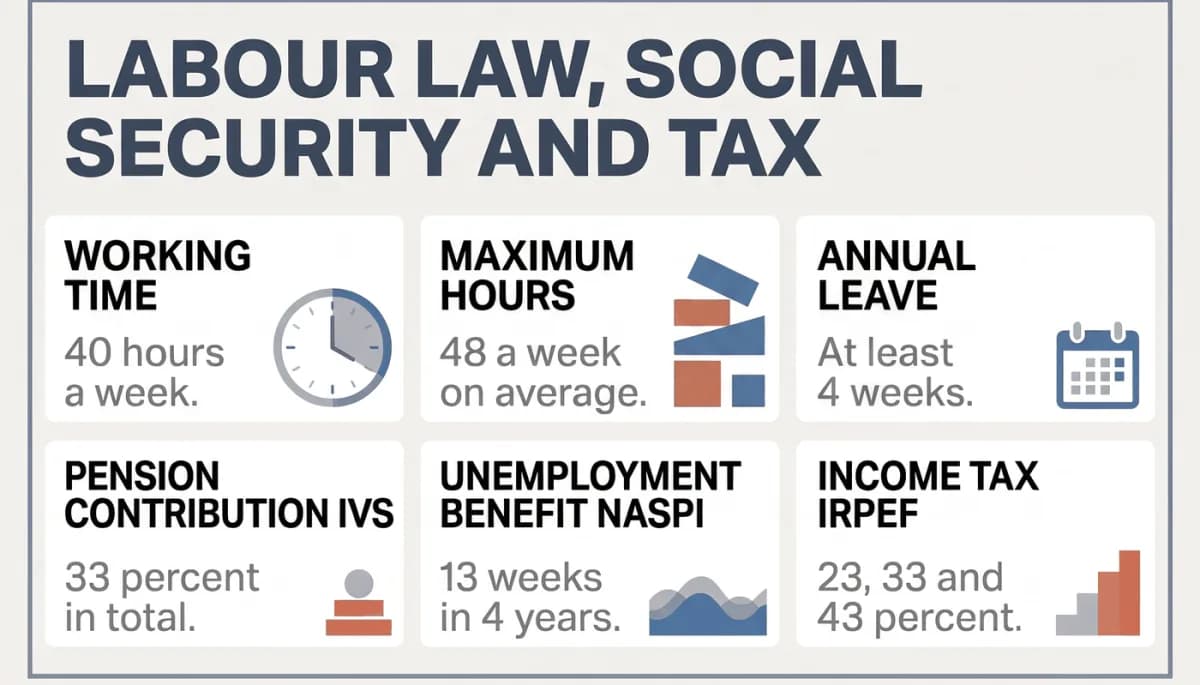
INPS gives a total pension (IVS) rate of 33% for employees; the employer pays it and withholds the worker's share. We could not verify how it splits, so we give none.[^42] The state pension age is 67 in 2026, rising reportedly to 67 years and 1 month from 1 January 2027 and 67 years and 3 months from 1 January 2028 under the 2026 Budget Law.[^46]
Unemployment benefit (NASpI). INPS requires 13 weeks of unemployment-insurance contributions in the four years before the job ends. It pays 75% of average monthly pay up to a reference amount, plus 25% of the excess, falling by 3% a month from the 6th month (the 8th if you are 55 or over). It lasts half of the contribution weeks of the last four years. Resignations do not qualify, including resignation by conclusive acts (INPS circular 154 of 22 December 2025), except for just cause and the protected maternity or paternity period.[^43] For 2026 the reference pay is reported as EUR 1,456.72 and the monthly maximum as EUR 1,584.70 (likely, from INPS circular 4/2026, which we could not read in full).[^43] Check with INPS how this applies to your permit type.
Maternity and pension rights. Maternity leave is five months at 80% of pay (D.Lgs 151/2001 arts 16 and 22).[^44] On repatriation, a foreign worker keeps pension and social-security rights under art. 22 c.13 TUI and can claim them when the legal requirements are met.[^26] We did not verify the health-service registration steps, so ask your local health authority (ASL).
Japan-Italy social security agreement. It has been in force since 1 April 2024. It prevents double contributions for dispatched employees: with an expected stay of up to five years, only the home-country scheme applies. It has no totalisation, so Japanese and Italian contribution periods are not added together.[^45]
What this means for a job seeker: NASpI depends on contributions, so a short first contract may not qualify, and resigning usually cuts off the benefit.
Taxes on your salary
Italy taxes employment income through IRPEF, a progressive state tax, plus regional and municipal surcharges. For 2026 the rates are 23% up to EUR 28,000, 33% from EUR 28,001 to 50,000 and 43% above EUR 50,000 (L. 199/2025 art. 1 c.3-4).[^47]
| Taxable annual income (EUR) | IRPEF rate |
|---|---|
| Up to 28,000 | 23% |
| 28,001 to 50,000 | 33% |
| Above 50,000 | 43% |
- Regional surcharge. The base rate is 1.23%, and regions may add up to 2.1 points, so the actual rate varies by region (special-status regions follow different limits).[^48]
- Municipal surcharge. Municipalities may charge up to 0.8%, and Rome is reported to charge 0.9% since 2011 (likely). These two surcharges are the closest equivalent to Japan's resident tax (jūminzei), and your region and municipality set them.[^49]
- Withholding. Employers normally withhold income tax from salary; check with the Agenzia delle Entrate how the annual return applies to you.
- Impatriati regime (art. 5 D.Lgs 209/2023, text valid for 2026). Only 50% of income is taxable, up to EUR 600,000 a year, or 40% with a minor child. You must have been non-resident for the 3 prior tax years (more if you return to the same employer or group), work mostly in Italy and be highly qualified. It covers the transfer year plus 4 years, and you commit to stay 4 years.[^50] D.Lgs 117/2026 (the new income-tax code) is shown as repealing these articles from 1 January 2027, so rules may change from 2027; check with the Agenzia delle Entrate.[^50]
- New-resident flat tax. EUR 300,000 a year, plus EUR 50,000 per family member, for people who were non-resident in 9 of the previous 10 years, after a prior ruling (art. 24-bis TUIR, text valid for 2026).[^51]
- Tax residence. Art. 2 c.2 TUIR looks at most of the tax year: residence or domicile in Italy, or physical presence, not only a 183-day count.[^51]
- VAT. The ordinary rate is 22%, with reduced rates of 10%, 5% and 4%.[^52]
- Tax treaty. The Japan-Italy treaty has been in force since 17 March 1973, with a protocol from 28 January 1982.[^53]
What this means for a job seeker: only income above each limit is taxed at the higher rate, and the surcharges come on top, so compare offers by net pay.
Language and what Italian employers expect in a CV
- Language. Italian is expected at most employers. English is common in multinationals, finance and technology. Ask which level is expected and write the CV in the language of the advert.
- Format. Keep the CV short, clear and tailored. A photo is not a legal requirement.
- Privacy clause. Many candidates add a privacy sentence by habit, but art. 111-bis of D.Lgs 196/2003 says the GDPR art. 13 information is given at the first useful contact after a spontaneous CV arrives, and "il consenso al trattamento dei dati personali presenti nei curricula non è dovuto". Recruiters do not have to discard CVs without the clause.[^54]
- Fair selection. L. 300/1970 art. 8 bans inquiries into political, religious and union opinions and facts irrelevant to professional aptitude. D.Lgs 198/2006 art. 27 bans sex discrimination in access to work, and D.Lgs 276/2003 art. 10 applies similar limits to agencies. D.Lgs 215/2003 covers race and ethnic origin, and D.Lgs 216/2003 covers religion, beliefs, disability, age, nationality and sexual orientation.[^55]
- Qualifications. CIMEA is the Italian ENIC-NARIC centre for comparing foreign degrees. Regulated professions are covered by D.Lgs 206/2007, and the competent ministry depends on the profession.[^56]
- Employer checks. Private employers must notify the competent office "entro il giorno antecedente" the start of employment (UNILAV).[^33]
- Guides. See our ATS-friendly CV guide and, for the CV and resume difference, CV vs resume for international applications.
Verify a listing before sharing documents
- A recruiter or agency may not charge a job seeker fees (D.Lgs 276/2003 art. 11). Treat a fee request as a warning sign.[^18]
- Check that an agency appears in the Albo kept by the Ministry of Labour.[^17]
- Never send passport or identity copies before you have accepted an offer.
- Check the company against its own career page, and drop any offer that asks you to forward money for someone else.
- Be sceptical of anyone selling decreto flussi permits. The nulla osta goes through the state's Sportello Unico, and we found no official price list.
- Report suspected fraud to the Polizia Postale (commissariatodips.it) and ask the labour inspectorate about unlawful work.[^57]
A seven-day search routine
- Day 1: pick two sectors and save 20 adverts from general boards and one English-language or public channel.
- Day 2: list repeated titles, skills and Italian-language requirements.
- Day 3: build one master CV and a tailored version.
- Day 4: set alerts, check SIISL and visit employer pages.
- Day 5: if you need a permit, work out which route fits.
- Day 6: send targeted applications.
- Day 7: review replies and keep the channels that worked.
Final checklist before you apply
- [ ] My CV is clear and tailored to the advert.
- [ ] I know which CCNL applies and the pay stated in the advert.
- [ ] If I need a permit, I know which route fits and who applies.
- [ ] I know my hours, leave, probation and public holidays.
- [ ] I know the pension, NASpI and tax deductions and have compared net pay.
- [ ] The agency has asked me for no fee.
FAQ
What are the best job sites in Italy?
SIISL, inPA, ClicLavoro, InfoJobs, Subito Lavoro, LinkedIn Jobs and EURES loaded in our checks. Indeed, Glassdoor, Bakeca and Jobrapido block automated checks, and we found no verified ranking.[^7][^12]
Is there a minimum wage in Italy?
No general statutory minimum wage exists. Pay is benchmarked on the CCNL under D.L. 62/2026 art. 7. For example, live-in domestic work level A is EUR 908.10 a month from 1 January 2026 (about USD 1,018).[^8][^22]
Can I work in Italy without Italian?
In multinationals and some Milan roles English may be enough, but most employers expect Italian.
Which permit should a foreign professional apply for?
Most non-EU workers enter through the decreto flussi quota with an employer's nulla osta, while highly qualified workers may use the EU Blue Card outside the quotas. A visitor may not work.[^25][^27]
What is the EU Blue Card salary threshold?
The statute sets no euro figure. Pay must be not below the CCNL and not below the ISTAT average annual gross wage, and we found no confirmed 2026 amount.[^27]
Can Japanese citizens use a working holiday or enter without a visa?
They may reportedly stay visa-free up to 90 days in any 180 (likely) but may not work as visitors. MOFA lists Italy's working holiday with a start year of 2026 and a cap of 500 a year.[^32]
What are the working hours and overtime rules?
Normal hours are 40 a week, with a 48-hour average maximum including overtime. A CCNL sets overtime premiums.[^34]
How much annual leave and how many public holidays do I get?
At least four weeks of paid leave, and 12 national holidays in 2026, including 4 October, which falls on a Sunday.[^34][^41]
Do foreigners get unemployment benefit (NASpI) in Italy?
NASpI needs 13 weeks of contributions in the previous four years, and resignations generally do not qualify. Check your case with INPS.[^43]
How much income tax and local surcharge will I pay?
IRPEF is 23% to EUR 28,000, 33% to EUR 50,000 and 43% above. The regional surcharge starts at 1.23%, and municipalities may add up to 0.8%.[^47][^48][^49]
How to use AIResume
Keep one master CV in AIResume and create a tailored version for each advert. Use the how to tailor your CV to a job description guide to match each advert.
Related AIResume guides
- Job boards in Spain
- Job boards in Portugal
- Job boards in France
- Job boards in Switzerland
- Job boards in the United Kingdom
- Job boards in Ireland
- How to write an ATS-friendly CV
- How to tailor your CV to a job description
- CV vs resume for international applications
Sources
[^1]: World Bank, World Development Indicators: Italy (accessed 21 October 2026)
[^2]: ISTAT, demographic indicators 2025 report
[^3]: Ministry of Labour, XVI Rapporto on foreigners in the labour market
[^4]: INPS, Osservatorio on private-sector employees, 2024 data
[^5]: MOFA Japan, overseas Japanese nationals survey 2025
[^6]: European Central Bank, EUR/USD and EUR/JPY reference rates (22 October 2026)
[^7]: Ministry of Labour, SIISL open to citizens and firms; INPS, SIISL news; Normattiva, D.L. 48/2023 art. 5; SIISL
[^8]: Normattiva, D.L. 62/2026 art. 7; Normattiva, D.L. 62/2026
[^9]: Normattiva, D.L. 75/2023 art. 3
[^10]: Normattiva, D.Lgs 165/2001 art. 35-ter; inPA
[^11]: Ministry of Labour, GOL programme press release
[^12]: ClicLavoro; Regione Lazio, labour pages; InfoJobs; LinkedIn Jobs; Subito Lavoro
[^13]: EURES; JobsInMilan; The Hub
[^14]: Polimi Career Service; Bocconi University
[^15]: Eni careers; Enel careers; Generali, work with us; Ferrero careers
[^16]: Randstad; Adecco; Manpower; Gi Group; Umana; Openjobmetis; Synergie; Hays; Michael Page; Hunters Group
[^17]: Ministry of Labour, Albo nazionale delle agenzie per il lavoro
[^18]: Normattiva, D.Lgs 276/2003 art. 11; Normattiva, D.Lgs 276/2003 art. 18
[^19]: Normattiva, D.Lgs 81/2015 art. 35
[^20]: Normattiva, D.L. 62/2026 art. 12
[^21]: Regione Lazio, tirocini extracurriculari
[^22]: Ministry of Labour, domestic work pay table 2026
[^23]: CNEL, contracts archive
[^24]: Normattiva, D.Lgs 96/2026
[^25]: DPCM 2 October 2025 (copy hosted by the Cosenza Chamber of Commerce)
[^26]: Normattiva, D.Lgs 286/1998 art. 22
[^27]: Normattiva, D.Lgs 286/1998 art. 27-quater
[^28]: Italian embassy in Chisinau, remote worker visa guidance (18 March 2026)
[^29]: Integrazione Migranti, study-to-work conversion
[^30]: Normattiva, D.Lgs 286/1998 art. 9
[^31]: Ministry of the Interior, Eligendo archive, referendum of 8 and 9 June 2025
[^32]: MOFA Japan, working holiday countries; Normattiva, L. 136/2025
[^33]: Normattiva, D.L. 510/1996 art. 9-bis
[^34]: Normattiva, D.Lgs 66/2003
[^35]: INPS
[^36]: Normattiva, D.Lgs 104/2022 art. 7; Normattiva, L. 203/2024 art. 13
[^37]: Normattiva, D.Lgs 23/2015 art. 3
[^38]: Normattiva, Civil Code art. 2120
[^39]: Normattiva, D.Lgs 81/2015 art. 19
[^40]: Normattiva, L. 203/2024 art. 19
[^41]: Normattiva, L. 151/2025
[^42]: INPS, contribution rates
[^43]: INPS, NASpI; INPS, circular 4 of 28 January 2026
[^44]: Normattiva, D.Lgs 151/2001
[^45]: Japan Ministry of Health, Labour and Welfare, Japan-Italy social security agreement
[^46]: INPS (pension age per Budget Law 2026, L. 199/2025; reported)
[^47]: Agenzia delle Entrate, IRPEF rates; Ministry of Economy and Finance, Budget Law 2026
[^48]: Finance Department, regional IRPEF surcharge
[^49]: Finance Department, municipal IRPEF surcharge
[^50]: Normattiva, D.Lgs 209/2023 art. 5; Normattiva, D.Lgs 117/2026
[^51]: Normattiva, TUIR (DPR 917/1986) art. 24-bis and art. 2
[^52]: Agenzia delle Entrate, VAT rates
[^53]: Japan Ministry of Finance, list of tax conventions
[^54]: Normattiva, D.Lgs 196/2003 art. 111-bis
[^55]: Normattiva, L. 300/1970 art. 8; Normattiva, D.Lgs 198/2006 art. 27; Normattiva, D.Lgs 276/2003 art. 10
[^56]: CIMEA; Normattiva, D.Lgs 206/2007 art. 1
[^57]: Polizia Postale, commissariatodips.it; Ispettorato Nazionale del Lavoro
Your next step
- DeelFor employers hiring across borders: contracts, payroll and visas handled.See how Deel works
Affiliate links: we may earn a commission at no cost to you. Affiliate link