

South Korea Job Search in 2026: Job Boards, Minimum Wage, Visas and Labour Law
South Korea is a large, export-oriented economy built around manufacturing and technology, with a GDP of about USD 1.87 trillion and roughly 51.7 million people. The World Bank lists unemployment at 2.7% for 2025, but youth unemployment (ages 15 to 24) is 6.7%, about two and a half times the headlin
By AIResume Editorial Team
Last updated: 23 October 2026
South Korea is a large, export-oriented economy built around manufacturing and technology, with a GDP of about USD 1.87 trillion and roughly 51.7 million people. The World Bank lists unemployment at 2.7% for 2025, but youth unemployment (ages 15 to 24) is 6.7%, about two and a half times the headline rate. The labour market is also dual: large groups and SMEs recruit and pay differently. Korean is the working language of most employers, while English is more common in multinationals and tech. Your route also depends on status: citizens and long-term residents search freely, while other foreign nationals need a visa that allows the work.
This guide covers the economy, where to search, the 2026 minimum wage, visas, labour law, holidays, social insurance, taxes and CV expectations. For other markets, see our published job-board guides to Singapore, Australia, New Zealand and India.
Editorial boundary: This is practical job-search guidance, not legal, immigration or tax advice. We only list figures we could read in an official or primary source, and we mark those that come from press reports or a secondary summary as "reported" or "likely". Confirm details with the Ministry of Employment and Labor, Work24, the Minimum Wage Commission, the Korea Immigration Service and HiKorea, Statistics Korea (now the National Data Office, 국가데이터처), the National Pension Service, the National Tax Service and the law texts on law.go.kr before you sign.
Before you apply
- SafetyWing Nomad InsuranceHealth insurance that works in your new country from day one.Get a quote
Affiliate links: we may earn a commission at no cost to you. Affiliate link
South Korea's economy in numbers
| Indicator | 2020 | 2021 | 2022 | 2023 | 2024 | 2025 |
|---|---|---|---|---|---|---|
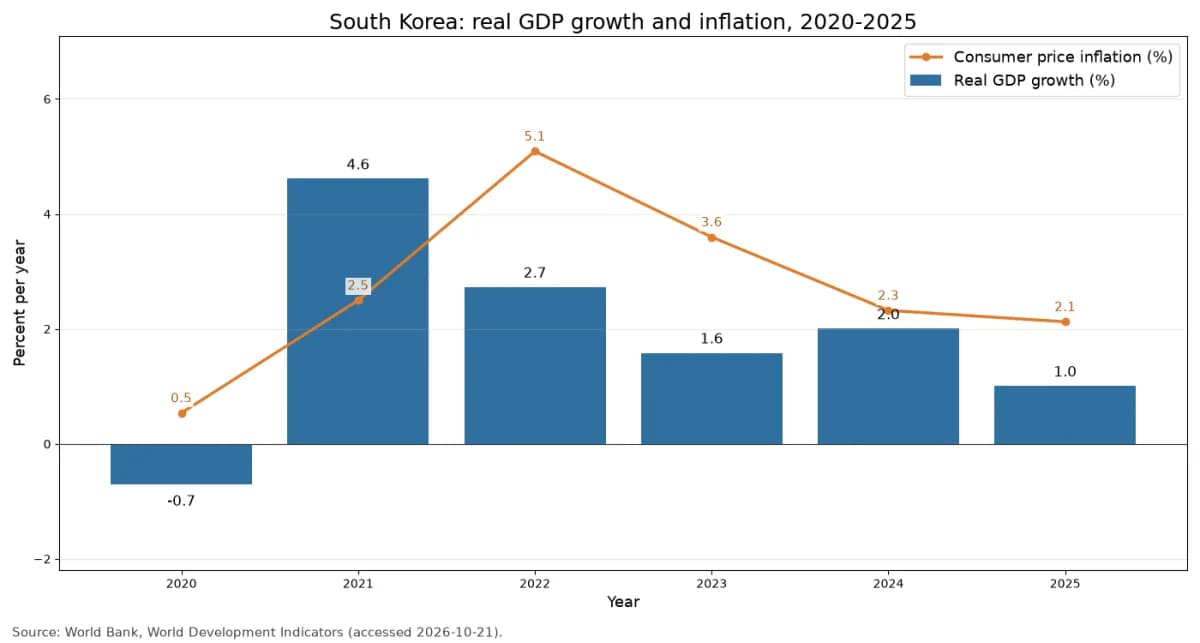
| GDP (USD billion) | 1,744.1 | 1,942.3 | 1,799.4 | 1,844.8 | 1,875.4 | 1,872.4 |
| GDP per person (USD) | 33,646 | 37,518 | 34,822 | 35,674 | 36,239 | 36,227 |
| Real GDP growth (%) | -0.7 | 4.6 | 2.7 | 1.6 | 2.0 | 1.0 |
| Inflation (%) | 0.5 | 2.5 | 5.1 | 3.6 | 2.3 | 2.1 |
| Population (million) | 51.84 | 51.77 | 51.67 | 51.71 | 51.75 | 51.68 |
*Source: World Bank, World Development Indicators (accessed 21 October 2026).*[^1]
The World Bank also lists an international migrant stock of 1,811,507 for 2024 and personal remittances received at 0.4% of GDP for 2025.[^1] The figures below come from Korean and Japanese primary sources, plus one survey known only from press.
| Measure | Value | Source |
|---|---|---|
| Foreign residents, end of 2025 | 2,783,247, or 5.44% of 51,117,378 residents; up 5.0% | Ministry of Justice[^2] |
| Foreign employed people, May 2025 | Over 1.1 million (reported) | National Data Office survey, via press[^3] |
| Japanese registered in Korea, 1 October 2025 | 44,471 (27,242 long-term, 17,229 permanent) | MOFA Japan[^4] |
| Japanese nationals among foreign residents, end of 2025 | 70,375, including short-term stays | Ministry of Justice[^2] |
| Exchange rate, 23 October 2026 | USD 1 = KRW 1,324.60; JPY 100 = KRW 846.12 | Bank of Korea / SMBS[^5] |
We convert won to US dollars at KRW 1,324.60 per USD, the 23 October 2026 reference rate, and write "about" because the rate moves daily.[^5] The two Japanese counts use different bases: MOFA counts registered Japanese abroad, the Ministry of Justice counts Japanese nationals with a Korean stay status.
What this means for a job seeker: a 2.7% headline rate hides a youth rate of 6.7% and a split between large firms and SMEs. Read adverts in your own field before you set an expectation.
South Korea job search in one table
| Channel | What it is | Use it for | Limit |
|---|---|---|---|
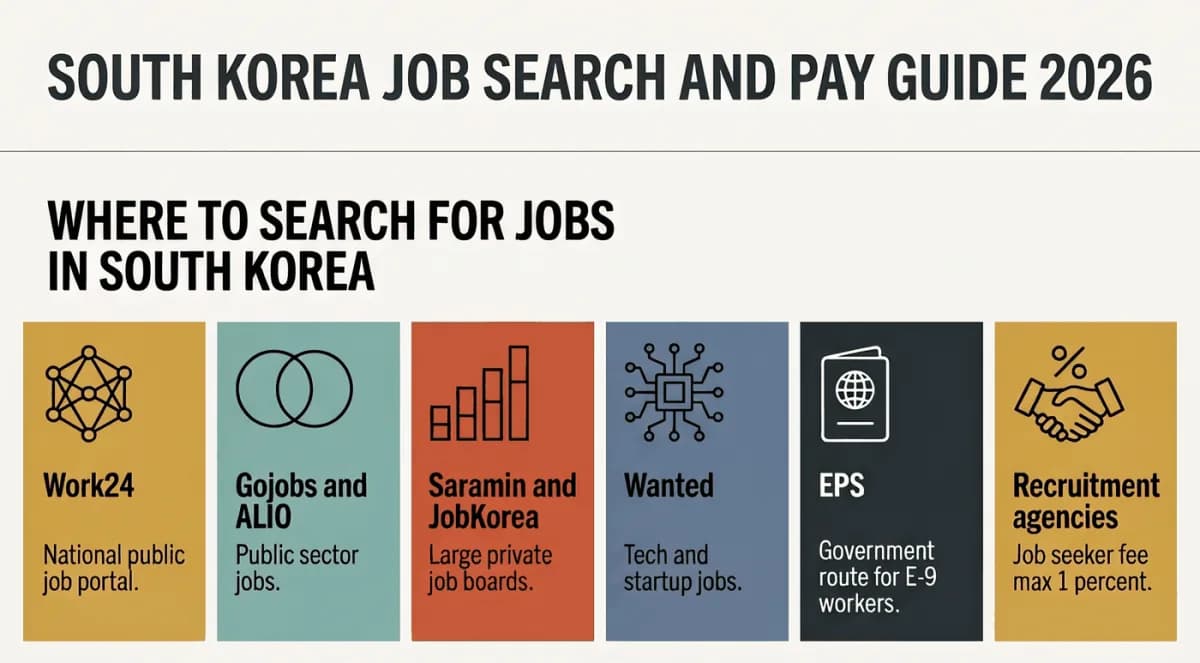
| Work24 (고용24) and employment centres | The integrated public employment portal run by the Ministry of Employment and Labor, from 2024 | Public vacancies, job-seeker support, the National Employment Support Programme | Sources differ on the launch date; vacancies not reviewed[^6] |
| 나라일터 and ALIO | Civil-service jobs; public-institution recruitment system | Government and public-body posts | Language and nationality rules differ by notice[^8] |
| Saramin, JobKorea, Incruit, Wanted | Large general private boards | Broad search and alerts | Most are free for applicants (likely); no ranking claims[^9] |
| Albamon | Part-time and short-term work board, reportedly run by JobKorea | Part-time work | Press-based ownership claim (likely)[^9] |
| Remember, Linkareer | A career platform for experienced hires; a site for students, interns and graduate hiring | Experienced switchers; students | Aimed at those groups only[^9] |
| Peoplenjob, LinkedIn | A site for jobs at foreign companies; a global network | English-speaking and international roles | Korean is still expected at most employers[^9] |
| K-Startup, Blind | Startup agency portal; anonymous professional community | Startup and employer research | We reviewed no programmes or vacancy data[^9] |
| Employer pages | Samsung, SK, Hyundai, LG, Lotte, Hanwha, CJ, Naver, Kakao, Coupang, KT, Korean Air | Direct applications | Pages change; vacancies not checked[^10] |
What this means for a job seeker: register on Work24 for public services, pick two general boards, add the channel that fits your status and set alerts. Treat the table as a snapshot, not a ranking.
Public employment services and public-sector jobs
The ministry is still 고용노동부 (Ministry of Employment and Labor).[^6] The National Employment Support Programme (국민취업지원제도) Type I pays a job-seeking allowance of KRW 600,000 a month (about USD 453) for up to 6 months from 1 January 2026, up from KRW 500,000. Type II is described as job-support services without the monthly allowance (likely).[^7] Public institutions have run blind hiring since July 2017 under a government guideline, not a statute.[^12] Civil-service posts are on 나라일터 and public-institution posts on ALIO.[^8]
Channels in English and for international talent
Peoplenjob lists jobs at foreign companies; expect Korean to be required elsewhere.[^9] HiKorea, the Korea Immigration Service portal, is the place for visa and stay information.[^16] E-9 workers are hired only through the government-to-government Employment Permit System (EPS, 고용허가제): the Foreign Workers Act art. 8(6) bars anyone other than the public employment service from intervening in selecting, brokering or hiring them, so private agencies cannot place E-9 workers.[^15] It reportedly has 17 sending countries (likely).[^15]
Recruitment and staffing agencies
Under the Employment Security Act (직업안정법) art. 19(1), paid placement businesses must register: domestic ones with the local head, overseas ones with the Minister. Art. 19(3) bars fees beyond the Minister's notified fee, and art. 32 bars recruiters from taking money from applicants, with an exception for registered paid agencies placing for an employer.[^13] Under MOEL notice 2017-22, an agency may charge the employer up to 30% of wages and the job seeker up to 1%, only on a prior written contract (the base is the first three months' wages for jobs of three months or more).[^13] Art. 47 (up to 5 years or KRW 50 million, about USD 37,747) covers operating without registration, art. 32 breaches and false job ads. Exceeding the notified fee is a fine of up to KRW 10 million under art. 50.[^13]
Agency work is a different arrangement. Under the Temporary Agency Workers Act (파견법), dispatch is allowed only for jobs listed in the Enforcement Decree (Annex 1). Art. 6 sets a limit of 1 year, extendable to 2 years in total, and art. 6-2 makes the user firm directly employ the worker if the limits are broken.[^14] We found no verified ranking or list of Korean agencies and name none.
Graduates, internships and large-company hiring
Samsung says it is the only one of the four top groups that has kept open recruitment (공채) since 1957. Its second-half 2026 round began on 8 September with 19 affiliates, with the GSAT aptitude test in October. The others have moved to rolling hiring (수시채용).[^11] Check each employer's career page for its current method; we verified no other company's test or timetable.[^10]
Pay in 2026: the minimum wage
| Year | Hourly (KRW) | USD at 1,324.60 | Monthly, 209 hours (KRW) | USD |
|---|---|---|---|---|
| 2025 | 10,030 | about 7.57 | 2,096,270 | about 1,583 |
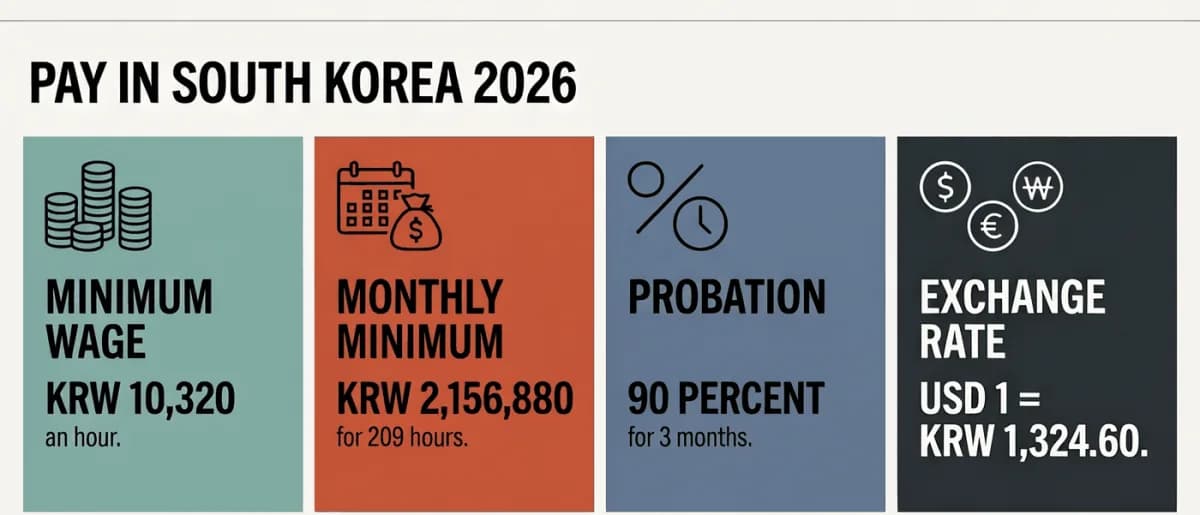
| 2026 | 10,320 | about 7.79 | 2,156,880 | about 1,628 |
| 2027 (reported) | 10,700 | about 8.08 | 2,236,300 | about 1,688 |
The 2026 rate rises KRW 290 (2.9%) on 2025.[^18] The 209 hours are (40 + 8) x 365 / 7 / 12, rounded. The 2027 rate was reportedly decided on 14 July 2026 and notified on 5 August 2026, effective 1 January 2027. The official page did not show it, so confirm it on minimumwage.go.kr.[^19]
Who is covered. The Minimum Wage Act art. 3 applies to all businesses, including those with fewer than five workers, except those employing only live-in relatives, and it excludes domestic workers and seafarers under their own act. The Labor Standards Act (LSA, 근로기준법) art. 6 bans discrimination in working conditions by nationality, and the Foreign Workers Act art. 22 bans unfair discrimination because of foreign status.[^18] Underpaying is punishable by up to 3 years or KRW 20 million under the Minimum Wage Act art. 28(1).[^18]
Probation. Art. 5(2) and Enforcement Decree art. 3 allow 90% of the minimum wage, only for contracts of one year or more, only in the first 3 months, and not for simple-labour jobs listed by the Minister. That is KRW 9,288 an hour in 2026 (about USD 7.01).[^18]
Weekly holiday allowance. LSA art. 55(1) requires at least one paid rest day a week on average. Workers averaging under 15 scheduled hours a week are excluded (art. 18(3)).[^20]
Visa salary floors. E-7 floors from 1 February 2026 are reported (likely) as follows. We could not find the 2026 ministry notice, so these are the 2025 notice base plus reported increases.[^21]
| Visa | Minimum annual pay (KRW) | USD |
|---|---|---|
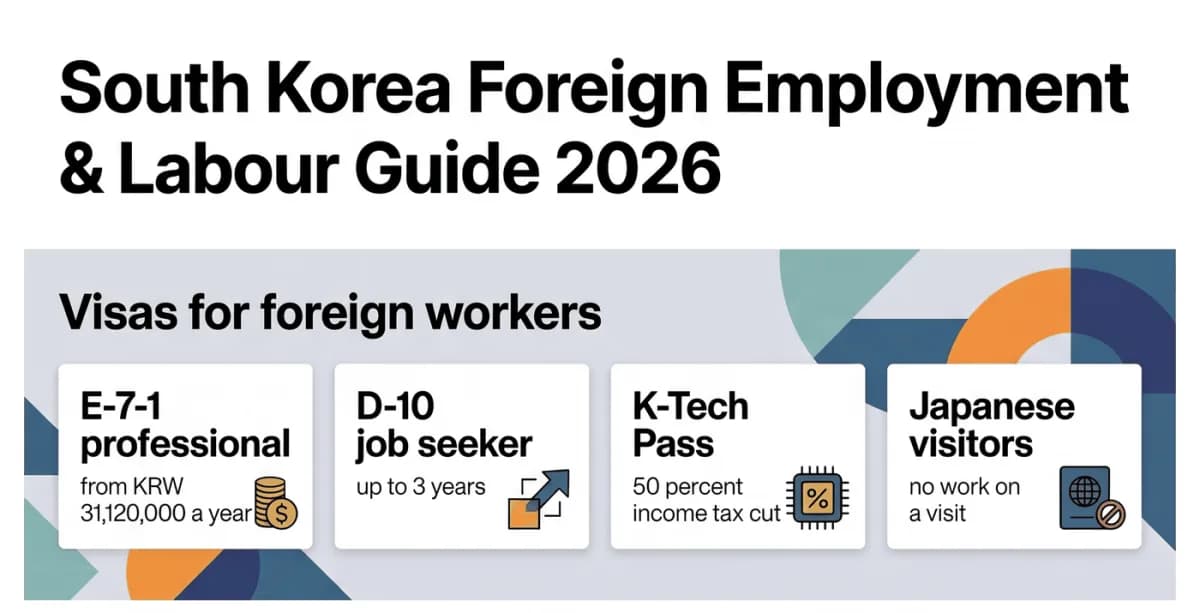
| E-7-1 | 31,120,000 | about 23,494 |
| E-7-2 and E-7-3 | 25,890,000 | about 19,546 |
| E-7-4 | 26,000,000 | about 19,629 |
Per-capita GNI for 2025 is KRW 52,416,000 (Bank of Korea, provisional, 10 March 2026; likely), or about USD 39,571.[^22] We found no verified average or median wage for 2026, so we give none.
What this means for a job seeker: compare a monthly offer with KRW 2,156,880 for a 209-hour month, ask whether probation pay applies, and check the visa floor if you need sponsorship.
Visas and routes for foreign workers
Visa rules change often. Check current conditions with HiKorea before you apply.[^16]
| Route | Who it is for | Key condition | Note |
|---|---|---|---|
| E-9 via EPS | Non-professional workers from sending countries | Government-to-government hiring only; private agencies excluded | 2026 quota 80,000 (2025: 130,000), decided 22 December 2025 (reported)[^15] |
| E-8 seasonal | Seasonal workers | Quota in the non-professional cap | 109,000 in 2026 (reported); brokering is punished under Immigration Act art. 94 item 11-2 (3 years or KRW 30 million)[^15][^17] |
| E-7 professional | Skilled workers sponsored by an employer | Pay at or above the floors above | E-7-4 has its own floor; we give no quota[^21] |
| D-10 job seeker | Graduates and job seekers | Graduates of Korean universities may stay up to 3 years, renewed one year at a time (from late October 2025) | Intern cap rules relaxed[^24] |
| Top-tier visa | Top-university graduates with senior careers | Master's or doctorate from a top-100 global university, a qualifying career and annual earned income of at least 3x per-capita GNI | Family receive F-2; permanent residence application after 3 years (MOJ, April 2025)[^22] |
| K-Tech Pass | Technology talent | F-2-T visa in two weeks; 50% income-tax reduction for up to 10 years | MOJ release, 2 July 2026[^23] |
| D-2 students | Degree students | Reported: 25 hours a week with TOPIK 3 or KIIP 3 in years 1 and 2, 10 hours otherwise, vacations uncapped for degree courses; D-4 language trainees 20 hours | Secondary guide; confirm on HiKorea[^27] |
| F-series residents | F-2, F-5, F-6 holders | Resident visas | F-3 dependants generally cannot work (likely); E-2 teachers and H-2: check HiKorea[^16] |
On the top-tier visa (launched 2 April 2025), 3x GNI is about KRW 157 million by our arithmetic from the 2025 GNI; the launch notice said about KRW 150 million on older data, so ask the MOJ which figure applies.[^22]
Employer duties. Employing a foreigner without work-capable status is an offence (Immigration Act art. 18(3), art. 94 item 9): up to 3 years or KRW 30 million (about USD 22,648). Employers report to immigration within 15 days of a dismissal, resignation, death, disappearance or material contract change (art. 19). Holding a passport or foreigner registration card as security for a contract or debt is banned by art. 33-3 and carries the same penalty (art. 94 item 19).[^17]
Japanese nationals. The Korean K-ETA (electronic travel authorisation) requirement has been waived for Japanese and 21 other jurisdictions through 31 December 2026 (reported by EY), although an e-Arrival card is still required; check what applies after that date.[^25] A visit does not give a right to work. Japan and Korea have a working holiday arrangement, in force since 1999 with a one-year visa according to MOFA Japan. We could not verify the Korea-side quota, age or conditions, so check the Korean embassy in Japan for current terms.[^26]
Foreign residents and workers in numbers
At the end of 2025 there were 2,159,052 long-term and 624,195 short-term foreign residents. The largest groups were China (980,670), Vietnam (337,183) and the United States (180,230). Students numbered 308,838 and work-status visa holders 594,047.[^2]
What this means for a job seeker: decide your route before you apply. A visitor may not work.
Labour law: hours, leave and dismissal
The LSA fully applies to workplaces with five or more regular workers (art. 11); below that, only parts apply by decree. Your contract may be better than these minimums.
| Topic | Rule | Law |
|---|---|---|
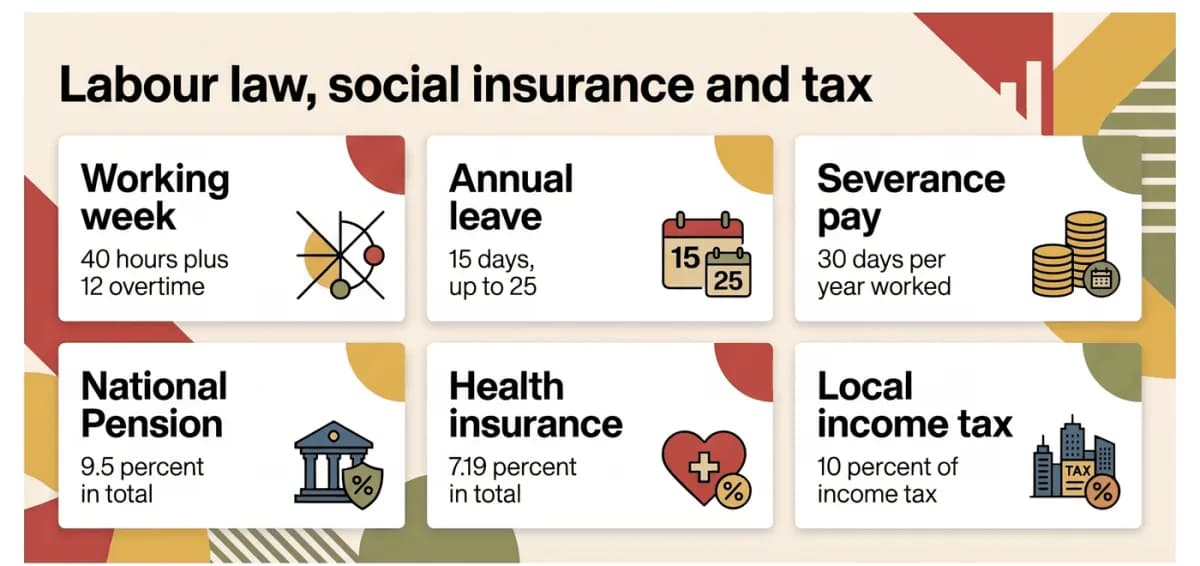
| Normal hours | 40 hours a week, 8 hours a day | LSA art. 50[^20] |
| Overtime | Up to 12 hours a week, so 52 hours in all | LSA art. 53(1)[^20] |
| Premiums | 50% for overtime and night work (22:00 to 06:00); holiday work 50% up to 8 hours and 100% beyond | LSA art. 56[^20] |
| Weekly paid holiday | At least one paid rest day a week; not for under 15 hours a week | LSA arts 55(1), 18(3)[^20] |
| Annual leave | 1 day per full month in year one (up to 11); 15 days after 80% attendance; +1 day per 2 years beyond year one; maximum 25 | LSA art. 60[^20] |
| Public holidays | Paid days off at workplaces with 5+ workers; phased in by 2022 | LSA art. 55(2)[^20] |
| Dismissal | Needs just cause; 30 days' notice or 30 days' ordinary wage; written notice stating reason and date, otherwise void | LSA arts 23, 26, 27[^20] |
| Remedy | Apply to the Labour Relations Commission within 3 months | LSA art. 28[^20] |
Art. 23 also bars dismissal during work-injury or maternity leave and for 30 days after. Art. 26 excepts workers with under 3 months of service from notice.[^20] Managerial dismissal requires consulting a worker representative 50 days before (art. 24). The 1350 line is the Ministry's general call centre; a multilingual helpline, the Foreign Workforce Counselling Centre at 1577-0071, is reported (likely).[^41]
Dismissal, severance pay and fixed-term rules
Severance pay (퇴직금) under the Employee Retirement Benefit Security Act art. 4(1) excludes those under one year of service or averaging under 15 hours a week. Art. 8(1) gives 30 days of average wage per year of service.[^33] Fixed-term contracts under the Act on Fixed-term Workers art. 4 can run at most 2 years including renewals, with listed exceptions such as projects, replacement and age 55 or over. Beyond that, the contract is treated as open-ended (art. 4(2)).[^40] The Serious Accidents Punishment Act has covered workplaces with 5 to 49 workers since 27 January 2024.[^40]
EPS workplace changes. Under the Foreign Workers Act art. 25, an E-9 worker may change workplace for listed reasons: normally at most 3 times in the base period and 2 in the extension, and changes caused by employer fault do not count (art. 25(4)). You must reapply within 1 month and leave if you find no new job in 3 months. The Act was amended on 9 June 2026; we read the text before that amendment took effect, so check the current version.[^15]
Public holidays in 2026
From 2026, 1 May (노동절, Labour Day) and 17 July (제헌절, Constitution Day) are public holidays. The Regulation on Public Offices' Holidays was amended on 30 April 2026 for 17 July, and 1 May is listed in its art. 2.[^39] The Labour Day Act makes 1 May a paid holiday, which MOEL reportedly says cannot be moved for private staff.[^39]
| Holiday | Date in 2026 |
|---|---|
| New Year's Day | Thursday 1 January |
| Seollal | Monday 16 to Wednesday 18 February |
| Independence Movement Day (3·1) | Sunday 1 March; substitute Monday 2 March |
| Labour Day | Friday 1 May |
| Children's Day | Tuesday 5 May |
| Buddha's Birthday | Sunday 24 May; substitute Monday 25 May |
| Local elections | Wednesday 3 June |
| Memorial Day | Saturday 6 June; no substitute |
| Constitution Day | Friday 17 July |
| Liberation Day | Saturday 15 August; substitute Monday 17 August |
| Chuseok | Thursday 24 to Saturday 26 September; no substitute |
| National Foundation Day | Saturday 3 October; substitute Monday 5 October |
| Hangul Day | Friday 9 October |
| Christmas Day | Friday 25 December |
Seollal and Chuseok get a substitute only when they overlap a Sunday or another holiday (not a Saturday), so there is none on 28 September.[^39]
Social security: the four insurances
| Insurance | 2026 total rate | Employee share | Note |
|---|---|---|---|
| National Pension | 9.5% | 4.75% | Income ceiling KRW 6,590,000 a month from 1 July 2026 (reported)[^28] |
| National Health Insurance | 7.19% | 3.595% | Decree art. 44, in force 1 October 2026[^30] |
| Long-term care | 13.14% of the health premium (about 0.9448% of pay, reported) | Calculated on the health premium | Rate reported by the Ministry of Health and Welfare[^30] |
| Employment insurance (unemployment) | 1.8% | 0.9% | Employer alone adds 0.25% to 0.85% for training, by firm size[^31] |
| Industrial accident insurance | Employer pays | None | Employer-paid[^31] |
The pension rate rises 0.5 point a year from 2026 (from 9.0%).[^28] The pension age is 63 for people born 1961 to 1964 (likely).[^28]
Unemployment benefit (구직급여). It pays 60% of average wage, with a 2026 daily cap of KRW 68,100 (about USD 51) and a floor of KRW 66,048 (about USD 50). You need 180 insured days in the previous 18 months, and it lasts 120 to 270 days.[^32] Employment insurance is compulsory for D-7, D-8 and D-9 holders (under reciprocity) and F-2, F-5 and F-6 holders; E-1 to E-10 holders (including E-7) and F-4 join by application, as do E-9 workers for the benefit chapter.[^32]
Sick pay. We found no statutory paid sick leave in the LSA. A sickness allowance (상병수당) pilot has run since July 2022; a national roll-out from the second half of 2027 is reportedly planned but undecided.[^41]
Parental leave. Monthly benefit caps are KRW 2.5 million (months 1 to 3), KRW 2.0 million (months 4 to 6) and KRW 1.6 million from month 7. Under the 6+6 scheme for both parents (child under 18 months), caps for months 1 to 6 are KRW 2.5, 2.5, 3.0, 3.5, 4.0 and 4.5 million.[^32]
Severance and pension refund. Severance pay is set out above.[^33] A departing foreigner can claim a National Pension lump-sum refund if their nationality is on the NPS list of 24 agreement and 26 reciprocity countries, or if they hold E-8, E-9 or H-2. The list dated 15 June 2026 does not include Japan, so Japanese nationals on E-7 and similar visas get no refund.[^29]
Japan-Korea social security agreement. For dispatched employees expected to stay five years or less, a certificate of coverage keeps you in the Japanese pension scheme and exempts you from the Korean National Pension.[^34] The agreement reportedly covers pensions only and took effect on 1 April 2005 (likely).[^34]
What this means for a job seeker: compare net pay after the four deductions, and ask whether a refund or exemption applies to your nationality.
Taxes on your salary
South Korea taxes employment income through national income tax, with local income tax on top. For 2026 the national rates under the Income Tax Act art. 55 are:
| Taxable annual income (KRW) | Rate |
|---|---|
| Up to 14 million | 6% |
| Over 14 million to 50 million | 15% |
| Over 50 million to 88 million | 24% |
| Over 88 million to 150 million | 35% |
| Over 150 million to 300 million | 38% |
| Over 300 million to 500 million | 40% |
| Over 500 million to 1 billion | 42% |
| Over 1 billion | 45% |
Source: Income Tax Act art. 55, in force 1 January 2026.[^35] KRW 50 million is about USD 37,747.
- Local income tax. The Local Tax Act art. 92 sets 1/10 of each national band, so 0.6% to 4.5%. It is the closest equivalent to Japan's resident tax (jūminzei), but it is withheld monthly with your salary, not billed the following year.[^36]
- Per-capita residence tax (주민세). Up to KRW 10,000 by municipal ordinance, up to KRW 15,000 where residents petition (art. 78).[^36]
- Foreign flat 19% option. A foreign employee who starts working in Korea on or before 31 December 2026 may elect 19% on gross pay for up to 20 years (Restriction of Special Taxation Act art. 18-2). No deductions or credits apply, and the employer may withhold it. With 10% local tax that is about 20.9%. Check with the National Tax Service whether this is extended after 2026.[^37]
- Foreign engineers. Earned income of foreign technicians is reduced 50% for 10 years from the first work day, if the first work is on or before 31 December 2026 (art. 18).[^37] K-Tech Pass holders get a 50% reduction for up to 10 years.[^23]
- Tax residence. A resident has a domicile in Korea or lives there 183 days or more (art. 1-2).[^35]
- VAT. The standard rate is 10% (check the National Tax Service).
- Tax treaty. The Japan-Korea tax treaty was signed on 8 October 1998 and has been in force since 22 November 1999.[^38]
What this means for a job seeker: only income above each limit is taxed at the higher rate, and the local tax comes on top, so compare offers by net pay.
Language and what Korean employers expect in a CV
- Language. Korean is expected at most employers. English is more common in multinationals and technology. Ask which level is expected and write the CV in the language of the advert.
- Format. Applications usually use a CV (이력서) and a cover essay (자기소개서). Keep both short and tailored; ask your employer about the year-end tax settlement (연말정산) separately.
- Fair hiring. The Fair Hiring Procedure Act art. 4-3 (added 2019) bans asking for appearance, height or weight, birthplace, marital status, property and the education, occupation or property of close family, unless the information is needed for the job. A breach carries a fine of up to KRW 5 million (art. 17(2)). It applies to workplaces with 30 or more regular workers (art. 3).[^12]
- Photos. Public blind hiring is a 2017 government guideline, not a statute; whether a photo is asked for elsewhere depends on the employer, so follow the advert.[^12]
- TOPIK. The Test of Proficiency in Korean (TOPIK) appears in some visa rules: TOPIK 4 or higher for the D-10 exemption of Korean-university graduates, and TOPIK 3 for D-2 work hours (reported).[^24][^27] We found no verified employer norm, so ask each employer.
- Qualifications. Regulated professions such as medicine have their own licensing bodies, for example the Korea Health Personnel Licensing Examination Institute. We did not verify the recognition process for foreign degrees.
- Guides. See our ATS-friendly CV guide and, for the CV and resume difference, CV vs resume for international applications.
Verify a listing before sharing documents
- A licensed agency may not take more than the notified fee from you, and a recruiter may not take money from applicants at all (Employment Security Act arts 19(3), 32). Treat a fee request as a warning sign.[^13]
- Be sceptical of courier-job ads, offers to work abroad that require you to travel first, requests to rent out your bank account and fake visa brokers. These are common scam patterns; we did not check an official warning page, so confirm with the police.
- Nobody may hold your passport or foreigner registration card as security (Immigration Act art. 33-3).[^17]
- Anyone selling an E-9 place is acting outside the law: only the public employment service handles E-9 hiring.[^15]
- Check the company against its own career page and visa claims on HiKorea.[^16] For work-rights questions, call 1350.[^41]
A seven-day search routine
- Day 1: pick two sectors and save 20 adverts from general boards and one public channel.
- Day 2: list repeated titles, skills and Korean-language requirements.
- Day 3: build one master CV and a tailored version.
- Day 4: set alerts, check Work24 and visit employer pages.
- Day 5: if you need a visa, work out which route fits and who sponsors it.
- Day 6: send targeted applications.
- Day 7: review replies and keep the channels that worked.
Final checklist before you apply
- [ ] My CV and cover essay are clear and tailored to the advert.
- [ ] I know the monthly pay, and whether it clears KRW 2,156,880 for a 209-hour month.
- [ ] I know which visa fits and who applies for it.
- [ ] I know my hours, leave, probation, holidays, insurances and tax, and have compared net pay.
- [ ] No agency has asked me for a fee.
FAQ
What are the best job sites in South Korea?
Work24, 나라일터, ALIO, Saramin, JobKorea, Incruit, Wanted, Remember, Linkareer and Peoplenjob loaded in our checks; we found no verified ranking.[^6][^9]
What is the minimum wage in South Korea in 2026?
KRW 10,320 an hour (about USD 7.79), or KRW 2,156,880 a month for 209 hours. A 2027 rate of KRW 10,700 is reported.[^18][^19]
Can I work in Korea without Korean?
English may be enough in multinationals, but most employers expect Korean.
Which visa should a foreign professional apply for?
E-7, sponsored by an employer, with pay floors such as KRW 31,120,000 for E-7-1 (reported). Top-tier and K-Tech Pass routes exist for senior or technology talent.[^21][^22][^23]
How does EPS (E-9) hiring work?
It is government-to-government through the public employment service; private agencies are excluded. The 2026 quota is reported at 80,000.[^15]
Can Japanese citizens use a working holiday or enter without a visa?
The K-ETA exemption for Japanese is reported to run to 31 December 2026, and a visit gives no right to work. Check the Korean embassy in Japan for working holiday terms.[^25][^26]
What are the working hours and the 52-hour week?
Normal hours are 40 a week, plus up to 12 hours of overtime, so 52 in all.[^20]
How much annual leave and how many public holidays do I get?
15 days of leave after 80% attendance, up to 25 with service, and public holidays are paid at workplaces with 5 or more workers. 1 May and 17 July are public holidays from 2026.[^20][^39]
Do foreigners get unemployment benefit?
It depends on the visa: compulsory for F-2, F-5 and F-6, by application for E-7 and E-9. The 2026 daily cap is KRW 68,100.[^32]
How much income tax and local income tax will I pay?
National rates run from 6% to 45%, and local income tax is 10% of the national tax. Foreign employees who start work by 31 December 2026 may elect a flat 19%.[^35][^36][^37]
How to use AIResume
Keep one master CV in AIResume and create a tailored version for each advert with the how to tailor your CV to a job description guide.
Related AIResume guides
- Job boards in Singapore
- Job boards in Australia
- Job boards in New Zealand
- Job boards in India
- How to write an ATS-friendly CV
- How to tailor your CV to a job description
- CV vs resume for international applications
Sources
[^1]: World Bank, World Development Indicators: Korea, Rep. (accessed 21 October 2026)
[^2]: Ministry of Justice, foreign residents statistics, end of 2025
[^3]: National Data Office (formerly Statistics Korea); survey of May 2025 as reported in the press in December 2025; we did not read the release
[^4]: MOFA Japan, overseas Japanese nationals survey 2025
[^5]: Bank of Korea ECOS, USD/KRW and JPY/KRW reference rates, 23 October 2026; Seoul Money Brokerage, today's rates
[^6]: Ministry of Employment and Labor; Work24
[^7]: MOEL, National Employment Support Programme card news (1 January 2026); MOEL, achievements (February 2026)
[^8]: 나라일터; ALIO public institution recruitment
[^9]: Saramin; JobKorea; Incruit; Wanted; Remember; Blind; LinkedIn; Albamon; Linkareer; Peoplenjob; K-Startup
[^10]: Samsung Careers; SK Careers; Hyundai; LG Careers; Lotte; Hanwha; CJ; Naver; Kakao; Coupang; KT; Korean Air
[^11]: Samsung Newsroom, 2026 second-half open recruitment
[^12]: law.go.kr, Fair Hiring Procedure Act (채용절차의 공정화에 관한 법률)
[^13]: law.go.kr, Employment Security Act (직업안정법); law.go.kr, paid placement fee notice 2017-22
[^14]: law.go.kr, Temporary Agency Workers Act (파견근로자 보호 등에 관한 법률)
[^15]: law.go.kr, Foreign Workers Act (외국인근로자의 고용 등에 관한 법률); Korea Herald, 2026 foreign worker quota; Newsis, 22 December 2025; KDI EIEC, EPS sending countries
[^16]: HiKorea
[^17]: law.go.kr, Immigration Act (출입국관리법)
[^18]: Minimum Wage Commission, minimum wage; law.go.kr, Minimum Wage Act (최저임금법); law.go.kr, Minimum Wage Act Enforcement Decree
[^19]: Segye Ilbo, 2027 minimum wage notice (5 August 2026)
[^20]: law.go.kr, Labor Standards Act (근로기준법)
[^21]: Ministry of Justice, 2025 E-7 wage notice; KoWork, E-7 salary requirements 2026 (secondary)
[^22]: Newsis, 2025 GNI per capita (10 March 2026); Ministry of Justice, top-tier visa; Immigration Service, top-tier visa
[^23]: Ministry of Justice, K-Tech Pass (2 July 2026)
[^24]: Immigration Service, D-10 reform (2 December 2025); KoWork, D-10 (secondary)
[^25]: EY, Korea extends K-ETA exemption to 31 December 2026
[^26]: MOFA Japan, working holiday in Korea; Korean MOFA, working holiday table
[^27]: Jobploy, international student work hours (secondary, 9 July 2026)
[^28]: law.go.kr, National Pension Act (국민연금법); National Pension ceiling as reported by the Ministry of Health and Welfare in the press (Segye Ilbo, 11 January 2026)
[^29]: National Pension Service, lump-sum refund for foreigners
[^30]: law.go.kr, National Health Insurance Act Enforcement Decree art. 44; long-term care rate as reported by the Ministry of Health and Welfare (4 November 2025)
[^32]: law.go.kr, Employment Insurance Act Enforcement Decree; law.go.kr, Employment Insurance Act
[^33]: law.go.kr, Employee Retirement Benefit Security Act
[^34]: Japan Pension Service, Japan-Korea agreement; Japan Pension Service, application form
[^35]: law.go.kr, Income Tax Act (소득세법)
[^36]: law.go.kr, Local Tax Act (지방세법)
[^37]: law.go.kr, Restriction of Special Taxation Act (조세특례제한법)
[^38]: Japan Ministry of Finance, Japan-Korea tax convention and MLI
[^39]: law.go.kr, Regulation on Public Offices' Holidays; law.go.kr, Labour Day Act; Money Today, 17 July holiday (28 April 2026); Newsis, 28 April 2026
[^40]: law.go.kr, Act on Fixed-term and Part-time Workers; law.go.kr, Serious Accidents Punishment Act
[^41]: Press reports without a link we tested: Kyunghyang Shinmun (5 February 2024) on the 1577-0071 helpline; Kyonggi Ilbo and KB Maeil (12 July 2026) on the sickness allowance; 1350 is the Ministry of Employment and Labor call centre (see moel.go.kr)
Your next step
- DeelFor employers hiring across borders: contracts, payroll and visas handled.See how Deel works
Affiliate links: we may earn a commission at no cost to you. Affiliate link