
Ireland Job Boards in 2026: Where to Search, Employment Permits and the New Salary Thresholds
Ireland's job market works differently depending on your passport. Irish, EU, EEA and Swiss citizens can take any job. Most other nationals need an employment permit, and the salary an employer must offer for a permit rose on 1 March 2026. Where you search, and which jobs are realistic, follows from
Ireland Job Boards in 2026: Where to Search, Employment Permits and the New Salary Thresholds
By AIResume Editorial Team
Last updated: 4 October 2026
Ireland's job market works differently depending on your passport. Irish, EU, EEA and Swiss citizens can take any job. Most other nationals need an employment permit, and the salary an employer must offer for a permit rose on 1 March 2026. Where you search, and which jobs are realistic, follows from that.
This guide covers where to search and the rules that decide whether an employer can hire you. For CV layout, see our UK CV format guide. Irish CVs follow very similar conventions.
Ireland job search in one table
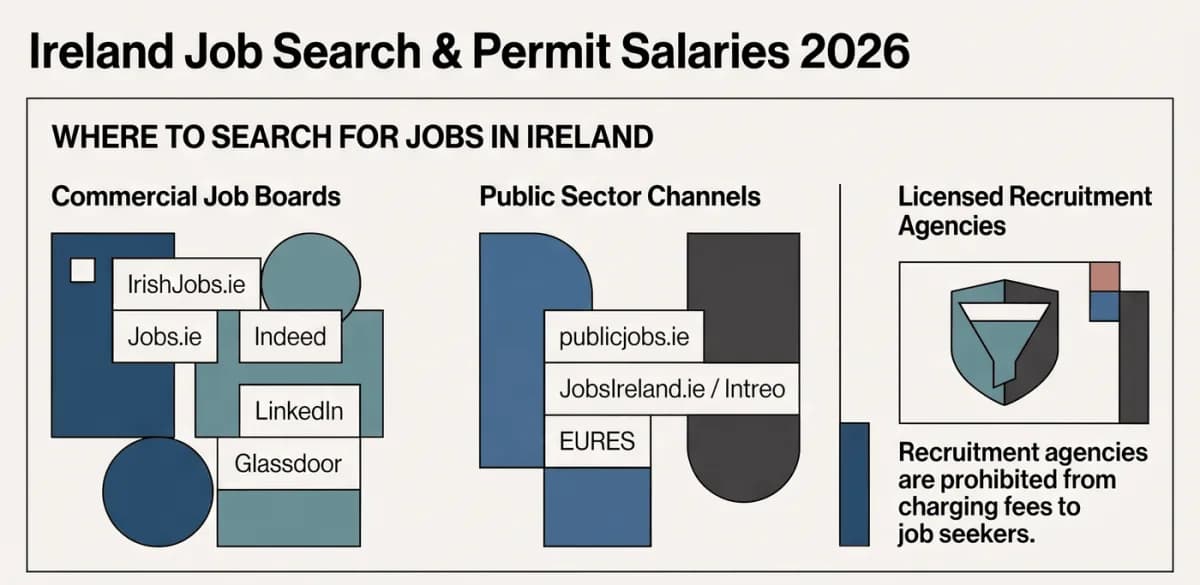
| Channel | Best for | What to know |
|---|---|---|
| IrishJobs.ie | Professional, technical, finance and management roles | Large multinational and domestic employers. Good for roles that may qualify for a Critical Skills permit |
| Jobs.ie | Retail, hospitality, customer service, admin | Same group as IrishJobs.ie, aimed at operational and regional roles |
| Indeed Ireland | Every level and region | Aggregator. Check the listing on the employer's own site |
| Tech, pharma, finance and executive roles | Strong in Dublin, Cork and Galway. Useful for contacting hiring managers directly | |
| Glassdoor | Salary and interview research | Use it to check pay before you apply |
| publicjobs.ie | Civil service, local authorities, state agencies | Run by the Public Appointments Service. Uses competency-based application forms |
| JobsIreland.ie (Intreo) | General jobs; vacancies advertised for the labour market needs test | Run by the Department of Social Protection. Vacancies also appear on EURES |
| EURES | EU/EEA citizens moving to Ireland | European job mobility portal |
| Recruitment agencies | Tech, healthcare, engineering, executive and contract roles | Must be licensed. Agencies must not charge job seekers fees |
The practical rule: EU/EEA citizens can use every channel. Non-EEA applicants should focus on IrishJobs.ie, LinkedIn and specialist agencies, and target roles that meet the permit salary thresholds below.
Employment permits: the 2026 salary thresholds
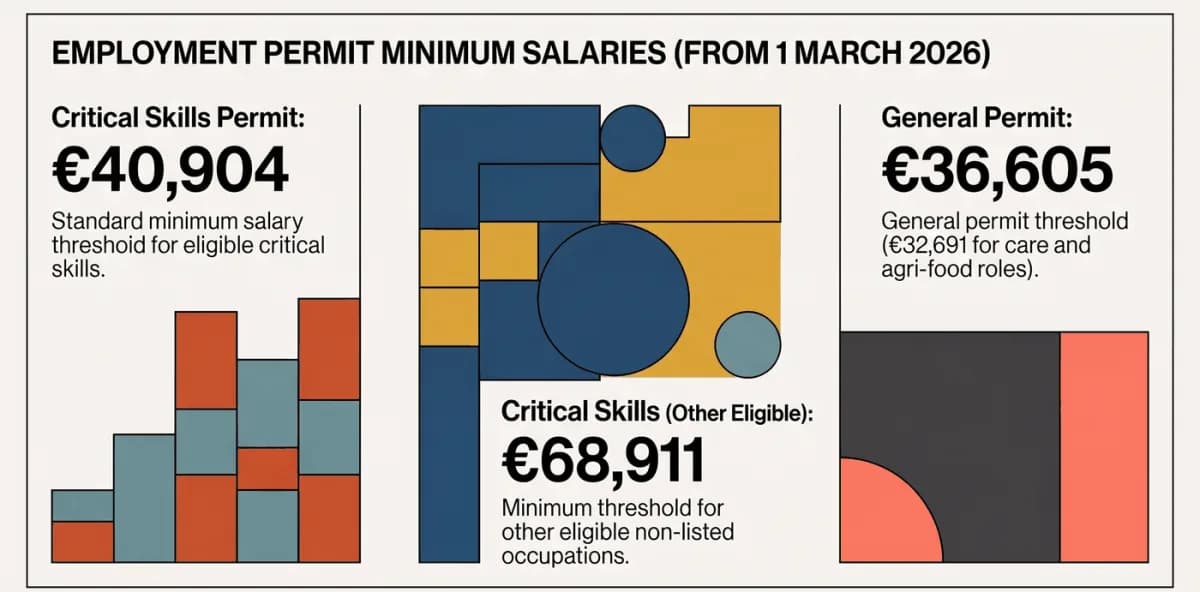
Ireland's Department of Enterprise, Tourism and Employment (DETE) sets a minimum annual remuneration for each permit. On 2 December 2025 the government published a roadmap of increases up to 2030. The first increases took effect on 1 March 2026:
| Permit | Before 1 March 2026 | From 1 March 2026 |
|---|---|---|
| Critical Skills Employment Permit (occupation on the Critical Skills list, relevant degree) | €38,000 | €40,904 |
| Critical Skills Employment Permit (other eligible occupations) | €64,000 | €68,911 |
| Critical Skills, recent graduate of an Irish institution | — | €36,848 |
| General Employment Permit (standard) | €34,000 | €36,605 |
| General Employment Permit (healthcare assistants, home carers, meat processing, horticulture) | €30,000 | €32,691 |
| General Employment Permit, recent graduate of an Irish institution | — | €34,009 |
| Intra-Company Transfer (senior staff) and Contract for Services | €46,000 | €49,523 |
Thresholds are based on a 39-hour week. Further increases are planned each year until 2030, so check the current figure on enterprise.gov.ie before you accept an offer.
Critical Skills or General permit?
| Critical Skills Employment Permit | General Employment Permit | |
|---|---|---|
| Who it is for | Occupations in short supply, listed on the Critical Skills Occupations List, or high-paid roles | Most other occupations not on the Ineligible Occupations List |
| Labour market needs test | Not required | Usually required |
| Family | Spouse or partner can join and work without a permit (Stamp 1G) | Family reunification usually after 12 months |
| Path to Stamp 4 | Faster | Longer |
| Contract | At least 2 years | Usually issued for 2 years, renewable |
The labour market needs test and the 50:50 rule
For most General Employment Permits, the employer must first advertise the job to Irish and EEA candidates. Under the Employment Permits Act 2024, the advert must run for 28 days on JobsIreland.ie (which also shares it with EURES) and on one other online platform. Newspaper adverts are no longer required.
The 50:50 rule means at least half of the employer's staff must be Irish, EEA or Swiss citizens, with exceptions for some supported start-ups. Permit holders must be employed directly by the company; agency staffing arrangements do not qualify.
What this means for your search: if you need a permit, filter for roles on the Critical Skills Occupations List or roles that pay well above €40,904. Ask early whether the employer has sponsored permits before.
Immigration stamps
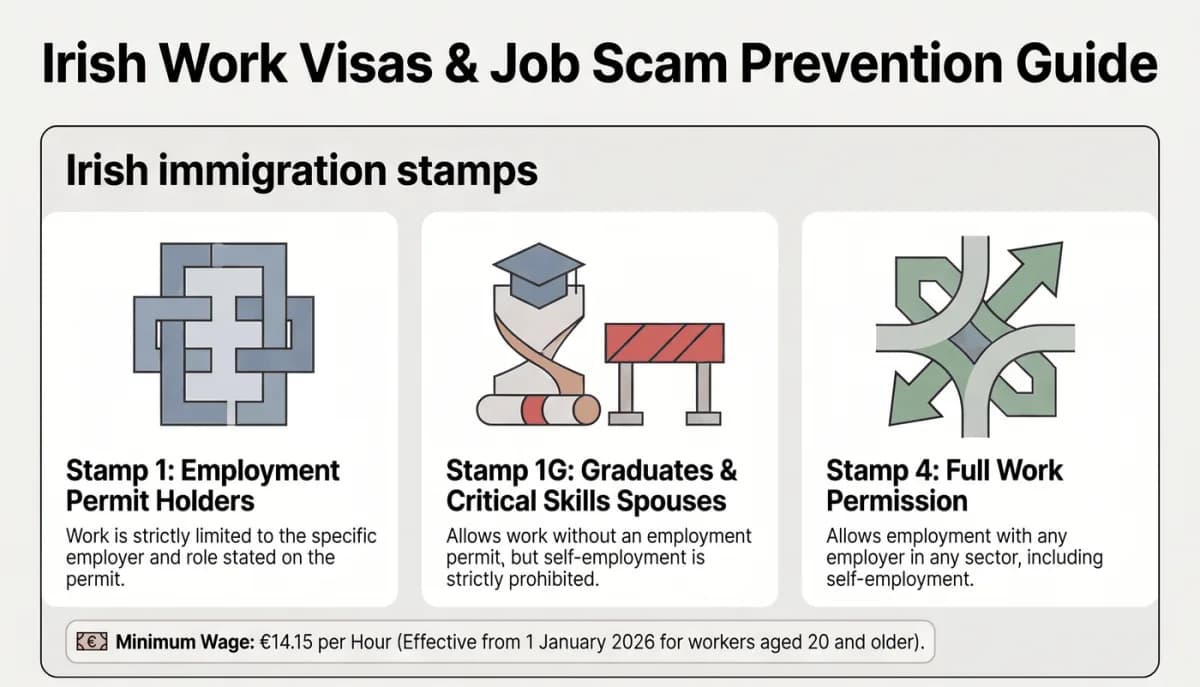
After arriving, non-EEA nationals register with Immigration Service Delivery and receive an Irish Residence Permit (IRP). The stamp on it decides where you can work:
| Stamp | Who has it | Work rights |
|---|---|---|
| Stamp 1 | Employment permit holders | Only for the employer and role on the permit |
| Stamp 1G | Graduates of Irish institutions (Third Level Graduate Programme); spouses and partners of Critical Skills permit holders | Work without a permit. Self-employment not allowed |
| Stamp 4 | Long-term permit holders who qualify, spouses of Irish citizens and others | Any employer, any sector, self-employment allowed |
Graduates with a Level 8 degree from an Irish institution can usually stay 12 months on Stamp 1G; Level 9 and 10 graduates up to 24 months. Check current conditions with Irish Immigration.
Minimum wage in 2026
The national minimum wage rose to €14.15 an hour on 1 January 2026, under the National Minimum Wage Order 2025.
| Age | Hourly rate |
|---|---|
| 20 and over | €14.15 |
| 19 | €12.74 |
| 18 | €11.32 |
| Under 18 | €9.91 |
Applying: CVs, cover letters and public sector forms
- CV: two A4 pages, reverse-chronological, achievements with numbers. Leave out your photo, date of birth, marital status and PPS number.
- Work status: state it in one line, for example "EU citizen", "Stamp 1G until June 2027" or "Requires Critical Skills Employment Permit".
- Cover letter: one page, formal, linked to the job advert.
- publicjobs.ie: civil service jobs use online application forms with examples matched to the competency framework, not just a CV.
For the CV itself, follow our UK CV format guide and check it against our guide to writing an ATS-friendly CV.
Avoiding recruitment scams
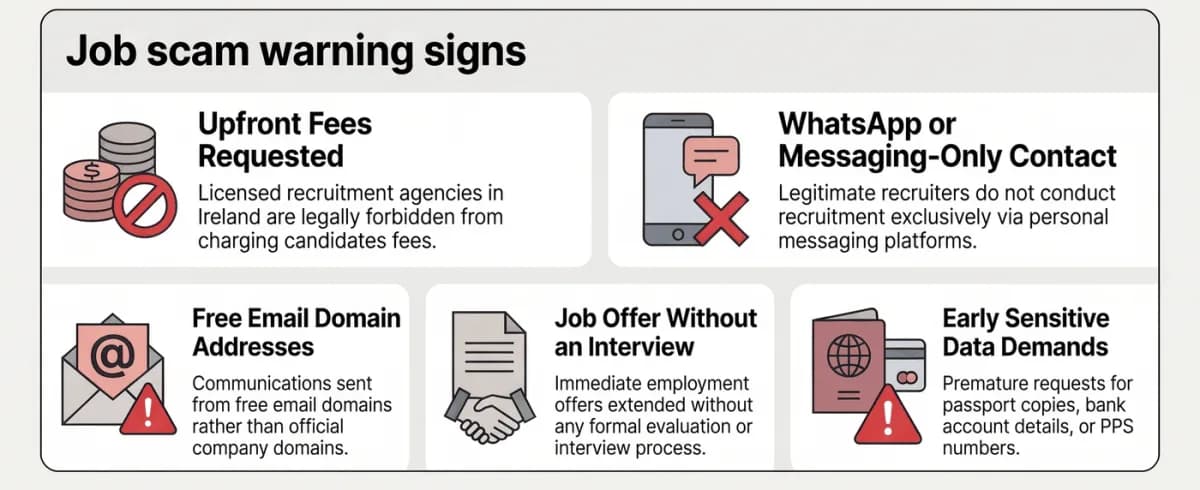
Scammers often pretend to be well-known agencies or multinational employers. Warning signs:
- Fees. Licensed agencies cannot charge job seekers. Never pay for a job, a visa or "processing".
- Chat-only contact. Recruitment only through WhatsApp, Telegram or Messenger.
- Free email addresses instead of the company's own domain.
- An offer without an interview.
- Early requests for your passport, bank details or PPS number.
If something looks wrong, stop replying and contact the company through the phone number on its official website. Report it to the company being impersonated, the job site and An Garda Síochána.
FAQ
What is the minimum salary for a Critical Skills Employment Permit in 2026?
€40,904 a year from 1 March 2026 for occupations on the Critical Skills list with a relevant degree, and €68,911 for other eligible occupations. Recent graduates of Irish institutions qualify at €36,848.
What is the minimum salary for a General Employment Permit in 2026?
€36,605 a year from 1 March 2026. Healthcare assistants, home carers, meat processing and horticulture roles have a lower threshold of €32,691.
What is the minimum wage in Ireland in 2026?
€14.15 an hour for workers aged 20 and over, from 1 January 2026.
Can recruitment agencies charge me a fee in Ireland?
No. Licensed agencies are paid by employers. A request for a fee is a warning sign.
Do EU citizens need a permit to work in Ireland?
No. EU, EEA and Swiss citizens can work in Ireland without an employment permit.
How to use AIResume
Keep one master CV in AIResume and create an Irish version with a one-line work status at the top. If you are also looking across the Irish Sea, compare our guide to job boards in the United Kingdom.
Sources
- Lewis Silkin, Ireland's revised roadmap on minimum annual remuneration thresholds (11 December 2025) — lewissilkin.com
- Department of Enterprise, Tourism and Employment, Employment permits — enterprise.gov.ie
- Irish Statute Book, S.I. No. 472/2025 National Minimum Wage Order 2025 — irishstatutebook.ie
- Citizens Information, Employment permits and minimum wage — citizensinformation.ie
- Irish Immigration Service Delivery — irishimmigration.ie
- Public Appointments Service — publicjobs.ie