

Japan Job Search in 2026: Job Boards, Minimum Wage, Visas and Labour Law
Japan is a USD 4.4 trillion economy with about 123.4 million people and a shrinking population (126.3 million in 2020). Employers compete for workers: the job-openings ratio was 1.18 in August 2026 and unemployment 2.5%. Japanese is the working language of most employers, while English is more commo
By AIResume Editorial Team
Last updated: 23 October 2026
Japan is a USD 4.4 trillion economy with about 123.4 million people and a shrinking population (126.3 million in 2020). Employers compete for workers: the job-openings ratio was 1.18 in August 2026 and unemployment 2.5%. Japanese is the working language of most employers, while English is more common in multinationals and tech. Hiring has two tracks: new-graduate bulk hiring (新卒一括採用) and mid-career change (転職). Your options also depend on status: citizens and permanent residents search freely, while other foreign nationals need a status that allows the work.
This guide is for three readers: Japanese citizens and residents changing jobs or graduating, foreign residents already in Japan, and foreign professionals abroad. It covers the economy, job channels, the minimum wage, visas, labour law, holidays, social insurance, taxes and CVs. For other markets, see our published job-board guides to Singapore, Australia, New Zealand and India.
Editorial boundary: This is practical job-search guidance, not legal, immigration or tax advice. We only list figures we could read in an official or primary source, and we mark softer ones as "reported" or "likely". Confirm details with the Ministry of Health, Labour and Welfare (MHLW), Hello Work, the Immigration Services Agency (ISA), the National Tax Agency (NTA), the Japan Pension Service, the Cabinet Office and the e-Gov law database before you sign.
Before you apply
- SafetyWing Nomad InsuranceHealth insurance that works in your new country from day one.Get a quote
Affiliate links: we may earn a commission at no cost to you. Affiliate link
Japan's economy in numbers
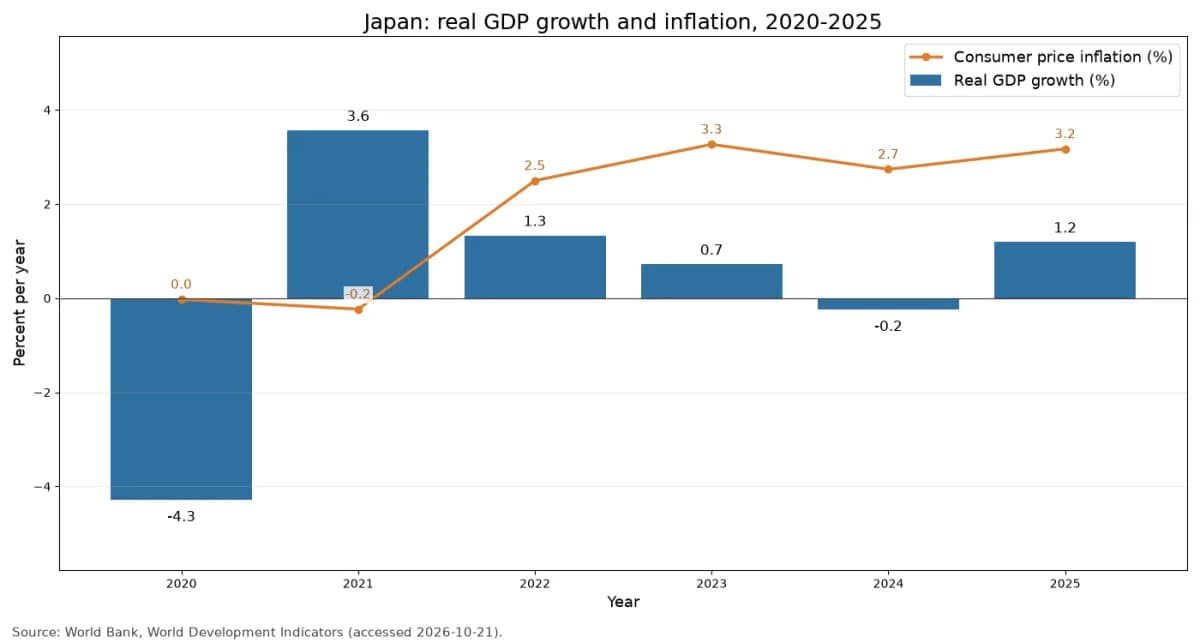
| Indicator | 2020 | 2021 | 2022 | 2023 | 2024 | 2025 |
|---|---|---|---|---|---|---|
| GDP (USD billion) | 5,189.2 | 5,225.9 | 4,448.0 | 4,384.9 | 4,190.0 | 4,435.2 |
| GDP per person (USD) | 41,099 | 41,581 | 35,548 | 35,215 | 33,797 | 35,951 |
| Real GDP growth (%) | -4.3 | 3.6 | 1.3 | 0.7 | -0.2 | 1.2 |
| Inflation (%) | 0.0 | -0.2 | 2.5 | 3.3 | 2.7 | 3.2 |
| Population (million) | 126.26 | 125.68 | 125.12 | 124.52 | 123.98 | 123.37 |
*Source: World Bank, World Development Indicators (accessed 21 October 2026).*[^1]
The World Bank also lists unemployment of 2.5% and youth unemployment (ages 15 to 24) of 3.9% for 2025, and an international migrant stock of 3,409,529 for 2024.[^1]
| Measure | Value | Source |
|---|---|---|
| Job-openings ratio, August 2026 | 1.18 (seasonally adjusted); regular-staff ratio 1.00; by workplace, highest Fukui 1.72, lowest Osaka 0.95 | MHLW[^3] |
| Unemployment rate, August 2026 | 2.5%; 1.80 million unemployed | Statistics Bureau[^4] |
| Average annual salary, 2025 | About JPY 4.87 million (about USD 30,975); men JPY 5.97 million, women JPY 3.42 million; regular staff JPY 5.59 million, non-regular JPY 2.10 million | NTA[^5] |
| Scheduled monthly pay, June 2025 (general workers, average) | JPY 340,600 (about USD 2,166); men JPY 373,400, women JPY 285,900 | MHLW wage census[^6] |
| 2026 spring wage round | 5.01%, the third year above 5% | RENGO, a union confederation[^7] |
| Exchange rate, 22 October 2026, 17:00 | USD 1 = JPY 157.22 to 157.24; EUR 1 = JPY 176.63 to 176.67 | Bank of Japan[^2] |
We convert yen at about JPY 157.2 per USD and write "about" because the rate moves daily.[^2] Both pay figures are averages, not medians.[^5][^6]
What this means for a job seeker: a ratio of 1.18 is an average. It runs from 0.95 in Osaka to 1.72 in Fukui, and for regular positions it is 1.00, so check your own region and field.[^3]
Japan job search in one table
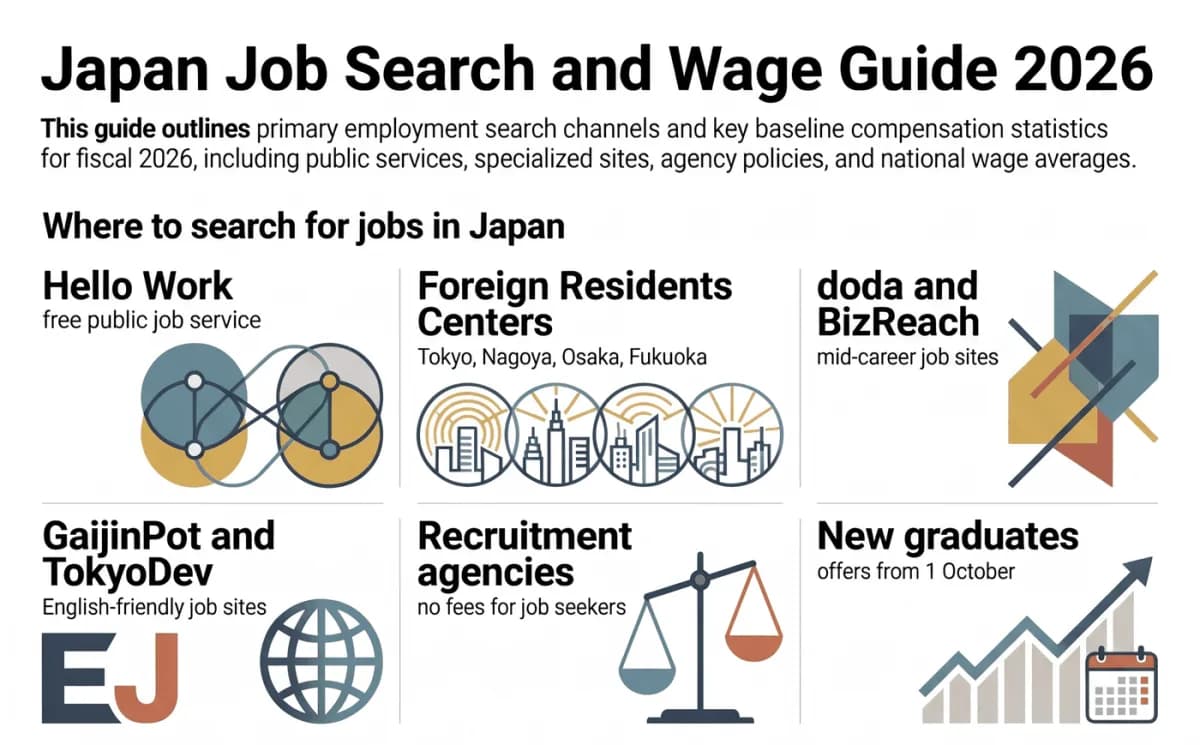
| Channel | What it is | Use it for | Limit |
|---|---|---|---|
| Hello Work Internet Service | The public employment portal run by MHLW (see also Job tag[^12]) | Public vacancies, online registration | First-time applicants register online; recent applicants may need a counter[^8] |
| Saposute and Job Café | Support stations for young people (Saposute: ages 15 to 49) | Young people unsure about work | Job Café age limits are set by each prefecture[^10] |
| 人事院 (National Personnel Authority) | National civil-service exams | Government careers | Nationality rules apply to some posts[^13] |
| doda, en-gage, BizReach, type, Daijob | General and mid-career job sites | Broad search, scouting | We make no ranking claim[^14] |
| Green, Wantedly, Findy, LAPRAS, Forkwell | IT and startup job sites | Engineers and startups | Mostly Japanese-language[^14] |
| OfferBox | A site for new graduates | Graduate hiring | Aimed at students[^14] |
| Indeed Japan, LinkedIn, GaijinPot Jobs, TokyoDev, Japan Dev | Aggregators and English-friendly boards | International and English-speaking roles | Japanese is still expected at most employers[^14] |
| Employer pages | Hitachi, SoftBank, Rakuten, Mercari, Mitsui, Recruit | Direct applications | Vacancies not checked[^20] |
What this means for a job seeker: register with Hello Work, pick two general sites, add the channel that fits your status and set alerts. The table is a snapshot, not a ranking.
Hello Work and public employment services
A person who has never applied through Hello Work opens a My Page (求職者マイページ) from "求職申込み" on the top page, and sign-in through the Mynaportal single sign-on exists. A person who applied within about five years asks at a Hello Work counter.[^8] Foreign Residents Employment Service Centers operate in Tokyo (Yotsuya), Nagoya, Osaka and Fukuoka; Tokyo also has a separate Shinjuku centre for people with unrestricted statuses and student part-timers. Re-check phone numbers before calling.[^9]
Saposute covers people aged 15 to 49 who are worried about working, with about 179 stations on the MHLW page (April 2025 figure).[^10] The Job Café rule differs by prefecture, and the national youth Hello Work (わかものハローワーク) targets roughly people under 35.[^10] Through the job-seeker support system (求職者支援制度) you can receive JPY 100,000 a month (about USD 636) while in training, plus commuting allowance up to JPY 42,500 and lodging allowance of JPY 10,700. Conditions include personal income of at most JPY 80,000 a month, household income of at most JPY 300,000 and household financial assets of at most JPY 3 million.[^11]
Public-sector jobs
The National Personnel Authority runs national exams (総合職, 一般職 and experienced-hire).[^13] Its exam pages state no nationality rule. The rule is an unwritten principle (当然の法理) from a 1953 Cabinet Legislation Bureau view: posts that exercise public authority need Japanese nationality. A 2005 Supreme Court ruling let local governments appoint resident foreigners under their own rules, so practice differs (likely).[^13]
Channels in English and for international talent
JETRO runs an English portal called "Open for Professionals" for skilled foreign talent.[^15] The JET Programme is run by CLAIR; its own site currently redirects to the CLAIR page, so use clair.or.jp or a Japanese embassy page (likely).[^15] For Specified Skilled Worker (SSW) matching in construction, JAC has a dedicated site.[^15]
Recruitment and staffing agencies
Under the Employment Security Act (職業安定法) art. 32-3(2), a fee-charging agency may not collect fees from job seekers, except where an MHLW ordinance says it benefits the job seeker. A breach is punishable by up to 6 months' imprisonment or a fine of up to JPY 300,000 (art. 65 item 2).[^16] The narrow exception in Enforcement Rule 20(2) covers entertainers and models, and scientists, executives and skilled craftspeople paid over the figure in MHLW notice No. 26 (JPY 7 million in the year after hiring), with a cap of 11% of the first six months' wages.[^16] Employer fees are set in each agency's filed fee table; we found no official typical rate.[^16] Check a licence on the MHLW business search.
Job ads must not be false or misleading and must stay accurate and up to date (art. 5-4, in force since 1 October 2022).[^16] Agency work is different. Under the Worker Dispatch Act, the same worker may work in the same organisational unit for at most 3 years (art. 35-3), and a client site may use dispatch for 3 years unless it consults the majority union (art. 40-2). Port transport, construction and security are banned fields (art. 4), and dispatching day labourers is prohibited except for listed specialist jobs (art. 35-4).[^17] We name no agencies.
New graduates, internships and mid-career hiring
For students graduating in March 2028 (the "FY2027" cohort), the rule is information sessions from 1 March, selection from 1 June and formal offers from 1 October. Earlier selection is possible only through a Type 3 specialist internship in the spring break before the graduation year, followed by selection after it.[^18]
Under the three-ministry agreement on internships, Types 1 (open company) and 2 (career education) are not internships and cannot be used for hiring. Type 3 means more than half the days are work experience with staff feedback: 5 or more days for the general type and 2 or more weeks for the specialist type. Information from Types 3 and 4 may be used only from the March and June start dates.[^19] Some firms use aptitude tests such as SPI and Tamatebako; read each employer's instructions.[^20]
Pay in 2026: the minimum wage
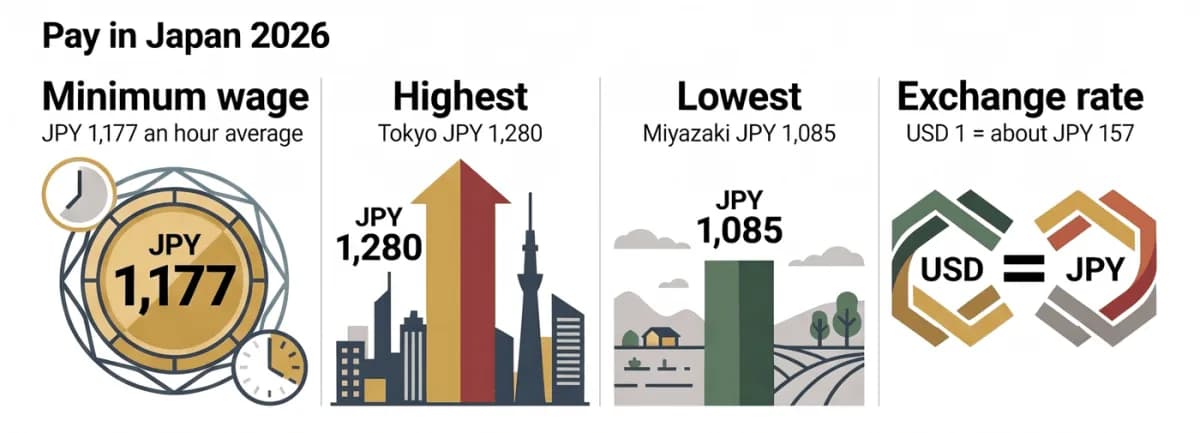
Japan sets minimum wages by prefecture. For FY2026 (令和8年度) the national weighted average is JPY 1,177 an hour, up JPY 56 (5.0%) from JPY 1,121 in FY2025.[^21]
| Measure | JPY an hour | USD at about 157.2 | Note |
|---|---|---|---|
| FY2025 national weighted average | 1,121 | about 7.13 | Before revision |
| FY2026 national weighted average | 1,177 | about 7.49 | +5.0% |
| FY2026 highest: Tokyo | 1,280 | about 8.14 | From 1,226; effective 1 October 2026 |
| FY2026 lowest: Miyazaki | 1,085 | about 6.90 | From 1,023; effective 24 October 2026 |
New rates take effect between 1 October and 2 December 2026, depending on the prefecture (for example Kyoto 16 November, Okinawa 2 December). Many prefectures were still on the FY2025 rate on 23 October.[^21]
Who is covered. The Minimum Wages Act art. 4 binds employers for all workers it covers, with no nationality test (likely; we did not find an MHLW sentence stating it for foreign workers).[^21] Reductions. A reduction for probation, disability-related reduced work capacity, certain accredited training or light work needs the permission of the Labour Bureau Director (art. 7). It is not automatic.[^21] Some industries also have a higher industry-specific minimum.
Visa salary rules. Engineer, Specialist in Humanities and International Services statuses require pay equal to or above that of a Japanese national.[^22] Highly Skilled Professional (HSP) status needs 70 points, and for categories 1(b) and 1(c) at least JPY 3 million a year (about USD 19,080).[^22] J-Skip needs JPY 20 million (about USD 127,200) or, for managers, JPY 40 million.[^22]
What this means for a job seeker: compare an hourly offer with your prefecture's rate on its effective date, not the national average, and ask whether any probation reduction has a permit.
Visas and routes for foreign workers
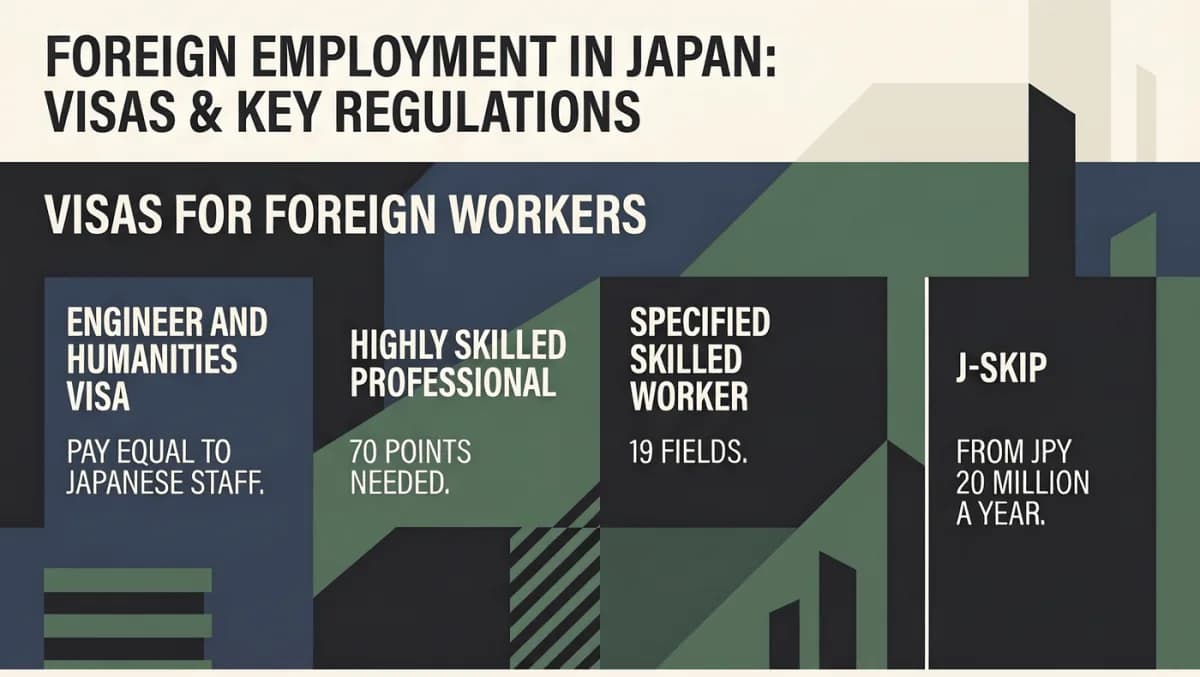
Confirm conditions with the Immigration Services Agency first.
| Route | Who it is for | Key condition | Note |
|---|---|---|---|
| Engineer / Specialist in Humanities / International Services | Office, technical and language staff | University degree in a related field or 10 years' experience; International Services needs 3 years' experience (not for graduates doing translation, interpreting or language teaching) | Pay equal to or above a Japanese national[^22] |
| Highly Skilled Professional (HSP) | Researchers, specialists, managers | 70-point test; at least JPY 3 million for categories 1(b) and 1(c) | Permanent residence after 3 years at 70 points or 1 year at 80[^22] |
| J-Skip | Top earners | Master's or higher and JPY 20 million, or 10 years' experience and JPY 20 million; managers: 5 years and JPY 40 million | Permanent residence after 1 year[^22] |
| J-Find | Graduates of top universities | Top 100 in 2 of 3 rankings (QS, THE, ARWU); degree within 5 years; funds of JPY 200,000 or more | Up to 2 years, Designated Activities[^23] |
| Designated Activities No. 46 | Japanese-university graduates | JLPT N1 or BJT 480; Japanese-language duties; pay equal to Japanese staff | Basics only[^23] |
| Specified Skilled Worker (SSW) | Skilled and industry-specific workers | 19 specified industry fields | Cap of 805,700 SSW (i) to end of March 2029[^25] |
| Employment for Skill Development (育成就労) | Replaces the Technical Intern Training Program (TITP) | In force from 1 April 2027; 17 fields; own-will transfer after 1 to 2 years per field, with a skill test and Japanese level | Cap of 426,200; combined cap 1,231,900[^25] |
| Digital nomad (Designated Activities No. 53) | Remote workers | Income of JPY 10 million or more; up to 6 months, no renewal; about 50 eligible countries and regions; private insurance cover of JPY 10 million | Not a job-search route[^23] |
| Working holiday | Young people from partner countries | 32 countries and regions at 1 April 2026 (Malta and Italy added in 2026); ages 18 to 30 (18 to 25 for four partners unless allowed to 30) | Check your country's terms[^24] |
| Students | Enrolled students | Permission for other activities: 28 hours a week, up to 8 hours a day in long school vacations | Only while enrolled[^30] |
A Cabinet decision of 23 January 2026 sets 19 SSW fields.[^25] A travel authorisation system, JESTA, is planned: the law passed in 2026, the start must come by 31 March 2029 and the target is FY2028.[^25]
SSW job loss. An SSW worker whose contract ends must notify the ISA within 14 days (Immigration Control Act art. 19-16). Status can be revoked if the activity is not carried out for 3 months or more without justifiable reason (art. 22-4).[^25]
Foreign residents and workers in numbers
At the end of 2025 there were 4,125,395 foreign residents. At the end of June 2026 there were 4,281,026, up 3.8% on end-2025. The largest groups were China (941,031), Vietnam (693,750), Korea (408,682), the Philippines (362,761), Nepal (334,850) and Indonesia (307,456), and SSW holders numbered 444,256.[^26] At 31 October 2025 MHLW counted 2,571,037 foreign workers (+11.7%) at 371,215 employers, with Vietnam 605,906, China 431,949 and the Philippines 260,869.[^27] Of these, 865,588 held professional or technical status and 499,394 were technical interns.[^27]
Residence-card checks. Employers must check the residence card (在留カード). The ISA app reads the IC chip and, since 14 November 2025, can check revocation information. From 14 June 2026 the card design changed: period of stay and permission details are recorded in the chip rather than printed, and a combined card with the My Number card (特定在留カード) started.[^28]
Employer notification and penalties. Employers report hiring and leaving of foreign workers to Hello Work (労働施策総合推進法 art. 28): by the 10th of the following month for insured employees, or the end of the following month for non-insured ones, with a fine of up to JPY 300,000 for failure.[^29] Facilitating illegal employment (Immigration Control Act art. 73-2) carries up to 3 years or JPY 3 million today, rising to up to 5 years or JPY 5 million from 1 April 2027.[^29] Permanent-residence revocation for failing legal duties also starts from 1 April 2027.[^22] An express ban on holding a worker's passport exists in the Technical Intern Training Act (art. 48) and its successor; we found no equivalent for ordinary employees.[^34]
Labour law: hours, leave and dismissal
| Topic | Rule | Law |
|---|---|---|
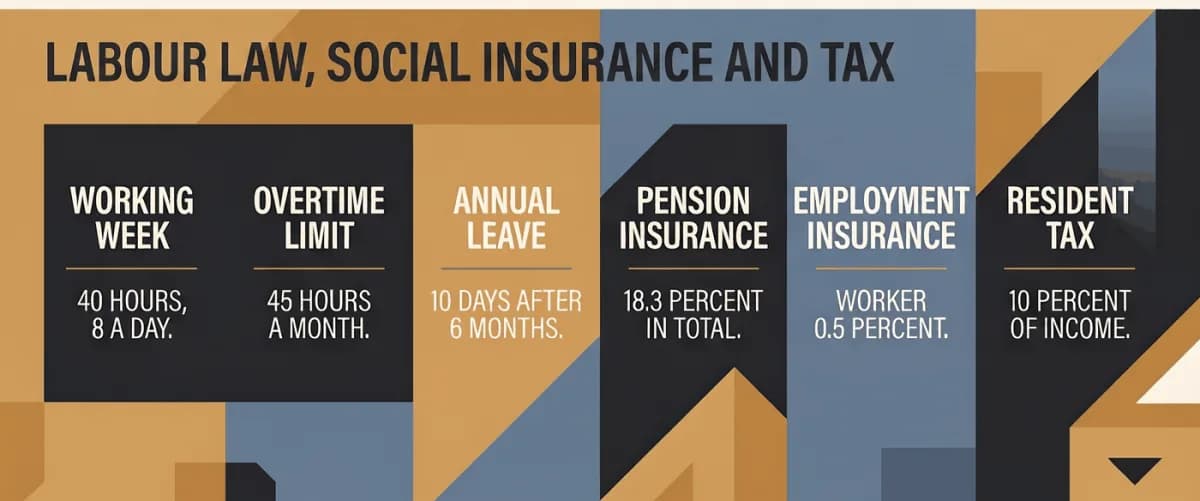
| Normal hours | 40 hours a week, 8 hours a day | Labour Standards Act (LSA) art. 32[^31] |
| Overtime limits | Under a "36 agreement": 45 hours a month and 360 a year; special clause: under 100 hours a month including holiday work and 720 a year, with 45 exceeded in at most 6 months | LSA art. 36[^31] |
| Average cap | Under 100 hours in any month and 80-hour average over 2 to 6 months | LSA art. 36 para 6[^31] |
| Premiums | At least 25% for overtime, 50% for hours over 60 a month, 25% late night (22:00 to 05:00); holiday premium 35% set by cabinet order | LSA art. 37[^31] |
| Weekly day off | At least one day a week (or 4 days in 4 weeks) | LSA art. 35[^31] |
| Annual leave | 10 days after 6 months; the employer must give 5 days a year when the entitlement is 10 or more | LSA art. 39[^31] |
| Dismissal notice | 30 days' notice or 30 days' pay; the notice rule does not apply to a probationary worker used for 14 days or less | LSA art. 20, art. 21 item 4[^31] |
| Dismissal | Void if without objectively reasonable grounds | Labour Contract Act art. 16[^32] |
| Fixed-term conversion | Right to ask for an open-ended contract once contracts exceed 5 years | Labour Contract Act art. 18[^32] |
Art. 19 of the Labour Contract Act protects renewal of fixed-term contracts.[^32] We verified the first annual-leave step (10 days) and the 5-day rule; check the Act for later steps of the scale.[^31]
Dismissal, fixed-term and harassment rules
From 1 October 2026 two prevention duties start, in different Acts. All employers must take measures against customer harassment (カスハラ) under the Comprehensive Labour Policy Promotion Act art. 33, and employers must prevent sexual harassment of job seekers under the Equal Employment Opportunity Act art. 13. The second covers sexual remarks only, not general job-hunting harassment.[^33]
Public holidays in 2026
Japan has 18 days off in 2026: 16 named holidays, a substitute holiday on 6 May and a citizens' holiday on 22 September.[^35]
| Date | Holiday |
|---|---|
| 1 January | New Year's Day |
| 12 January | Coming of Age Day |
| 11 February | National Foundation Day |
| 23 February | The Emperor's Birthday |
| 20 March | Vernal Equinox Day |
| 29 April | Showa Day |
| 3 May | Constitution Memorial Day |
| 4 May | Greenery Day |
| 5 May | Children's Day |
| 6 May | Substitute holiday (Holiday Act art. 3(2)) |
| 20 July | Marine Day |
| 11 August | Mountain Day |
| 21 September | Respect for the Aged Day |
| 22 September | Citizens' holiday (art. 3(3)) |
| 23 September | Autumnal Equinox Day |
| 12 October | Sports Day |
| 3 November | Culture Day |
| 23 November | Labour Thanksgiving Day |
A public holiday is not a statutory paid day off: the LSA requires one day off a week, and a holiday is paid only if your work rules or contract say so.[^35]
Social security: the social insurances
| Insurance | FY2026 total rate | Worker share | Note |
|---|---|---|---|
| Employees' pension (厚生年金) | 18.3% | 9.15% | Standard monthly pay capped at JPY 650,000[^36] |
| Health insurance (協会けんぽ), Tokyo | 9.85% | 4.925% | National average 9.90%; rates vary by prefecture[^36] |
| Long-term care (ages 40 to 64) | 1.62% | 0.81% | Same nationwide[^36] |
| Child-rearing support levy | 0.23% | 0.115% | From April 2026, paid with the health premium[^36] |
| Employment insurance (general business) | 1.35% | 0.5% | Employer 0.85%[^36] |
| Workers' accident insurance | 0.25% to 8.8% | None | Employer pays all; FY2026 same as FY2025[^37] |
Part-timers. Coverage requires 20 or more scheduled hours a week, a firm with 51 or more employees (36 or more from October 2027) and not being a student. The JPY 88,000 monthly wage test was abolished on 1 October 2026.[^38]
Unemployment benefit (基本手当). You generally need 12 months of insurance in the past 2 years. For leaving dates on or after 1 April 2025, the waiting period after a voluntary quit is normally 1 month, or 3 months after two or more voluntary quits within 5 years or a dismissal for serious misconduct; it is waived for those in training. From 1 August 2026 the daily maximum is JPY 7,450 (under 30), JPY 8,270 (30 to 44), JPY 9,110 (45 to 59) and JPY 7,830 (60 to 64), with a minimum of JPY 2,562.[^39] The benefit is reported at 50% to 80% of previous pay.[^39]
Sickness and maternity. Sickness allowance (傷病手当金) pays two-thirds of the standard daily pay from day 4, for up to 1 year 6 months in total. Maternity allowance (出産手当金) pays two-thirds for 42 days before and 56 days after birth (health insurance rules).[^40] Childcare leave benefit pays 67% for the first 180 days and 50% afterwards. A postnatal support benefit (出生後休業支援給付) adds 13% for up to 28 days when both parents take at least 14 days within 8 weeks of birth, bringing it to 80% of pre-leave pay, with exceptions for single parents.[^41]
Leaving Japan. A non-Japanese who paid at least 6 months of pension and applies within 2 years of ceasing to live in Japan can claim a lump-sum withdrawal payment (脱退一時金), capped at 60 months.[^42] The refund is reported to be taxed at 20.42% (likely).[^42]
Social security agreements. Japan has 24 agreements in force, including Germany, the UK, Korea, the US, France, Canada, Australia, India, the Philippines and China. The UK, Korea, China and Italy agreements reportedly prevent double coverage only (likely). Poland signed in April 2026 but it is not in force.[^43]
What this means for a job seeker: compare net pay after insurance deductions, and ask whether an agreement or the withdrawal payment applies to you.
Taxes on your salary
For 2026 income, national income tax has seven brackets, and a 2.1% reconstruction surtax is added to the tax amount.[^44]
| Taxable annual income (JPY) | Rate |
|---|---|
| Up to 1.95 million | 5% |
| Over 1.95 million to 3.3 million | 10% |
| Over 3.3 million to 6.95 million | 20% |
| Over 6.95 million to 9 million | 23% |
| Over 9 million to 18 million | 33% |
| Over 18 million to 40 million | 40% |
| Over 40 million | 45% |
*Source: NTA, Tax Answer No. 2260.*[^44] From 1 January 2027 the surtax becomes a 1.1% reconstruction tax (extended to 2047) plus a new 1% defence special income tax, so the total stays 2.1%.[^44]
- 2025 deduction reform. For 2025 income, the basic deduction rose to JPY 950,000 (for total income up to JPY 1.32 million; it was JPY 480,000) and the minimum employment income deduction to JPY 650,000. The government states a tax-free threshold of JPY 1.6 million. It applied from the year-end adjustment (年末調整) in December 2025.[^45]
- Resident tax (住民税). Income-based tax of 10% (prefectural plus municipal; designated cities split 8% and 2%), billed on the previous year's income. Per-capita levy is JPY 4,000 (municipal 3,000, prefectural 1,000) plus the forest environment tax of JPY 1,000, so JPY 5,000.[^46]
- Residence status for tax. You are a non-permanent resident if you lack Japanese nationality and have lived in Japan 5 years or less in the past 10; foreign-source income is then taxed only if paid in or remitted to Japan. Non-residents are withheld at 20.42% on salary.[^47]
- Consumption tax. 10% standard and 8% reduced. A food tax cut from 1 April 2027 to 31 March 2029 is only planned, and the NTA says it applies only if the bill passes the Diet.[^48]
What this means for a job seeker: compare offers by net pay, and expect resident tax on last year's income to arrive after a job change.
Language and what Japanese employers expect in a CV
- Language. Japanese is expected at most employers, and English is more common in multinationals and tech. Ask which level is expected, and write the document in the language of the advert.
- Format. Applications usually use a CV form (履歴書) and a career history (職務経歴書). The MHLW sample CV form (2021) has an optional gender field, and the commuting-time, dependants and spouse fields were removed.[^49]
- Photo. The MHLW form says to attach a photo only if required; follow the advert.[^49]
- Fair hiring. MHLW guidance lists topics for which the applicant is not responsible, such as domicile of origin and birthplace, housing, family matters (occupation, health, education, income, assets) and living environment, and topics that should be free, such as religion, beliefs, political support and union membership. The list is guidance, not exhaustive and not a statute.[^50]
- Language tests. Designated Activities No. 46 asks for JLPT N1 or BJT 480.[^23] We verified no employer norm and no qualification-recognition process, so ask each employer and licensing body.
- Guides. See our ATS-friendly CV guide and CV vs resume for international applications.
Verify a listing before sharing documents
- Recruiting people to commit crimes is the "dark part-time job" (闇バイト) pattern. MHLW and the National Police Agency warn about it. Ask the police consultation line #9110 or your nearest station, and call 110 if you are threatened.[^51] Recruiting for crimes is punishable by 1 to 10 years' imprisonment or a fine of JPY 200,000 to 3 million (Employment Security Act art. 63).[^51]
- A fee-charging agency may not charge you a placement fee, bar narrow exceptions. Treat a fee request as a warning sign.[^16]
- Never hand over a passport or residence card as a deposit; we found an express ban only for technical-intern employers.[^34]
- Beware of fake visa brokers; check visa claims with the ISA.[^22]
A seven-day search routine
- Day 1: pick two sectors and save 20 adverts.
- Day 2: list repeated titles, skills and Japanese-language requirements.
- Day 3: build one 履歴書 and one 職務経歴書, then tailor them.
- Day 4: set alerts and visit employer pages.
- Day 5: if you need a status, find the route and sponsor.
- Day 6: send targeted applications.
- Day 7: review replies and keep what worked.
Final checklist before you apply
- [ ] My CV and career history are clear and tailored to the advert.
- [ ] I know the hourly pay and whether it clears my prefecture's minimum wage on its effective date.
- [ ] I know which status fits and who applies for it.
- [ ] I know my hours, leave, holidays, insurances and tax, and have compared net pay.
- [ ] No agency has asked me for a fee.
FAQ
What are the best job sites in Japan?
Hello Work, doda, en-gage, BizReach, Green, Indeed Japan, GaijinPot Jobs and TokyoDev loaded in our checks. We found no verified ranking.[^8][^14]
What is the minimum wage in Japan in 2026?
The FY2026 national weighted average is JPY 1,177 an hour (about USD 7.49). Tokyo is JPY 1,280 and Miyazaki JPY 1,085, and rates take effect between 1 October and 2 December 2026.[^21]
Can I work in Japan without Japanese?
Some multinationals and tech firms work in English, but most employers expect Japanese.[^14]
Which visa should a foreign professional apply for?
Engineer, Specialist in Humanities or International Services, sponsored by an employer, with pay equal to a Japanese national. HSP, J-Skip and J-Find exist for senior or top-university talent.[^22][^23]
How does Specified Skilled Worker hiring work?
It covers 19 fields, with a cap of 805,700 SSW (i) to March 2029. A worker whose contract ends must notify the ISA within 14 days.[^25]
How does new-graduate hiring work?
For March 2028 graduates, information sessions start on 1 March, selection on 1 June and formal offers on 1 October.[^18]
What are the working hours and overtime limits?
40 a week and 8 a day. Overtime under a 36 agreement is capped at 45 hours a month and 360 a year, or 720 a year under the special clause.[^31]
How much annual leave and how many public holidays do I get?
10 days after 6 months, with 5 days a year that the employer must give once you have 10 or more. There are 18 days off in 2026, paid only if your contract says so.[^31][^35]
Do foreigners get unemployment benefit?
It depends on your insurance record, generally 12 months in the past 2 years. We found no separate nationality rule, so ask Hello Work. The 2026 daily maximum is JPY 7,450 to 9,110 by age.[^39]
How much income tax and resident tax will I pay?
National rates run from 5% to 45%, plus a 2.1% surtax on the tax amount. Resident tax is 10% of the previous year's income, plus JPY 5,000 per person.[^44][^46]
How to use AIResume
Keep one master CV in AIResume and tailor it for each advert with the how to tailor your CV to a job description guide.
Related AIResume guides
- Job boards in Singapore
- Job boards in Australia
- Job boards in New Zealand
- Job boards in India
- How to write an ATS-friendly CV
- How to tailor your CV to a job description
- CV vs resume for international applications
Sources
[^1]: World Bank, World Development Indicators: Japan (accessed 21 October 2026)
[^2]: Bank of Japan, daily foreign exchange rates, 22 October 2026, 17:00
[^3]: MHLW, job-openings statistics, August 2026
[^4]: Statistics Bureau, Labour Force Survey monthly results
[^5]: NTA, private salary survey 2025 (published September 2026)
[^6]: MHLW, 2025 Basic Survey on Wage Structure
[^7]: RENGO, 2026 spring wage round final tally (no. 7, 1 July 2026)
[^8]: Hello Work Internet Service
[^9]: Tokyo Foreign Residents Employment Service Center; Nagoya; Osaka; Fukuoka
[^10]: MHLW, Saposute; MHLW, young-people support; MHLW, youth employment
[^11]: MHLW, job-seeker support system (求職者支援制度)
[^12]: MHLW, Job tag occupation site
[^13]: National Personnel Authority, recruitment; House of Representatives written answer; J-STAGE article
[^14]: Sites linked in the channel table, each loaded in our checks on 23 October: doda; en-gage; BizReach; Green; Indeed Japan; GaijinPot Jobs; TokyoDev
[^15]: JETRO, Open for Professionals; JAC SSW site; CLAIR
[^16]: e-Gov, Employment Security Act; e-Gov, Enforcement Rules of the Employment Security Act; MHLW notice No. 26; MHLW human-resources business search
[^17]: e-Gov, Worker Dispatch Act
[^18]: MHLW, hiring schedule for FY2027 graduates
[^19]: MHLW, three-ministry internship agreement
[^20]: Hitachi; SoftBank; Rakuten; Mercari; Mitsui; Recruit; SHL Japan
[^21]: MHLW, minimum wages by prefecture; MHLW, FY2026 table; e-Gov, Minimum Wages Act
[^22]: ISA, Highly Skilled Professional; ISA, J-Skip; e-Gov, HSP ministerial ordinance; e-Gov, Immigration Control Act landing standards; e-Gov, Immigration Control Act
[^23]: ISA, digital nomad (Designated Activities No. 53); J-Find (No. 51) and No. 46 conditions from the Immigration Services Agency Designated Activities pages
[^24]: MOFA, working holiday (loads only in a browser)
[^25]: ISA, SSW fields and caps; e-Gov, Immigration Control Act; e-Gov, Employment for Skill Development Act
[^26]: ISA, foreign residents, end-June 2026; ISA, end-2025
[^27]: MHLW, foreign workers at 31 October 2025
[^28]: ISA, residence card support
[^29]: e-Gov, Act on Comprehensive Promotion of Labour Policies; e-Gov, Immigration Control Act
[^30]: ISA, permission to engage in activity other than that permitted
[^31]: e-Gov, Labour Standards Act
[^32]: e-Gov, Labour Contract Act
[^33]: e-Gov, Comprehensive Labour Policy Promotion Act; e-Gov, Equal Employment Opportunity Act
[^35]: Cabinet Office, national holidays; e-Gov, Labour Standards Act
[^36]: Japan Health Insurance Association, Tokyo rates FY2026; Japan Health Insurance Association, 2026 premiums; MHLW, employment insurance rates
[^37]: MHLW, workers' accident insurance rate table (file roumuhiritu_r05.pdf), no tested link; see MHLW
[^38]: Japan Pension Service, notice on the end of the wage test (1 October 2026); MHLW expansion-of-coverage page (no tested link)
[^39]: MHLW, unemployment benefit daily amounts from 1 August 2026; MHLW waiting-period guidance (no tested link)
[^40]: Japan Health Insurance Association, benefits
[^41]: MHLW, postnatal support benefit guidance (no tested link); see MHLW
[^42]: Japan Pension Service, lump-sum withdrawal payment; NTA Tax Answer No. 2884 (see note 44)
[^43]: MHLW, social security agreements
[^44]: NTA, Tax Answer No. 2260; NTA, Tax Answer No. 2884
[^45]: NTA, 2025 basic deduction reform; Cabinet Secretariat, annual income wall
[^46]: Ministry of Internal Affairs and Communications, resident tax
[^47]: NTA, Tax Answer No. 2010; NTA Tax Answer No. 2884 (see note 44)
[^48]: NTA, consumption tax Q&A on the planned food tax cut (file 0026008-127_qa.pdf), no tested link; see NTA
[^49]: MHLW, CV sample form (履歴書様式例)
[^50]: MHLW, fair recruitment and selection
[^51]: MHLW, warning on recruitment for crimes; National Police Agency
Your next step
- DeelFor employers hiring across borders: contracts, payroll and visas handled.See how Deel works
Affiliate links: we may earn a commission at no cost to you. Affiliate link