

Norway CV Format 2026: Søknad Tips, Sector Minimum Pay, Permits and Tax
A good Norwegian CV is a short, factual, vacancy-specific document, usually one to two pages, with your latest job first, written in Norwegian or English depending on the employer. A photo is optional, and you should leave out your national identity number. All of this is common advice, not law: we
By AIResume Editorial Team
Last updated: 28 October 2026
A good Norwegian CV is a short, factual, vacancy-specific document, usually one to two pages, with your latest job first, written in Norwegian or English depending on the employer. A photo is optional, and you should leave out your national identity number. All of this is common advice, not law: we found no Norwegian statute or official rule that prescribes a CV template, a length or a file format. What the law does regulate is how an employer may treat applicants. The equality and anti-discrimination act (likestillings- og diskrimineringsloven) protects applicants on listed grounds, and the Working Environment Act (arbeidsmiljøloven, aml) limits which questions an employer may ask.[^1][^2]
This guide covers the CV and the søknad (the Norwegian job application), anti-discrimination law and personal data, an annotated fictional CV, contracts and documents, foreign qualifications, sector minimum pay and take-home pay, the economy, work permits, labour law, social security, taxes and job scams. For the full list of job boards, see our Norway job-board guide. It is written for Nordic and EU/EEA nationals, for UK nationals, for non-EEA skilled workers (for example from India, the Philippines, Brazil or China), for international students and graduates, for Ukrainians under collective protection, for Working Holiday makers and for Japanese nationals.
Editorial boundary: This is practical job-search guidance, not legal, immigration or tax advice. Our references are Lovdata (the legal database), Arbeidstilsynet (the Labour Inspection Authority), UDI (the Directorate of Immigration), Nav (the labour and welfare administration), Skatteetaten (the Tax Administration), HK-dir (the Directorate for Higher Education and Skills), Helsedirektoratet (the Directorate of Health), Datatilsynet (the Data Protection Authority), SSB (Statistics Norway) and Norges Bank, and we only list figures we could read in an official or primary source. Lovdata and regjeringen.no refused automated access, so we read the law text in Arbeidstilsynet's consolidated copy and in quoted decisions, and we did not use regjeringen.no; the Japanese foreign ministry site also needed a browser. Items resting on press or bank summaries, search-index excerpts or a single professional source are marked "reported" or "likely". Confirm details with UDI, Skatteetaten, Nav or your employer before you rely on them.
Exchange rates move daily. This guide uses the Norges Bank reference rates of 27 October 2026: USD 1 = NOK 9.3170 and JPY 100 = NOK 5.9036, so NOK 1 is about JPY 16.94. At those rates NOK 218.62 is about US$23.46 or JPY 3,700.[^3]
Before you apply
- SafetyWing Nomad InsuranceHealth insurance that works in your new country from day one.Get a quote
Affiliate links: we may earn a commission at no cost to you. Affiliate link
Norway CV format at a glance
| Topic | Practice in 2026 | Law or official guidance |
|---|---|---|
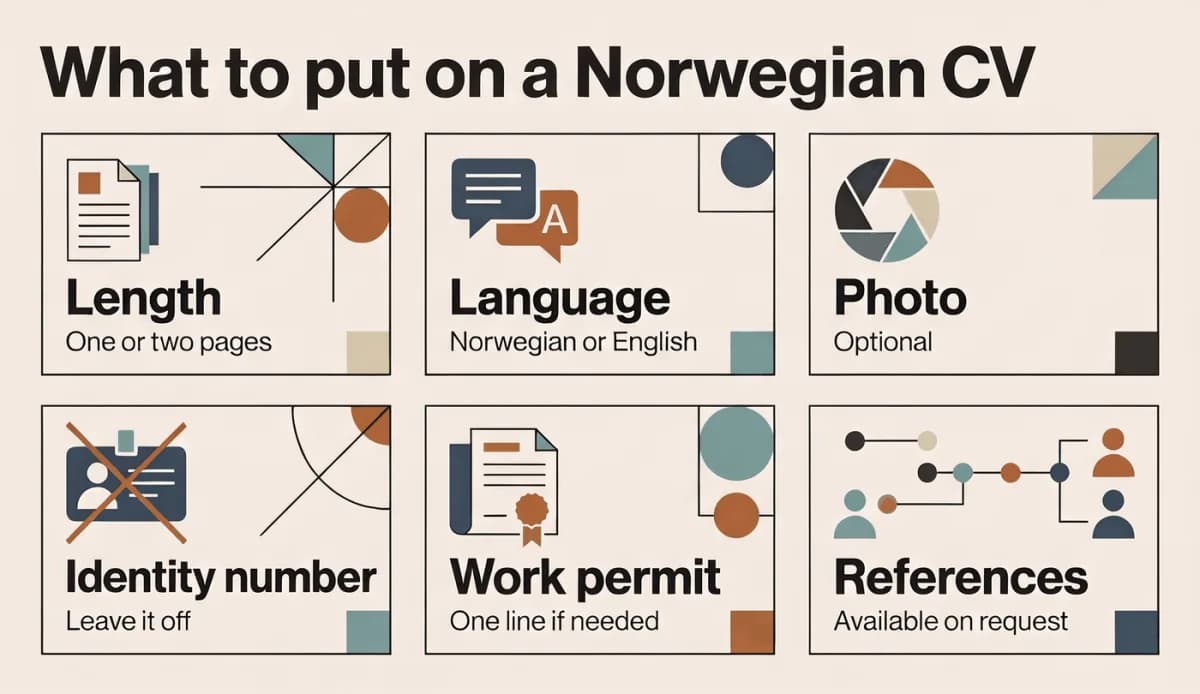
| Length | One page for early-career candidates, two pages at most for experienced ones | Common advice; no official rule found |
| Language | Norwegian or English, as the advert is written; Norwegian is usually expected in health care, schools and local government | Practice. Health authorisation for applicants educated outside the EU/EEA needs Norwegian at level B2[^4] |
| Photo | Optional; follow the advert and the norms of your sector | Practice only; we found no law that requires or bans a photo |
| National identity number (fødselsnummer) or D-number | Leave it off the CV and the søknad | Datatilsynet: you must give the number only if the asker has a legal basis, and you may refuse if there is no legal basis or no objective need[^5] |
| Personal details you need not give | Marital status, children, family plans, religion, political views, union membership, sexual orientation | Questions on these are restricted by aml § 13-4 and the equality act § 30 (see the next section)[^2][^6] |
| Work authorisation | One line if you need a permit (for example "Job-seeker permit valid to June 2027"); EU/EEA and Nordic citizens need no line | Practical advice only |
| References | "Available on request", or two named referees who agreed in advance | Practice |
| Søknad (cover letter) | One page, tied to the advert | Practice; no law requires it |
| File format | A plain, text-based PDF unless the advert says otherwise | Editorial advice; no official rule |
| Public-sector applications | Use the portal named in the advert; many state bodies use Jobbnorge | Offentleglova § 25: the public applicant list shows name, age, title and municipality[^7] |
Discrimination law, personal data and fair hiring
Protected grounds and banned questions
The equality and anti-discrimination act (law of 16 June 2017 no. 51) governs recruitment, and the Storting amended aml §§ 13-1 and 13-4 to refer to it.[^8] Arbeidstilsynet lists the protected grounds as sex, pregnancy, leave at birth or adoption, care responsibilities, ethnicity (including national origin, skin colour and language), religion and belief, disability, sexual orientation, gender identity, gender expression and age. Chapter 13 of the Working Environment Act adds political views, trade-union membership, and part-time and temporary employees.[^1]
Two laws govern the questions an employer may ask:
- Aml § 13-4(1) says an employer may not ask applicants about political views or trade-union membership. The exceptions are a position whose nature requires it, or a business that promotes political views, and then the advert must say so. Section 13-4(3) also bars obtaining the information covered by the equality act's § 30.[^2]
- Equality act § 30 bars questions about pregnancy, adoption and family plans. The Anti-Discrimination Tribunal found a breach when a restaurant asked. Datatilsynet's summary is that, as a rule, an employer may not ask about pregnancy, sexual orientation, union membership or political views.[^6]
Ethnicity is a protected ground, but we did not find it named as a banned question, so we do not list it as one.
Health information and medical examinations
Aml § 9-3 and § 9-4 are different rules. Section 9-3 says an employer may not ask applicants for health information beyond what is necessary for the duties of the job. Section 9-4 covers medical examinations, which are allowed only where a law or regulation requires them, for positions with special risk, or when needed to protect life and health. Datatilsynet gives statutory health certificates for sea and air work as examples.[^2][^6]
If you are turned down
A rejected applicant who suspects discrimination may ask in writing for the hired person's education, experience and other clearly established qualifications (equality act § 31, aml § 13-7). The Equality and Anti-Discrimination Ombud (LDO) says there is no right to a justification or an assessment of personal traits. In the public sector you can request an extended applicant list; a private employer need not show you the list.[^9][^2]
Personal data in recruitment
Employers are bound by the GDPR: they must inform you, respect your rights, keep data secure and store it only as long as necessary. Datatilsynet's pages say that no licence is needed to process applications, that headhunters follow the same rules, that credit-check information is deleted if the applicant drops out, and that information from interviews and tests must be deleted when the process ends. A police certificate may be demanded only where a specific law allows it, and the employer should name that legal basis, ideally in the advert.[^6][^10] We found no Datatilsynet wording on social-media checks, so treat those as a general GDPR question and ask the recruiter what it checks.
Police certificate (politiattest)
An employer needs a legal basis and must state the purpose. You apply for the certificate yourself, digitally or by post, with a confirmation of purpose from the employer. The police say processing takes about 14 days from complete documents, then it arrives in your digital mailbox or by post (up to three weeks by post); you can complain within three weeks, and the minimum age is 15. A staffing agency cannot demand to see the certificate, and an employer should not ask for a new one for the same post. We did not find a fee on the pages we read, so we publish none.[^11][^12]
Public applicant lists (offentleglova § 25)
When a public body hires, it must draw up a public applicant list. According to a Statsforvalteren decision that quotes the Act, the list contains name, age, title and home or work municipality, and it is normally ready two to three days after the deadline. A candidate may ask to be left off. The body decides case by case, because the Act says it "may" grant the request, with weight on whether the post is of special public interest, and the bar is higher for senior posts.[^7] The advert must say a public list will be drawn up. Ask the employer before you apply if this matters to you.
Pay transparency
We found no verified Norwegian rule that makes employers show salary ranges in adverts or bans salary-history questions. Do not assume either; ask the recruiter.
Structure of a Norwegian CV
The structure below is editorial advice. Keep one master CV and cut a version for each vacancy.
1. Contact details
Name, city (for example Bergen), a professional email address, a mobile number with +47 or your home country code, and a LinkedIn link if relevant. Leave out your fødselsnummer or D-number.
2. Profile
Three or four lines: your job title, years of experience, two or three skills that match the advert, and what you want. If you need a permit, add the work-authorisation line here ("Skilled-worker permit holder, valid to August 2028").
3. Work experience in reverse chronology
List the latest job first: title, employer, city, months and years. Give three to five bullets per job that start with a verb and show a result, with a number where you honestly have one. Explain gaps in one factual line.
4. Education and recognition
Give the award as issued, the institution, the country and the year. For a foreign degree, add the HK-dir recognition only if you have it (see the qualifications section). Regulated professionals add their authorisation number.
5. Skills and languages
Use the tools and certificates the advert names, in its words, because applicant-tracking systems match keywords. Show languages with a CEFR level, for example "Norwegian B2, English C1". Our guide to an ATS-friendly CV explains why a single column, standard headings and a text-based PDF work best.
Annotated fictional Norwegian CV
The sample is entirely fictional: person, employers, contacts and numbers. It sets no legal rule, and the employers are described generically on purpose. Replace every item with truthful information.
Ingrid Exemplar, Mechanical Engineer · Bergen · [email protected] · +47 XXX XX XXX · linkedin.com/in/ingrid-exemplar-example
*Annotation: fictional contacts. City only, no street address, no identity number.*
Profile: Mechanical engineer with four years of experience maintaining pumps and heat exchangers for an energy company. Holds a Norwegian master's degree and a job-seeker residence permit valid to June 2027. Looking for a project engineer role in Bergen, Stavanger or Oslo.
*Annotation: the work-authorisation fact sits in the profile so a screener sees it at once. State only what your residence card shows.*
Work experience: Maintenance Engineer, a Bergen-based energy company (fictional) · Bergen · August 2022 to present
- Cut unplanned downtime on a pump station by 18% by replacing a bearing supplier.
- Wrote 25 maintenance procedures in Norwegian and English.
- Coordinated a team of six technicians during a two-week turnaround.
*Annotation: employer and figures are fictional. Name the sector if you cannot name the firm, and use numbers you can defend at interview.*
Work experience: Engineering Intern, a Stavanger-based supplier (fictional) · Stavanger · June to August 2021
- Built a spreadsheet that cut spare-part search time from 15 to 5 minutes.
*Annotation: one relevant bullet beats a long list of duties.*
Education: MSc in Mechanical Engineering, Exemple University (fictional), Bergen, 2022.
*Annotation: keep the official name of the award.*
Skills and languages: SolidWorks · SAP PM · Python · Norwegian (B2) · English (C1) · Polish (native)
*Annotation: lead with what the advert asks for. Show language levels, not adjectives.*
References: Available on request.
*Annotation: do not print referees' contact details; ask them first.*
Søknad, references and documents
A søknad is a one-page letter that answers the advert. Write the job title and reference in the subject line, two short paragraphs linking your experience to the requirements, one line on your right to work, and a polite close. Do not repeat the CV. Many employers use an online form with a CV upload; follow it exactly. These are editorial norms, not rules.
Documents are normally requested after a shortlist or an offer, not with the first application.
Contract, probation and arbeidsattest
| Topic | Rule |
|---|---|
| Written contract | For employment longer than one month: no later than seven days after the job starts (aml § 14-5(2), in force 1 July 2024); under one month or agency work: immediately. Minimum content is in § 14-6 (identity, workplace, duties, start date, probation, holiday, notice, pay and pay date, hours, collective agreement)[^13][^2] |
| Probation | Up to six months; for a temporary job not more than half the period; extension for absence only if written notice was given at hiring (aml § 15-6)[^2][^14] |
| Notice in probation | 14 days unless agreed otherwise (§ 15-3(7)); dismissal in probation must rest on unsuitability, lack of skill or reliability (§ 15-6(1)) |
| Arbeidsattest | An employee who leaves after lawful notice may demand a written attest with name, date of birth, nature of work and duration (§ 15-15). A reason for leaving is not required content; a fuller attest may be requested where customary[^2] |
ID, D-number and tax card
Skatteetaten issues a D-number as a temporary identity number for foreigners who stay in Norway under six months and a national identity number for stays of six months or more. A tax card (skattekort) is issued after an in-person ID check at a tax office with a passport or national ID card, and the employer may apply for it on your behalf. Until the card is issued, the employer deducts 50 per cent (reported by Skatteetaten pages; check the current rule). A D-number becomes inactive five years after issue and then needs a new ID check.[^15][^16][^17]
Foreign qualifications and regulated professions
Higher education. HK-dir handles general recognition of foreign bachelor's, master's and PhD degrees. Recognition is voluntary, does not apply to regulated professions, shows the level and scope of your degree and can help in salary placement. The HK-dir page dated 13 October 2026 gives an expected processing time of 4 to 6 months from complete documents, and you can appeal within three weeks. HK-dir also has an automatic-recognition route for selected countries; Japan appears in that list (we verified the name, not the full list), so check which degrees qualify. Employers can request a faster "turbo assessment". We found no fee on the pages we read.[^18][^19]
Health personnel. Authorisation comes from Helsedirektoratet, not HK-dir. For applicants educated outside the EU/EEA, the directorate requires Norwegian at level B2 (an approved test with B2 on all parts, or documented Norwegian, Swedish or Danish at B2), and it does not require C1. The fee is NOK 1,665 (about US$179 / JPY 28,200) for applicants from the EU/EEA, outside the EU/EEA and the UK. Processing outside the EU/EEA is stated as 23 months, including for pending applications, against 3 months for the EU/EEA and the UK. Non-EU/EEA applicants must also meet additional requirements within three years, with three attempts each.[^4][^20]
Language levels. The Norskprøven test covers A1 to B2 (listening, reading, writing, speaking) and there is a separate C1 test; B2 is the level for entry to higher education.[^21] HK-dir also keeps a list of regulated professions.[^22]
Apostille. Japan (in force 28 May 1970) and Norway (30 May 1983) are both parties to the Hague Apostille Convention, so an apostille is enough and no embassy legalisation is needed. Degrees from some Japanese national, public and private universities may only be eligible for a different Japanese certification route (reported); ask the Norwegian recipient which it accepts before you pay.[^23]
Pay: sector minimum rates and take-home pay
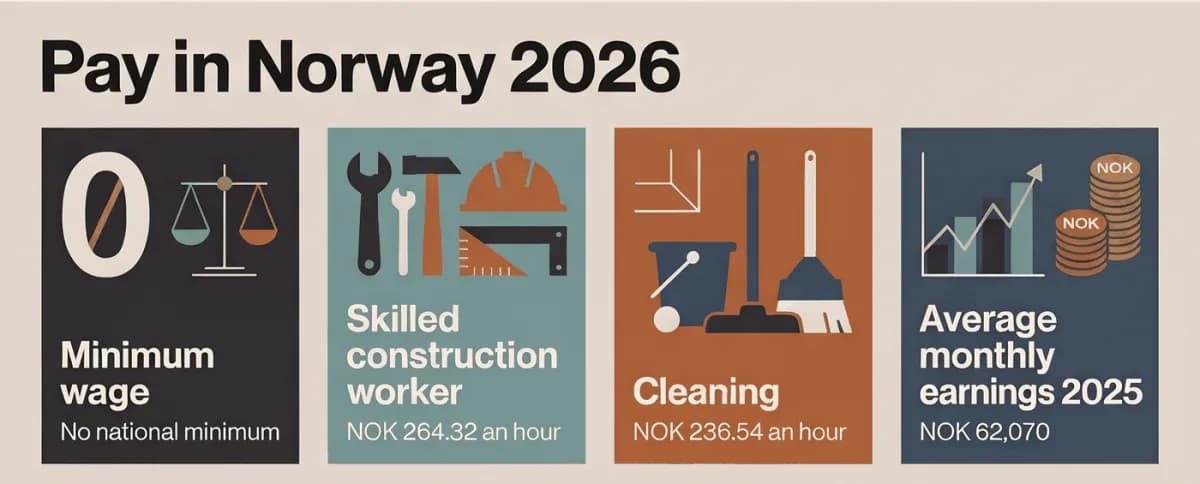
Norway has no statutory national minimum wage. Minimum pay exists only in sectors where a collective agreement has been made generally applicable (allmenngjøring); Arbeidstilsynet counts nine sectors with legal minimum-wage rules. Everywhere else pay is set by collective agreements or by negotiation. The rates below are NOK per hour and were valid on 28 October 2026; the pages showed no newer change.[^24][^25]
| Sector and group | Hourly rate | Valid from | About |
|---|---|---|---|
| Construction sites: skilled | NOK 264.32 | 15 June 2025 | US$28.37 / JPY 4,477 |
| Construction: unskilled, 1+ year in the sector | NOK 249.00 | 15 June 2025 | US$26.73 / JPY 4,218 |
| Construction: unskilled, no experience | NOK 239.61 | 15 June 2025 | US$25.72 / JPY 4,059 |
| Construction: under 18 | NOK 162.44 | 15 June 2025 | US$17.43 / JPY 2,752 |
| Electricians: skilled work | NOK 270.45 | 15 June 2025 | US$29.03 / JPY 4,581 |
| Electricians: other workers | NOK 241.77 | 15 June 2025 | US$25.95 / JPY 4,095 |
| Cleaning: 18 and over | NOK 236.54 | 15 June 2025 | US$25.39 / JPY 4,007 |
| Cleaning: under 18 | NOK 185.55 | 15 June 2025 | US$19.92 / JPY 3,143 |
| Maritime construction (ships and yards): skilled / semi-skilled / unskilled | NOK 216.79 / 207.14 / 197.61 | 15 June 2025 | US$23.27 / 22.23 / 21.21 |
| Agriculture and horticulture: permanent, unskilled | NOK 182.80 | 15 June 2025 | US$19.62 / JPY 3,096 |
| Agriculture: seasonal 18+, up to 12 weeks / 12 weeks to 6 months | NOK 162.90 / 168.40 | 15 June 2025 | US$17.48 / 18.07 |
| Hospitality: over 20, or 18+ after 4 months | NOK 204.79 | 15 June 2025 | US$21.98 / JPY 3,469 |
| Hospitality: age 18 / 17 / under 17 | NOK 166.34 / 152.08 / 142.58 | 15 June 2025 | US$17.85 / 16.32 / 15.30 |
| Road freight (vehicles over 2.5 t) | NOK 229.00 | 15 June 2025 | US$24.58 / JPY 3,879 |
| Passenger transport by tour bus | NOK 218.62 | 15 June 2025 | US$23.46 / JPY 3,703 |
| Automotive trade: newly qualified skilled / skilled 1+ year | NOK 223.50 / 237.00 | 15 June 2026 | US$23.99 / 25.44 |
| Automotive: unskilled 18+ / unskilled 18+ with 1+ year | NOK 208.00 / 212.00 | 15 June 2026 | US$22.32 / 22.75 |
The skilled-worker supplement in agriculture is NOK 14.50 an hour. In hospitality, an employer may deduct for accommodation up to NOK 675.67 a month for a single room (about US$72.52 / JPY 11,445) or NOK 439.46 for a double room (about US$47.17 / JPY 7,444). Overtime pay is at least 40 per cent on top of the hourly rate in most sectors; for electricians and maritime construction it is 50 per cent, and 100 per cent at night, on Sundays and on holidays.[^24] The fish-processing regulation was repealed on 3 August 2026; the Tariff Board is considering a new general application, so check the Arbeidstilsynet page before you rely on any fish-industry floor.[^25]
Average pay. Average monthly earnings of all employees were NOK 62,070 (about US$6,662 / JPY 1,051,400) in 2025, up from NOK 59,370 in 2024, a rise of 4.5 per cent (SSB). The average is not a floor and mixes high-paid sectors with low-paid ones.[^26]
Illustrative take-home pay
This is a worked example, not a minimum for any permit and not a payroll quote. It takes an illustrative gross salary of NOK 341,373 a year (about US$36,640 / JPY 5.78 million) for a single person with one job and the 2026 rules: minimum standard deduction (minstefradrag) of 46 per cent capped at NOK 95,700, personal allowance (personfradrag) of NOK 114,540, 22 per cent tax on ordinary income, 7.6 per cent national insurance contribution and bracket tax, with no pension or other deductions.[^27][^28][^29]
| Item | Amount | About |
|---|---|---|
| Gross salary per year | NOK 341,373 | US$36,640 / JPY 5.78 million |
| Taxable ordinary income (after NOK 95,700 and NOK 114,540) | NOK 131,133 | |
| Tax on ordinary income (22%) | NOK 28,849 | US$3,096 / JPY 488,700 |
| National insurance contribution (7.6%) | NOK 25,945 | US$2,785 / JPY 439,500 |
| Bracket tax (1.7% on NOK 92,200, 4.0% on NOK 23,073) | NOK 2,490 | US$267 / JPY 42,200 |
| Total tax and contribution | NOK 57,284 (16.8% of gross) | US$6,148 / JPY 970,300 |
| Net salary per year | NOK 284,089 | US$30,491 / JPY 4.81 million |
| Net salary per month | NOK 23,674 | US$2,541 / JPY 401,000 |
What this means: on a salary at this illustrative level, about 83 per cent of the gross reaches your account. Sector minimum rates cover only some jobs; an offer in another sector is whatever the contract or the collective agreement says, so compare it with rent in the city before you accept. The government has proposed changes for 2027 (see the tax section); they are not law yet.
Norway's economy in numbers
| Indicator | 2020 | 2021 | 2022 | 2023 | 2024 | 2025 |
|---|---|---|---|---|---|---|
| GDP (USD billion) | 382.3 | 521.6 | 617.3 | 502.2 | 500.9 | 530.8 |
| GDP per person (USD) | 71,058 | 96,443 | 113,122 | 90,984 | 89,889 | 94,594 |
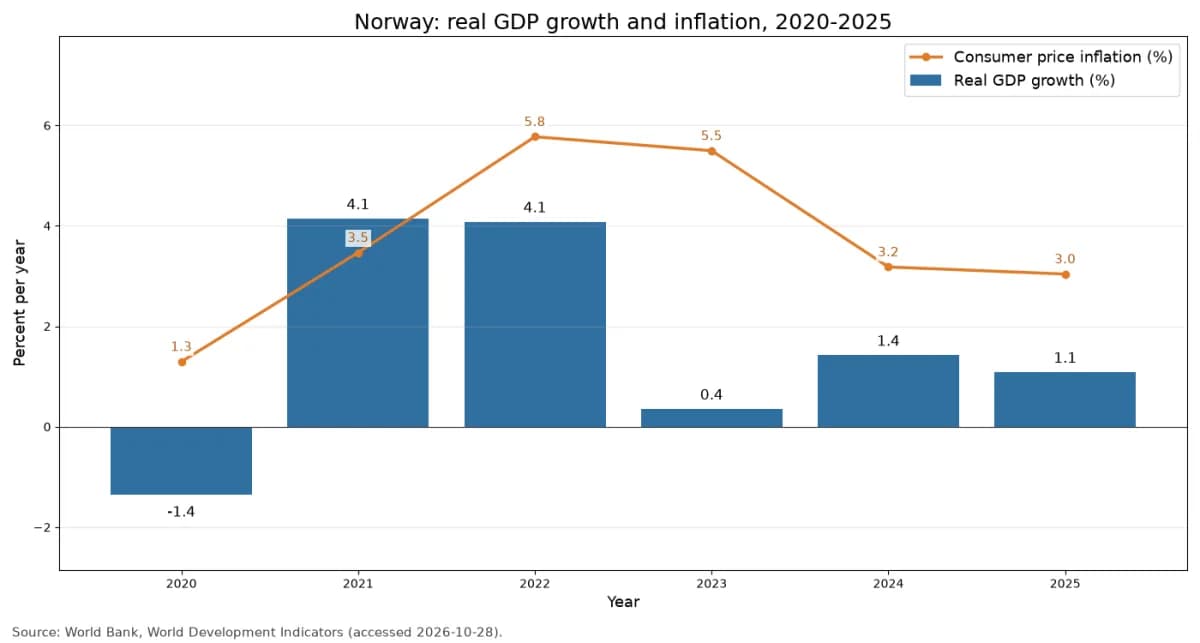
| Real GDP growth (%) | -1.4 | 4.1 | 4.1 | 0.4 | 1.4 | 1.1 |
| Inflation (%) | 1.3 | 3.5 | 5.8 | 5.5 | 3.2 | 3.0 |
| Population (million) | 5.38 | 5.41 | 5.46 | 5.52 | 5.57 | 5.61 |
*Source: World Bank, World Development Indicators (accessed 28 October 2026).*[^30]
The World Bank's ILO-modelled unemployment rate for 2025 is 4.6 per cent, and 13.4 per cent for ages 15 to 24. Norway's own statistics give a similar picture: SSB's Labour Force Survey showed 4.5 per cent unemployment in August 2026 (trend, ages 15 to 74), Nav registered 59,400 fully unemployed people (2.0 per cent of the labour force) in September 2026, consumer prices rose 3.4 per cent in the 12 months to September 2026, and Norges Bank's policy rate has been 4.50 per cent since 25 September 2026.[^30][^31][^32][^33][^34]
What this means: the economy is rich but not fast-growing, and unemployment is low, so employers compete for skilled people but still prefer candidates who can work in Norwegian. Inflation of about 3 per cent means you should compare offers in real terms and watch the annual wage settlement.
Work permits and rules for foreign workers
Who needs a permit
- Nordic citizens need no residence permit; UDI has a dedicated Nordic page, and a longer stay (reported: more than six months) must be reported to Skatteetaten.[^35]
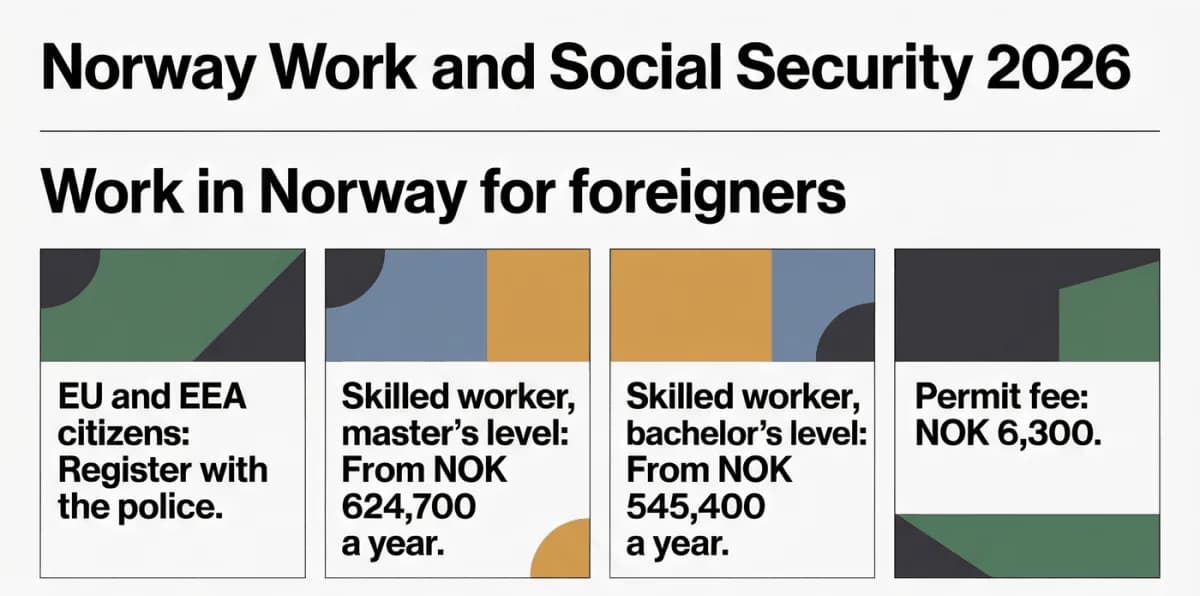
- EU/EEA nationals can start work at once. They register with the police (not with UDI online), normally within three months of arrival, and register once. They may stay three months and longer only as a worker, self-employed person, student, person with own funds or job seeker (a job seeker for up to six months, registering within three months). The registration certificate does not itself prove a right of residence, and you should apply for an identity number and tax card at Skatteetaten at the same time. Registration is reported to be free.[^36][^37]
- UK nationals who lived in Norway before the end of 2020 kept their rights under the Brexit arrangements (the application deadline was 31 December 2021); others apply under ordinary third-country rules.[^38]
- Everyone else needs a permit before working, unless a rule says otherwise.
Skilled workers
UDI's skilled-worker route requires vocational training (three years of upper secondary), a university or college degree, or special qualifications (about six years of experience, and UDI says many such applications are rejected). You need a concrete job offer, normally full time (80 per cent is accepted), and the employer must confirm the offer in UDI's form with a code when you apply from abroad. A permit lasts up to one year for vocational workers and normally up to three years for degree holders; you can apply for permanent residence after three years, and you have six months to find a new job if made redundant.[^39]
Pay must follow the collective agreement where one applies; otherwise it must be "not poorer than normal". UDI's pay page states at least NOK 624,700 a year before tax (about US$67,049 / JPY 10.58 million) for a position that needs a master's degree and NOK 545,400 (about US$58,538 / JPY 9.24 million) for a bachelor's-level position; lower pay needs substantial documentation.[^40] The fee for an adult work permit is NOK 6,300 (about US$676 / JPY 106,700), NOK 3,150 under 18.[^41] UDI gives no fixed processing time, and vocational cases (cook, mechanic, carpenter, painter, bricklayer, hairdresser) take longer because of document checks. You may not start before the permit unless the police confirm an early start, which UDI allows with a full application, at least a three-year university education and a citizenship other than Iran or North Korea.[^39][^42]
Students and graduates
A study permit allows part-time work up to 20 hours a week (remote work included) and full-time work during holidays.[^43] After a degree in Norway you can apply for a job-seeker permit of up to one year, at least one month before your study permit expires. You may work any job, full or part time, but not as self-employed. You need own funds of NOK 28,448 a month (about US$3,053 / JPY 481,900), that is NOK 341,373 a year, usually in a Norwegian bank account; former PhD candidates with a skilled permit need NOK 85,344.[^44] NOK 341,373 is a funds requirement, not a salary floor for skilled workers.
Seasonal workers
Seasonal permits are reported to run for at most six months in any twelve, followed by six months outside Norway; agriculture and forestry fall within a quota. Check the UDI page for the current rule.[^45]
Ukrainians under collective protection
UDI's page, updated on 2 March 2026, says the collective protection scheme is extended by one year, and holders from areas defined as safe can still extend. The government has said it will not end the scheme in 2027, and it proposes to lengthen the limit from five to seven years and to let working Ukrainians apply for a work-based permit; both are consultation proposals, not adopted law. We did not read work rights on the pages we opened, but the scheme is reported to include the right to work, so confirm it with UDI.[^46][^47]
Japanese nationals
Working Holiday. UDI's page for Japanese citizens says permanent residency in Japan is not enough: you must reside in Japan, be over 18 and not yet 31 at the time of application, and show funds of NOK 15,488 a month, NOK 46,464 for the first three months (about US$4,987 / JPY 787,000), in a bank or as a concrete paid job offer. You may not work more than six months for the same employer, the permit lasts at most one year in total, you need good health and medical insurance for the whole stay, study over three months is not allowed, family cannot follow, and the period does not count towards permanent residence. The scheme has run since 2013. We found no quota number on UDI's page, and the Japanese foreign ministry's table (as of 1 April 2026) lists the Norwegian quota as none.[^48][^49]
Entry. Japanese skilled workers are visa-exempt for short stays and may enter before a decision, but may not work, including remotely, until they hold the permit or an early-start confirmation.[^39]
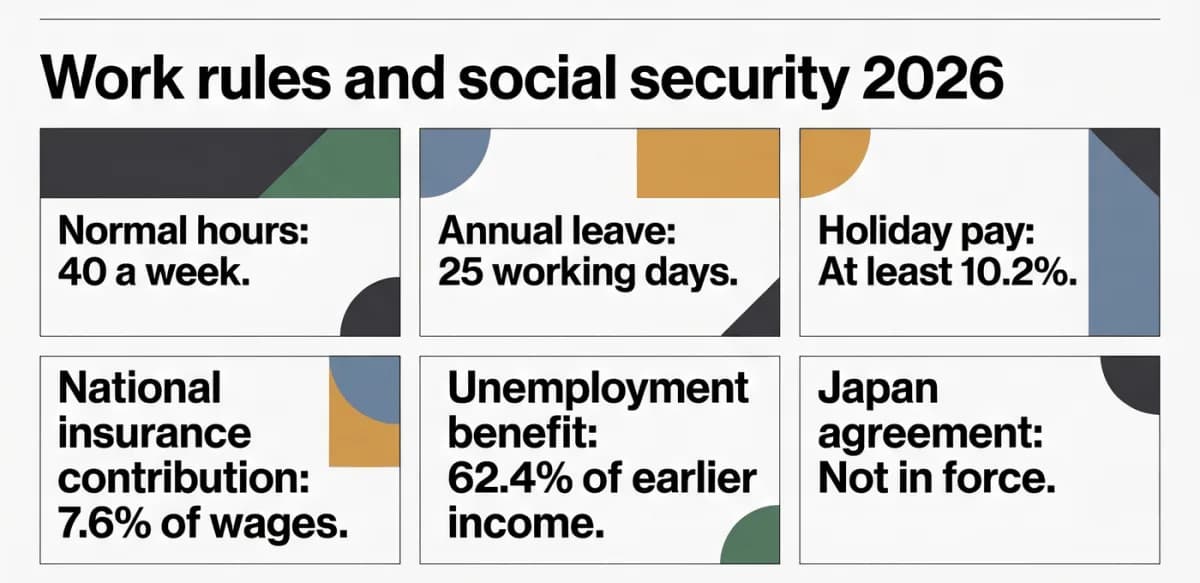
Social security. Japan and Norway have no social security agreement in force; the Japanese labour ministry's overview (status 2 June 2026) shows Norway under intergovernmental negotiation.[^50] Without an agreement, workers posted from Japan can face contributions in both countries, and the EEA coordination rules do not apply to Japanese nationals, so ask your employer how your pension periods will be treated.
Tax treaty. The Japan-Norway income tax convention was signed on 4 March 1992 and entered into force on 16 December 1992; the OECD multilateral instrument (MLI) also applies, and the Japanese Ministry of Finance list as of 26 June 2026 shows no newer convention.[^51][^52]
Japanese residents. The Japanese foreign ministry counted 1,769 Japanese nationals living in Norway in its October 2025 survey.[^82]
Foreign workers in numbers
SSB counted 987,120 immigrants (17.5 per cent of 5,627,400 residents) and 238,507 Norwegian-born children of immigrant parents on 1 January 2026. The largest groups were Poland (111,740), Ukraine (85,461), Lithuania (43,065), Syria (42,040) and Sweden (37,732). In the fourth quarter of 2025, 545,068 immigrants aged 20 to 66 were employed (an employment rate of 67.5 per cent), and 88,429 wage earners were non-resident short-term workers. All labour immigration, including from the EEA, was 10,545 people in 2025, down from 13,581 in 2024 and 17,013 in 2023. The World Bank counts an international migrant stock of 1,012,404 in 2024.[^53][^54][^55][^56][^30] These are not UDI permit counts, which we could not read.
Labour law: hours, leave, notice and dismissal
The main rules come from the Working Environment Act (aml) and the Holidays Act (ferieloven).
| Topic | Rule |
|---|---|
| Normal hours | 9 hours per 24 and 40 per 7 days (38 or 36 for shift and round-the-clock work), aml § 10-4[^57] |
| Overtime | Only for exceptional, time-limited need; at least 40% on top of the hourly rate; limits 10 hours per 7 days, 25 per 4 weeks and 200 per 52 weeks; total at most 13 hours per 24 and 48 per week on average over 8 weeks (§ 10-6)[^58] |
| Rest | 11 hours continuous per 24 and 35 hours per 7 days; a collective agreement may cut these to 8 and 28 hours with compensation; a 30-minute break if the day is extended by more than 2 hours (§§ 10-8, 10-9)[^57] |
| Annual leave | At least 25 working days (4 weeks and 1 day; Saturday counts); one extra week for those turning 60. The fifth week most people have comes from collective agreements, not the Act[^59] |
| Holiday pay | At least 10.2% of the earning-year pay; 12% under typical collective agreements; 12.5% for over-60s[^60] |
| Sick pay | Employer pays the first 16 days; Nav pays up to 6 G (G is the basic amount, see the social security section; 6 G = NOK 819,294) for at most 52 weeks; normally full pay up to 6 G; you need 4 weeks of work just before and annual income of at least 0.5 G[^61] |
| Self-certification | Employed at least 2 months: 3 calendar days at a time, up to 4 times in 12 months, within the first 16 days; many workplaces allow 8 days and 24 per year[^62] |
| Notice | One month by default; 2 months after 5 years, 3 months after 10 years; if dismissed after 10 years' service, 4, 5 or 6 months after ages 50, 55 and 60 (§ 15-3)[^63] |
| Dismissal | Must be objectively justified by the undertaking, the employer or the employee (§ 15-7); the employer should discuss the matter with you first (§ 15-1); you may stay in the post during an unfair-dismissal dispute, except in summary dismissal, probation and agency or temporary work (§ 15-11)[^64] |
| Severance | The Act contains no general severance pay (likely); check your collective agreement |
| Temporary jobs | Permanent employment is the rule; temporary only on listed grounds; after three consecutive years you are deemed permanent (§ 14-9)[^65] |
On 1 May and 17 May, you get full pay if the day would normally be a workday and you worked for the employer at least 30 days beforehand. If you work, you receive ordinary pay plus a premium of at least 50 per cent unless otherwise agreed. These days are not paid holidays for everyone.[^66]
2026 public holidays
There are 12 public holidays in 2026 besides Sundays.
| Date | Holiday |
|---|---|
| Thursday 1 January | New Year's Day |
| Thursday 2 April | Maundy Thursday |
| Friday 3 April | Good Friday |
| Sunday 5 April | Easter Sunday |
| Monday 6 April | Easter Monday |
| Friday 1 May | Labour Day |
| Thursday 14 May | Ascension Day |
| Sunday 17 May | Constitution Day |
| Sunday 24 May | Whit Sunday |
| Monday 25 May | Whit Monday |
| Friday 25 December | Christmas Day |
| Saturday 26 December | Boxing Day |
Easter Sunday, Ascension Day and Whit Monday are confirmed in the Church of Norway's 2025-2026 calendar; the other dates follow from it.[^67]
Social security: what you pay and what you get
Employees in Norway, including foreign workers, are members of the national insurance scheme (folketrygden).
| Item | 2026 | Source note |
|---|---|---|
| Employee contribution (trygdeavgift) on wages | 7.6% | Lower limit NOK 99,650 of personal income; 5.1% on pension income; 10.8% on other business income (7.6% for fishing, hunting and childminding self-employed)[^28] |
| Proposed for 2027 | 7.4% on wages; 10.6% on other business income | Proposed in the 7 October 2026 budget, not yet adopted; applies from 1 January 2027 only if the Storting passes it[^68] |
| Employer contribution by zone | I 14.1%; II 10.6%; III 6.4%; IV 5.1%; IVa 7.9%; V 0% | Zone V is Finnmark and parts of Troms[^27] |
| Occupational pension (OTP) | At least 2% of pay (up to 12 G), likely | Employer duty when the scheme tests are met[^69] |
| Basic amount (G) | NOK 136,549 (about US$14,656 / JPY 2.31 million) from 1 May 2026 | Used to set benefit ceilings[^70] |
| Benefit | What you get | Main conditions |
|---|---|---|
| Sick pay (sykepenger) | Normally full pay up to 6 G for up to 52 weeks | Employer pays days 1 to 16; Nav from day 17[^61] |
| Unemployment benefit (dagpenger) | 62.4% of earlier income up to 6 G; up to 104 weeks if earnings were at least NOK 273,098 (2 G), otherwise 52 weeks | Earned at least NOK 204,824 (1.5 G) in 12 months or NOK 409,647 (3 G) in 36 months; lost at least 50% of working time; under 67; registered and ready to work in Norway; 18-week quarantine if you caused the loss of the job[^71] |
| Parental benefit (foreldrepenger) | 49 weeks at 100% or 61 weeks and 1 day at 80% for one child (birth from 1 July 2024) | Earnings test applies[^72] |
Yes, Norway has unemployment benefit. Foreign workers who are members of the national insurance scheme can claim sykepenger and dagpenger on the same conditions as Norwegians if the earnings tests are met; dagpenger also requires being registered and ready to work in Norway. Permit-specific limits (for example how long your permit is valid) are not covered here, so check with Nav.
Japan. Because no Japan-Norway social security agreement is in force, Japanese workers should ask their employer how contributions in both countries will be handled.[^50]
Taxes on employees
Income tax. Ordinary income is taxed at 22 per cent. The Storting's 2026 resolution splits it into a state share of 8.25 per cent, a municipal share of up to 11.35 per cent and a county share of up to 2.40 per cent; councils may set lower rates. The municipal share is the nearest thing to Japan's resident tax (住民税, juminzei), but it is not a separate bill: it is part of the single 22 per cent assessed on your ordinary income and collected through the same tax card. Bracket tax and the national insurance contribution are state taxes only.[^27] The personal allowance is NOK 114,540 (about US$12,294 / JPY 1.94 million), and the minimum standard deduction is 46 per cent of salary, capped at NOK 95,700 (about US$10,272 / JPY 1.62 million).[^27]
Bracket tax (trinnskatt) 2026.
| Income above | Rate | About |
|---|---|---|
| NOK 226,100 | 1.7% | US$24,267 / JPY 3.83 million |
| NOK 318,300 | 4.0% | US$34,163 / JPY 5.39 million |
| NOK 725,050 | 13.7% | US$77,820 / JPY 12.28 million |
| NOK 980,100 | 16.8% | US$105,195 / JPY 16.60 million |
| NOK 1,467,200 | 17.8% | US$157,476 / JPY 24.85 million |
For a top earner, the marginal rate on salary is 22 + 17.8 + 7.6 = 47.4 per cent.[^29]
Flat tax at source (kildeskatt på lønn). Short-stay workers (under 183 days in 12 months or under 270 days in 36 months) and people in their first year of Norwegian tax residence can opt for a flat 25 per cent of salary, including the national insurance contribution (17.4 per cent in 2026 if exempt from it), on income up to NOK 725,050 in 2026 (about US$77,820 / JPY 12.28 million). No deductions can be claimed and no tax return is filed; the scheme is voluntary and you can opt out. It is not for people with Norwegian business income or capital income above NOK 10,000.[^73]
Without a tax card. Employers withhold 50 per cent of wages when no tax-card information exists (reported); get the ID check done early.[^16] A 10 per cent standard deduction still exists in Skatteetaten guidance but is likely limited to non-residents who work on ships or the continental shelf, so do not count on it as a general foreigner deduction.
VAT. The standard rate is 25 per cent, 15 per cent on food and water, and 12 per cent on passenger transport, hotel stays, cinema and sports events.[^74]
Proposed for 2027 (not adopted). The government proposed on 7 October 2026 to raise the personal allowance from NOK 114,540 to NOK 120,180 and the minimum standard-deduction cap from NOK 95,700 to NOK 99,550, to keep bracket-tax rates unchanged while thresholds rise with wage growth, and to cut the contribution on wages to 7.4 per cent. These come from bank and press summaries, because regjeringen.no refused automated access, and they take effect on 1 January 2027 only if the Storting passes them.[^68]
Treaty. The Japan-Norway tax convention of 1992, modified by the MLI, is in force (see the Japanese nationals section).[^51]
Where to find jobs, recruitment agencies and job scams
Channels. Arbeidsplassen (Nav's board), Jobbnorge (public sector), FINN jobb and the EURES portal all loaded on our check. Employers must notify vacancies to Nav, which they can do free on Arbeidsplassen. Our Norway job-board guide lists the boards in detail.[^75]
Agencies. Staffing agencies must be approved by Arbeidstilsynet, and hiring from an unapproved agency has been illegal since 1 January 2024 (reported by a professional summary); check the approved list. Agencies whose websites we could open include Adecco, Manpower, Randstad, Jobzone and Experis. Hiring labour from agencies is banned for construction work on building sites in Oslo, Akershus, Buskerud, Østfold and Vestfold.[^76]
No fees. Arbeidsplassen's terms say an employer offering a job may not demand any fee or payment from the job seeker.[^77]
Scams. UDI warns about fraudulent job offers: the employer must confirm a genuine offer to UDI with a form and a four-word code, UDI cannot verify offers for you, and a forged offer can lead to a five-year Schengen entry ban (reported).[^78] EURES warns that scammers use company or EURES names with fake email domains, so check the sender's domain.[^79] Skatteetaten reportedly says it never sends unprompted links by email or SMS, and the police warn that job offers can be used to recruit money mules who lend their bank account.[^80][^81] Never pay for a job, a permit "guarantee" or an interview. Norway's Penal Code makes human trafficking, including forced labour or services, a crime in section 257 (maximum six years) and aggravated trafficking a crime in section 258 (maximum ten years); we could not open Lovdata, so treat these numbers as likely. If you think you are being exploited, contact the police.
Final checks before you apply
- [ ] The CV is one to two pages, in Norwegian or English as the advert is written, latest job first.
- [ ] No fødselsnummer or D-number on the CV or the søknad.
- [ ] One line on work authorisation if I need a permit.
- [ ] The søknad is one page and answers the advert.
- [ ] For a public body, I know the applicant list shows name, age, title and municipality, and I have asked whether I can be left off.
- [ ] My expected pay meets the UDI floor for the job level (NOK 624,700 or NOK 545,400), or the collective agreement where one applies.
- [ ] I know whether the job falls under a sector minimum rate (NOK 182.80 to NOK 270.45 an hour in 2026).
- [ ] I will get a written contract within seven days, and I know the probation (at most six months) and notice terms.
- [ ] I have booked the ID check for my tax card and know about the 25 per cent flat tax option.
- [ ] Nobody has asked me for a fee for a job, a permit or an interview, and any agency is approved by Arbeidstilsynet.
FAQ
What is the standard Norwegian CV format?
There is no legal template. A clear CV of one to two pages in reverse chronological order, in Norwegian or English as the advert is written, without your fødselsnummer, is the safe default. A photo is optional.
Should a Norwegian CV include a photo?
It is optional. No law requires or bans a photo; follow the advert, and skip it if you are unsure.
Can an employer ask about my family plans, religion or union membership?
Not as a rule. The equality act § 30 bars questions on pregnancy, adoption and family plans, and aml § 13-4 bars questions about political views and trade-union membership. Datatilsynet adds sexual orientation to its list of questions that an employer may not ask as a rule. Aml § 9-3 also limits health questions to what the duties need.
Do I have to give my national identity number in an application?
No. Datatilsynet says you must give it only if the asker has a legal basis, and you may refuse if there is no legal basis or objective need. Give it later, when you take the job and register with Skatteetaten.
What is the minimum wage in Norway?
There is no general statutory minimum wage. Nine sectors have generally applicable minimum rates, from NOK 182.80 an hour for permanent unskilled agricultural work to NOK 270.45 for skilled electricians (about US$19.62 to US$29.03 / JPY 3,096 to JPY 4,581). Average monthly earnings of all employees were NOK 62,070 in 2025.
How much salary do I need for a skilled-worker permit?
UDI's pay page says at least NOK 624,700 a year before tax for a job that needs a master's degree and NOK 545,400 for a bachelor's-level job, unless a collective agreement sets the pay or lower pay is substantially documented. NOK 341,373 is the job-seeker funds amount, not a salary floor.
How long can probation last?
At most six months, and for a temporary job not more than half the contract period. Notice during probation is 14 days unless agreed otherwise.
How many days of annual leave do I get?
At least 25 working days (4 weeks and 1 day), plus one extra week the year you turn 60. Many collective agreements add a fifth week. Holiday pay is at least 10.2 per cent, and 12 per cent under typical collective agreements.
Can Japanese citizens work in Norway on a Working Holiday?
Yes, if they live in Japan and are over 18 and not yet 31 at application. The permit lasts up to one year, you need NOK 46,464 for the first three months, and you may work at most six months for one employer.
Can a recruitment agency charge me?
No. Arbeidsplassen's terms say an employer may not demand any fee from a job seeker. If an agency or "employer" asks for money, walk away and check that the agency is approved by Arbeidstilsynet.
How to use AIResume
Keep one master CV in AIResume and cut a version for each vacancy: use the advert's keywords, lead with your strongest result and add the right-to-work line if you need it. Leave out your identity number, export a text-based PDF and check it with our ATS-friendly CV guide before you apply.
Related AIResume guides
- Job boards in Norway
- Job boards in Sweden
- Job boards in Denmark
- United Kingdom CV format
- Switzerland CV format
- How to write an ATS-friendly CV
Sources
[^1]: Arbeidstilsynet, protection against discrimination
[^2]: Arbeidstilsynet, Working Environment Act (arbeidsmiljøloven), consolidated Norwegian text
[^3]: Norges Bank, reference exchange rates, 27 October 2026
[^4]: Helsedirektoratet, additional requirements for applicants educated outside the EU/EEA
[^5]: Datatilsynet, national identity number (fødselsnummer)
[^6]: Datatilsynet, questions and answers on working life
[^7]: Statsforvalteren i Trøndelag, decision on public applicant lists (offentleglova § 25)
[^8]: Storting, decision 2016-2017 no. 118 (amendments to aml §§ 13-1 and 13-4)
[^9]: LDO, if you did not get the job
[^10]: Datatilsynet, background checks before hiring
[^11]: Politiet, apply for a police certificate (private individuals)
[^12]: Politiet, requiring a police certificate
[^13]: Arbeidstilsynet, Working Environment Act § 14-5 (English)
[^14]: Arbeidstilsynet, employment (ansettelse)
[^15]: Skatteetaten, D-number
[^16]: Skatteetaten, ID check
[^17]: Skatteetaten, tax deduction cards for foreign employers
[^18]: HK-dir, recognition of foreign higher education (bachelor, master and PhD)
[^19]: HK-dir, after you have applied (processing time)
[^20]: Helsedirektoratet, you have applied or received a decision
[^21]: HK-dir, what the Norskprøven levels mean
[^22]: HK-dir, regulated professions
[^23]: HCCH, Apostille Convention status table
[^24]: Arbeidstilsynet, minimum wage and generally applicable agreements
[^25]: Arbeidstilsynet, minstelønn (Norwegian page)
[^26]: SSB, wages
[^27]: Storting, Innst. 3 S (2025-2026), 2026 tax and duty package
[^28]: Skatteetaten, national insurance contributions
[^29]: Skatteetaten, bracket tax
[^30]: World Bank, World Development Indicators: Norway (accessed 28 October 2026)
[^31]: SSB, Labour Force Survey
[^32]: Nav, registered unemployment September 2026
[^33]: SSB, consumer price index
[^34]: Norges Bank, policy rate series
[^35]: UDI, Nordic nationals who are going to live in Norway
[^36]: UDI, registration certificate for EU/EEA nationals
[^37]: UDI, answers for EU/EEA nationals
[^38]: UDI, residence according to the Brexit regulations
[^39]: UDI, skilled workers
[^40]: UDI, pay and working conditions in Norway
[^41]: UDI, fees
[^42]: UDI, early employment start
[^43]: UDI, study permit
[^44]: UDI, job seekers
[^45]: UDI, seasonal work answer page
[^46]: UDI, the collective protection scheme is extended by one year
[^47]: UDI, situation in Ukraine
[^48]: UDI, exchange programmes (Japan Working Holiday)
[^49]: MOFA, working holiday
[^50]: MHLW, social security agreements overview (status 2 June 2026)
[^51]: Japan Ministry of Finance, list of tax conventions
[^52]: Japan Ministry of Finance, MLI page
[^53]: SSB, immigrants and Norwegian-born to immigrant parents
[^54]: SSB, employment among immigrants (register-based)
[^55]: SSB, table 14358
[^56]: SSB, table 07113 (labour immigration)
[^57]: Arbeidstilsynet, working hours
[^58]: Arbeidstilsynet, overtime
[^59]: Arbeidstilsynet, holiday
[^60]: Arbeidstilsynet, holiday pay
[^61]: Nav, sickness benefit (sykepenger)
[^62]: Nav, self-certification (egenmelding)
[^63]: Arbeidstilsynet, Working Environment Act § 15-3, notice (English)
[^64]: Arbeidsmiljøloven (Arbeidstilsynet translation): § 15-1, § 15-7, § 15-11
[^65]: Arbeidstilsynet, Working Environment Act § 14-9, temporary employment (English)
[^66]: Arbeidstilsynet, pay and minimum rates of pay (section on 1 May and 17 May)
[^67]: Church of Norway, church-year calendar 2025-2026
[^68]: DNB, state budget 2027 (proposal of 7 October 2026)
[^69]: Skatteetaten, mandatory occupational pension (OTP)
[^70]: Nav, basic amount (grunnbeløp)
[^71]: Nav, unemployment benefit (dagpenger)
[^72]: Nav, parental benefit (foreldrepenger)
[^73]: Skatteetaten, flat tax at source on salary (kildeskatt på lønn)
[^74]: Skatteetaten, value-added tax
[^75]: Nav, recruiting (employers' duty to notify vacancies)
[^76]: Arbeidstilsynet, hiring labour from staffing enterprises
[^77]: Arbeidsplassen, terms of use
[^78]: UDI, fraudulent work offers
[^79]: EURES, how to spot fraudulent job offers
[^80]: Skatteetaten, scam warning
[^81]: Politiet, advice on ID theft and fraud
[^82]: MOFA, Norway basic data
Your next step
- DeelFor employers hiring across borders: contracts, payroll and visas handled.See how Deel works
Affiliate links: we may earn a commission at no cost to you. Affiliate link