

Luxembourg CV Format 2026: Languages, Photo, EUR 2,771 Minimum Wage, Permits
A good Luxembourg CV is a clear, vacancy-specific document of one or two pages with your latest job first, written in the language of the advert: French, German or English depending on the employer and the sector, with Luxembourgish as a plus. No Luxembourg law we could read prescribes a CV template
By AIResume Editorial Team
Last updated: 28 October 2026
A good Luxembourg CV is a clear, vacancy-specific document of one or two pages with your latest job first, written in the language of the advert: French, German or English depending on the employer and the sector, with Luxembourgish as a plus. No Luxembourg law we could read prescribes a CV template or requires a photo. The employment agency ADEM says in its CV guide that a photo is not obligatory, that you need not give your place of birth and that you need not go into detail on marital status and children.[^1] What the law does regulate is how an employer may treat you: the Code du travail bans discrimination in recruitment, requires a written contract at the latest when you start, and lets you ask for a certificate of employment when a contract ends.[^2]
This guide covers the CV and application, personal data and fair hiring, an annotated fictional CV, documents and foreign degrees, the social minimum wage, contracts and probation, the economy, work permits, labour law and the 2026 public holidays, social security, taxes and job scams. For the full list of job boards, see our Luxembourg job-board guide. It is written for EU, EEA and Swiss nationals and for cross-border commuters from France, Belgium and Germany, for Portuguese and other resident foreigners, for non-EU nationals (for example from India, China, the Philippines or Brazil), for beneficiaries of international protection and for Japanese nationals. It uses terms you will meet in Luxembourg, such as lettre de motivation, CDI, CDD, période d'essai, salaire social minimum (SSM), certificat de travail, extrait du casier judiciaire, Registre des titres, Sproochentest, ADEM, CCSS, ACD and ITM.
Editorial boundary: This is practical job-search guidance, not legal, immigration or tax advice. Our references are the Code du travail on Legilux, ADEM, Guichet.lu, the labour inspectorate (ITM), the social security body (CCSS), the direct tax administration (ACD), the statistics office STATEC and the European Central Bank, and we only list figures we could read in an official or primary source. Japan's foreign ministry site (mofa.go.jp) refused automated access, so we read it in a browser; the consolidated texts on Legilux carry a notice that they have documentary value only, and the newest consolidated Code du travail we could find is dated 26 July 2026. Items resting on press reports or a single law-firm note are marked "reported" or "likely". Confirm details with ADEM, Guichet.lu, the CCSS or the ACD before you rely on them.
The euro moves daily. With the ECB reference rate of 27 October 2026 (EUR 1 = USD 1.1150 = JPY 175.97), the unskilled social minimum wage of EUR 2,771.33 a month is about US$3,090 or JPY 487,700.[^3][^4]
Before you apply
- SafetyWing Nomad InsuranceHealth insurance that works in your new country from day one.Get a quote
Affiliate links: we may earn a commission at no cost to you. Affiliate link
Luxembourg CV format at a glance
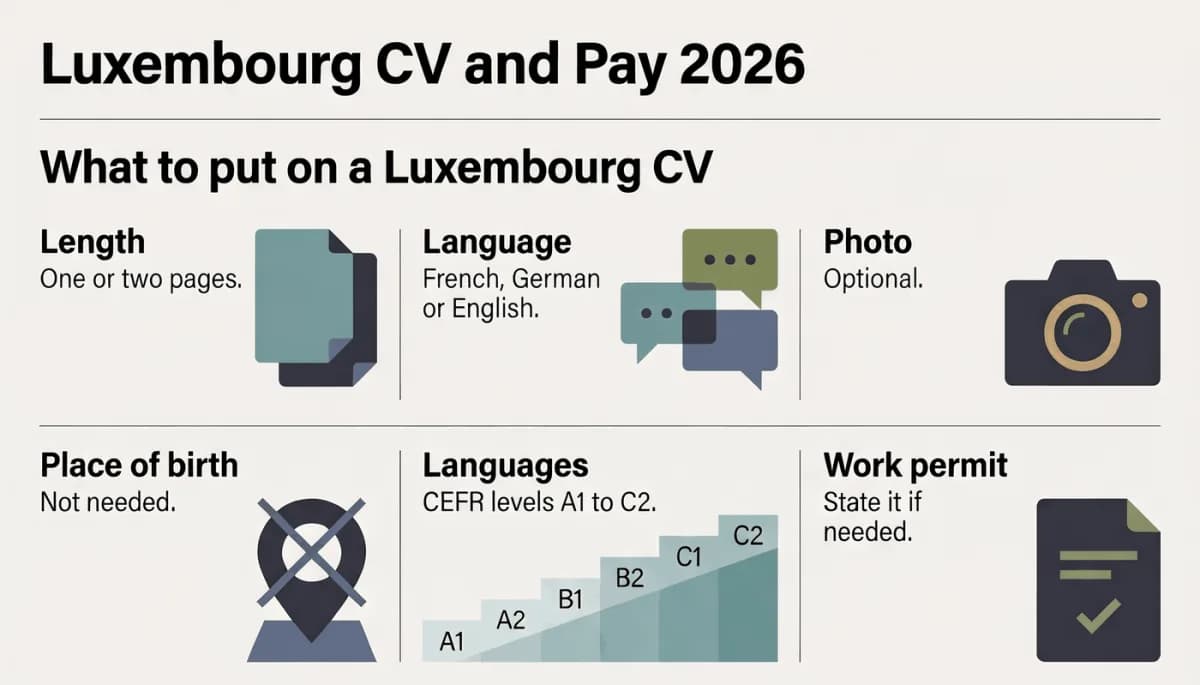
| Topic | Practice in 2026 | Law or official guidance |
|---|---|---|
| Length | One page for early-career candidates (editorial advice); up to two pages for experienced, highly qualified or responsible profiles | ADEM guide: two pages for highly qualified profiles, profiles with responsibility or 10 or more years of experience[^1] |
| Language | French, German or English according to the advert, employer and sector; Luxembourgish is a plus, not a default requirement | Market practice; no law found on CV language. See our job-board guide for the civil-service language tests |
| Photo | Optional; if you add one, keep it recent, on a neutral background and professional | ADEM: a photo is not obligatory[^1][^5] |
| Date of birth | Optional; ADEM lists it among recommended details | ADEM guide[^1] |
| Place of birth, marital status, children | Leave out the place of birth; no need to detail marital status or children | ADEM guide[^1]; sex discrimination, including by reference to marital or family status, is banned (art. L.241-1)[^2] |
| Languages | Mother tongue first, then each language with a CEFR level (A1 to C2) | ADEM guide[^1] |
| Work-authorisation line | If necessary, state whether you hold a work permit; EU citizens need no line | ADEM guide[^1] |
| References | Give two referees on request; no need to print their details on the CV | Practice |
| Expected salary | Give it only when the form asks; say gross and monthly | Practice; the SSM is the legal floor (see the pay section) |
| Degree recognition | Name the award as issued; register a foreign diploma only if you need the academic title or the EQF level | Registre des titres, EUR 75 per diploma[^6] |
| File and email | A readable PDF, sent by email or uploaded to the portal named in the advert | Not an official rule |
| Cover letter | A short lettre de motivation is expected for many corporate roles | Not required by law |
Personal data, photo and fair hiring
Non-discrimination. The Code du travail bans direct and indirect discrimination based on sex (art. L.241-1, which also covers discrimination by reference to marital or family status, and harassment). A second regime, art. L.251-1, covers religion or belief, disability, age, sexual orientation, true or supposed membership or non-membership of a nationality, and race or ethnic origin. Art. L.251-2 extends the second regime to access to employment, selection criteria and recruitment conditions.[^2] No article lists "forbidden interview questions", so treat lists of questions you may refuse as practice guidance.
Photo and personal details. ADEM calls a photo optional, lists the date of birth among recommended details and says nationality is relevant only to state whether you hold a work permit.[^1] Decide on purpose whether to add one, and give an employer your identity-document numbers only at onboarding.
Pre-employment medical exam. Art. L.326-1 says that every person taking up a post undergoes an examination by the occupational physician: before hiring for night workers and risk posts, otherwise within two months of hiring. If the exam happens after hiring, the contract carries a resolutive condition, so an "unfit" finding ends it by law. The purpose is to judge fitness for the intended post, and HIV screening is excluded (art. L.326-3).[^2] We could not confirm from the text who pays or whether the time counts as paid work.
Data protection. The GDPR applies to recruitment data: you may ask an employer what it keeps, and storage limitation (art. 5(1)(e)) means a controller should not keep rejected applications indefinitely. The data-protection authority CNPD publishes no general numeric limit for rejected CVs that we could verify, so each employer sets its own period. Ask a recruiter how long it will hold your file.[^7]
Criminal record. An employer may ask for the extract no. 3 of your criminal record at recruitment only if the request appears in the job offer and the post justifies it. It may keep the document for no more than one month after the contract is concluded; if you are not hired, it must destroy it without delay. The extract is free, available online through MyGuichet with LuxTrust or eID, or by post or email. Foreign nationals living in Luxembourg get an extract containing only Luxembourg convictions; a complete picture needs a certificate from the home state.[^8][^9]
Disability. Disabled-worker status under art. L.561-1 requires a reduction of working capacity of at least 30%. Art. L.562-3 sets quotas: 5% of staff for the State, communes and public establishments; at least one full-time disabled worker for private employers with 25 or more staff (when ADEM has a suitable candidate), 2% from 50 staff and 4% from 300. An employer that does not hire the required number pays a monthly levy of 50% of the SSM per unfilled post (art. L.562-5).[^2]
Structure of a Luxembourg CV
The structure below is market practice, built on the ADEM guide; it is not law. Keep one master CV and cut a version for each vacancy.[^1]
1. Contact details
Name, a monitored email, a mobile number with +352 (or your home country code) and the town you live in (Luxembourg City, Esch-sur-Alzette, Differdange, Kirchberg, or your home town across the border). Put the target job title under your name. Leave out your place of birth. A driving licence (category A or B) counts as a skill and can sit with your skills.
2. Profile
Two to four lines: role, years of experience, two or three strengths and the languages you work in. Use the employer's own terms from the advert.
3. Work experience in reverse chronology
List the latest job first with employer, town, month and year, and three to five bullets showing task, scope and result. Do not claim numbers you cannot explain in an interview. If you are a cross-border commuter, one line such as "lives in Thionville, France" tells the recruiter where you commute from.
4. Education and diplomas
State the degree, institution, country and year. Add "registered in the Registre des titres" only if that is true (see the degrees section).
5. Languages and skills
State your mother tongue first, then each language with a CEFR level from A1 to C2, for example "French C1, German B2, English C1, Luxembourgish A2".[^1] The Sproochentest is the Luxembourgish language exam you take as part of a naturalisation application, organised by the language institute INLL; it is not a test an employer asks for in a normal recruitment.[^10] Do not claim a CEFR level you cannot prove. Name the software and tools you can use.
6. ATS and file checks
Many large employers filter applications with software. Use simple headings, one column, standard fonts and a PDF with selectable text; put the keywords of the advert in your experience bullets, not in a graphic. Our ATS-friendly CV guide has the file checks. This is editorial advice, not an official rule.
Annotated fictional Luxembourg CV
The sample is entirely fictional: person, employers, contacts and numbers. It does not set a legal rule. Replace every item with truthful information.
Marta Exemplo, Accounting Assistant · Esch-sur-Alzette · [email protected] · +352 6XX XXX XXX
*Annotation: fictional contacts. A town is enough; no place of birth, no marital status. A photo is optional.*
Profile: Accounting assistant with four years of experience in supplier invoices, bank reconciliations and month-end closing at a mid-sized logistics company near Esch-sur-Alzette. Works in Portuguese, French and English. Looking for a junior accountant role in an accounting firm in Luxembourg City or Kirchberg.
*Annotation: match the role label to the vacancy. Do not add tools or language levels you cannot prove.*
Work experience: Accounting Assistant, Exemple Logistics S.A. (fictional) · Esch-sur-Alzette · March 2023 to present
- Processed about 300 supplier invoices a month and prepared monthly bank reconciliations.
- Built a month-end checklist that shortened the closing by two working days.
- Corresponded with suppliers and the fiduciary in French and English.
*Annotation: employer and figures are fictional. Support real claims with the certificate of employment you can request when a contract ends (art. L.125-6); ask for it before you leave.*
Work experience: Administrative Assistant, Exemple Services Sàrl (fictional) · Luxembourg City · September 2021 to February 2023
- Handled mail, filing and the daily cash report in a six-person office.
*Annotation: one relevant bullet beats a long list of duties.*
Education: Bachelor in Accounting and Finance, Exemple University of Applied Sciences (fictional), Lisbon, 2021. Registered in the Registre des titres, 2023 (fictional).
*Annotation: keep the official name of the award. Mention registration only if it is true.*
Languages and skills: Portuguese (mother tongue) · French C1 · English B2 · German A2 · Luxembourgish A1 · Excel · bank reconciliations · accounting software · driving licence B
*Annotation: mother tongue first, then CEFR levels from the ADEM guide. Put the skills the vacancy asks for first.*
Work status: Portuguese national, resident in Luxembourg.
*Annotation: one true line is enough; EU citizens need no permit line.*
Cover letter, references and documents
A short lettre de motivation is useful when it explains motivation, a move between countries, language fit or a sector change. Keep it to one page, formal, in the language of the advert, with the job title and reference in the subject line, one or two paragraphs linking your experience to the advert and a polite close. Do not repeat the CV.
Documents are requested after the shortlist, not on the CV. What we could verify:
| Document | What we found |
|---|---|
| Criminal record extract (extrait du casier judiciaire) | No. 3 only if stated in the job offer and justified by the post; free; kept by the employer for at most one month after the contract is concluded.[^8][^9] |
| Diplomas | Keep originals and certified copies. Register a foreign diploma only if you need the academic title; see the next section. |
| Work permit or residence document | Show it at onboarding if the employer asks; do not print its number on the CV. |
| Medical exam | The occupational-health exam comes with the contract (art. L.326-1), not with the application.[^2] |
| Certificate of employment (certificat de travail) | At the end of the contract the employer issues it on request. It contains only the start and end dates and the job or jobs held with their periods, and no tendentious or unfavourable mention. For a fixed-term contract it must be delivered on request at least 8 days before the contract expires (art. L.125-6).[^2] |
References. Name referees who agreed in advance, and tell them which job you applied for. Offer the details on request rather than printing them.
Foreign degrees: recognition, Apostille and legalisation
Registre des titres. Registering a diploma at the Ministry of Research and Higher Education costs EUR 75 per diploma (about US$84 / JPY 13,200), non-refundable. It gives the right to use the academic title and gives the diploma a CLQ level aligned with the European Qualifications Framework, but it does not give the right to practise a profession. Diplomas of the University of Luxembourg, Luxembourg BTS and accredited private institutions are recognised without registration, as are certain diplomas from Belgium, the Netherlands, Estonia, Latvia and Lithuania. Guichet last updated the page on 14 May 2024.[^6]
Law degrees. A foreign law degree needs a homologation, for the supplementary courses in Luxembourg law and certain legal careers, at EUR 125 per diploma (about US$139 / JPY 22,000), non-refundable; a duplicate costs EUR 10. A bill filed in January 2026 would replace the procedure but, as far as we found, has not been adopted.[^11]
Regulated professions. Recognition of a professional qualification costs EUR 75 per recognition and profession (duplicate EUR 10). Compensatory measures are an aptitude test or an adaptation period, and practising needs a separate authorisation or right of establishment. For EU qualifications the framework is Directive 2005/36/EC. Guichet last updated the page on 20 February 2026.[^12]
Apostille. The Hague Apostille Convention is in force for Luxembourg since 3 June 1979 and for Japan since 27 July 1970, so both countries are parties to the convention, which governs the Apostille for public documents used between them. We could not verify which Japanese office issues the Apostille, or the rules on sworn translation, so ask the receiving employer or authority what they require before you pay for any stamp.[^13]
Pay: minimum wage, indexation and salary components
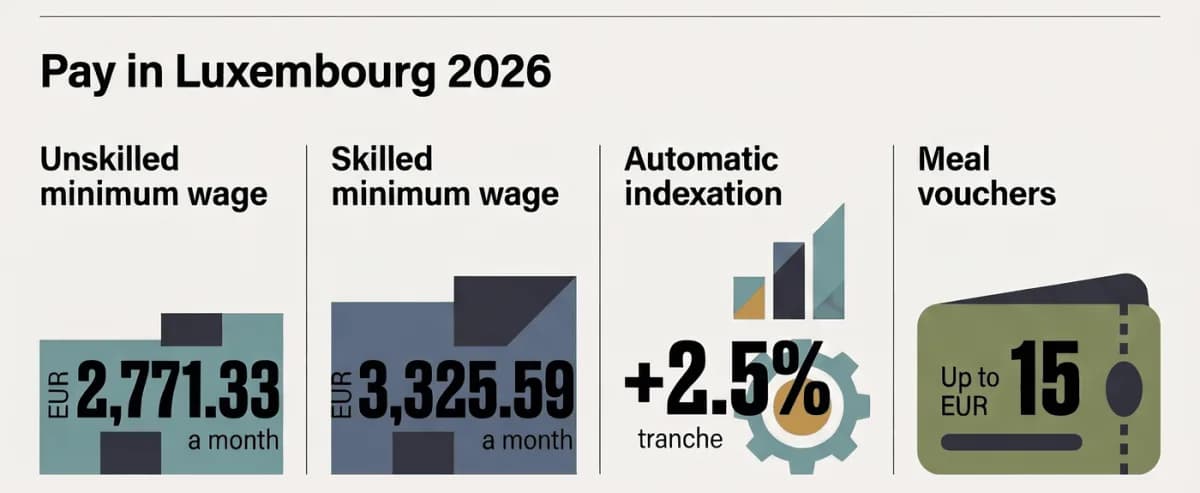
The social minimum wage (SSM) is the legal floor for adults and is indexed automatically. The table shows the monthly rates valid from 1 June 2026, index 992.24, with conversions at the ECB rate of 27 October 2026.[^14][^4]
| Category | EUR a month | EUR an hour | US$ a month | JPY a month |
|---|---|---|---|---|
| Unskilled worker, 18 and over | 2,771.33 | 16.0192 | about 3,090 | about 487,700 |
| Skilled worker, 18 and over | 3,325.59 | 19.2231 | about 3,708 | about 585,200 |
| Worker aged 17 to under 18 | 2,217.06 | 12.8154 | about 2,472 | about 390,100 |
| Worker aged 15 to under 17 | 2,078.49 | 12.0144 | about 2,318 | about 365,800 |
The Code du travail sets the skilled rate at 20% above the unskilled one (art. L.222-4) and the youth rates at 80% (17 to 18) and 75% (15 to 17); the hourly rate is the monthly rate divided by 173 (art. L.222-9).[^2] A worker counts as skilled (art. L.222-4) with a state-recognised certificate of at least CATP or DAP level; with a CCM or CCP certificate after two years in the trade or a CITP certificate after five years; without a certificate, after ten years of practice in the profession; and where no official certificate exists, after six years of practice with progressively rising skills. University degrees are not named in that article.[^2]
Indexation. The wage scale is tied to the consumer price index. A tranche of +2.5% is triggered when the half-yearly average of the index reaches the next threshold. The last tranche took effect on 1 June 2026 (index 968.04 to 992.24). On 7 October 2026 STATEC reported a half-yearly average of 1,058.56 against a next trigger of 1,064.75. The date of the next tranche is not known; the October index is published on 4 November 2026.[^14][^15]
Meal vouchers. Since tax year 2024 a meal voucher can have a face value of up to EUR 15 (about US$16.70 / JPY 2,640): the employer's share is exempt up to EUR 12.20 and the employee pays EUR 2.80. Employers may set a lower face value.[^16][^17]
Internships. A practical internship to gain experience, for a student or a graduate within 12 months of the last enrolment, lasts at most 6 months in 24 months with the same host. Pay is not mandatory under 4 weeks; from 4 to 12 weeks it is at least 40% of the unskilled SSM (about EUR 1,109, or US$1,236 / JPY 195,100) and from over 12 up to 26 weeks 75% (about EUR 2,079, or US$2,318 / JPY 365,800). For graduates of short or first-cycle higher education the reference is the skilled SSM (art. L.152-6 and L.152-8). Curricular internships of 4 weeks or more pay at least 30% of the unskilled SSM unless the school bans pay.[^2]
Student summer jobs. A holiday contract is open to people aged at least 15 and under 27, enrolled full time (or whose studies ended less than four months ago), for at most 2 months or 346 hours a calendar year, with pay of at least 80% of the SSM graded by age (art. L.151-2, L.151-4 and L.151-5).[^2]
Pay transparency. The EU Pay Transparency Directive (2023/970) had to be transposed by 7 June 2026. Press and law-firm notes reported on 28 October 2026 that Luxembourg had not yet transposed it and that no bill was published (likely); existing equal-pay rules apply meanwhile.[^18]
What this means: check an offer against the SSM first (EUR 2,771.33, or EUR 3,325.59 if you are skilled), ask whether the figure is gross, and ask in writing whether a 13th month, meal vouchers or a bonus are included. The 13th month is not statutory; look in your contract or the collective agreement.
Contracts and probation
Written contract. Art. L.121-4 requires a written contract per employee at the latest at entry into service. It lists 14 mentions, among them the parties, the start date, the workplace, the nature of the job, working time, pay, leave, the notice procedure, any probation, applicable collective agreements, the social security bodies and the right to training. Some mentions may be given within 7 calendar days of the first day and others within one month. The 2024 reform is from the law of 24 July 2024.[^2]
Probation (période d'essai). The trial clause is for permanent (CDI) contracts. It lasts at least 2 weeks and at most 6 months; at most 3 months if the vocational level is below CATP; and at most 12 months if the starting gross monthly salary reaches a level set by grand-ducal regulation. It must be in the written contract by entry into service or it is void, and it cannot be renewed (art. L.121-5). Neither side can end the contract unilaterally during the minimum 2 weeks, except for gross misconduct. After that, the notice is at least as many days as the weeks of trial or 4 days per month of the agreed trial, never below 15 days and never above one month.[^2]
Fixed-term contracts (CDD). A CDD is allowed for a precise, non-lasting task (art. L.122-1). It may last 24 months including renewals (art. L.122-4; seasonal contracts 10 months in 12) and may be renewed twice if the contract provides for it (art. L.122-5). A breach of the rules turns the contract into an open-ended one (art. L.122-9), and a new contract after a CDD continuation cannot include a trial period (art. L.122-8).[^2]
Sick pay and family leave. The employer pays the full wage to the end of the month in which the 77th day of incapacity falls, within 18 consecutive months (art. L.121-6). Maternity leave is 20 weeks (8 before and 12 after the birth) and paternity leave is 10 days.[^2]
Luxembourg's economy in numbers
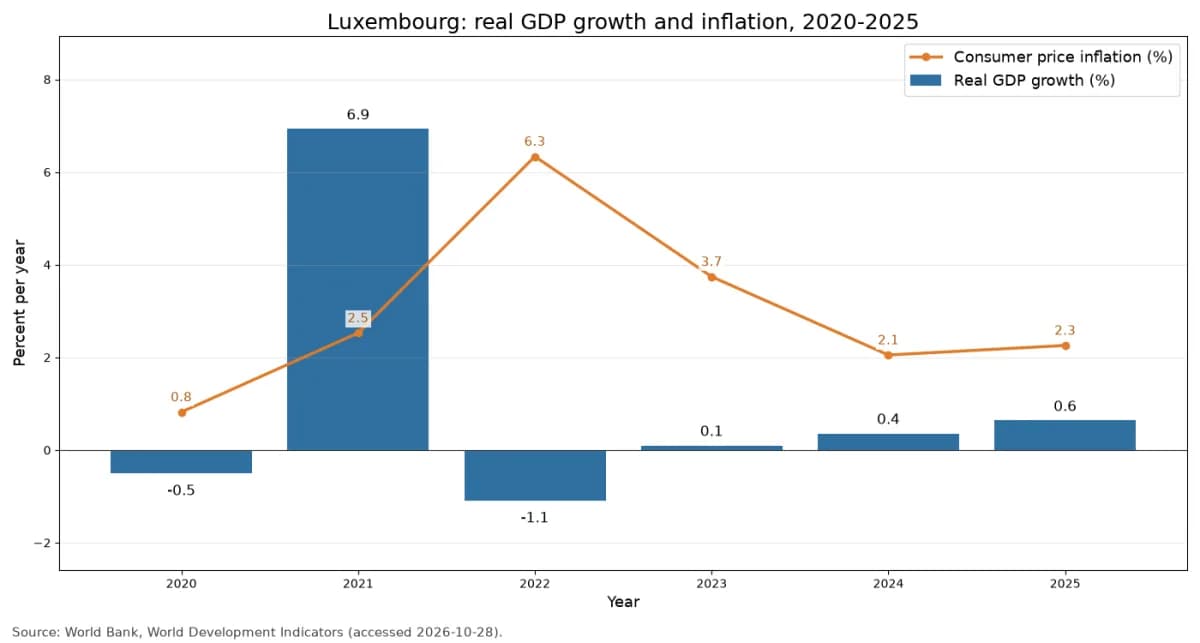
| Indicator | 2020 | 2021 | 2022 | 2023 | 2024 | 2025 |
|---|---|---|---|---|---|---|
| GDP (USD billion) | 73.7 | 86.4 | 80.8 | 88.8 | 93.3 | 101.2 |
| GDP per person (USD) | 116,860 | 134,966 | 123,720 | 133,231 | 137,782 | 147,252 |
| Real GDP growth (%) | -0.5 | 6.9 | -1.1 | 0.1 | 0.4 | 0.6 |
| Inflation (%) | 0.8 | 2.5 | 6.3 | 3.7 | 2.1 | 2.3 |
| Population (million) | 0.63 | 0.64 | 0.65 | 0.67 | 0.68 | 0.69 |
*Source: World Bank, World Development Indicators (accessed 28 October 2026).*[^19]
GDP per person is inflated by cross-border commuters: they produce output in Luxembourg but are counted in the population of France, Belgium and Germany. On 30 June 2026 there were 539,405 jobs in Luxembourg and 240,335 of them (44.6%) were held by cross-border commuters.[^20] The World Bank also lists (ILO-modelled) unemployment of 6.3% in 2025, youth unemployment (ages 15 to 24) of 21.5% and an international migrant stock of 344,309 in 2024.[^19]
Two unemployment rates. The seasonally adjusted rate of registered jobseekers was 6.5% in September 2026, with 20,269 resident jobseekers on 30 September 2026 (ADEM and STATEC).[^21] That is not the same measure as the World Bank's 6.3% for 2025: ADEM's rate is built from jobseekers registered at the agency, while the World Bank series is ILO-modelled, so the definitions differ. Compare each series with itself, not with the other.
Who lives here. Luxembourg had 690,959 inhabitants on 1 January 2026; 46.6% (322,050) were foreign nationals. The largest groups were Portuguese (12.8%), French (7.1%), Italians (3.7%), Belgians (2.6%) and Germans (1.8%).[^22]
What this means: a small country with a large foreign workforce means that many employers are used to multilingual and international CVs, and that where you live (in Luxembourg or across the border) is worth one line on your CV. High GDP per person does not mean high pay for every job: use the SSM and the offer itself, not the macro figures.
Work permits and rules for foreign workers
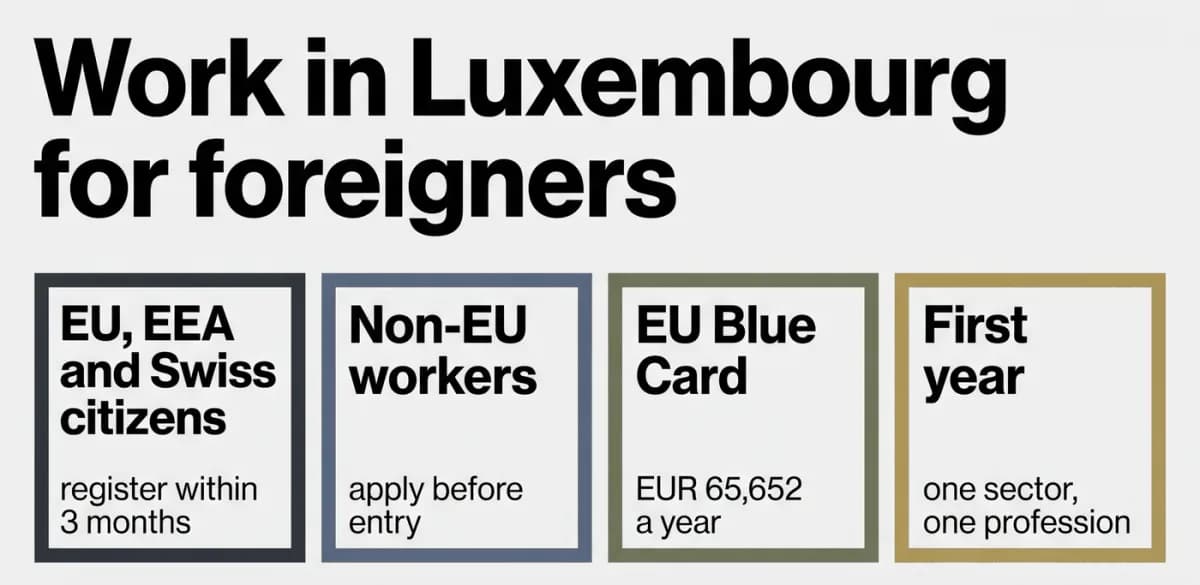
EU, EEA and Swiss nationals. You may live and work in Luxembourg without a work permit and register with the commune within 3 months (art. 8 of the law of 29 August 2008).[^23]
Third-country salaried workers. The application for a stay of more than three months must be filed before entry, or it is inadmissible (art. 39(1)), apart from an exceptional case in art. 39(2). The employer first declares the vacancy to ADEM (art. L.622-4); for a shortage-list job ADEM issues a certificate within 5 working days, otherwise ADEM checks for up to 7 working days and then issues the certificate within 5 working days. The decision comes within 4 months of the complete file (art. 42(3)); on arrival you declare yourself at the commune within 3 working days (art. 40(1)). In the first year of lawful employment you may work for any employer but only in one sector and one profession (art. 43); a change in that year needs an application. The permit is valid at most one year and is renewable up to 3 years; after the first year any sector and profession is open.[^23][^24][^25]
EU Blue Card. The single minimum gross salary is EUR 65,652 a year (about US$73,200 / JPY 11.55 million) from 3 March 2026, with a contract of at least 6 months. The earlier higher and lower tiers no longer apply. Guichet prints both 65,562 and 65,652 on its page; use 65,652 and check the page again before you apply.[^26][^27]
Other permits. An intra-corporate transferee permit runs up to 3 years for managers and experts (art. 47-1). After a Master's or a PhD completed in Luxembourg a job-seeker permit lasts 12 months (art. 67-4); apply at least 30 days before the student permit ends. Non-EU students may work an average of 15 hours a week (art. 57(3)), not during school holidays.[^23]
International protection. Since 12 June 2026 applicants for international protection no longer need a temporary work authorisation (AOT). They may work under the Code du travail once their application has been registered for at least 4 months with no final decision (the date appears on the pink attestation).[^28] We could not re-read the rules for recognised refugees (BPI) in full and therefore describe only what Guichet states: recognised refugees can be recognised as disabled workers on the same basis as others (art. L.561-1).
Japanese nationals
Japanese nationals are third-country nationals: the immigration law has no exemption for Japan, so the permit application is filed before entry (art. 39(1)).[^23] In October 2025 Japan's Ministry of Foreign Affairs counted 848 Japanese nationals in Luxembourg, and the Ministry of Justice counted 90 Luxembourg nationals in Japan in June 2025.[^29] The two countries have a tax treaty from 1992 (an amending protocol signed in 2010 entered into force in 2011), a social-security agreement in force since 2017 that totalises pension periods and allows secondment of up to 5 years, and a working-holiday scheme introduced in June 2024 with a reported quota of 100 visas a year, applied for at the Luxembourg Embassy in Tokyo.[^29][^30][^31] Check the age limit and the fee with the embassy.
Foreign workers in numbers
Almost half of the residents (46.6%) are foreign nationals, led by Portuguese, French, Italians, Belgians and Germans, and 44.6% of jobs are held by cross-border commuters (240,335 of 539,405 on 30 June 2026); among employees the share is 49.4%.[^22][^20] We found no verified permit counts, so we publish none.
Labour law: hours, leave, notice and dismissal
| Topic | Rule (Code du travail, version of 26 July 2026) |
|---|---|
| Normal hours | 8 hours a day and 40 hours a week (art. L.211-5); at most 10 hours a day and 48 hours a week (art. L.211-12) |
| Overtime | Compensated by 1.5 hours of rest per hour, or by pay increased by 40% when rest is not possible; not for senior executives (art. L.211-27) |
| Sunday work | +70% (art. L.231-7) |
| Night work | No single statutory premium. Collective agreements must provide for at least +15% (art. L.162-12); the retail chapter sets +25% for hours 01:00 to 06:00 (art. L.212-8) |
| Annual leave | At least 26 working days (art. L.233-4) |
| Notice from the employer | 2, 4 or 6 months depending on length of service (art. L.124-3); the employee's notice is half of that |
| Severance | 1 month from 5 years of service, 2 from 10, 3 from 15, 6 from 20, 9 from 25 and 12 from 30 years (art. L.124-7) |
| Claim deadline | 3 months from notification of the dismissal or of its reasons; a written objection to the employer interrupts it and starts a new one-year period (art. L.124-11) |
| Right to disconnect | Scheme set by collective agreement or, failing that, at company level (art. L.312-9); administrative fine of EUR 251 to 25,000 (about US$280 to 27,900 / JPY 44,200 to 4.40 million) imposed by the ITM director (art. L.312-10), in force since 4 July 2026 |
All rows from the Code du travail.[^2] Leave is counted in working days, not calendar days. If a holiday falls on a Sunday, or two holidays coincide, you get a compensatory day within three months, in kind only (art. L.232-3).[^2]
2026 public holidays
Art. L.232-2 lists 10 holidays; Christmas counts as two days (25 and 26 December), so there are 11 in total.[^2] Dates and weekdays:
| Date | Day | Holiday |
|---|---|---|
| 1 January | Thursday | New Year |
| 6 April | Monday | Easter Monday |
| 1 May | Friday | Labour Day |
| 9 May | Saturday | Europe Day |
| 14 May | Thursday | Ascension |
| 25 May | Monday | Whit Monday |
| 23 June | Tuesday | National Day |
| 15 August | Saturday | Assumption |
| 1 November | Sunday | All Saints |
| 25 December | Friday | Christmas |
| 26 December | Saturday | St Stephen |
Of the 11 holidays, 7 fall on weekdays, 3 on Saturdays and 1 on a Sunday. Only a Sunday (or two holidays on the same day) gives a compensatory day, so in 2026 only 1 November does; Saturdays (9 May, 15 August and 26 December) give none.
Social security: what you pay and what you get
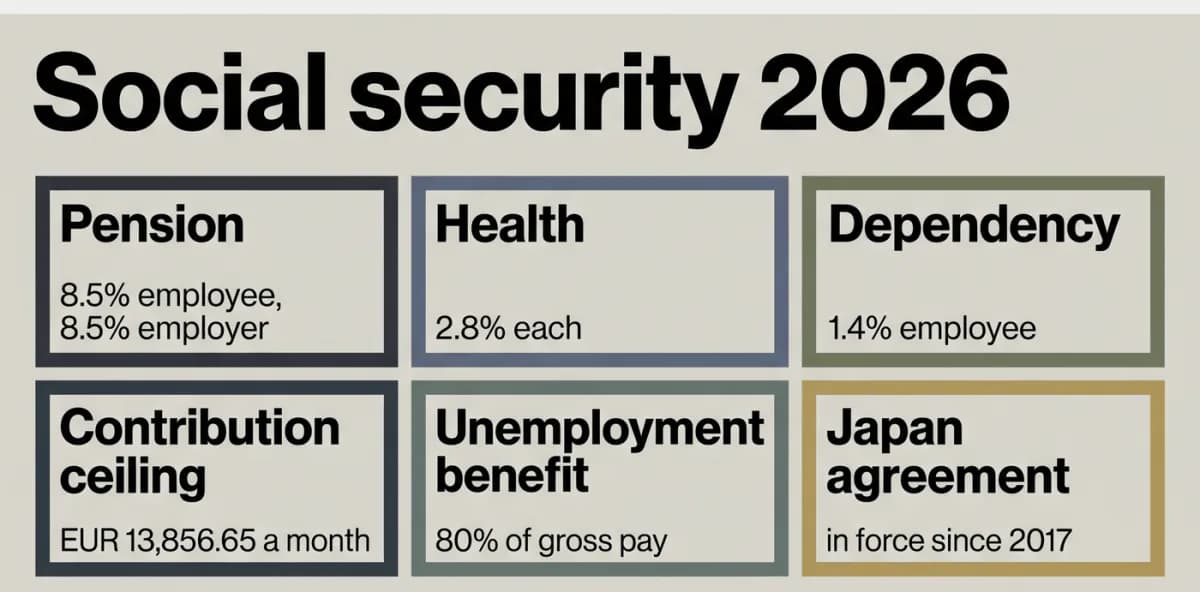
CCSS contribution rates in 2026 (notice of 16 January 2026):[^32]
| Item | Employee | Employer |
|---|---|---|
| Pension | 8.50% | 8.50% |
| Health insurance (sickness) | 2.80% | 2.80% |
| Cash benefits (sickness allowance) | 0.25% | 0.25% |
| Dependency (long-term care) | 1.40% | none stated |
| Accident insurance | none | 0.65% base (bonus-malus 0.5525% to 0.975%) |
| Occupational health | none | 0.14% |
| Employers' mutual fund (mutualité) | none | 0.23%, 0.95%, 1.56% or 2.66% by class |
Adding the employee rates gives about 12.95%. The dependency rate has no ceiling; the others are capped. The contribution ceiling is EUR 13,518.68 a month from January 2026 and EUR 13,856.65 (about US$15,450 / JPY 2.44 million) from 1 June 2026 after the indexation.[^32][^14]
Unemployment benefit. The benefit is 80% of the previous gross wage (85% with a child for tax purposes), capped at 250% of the SSM (about EUR 6,928), falling to 200% after 182 days of unemployment in 12 months and to 150% in the extended period. You need 26 weeks of insured work in the last 12 months (art. L.521-6 and L.521-14).[^2] Cross-border commuters who lose a Luxembourg job claim in their country of residence under Regulation 883/2004 (art. 65): ADEM issues the U1 form, and you may still register at ADEM.[^33]
Pension. Guichet confirms an early old-age pension from 57 or 60 years of age; read the conditions on the page.[^34] A person who leaves Luxembourg and has not reached the 120-month stage may ask for a refund of contributions from age 65 on.[^35]
Telework for commuters. CCSS says the framework agreement on telework covers telework of 25% to under 50% of working time; employer and employee must request it jointly. Check with the CCSS how it applies to you.[^36]
Japan. The social-security agreement in force since 2017 totalises pension periods and allows secondment of up to 5 years.[^31]
Taxes on employees
Income tax. The scale has 23 bands. It is 0% up to EUR 13,230, 39% from EUR 54,090, 40% from EUR 117,450, 41% from EUR 176,160 and 42% above EUR 234,870 (about US$261,900 / JPY 41.3 million). The scale has not changed since 1 January 2025. A surcharge for the employment fund (contribution au fonds pour l'emploi) of 7% is applied to the tax, and 9% on income above EUR 150,000 (class 1 and 1a) or EUR 300,000 (class 2); the top effective rate is 45.78%.[^37][^38]
Tax classes. Classes 1, 1a and 2 exist today. A bill (no. 8676) would replace them with a single tax class from the 2028 tax year; the plenary vote in the Chamber of Deputies was scheduled for 28 October 2026. It is a bill, not law, so plan with the current classes and check the ACD site for the outcome.[^39]
Credits. The employee tax credit (CIS) is EUR 600 a year (about US$669 / JPY 105,600) for gross pay between EUR 11,266 and EUR 40,000, phased out to zero at EUR 80,000, plus a CO2 credit of EUR 216. The minimum-wage credit (CISSM) is about EUR 81 a month (about US$90 / JPY 14,300) for gross pay between EUR 1,800 and EUR 3,000, degressive up to EUR 3,600, according to parliamentary documents.[^40][^41]
VAT. The standard rate is 17%; reduced rates of 14%, 8% and 3% are reported (likely).[^42]
Local tax. Individuals do not pay a municipal income tax comparable to Japan's resident tax (住民税, juminzei). The communes levy a business tax and a property tax; the municipal business tax applies to businesses, not to employees. The ACD's Mémento fiscal is the place to confirm this for your situation.[^37]
Telework tolerance. For cross-border commuters, France and Luxembourg agreed to tolerate 34 days of telework a year from 1 January 2023 without moving the taxation of the salary; check the position for your country of residence with the ACD.[^43] Japan and Luxembourg also have the treaty described above.
Where to find jobs, recruitment agencies and job scams
| Channel | Use |
|---|---|
| ADEM and EURES | Vacancies declared to ADEM, published on the EU portal; every employer must declare a vacancy to ADEM before advertising it (art. L.622-4)[^44] |
| GovJobs | State and public-sector recruitment; language tests apply[^45] |
| jobs.lu | Private job board for corporate roles |
| Agencies: Randstad, Adecco, Manpower, Hays | Temporary and permanent placement; a temporary-work agency needs a labour-ministry authorisation (art. L.131-2)[^46] |
For the complete list of boards, see our Luxembourg job-board guide.
Registering with ADEM. ADEM says anyone eligible to work in Luxembourg and available on the labour market can register as a jobseeker, through MyGuichet.lu or by appointment.[^47] ADEM's placement is free and ADEM says it never asks for payment for job offers or work visas.[^2][^48]
Scams. ADEM has warned about fake emails from @jobs-luxembourg.org asking for fees for jobs or visas, a fake domain adem-etat.lu, fake TikTok accounts (ADEM has none) and a phishing "annual statement" email of 2 October 2026.[^48] Check the sender's domain, the employer's legal name and its careers page before you send documents. Never pay for a job, a visa or an interview. We found no Code du travail article that bans agency fees, so we cite none; treat any request for money as a red flag.
Final checks before you apply
- [ ] The CV is one page (two if experienced), in the language of the advert, with the latest job first.
- [ ] Languages are listed mother tongue first, each with a true CEFR level.
- [ ] I decided on purpose whether to add a photo and a date of birth; no place of birth, no passport or ID number.
- [ ] If I need a permit, I know the route: EU citizens need none; third-country nationals apply before entry.
- [ ] My foreign diploma is registered or I know I do not need it (EUR 75 per diploma).
- [ ] The offer is at or above the SSM (EUR 2,771.33 a month, EUR 3,325.59 if skilled) and says gross or net.
- [ ] The contract is written, I understand probation and notice, and I will ask for the certificate of employment at the end.
- [ ] I know the social contributions (about 12.95% for the employee) and income tax come off my pay.
- [ ] If I commute from France, Belgium or Germany, I checked telework rules with the CCSS and the ACD.
- [ ] No one has asked me for a fee for a job, a visa or an interview.
FAQ
What is the standard Luxembourg CV format?
There is no legal template. A clear one-page CV (two for experienced profiles) in reverse chronological order, in French, German or English as the advert asks, is the safe default.
Should a Luxembourg CV include a photo?
No law we read requires or bans one, and ADEM calls a photo not obligatory. Add one only if you want to and the advert does not say otherwise.
Which languages should I list and how?
List your mother tongue first, then each language with a CEFR level from A1 to C2. Luxembourgish is a plus, not a default requirement.
Do I need a work permit to work in Luxembourg?
EU, EEA and Swiss citizens do not need one. Third-country nationals, including Japanese nationals, must apply before entry; in the first year they are limited to one sector and one profession.
What is the minimum wage in Luxembourg in 2026?
The unskilled social minimum wage is EUR 2,771.33 a month (about US$3,090 / JPY 487,700) from 1 June 2026, and EUR 3,325.59 for skilled workers.
How much does the EU Blue Card require?
A gross salary of at least EUR 65,652 a year since 3 March 2026 and a contract of at least 6 months.
How long is probation?
On a CDI it is 2 weeks to 6 months, 3 months if the vocational level is below CATP, and up to 12 months when the starting salary reaches a regulated level. It is not renewable and a CDD has no trial clause.
How many days of leave do I get?
At least 26 working days a year, plus public holidays (11 in 2026).
Can I claim unemployment benefit as a cross-border commuter?
You claim in your country of residence, which pays the benefit; ADEM issues the U1 form.
Can a recruitment agency charge me?
We found no article that bans agency fees, but ADEM never asks for payment, and a request for money before a job is a red flag.
How to use AIResume
Keep one master CV in AIResume and cut a French version, a German version and an English version for the employers you target. Put the language levels in CEFR form, leave out your place of birth and ID numbers, and move the strongest evidence for the role to the top. Export a PDF, use our ATS-friendly CV guide for file checks, and save the exact version and date you send.
Related AIResume guides
- Job boards in Luxembourg
- Belgium CV format
- France CV format
- Portugal CV format
- Switzerland CV format
- How to write an ATS-friendly CV
Sources
[^1]: ADEM, CV guide (English)
[^2]: Code du travail, consolidated 26 July 2026 (Legilux)
[^3]: ECB, EUR/USD reference rate
[^4]: ECB, EUR/JPY reference rate
[^5]: ADEM, writing your CV
[^6]: Guichet.lu, registering a diploma in the Registre des titres
[^7]: CNPD, data protection
[^8]: Ministry of Justice, criminal record
[^9]: Guichet.lu, criminal-record extract for individuals
[^10]: Guichet.lu, prerequisites for Luxembourg nationality
[^11]: Guichet.lu, homologation of a law diploma
[^12]: Guichet.lu, recognition of a foreign qualification for a regulated profession
[^13]: HCCH, Apostille Convention status table
[^14]: IGSS, social parameters, June 2026
[^15]: STATEC, consumer price index, September 2026 and wage indexation on 1 June 2026
[^16]: ACD, newsletter on meal vouchers (October 2023)
[^17]: Government of Luxembourg, meal vouchers (June 2023)
[^18]: Paperjam, pay transparency law puts Luxembourg employers on notice (reported)
[^19]: World Bank, World Development Indicators: Luxembourg (accessed 28 October 2026)
[^20]: IGSS, employment dashboard, June 2026
[^21]: ADEM press release, September 2026 labour-market figures
[^22]: STATEC, population on 1 January 2026
[^23]: Law of 29 August 2008, consolidated 12 June 2026 (Legilux)
[^24]: ADEM, hiring a third-country national
[^25]: Guichet.lu, third-country salaried worker
[^26]: Guichet.lu, highly qualified salaried worker (EU Blue Card)
[^27]: Arendt, EU Blue Card salary threshold
[^28]: Guichet.lu, temporary work authorisation for applicants for international protection
[^29]: Japan MOFA, Luxembourg basic data
[^30]: Luxembourg Ministry of Foreign Affairs, working-holiday visas for Japanese nationals
[^31]: Japan Pension Service, social security agreements by country
[^32]: CCSS, contribution rates notice of 16 January 2026
[^33]: Guichet.lu, unemployment benefit for frontaliers
[^34]: Guichet.lu, old-age pension
[^35]: Guichet.lu, refund of pension contributions
[^36]: CCSS, telework framework agreement
[^37]: ACD, personal income tax tariff and scales
[^38]: ACD, employment-fund surcharge
[^39]: Chamber of Deputies, bill 8676 (single tax class)
[^40]: ACD, employee tax credits 2026
[^41]: Government of Luxembourg, Resilienzpak presentation (June 2026)
[^42]: PwC Worldwide Tax Summaries, Luxembourg: other taxes (reported)
[^43]: Government of Luxembourg, France telework agreement (2022)
[^44]: ADEM — Agence pour le développement de l'emploi
[^45]: GovJobs, languages and nationality conditions
[^46]: Guichet.lu, temporary-work agencies
Your next step
- DeelFor employers hiring across borders: contracts, payroll and visas handled.See how Deel works
Affiliate links: we may earn a commission at no cost to you. Affiliate link