

Spain CV Format 2026: Photo, Personal Data, SMI, Permits and Labour Law
The safest Spanish CV is a clear, vacancy-specific document of one page, or two at most if you have a lot of experience, with your latest job first, written in Spanish unless the advert says otherwise and sent as a PDF. No law prescribes a Spanish CV template and none requires a photo: the public em

By AIResume Editorial Team
Last updated: 25 October 2026
The safest Spanish CV is a clear, vacancy-specific document of one page, or two at most if you have a lot of experience, with your latest job first, written in Spanish unless the advert says otherwise and sent as a PDF. No law prescribes a Spanish CV template and none requires a photo: the public employment service SEPE calls a photo "recomendable", while the EU's EURES portal says it is not compulsory, so the two official sources differ.[^1][^2] What the law does regulate is discrimination in hiring: the Workers' Statute (Estatuto de los Trabajadores, ET) voids discriminatory conditions of access to a job, and requesting personal data in a selection process in a discriminatory way is a "very serious" labour infringement.[^3][^5] The World Bank puts Spain's 2025 unemployment rate at 10.4% and the number of international migrants at 8,870,527 (2024), so the market is large but competitive.[^18]
This guide covers the Spanish CV and application, personal data and fair hiring, an annotated fictional CV, the cover letter and certificates, foreign degrees, pay and the minimum wage (SMI), contracts, the economy, work permits, labour law, social security, taxes and job scams. For where to find vacancies, see our Spain job-board guide.
Editorial boundary: This is practical job-search guidance, not legal, immigration or tax advice. We only list figures we could read in an official or primary source, and we mark figures from press reports or a single secondary summary as "reported" or "likely". Confirm details with the BOE (the official gazette), SEPE, the Ministerio de Trabajo, the Seguridad Social, the Agencia Tributaria, the INE (statistics institute), the AEPD (data-protection authority) and the Ministerio de Inclusión before you sign anything. Some sites could not be opened from our network (LinkedIn Jobs, Infoempleo, Randstad, the Moncloa press site, the AEPD FAQ page and the ministry's degree-recognition portal), so items that depend on them are marked "reported".
We convert euros (EUR) at the European Central Bank (ECB) reference rate of 23 October 2026: EUR 1 = USD 1.1193 = JPY 175.51.[^19] We write "about" because rates move daily.
Before you apply
- SafetyWing Nomad InsuranceHealth insurance that works in your new country from day one.Get a quote
Affiliate links: we may earn a commission at no cost to you. Affiliate link
Spain CV format at a glance
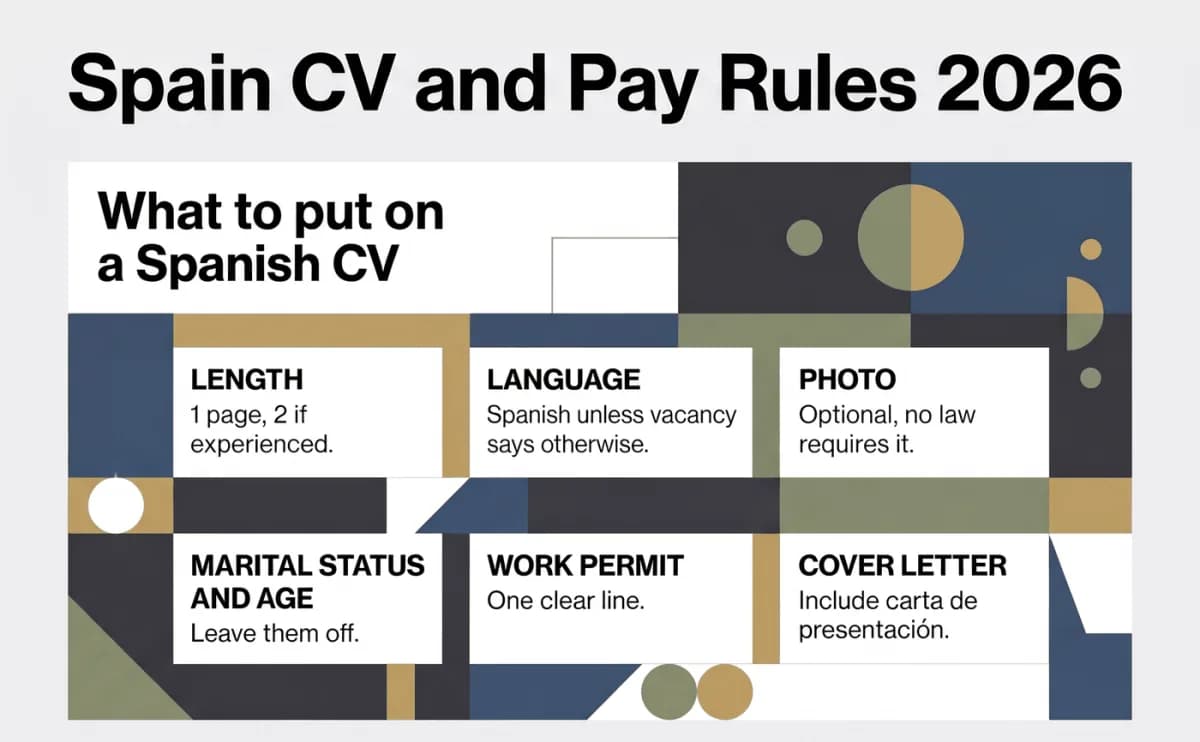
| Topic | Spanish practice in 2026 | Law or official guidance |
|---|---|---|
| Length | One page; two at most with a lot of experience | SEPE: one page, "maximum two"; EURES: two A4 pages. Guidance, not law[^1][^2] |
| Photo | Your choice. Follow the vacancy; leave it out if you prefer | SEPE: "recomendable" for Spain (neutral background). EURES: "not compulsory, although this may be useful for some jobs". No law requires one[^1][^2] |
| Personal data | Name, city, email, phone, profile link. Leave out marital status, children, religion, politics | SEPE advises leaving them out; asking for personal data in a discriminatory way is a "very serious" infringement (LISOS art. 16.1.c)[^1][^5] |
| Work-authorisation line | A short true line when it helps; never an ID or permit number | Employer checks authorisation separately |
| References | Do not list them on the CV; give them at interview | SEPE: do not include references[^1] |
| Salary expectation | Not on the CV; discuss when asked | SEPE: do not include salary expectations[^1] |
| Degree recognition | Name the award as issued; add recognition only if you hold it | RD 889/2022: homologación or declaración de equivalencia, fee EUR 166.50[^9] |
| File / ATS | PDF with selectable text, plain layout, keywords from the advert | SEPE: PDF preferred by email; tables and graphics lose visibility in keyword-screening software[^1] |
| Language | Spanish by default; the language of the advert | EURES: CV and letter in Spanish unless otherwise indicated[^2] |
| Cover letter | Short and tailored, one page at most | SEPE: adds a plus for qualified posts, "although used less and less"; EURES: A4[^1][^2] |
Personal data, photo and fair hiring
What the law covers. Articles 4.2.c and 17 of the Workers' Statute make discriminatory clauses and decisions void, and article 4.2.c covers access to employment. Article 17.1 lists age, disability, sex, origin including racial or ethnic origin, marital status, social condition, religion, political ideas, sexual orientation and identity, gender expression, sex characteristics, trade-union membership, family ties to people in the company, and language within Spain.[^3]
The equal-treatment law. Ley 15/2022 on equal treatment and non-discrimination applies to employment, which it defines as including access, working conditions, promotion and training. Its grounds include birth, racial or ethnic origin, sex, religion or belief, age, disability, sexual orientation or identity, gender expression, illness or health status, serological status, genetic predisposition, language and socioeconomic situation. If a claimant gives well-founded indications of discrimination, the other side must give an objective and reasonable justification that is sufficiently proven (art. 30.1); that rule does not apply in criminal or administrative sanctioning procedures.[^4]
Fines. Under the labour infringements law (LISOS), asking for personal data in selection processes or setting discriminatory conditions for access to employment is a "very serious" infringement, with fines from EUR 7,501 to EUR 225,018 (about USD 8,396 to USD 251,864 / JPY 1.32 million to JPY 39.5 million).[^5]
Data protection. Recruitment data falls under the GDPR and Spain's data-protection law, supervised by the AEPD. AEPD guides are not binding, but its labour guide says an employer cannot demand a criminal-record certificate from candidates unless a law or directly applicable EU rule requires it, that CV data should be minimised, and that keeping the CVs of rejected candidates needs consent or a proven legitimate interest. We could not reload that guide or the AEPD FAQ page, so treat these three points as reported.[^7]
Medical checks. Article 22 of the occupational-risk law covers health surveillance of workers. It is voluntary except in three listed cases: where it is needed to assess the effect of working conditions, where there is a danger to the worker or others, or where a legal provision requires it for special-risk activities.[^39]
Disability quota. Companies with 50 or more workers must have at least 2% of workers with a disability (LGD art. 42.1), with exceptions through a sector agreement or voluntary alternative measures. Disability here means a degree of 33% or more (art. 4.2).[^6]
Automated screening. The ET (art. 64.4.d) gives the works council, not individual candidates, a right to be told the parameters and rules of algorithms and AI systems that affect hiring and working conditions, including profiling.[^3] Under GDPR article 22 you may have rights against decisions based solely on automated processing with a significant effect; we kept that wording conditional. The EU's Digital Omnibus on AI, Regulation (EU) 2026/1744 (reported by law-firm sources), moved the stand-alone high-risk duties for employment systems to 2 December 2027, so we do not treat them as applying to recruiters in October 2026.[^42]
Practice versus law. No law says what is on a CV, and none bans or requires a photo. The photo is a practice question: SEPE recommends one, EURES says it is not needed, and employers differ. If a vacancy asks for one, decide whether you are comfortable; if it does not, a CV without a photo is defensible. Give contact details and relevant evidence, and leave out health, religion, politics, marital status and children.
Structure of a Spanish CV
SEPE's 2025 guide asks you to adapt each CV and letter to the job, use reverse chronological order, and keep the CV to one page or two at most.[^1]
1. Header and headline
Name, one professional email, a phone number, your city and, if relevant, a LinkedIn or portfolio link. Under the name, put a headline that names the target role. A full street address is unnecessary before an offer.
2. Profile
Three to four lines connecting your evidence to the role. Weak: "Dynamic person looking for a challenge." Stronger: "Operations coordinator with one year of internship experience maintaining service records and preparing weekly Excel reports."
3. Experience in reverse chronology
Title, employer, city, dates and two to five bullets. Build each bullet from an action, an object, the context and a verifiable result. Use the keywords of the advert only where they truthfully describe your work, because screening software looks for them.[^1]
4. Education and training
The most relevant award first, with institution, country and year. Do not translate a foreign award into a Spanish title unless an authority has granted recognition (see below).
5. Skills and languages
Group tools and languages so they scan well. For languages use levels you can defend (CEFR A1 to C2) and keep certificates separate.
Gaps and Europass
SEPE advises explaining a long gap clearly rather than leaving it unexplained: one factual line with dates (study, care, relocation, a project) is enough, with no medical or family detail.[^1] SEPE notes that the Europass format is increasingly known in Spain and EURES suggests creating a Europass CV, so it is a valid option, not a requirement.[^1][^2][^37] SEPE also warns that designed CVs with tables and graphics lose visibility in keyword-screening systems.[^1]
Annotated fictional Spanish CV
The sample is entirely fictional: person, employers, contacts and numbers.
Lucía Martín
Valencia · [email protected] · +34 600 00 00 00 · linkedin.com/in/lucia-martin-example
Coordinadora de operaciones junior | Excel · Atención al cliente · Seguimiento de procesos
Perfil
Candidata de operaciones con prácticas en el mantenimiento de registros de servicio y la preparación de informes semanales en Excel. Busca un puesto de operaciones o atención al cliente donde sean útiles el seguimiento preciso y la comunicación escrita clara.
Experiencia
*Becaria de operaciones, Servicios Ejemplo S.L., Valencia | febrero 2025 a julio 2025*
- Actualizó un registro de servicio compartido y comprobó que cada solicitud tuviera estado y responsable antes del traspaso diario.
- Preparó un resumen semanal en Excel de las categorías de solicitud más frecuentes para la supervisora.
- Coordinó recordatorios de citas con las plantillas aprobadas y el procedimiento de escalado.
Formación
Grado en Administración y Dirección de Empresas, Universidad Ejemplo | 2021 a 2025
Competencias e idiomas
Excel (tablas, filtros, funciones de búsqueda) · Atención al cliente · Introducción de datos · Español (nativo) · Inglés (nivel profesional de trabajo, autoevaluado)
Why this sample works
- Header: city, email, phone and a profile link are enough. There is no ID number, full address, date of birth, marital status or children; SEPE advises leaving personal details of that kind out, and the omission is minimisation, not a rule of Ley 15/2022.[^1]
- Headline and profile: the target role is specific and the skills are backed by the experience section.
- Bullets: each starts with an action and names a work product. No invented revenue, percentages or awards.
- No salary, no references, no photo by default: SEPE advises against salary expectations and references on the CV; the photo is a choice.[^1]
- Languages: levels are honest and self-assessed, not implied certificates. Add a recognition line such as "Declaración de equivalencia (RD 889/2022)" only if you hold one for a non-EU title.[^9]
Carta de presentación, vida laboral, references and certificates
Cover letter. SEPE recommends a personalised letter of one page at most; it says that, although letters are used less and less, they add a plus for qualified and specialised posts, and by email the letter may go in the body of the message. EURES adds that the letter and CV should be in Spanish unless told otherwise.[^1][^2]
Informe de vida laboral. The vida laboral is a report of your Social Security record issued by the Seguridad Social, available online through its Import@ss service. It is not a CV attachment; send it only if a specific employer or process asks.[^10]
Criminal-record certificate. An employer cannot generally demand a certificate of criminal record from a candidate (see the AEPD point above, reported). The exception is work with minors: article 57 of Organic Law 8/2021 requires that people who take up professions, trades or activities involving regular contact with minors show they have no conviction for crimes against sexual freedom or sexual indemnity or for human trafficking. It is proved with a negative certificate from the Registro Central de delincuentes sexuales; the Ministry of Justice calls the certificate "Certificado de Delitos de Naturaleza Sexual". Article 57.3 bars employers from employing people with such a record.[^8]
References. SEPE says not to include references in the CV; keep the names ready and give them at interview, after asking each person.[^1]
Certificates. EURES says certificates are not normally attached; bring or upload them when the posting or portal asks.[^2]
Foreign degrees: homologación and equivalencia
Royal Decree 889/2022 separates two procedures for foreign higher-education titles.[^9]
| Procedure | What it is for |
|---|---|
| Homologación | Titles you need for a regulated profession in Spain |
| Declaración de equivalencia | Recognition of the academic level (Grado, Máster or Doctorado) of a foreign title, without professional effects for titles obtainable by homologación |
- Fee: both procedures need a fee of EUR 166.50 (about USD 186 / JPY 29,220), paid online, with model 790-107 at a bank, or by transfer.[^41]
- Deadline: for homologación the resolution is due within 6 months from entry in the electronic register; after that the request may be treated as rejected by silence. An ANECA report can suspend the clock (3 months at most). The same 6 months applies to the correspondence with the MECES levels.[^9]
- Where: the ministry's Valida-TE page explains the procedure and applications go through the ministry's electronic office. That office was unreachable when we checked and the ministry page says it closes on 22 October 2026, so a new address is expected; start from the Valida-TE page.[^41]
- Regulated professions: the list is a single annex of references, so check the regulator for your job. Recognition is not needed for most private-sector jobs.
- Practice: we found no official figures for real-world processing times, so plan for the 6-month legal deadline and delays.
Pay: SMI, collective agreements and pay transparency
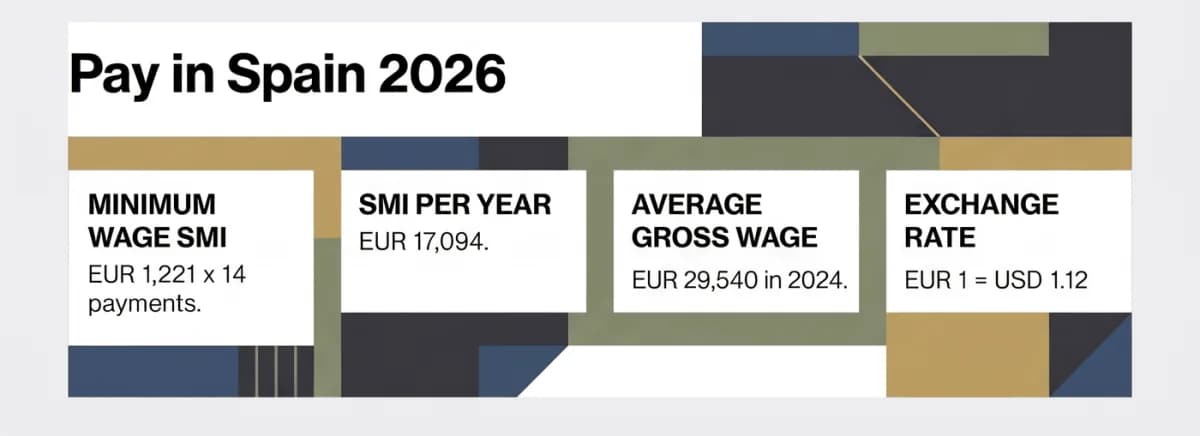
SMI. The salario mínimo interprofesional for 2026 is set by Royal Decree 126/2026 (BOE of 19 February 2026, in force 20 February, payable from 1 January 2026): EUR 40.70 a day (about USD 45.55 / JPY 7,143) or EUR 1,221 a month in 14 payments (about USD 1,367 / JPY 214,300), which is EUR 17,094 a year (about USD 19,133 / JPY 3.0 million). Spread over 12 payments the same annual figure is EUR 1,424.50 a month (about USD 1,594 / JPY 250,000; our calculation, not stated in the decree). Temporary workers employed for less than 120 days get EUR 57.82 a day, and domestic workers paid by the hour EUR 9.55. The increase over 2025 is 3.1%.[^11] Article 31 of the ET requires two extra payments a year; the months are set by the collective agreement.[^3]
Tax on the SMI. The SMI is not exempt from withholding. Royal Decree-law 5/2026 (art. 28) adds a tax credit in the annual IRPF: EUR 590.89 (about USD 661 / JPY 103,700) if gross work income is EUR 17,094 or less, tapering to zero at EUR 20,048.45 (about USD 22,440 / JPY 3.52 million) by subtracting 0.2 times the excess over EUR 17,094. The person must not have other non-exempt income above EUR 6,500. We did not verify whether payroll withholding is reduced in 2026.[^12] Before income tax, an employee on the SMI in an indefinite contract pays 6.50% to Social Security, which leaves about EUR 1,141.64 a month in 14 payments or EUR 1,331.91 in 12.
Wages in Spain. INE's 2024 wage survey (published 28 May 2026) gives an average gross annual wage of EUR 29,540.26 (about USD 33,064 / JPY 5.18 million), a median of EUR 24,497.17 (about USD 27,420 / JPY 4.30 million) and a mode of EUR 16,520.18 (about USD 18,491 / JPY 2.90 million). Women averaged EUR 26,904.90 and men EUR 32,057.55; hospitality was the lowest-paid sector at EUR 17,653.42.[^13]
Collective agreements. Convenios colectivos set pay floors by sector and province, and they apply on top of the SMI. We found no verified 2026 sector scale that we can quote, so ask the employer which agreement applies and search it in the official register of agreements (REGCON).[^36]
Pay transparency. Every company must keep a pay register (registro retributivo) for its whole workforce, whatever its size (RD 902/2020 art. 5), and an equality plan is compulsory from 50 workers (LO 3/2007 art. 45).[^15] The EU Pay Transparency Directive (2023/970) had a transposition deadline of 7 June 2026, which Spain missed. There is only a draft royal decree amending RD 902/2020, put to consultation in August 2026; it is a partial transposition. According to a law-firm analysis, it does not cover pay ranges before hiring or a ban on asking about pay history. We found no approval as of 25 October 2026.[^15]
What this means: compare an offer with the SMI and the agreement for your sector, ask for the gross annual figure, the number of payments (12 or 14) and extras in writing, and do not rely on a legal ban on salary-history questions yet.
Contracts, probation and internships
Probation (art. 14 ET). The trial period must be agreed in writing. The collective agreement comes first; failing that, the maximum is six months for qualified technicians (técnicos titulados) and two months for others, or three months for non-technicians in companies with fewer than 25 workers. For temporary contracts of six months or less it is one month unless the agreement says otherwise. The period is void if you already did the same functions in the company. Either side may end the contract during probation; a dismissal in probation is null for pregnancy or maternity unless it is unrelated.[^3]
Contract types (art. 15 ET, after the 2021 reform). An indefinite contract is presumed. A fixed-term contract is allowed only for production reasons or for substitution. Production contracts run six months at most (up to one year only if the sector agreement provides), with a separate limit of 90 days per calendar year for occasional, foreseeable needs (120 in agri-food). Substitution can also cover completing a reduced working day and filling a post during a selection process (three months at most). People hired in breach become permanent. Fijo-discontinuo work is regulated in art. 16, and formative contracts in art. 11.[^3]
Internships. Since 1 January 2024 trainees in external academic or training placements, paid or unpaid, are in the Social Security system. For unpaid trainees the 2026 flat contribution for common contingencies is reported at EUR 2.88 a day (about USD 3.22 / JPY 505) under Orden PJC/297/2026.[^17] A bill for an Estatuto del Becario (an "Estatuto de las personas en formación práctica no laboral") was sent to the Cortes on 3 March 2026 (Congress file 121/000087). It is a bill, not law: it would link placements to official studies, bar payment to access placements and limit trainees per company, according to press reports.[^40]
Public sector. Under the TREBEP (art. 57), EU nationals can enter public posts on equal terms, except posts involving the exercise of public power or safeguarding State interests. Art. 57.4 lets foreigners with legal residence join the administration as contract staff (personal laboral) on equal terms with Spaniards. Vacancies appear in the official gazettes and the Portal del Ciudadano (administracion.gob.es, "Empleo público"). The language level for co-official languages is set in each call, not by a general rule.[^16][^37]
Spain's economy in numbers
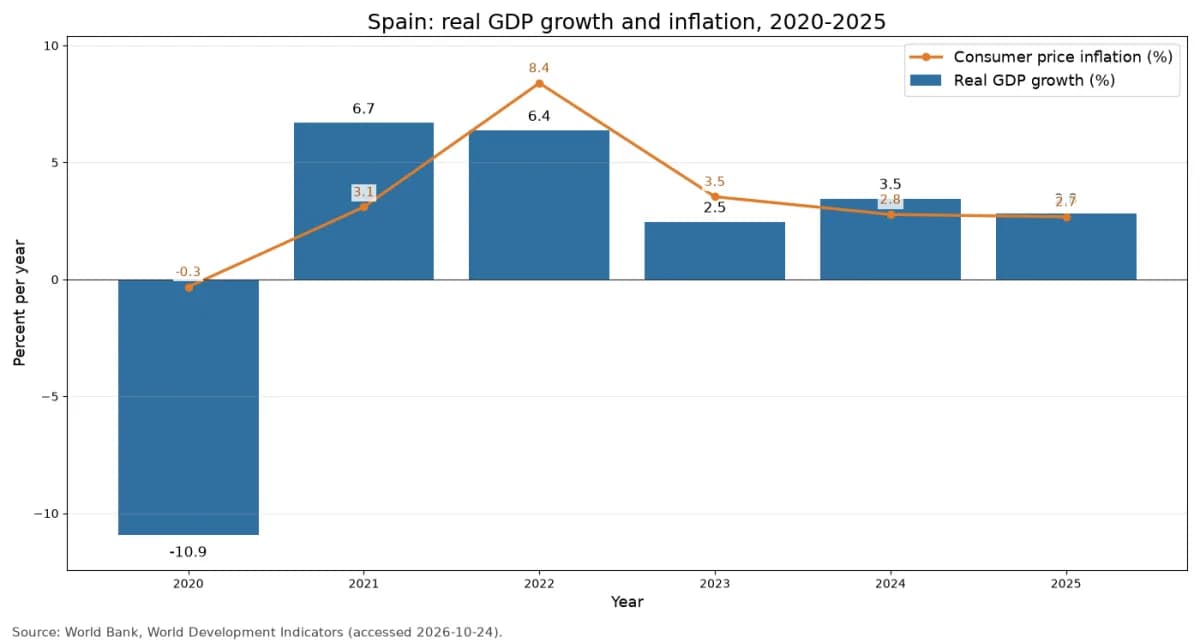
| Indicator | 2020 | 2021 | 2022 | 2023 | 2024 | 2025 |
|---|---|---|---|---|---|---|
| GDP (USD billion) | 1,289.8 | 1,461.2 | 1,448.9 | 1,619.5 | 1,725.7 | 1,906.5 |
| GDP per person (USD) | 27,234 | 30,799 | 30,319 | 33,493 | 35,327 | 38,627 |
| Real GDP growth (%) | -10.9 | 6.7 | 6.4 | 2.5 | 3.5 | 2.8 |
| Inflation (%) | -0.3 | 3.1 | 8.4 | 3.5 | 2.8 | 2.7 |
| Population (million) | 47.36 | 47.44 | 47.79 | 48.35 | 48.85 | 49.36 |
*Source: World Bank, World Development Indicators (accessed 24 October 2026).*[^18]
The World Bank also lists unemployment at 10.4% and youth unemployment (ages 15 to 24) at 24.7% for 2025, and an international migrant stock of 8,870,527 for 2024.[^18]
2026 labour data. INE's Labour Force Survey (EPA) for the second quarter of 2026, published 28 July 2026, counted 22,779,000 employed and 2,495,300 unemployed, an unemployment rate of 9.87%, compared with 9.93% in the fourth quarter of 2025. The third-quarter release was not yet published on 25 October 2026. The World Bank annual figure and the INE quarterly rate are different series, so compare like with like.[^14]
Shortage occupations. The Q3 2026 catalogue of hard-to-fill occupations lists 27 jobs: sport, merchant navy and seven trades (aluminium and PVC carpentry, metal joinery, building and general electricians, and three crane-operator types) (see the permits section).[^21]
What this means: growth is solid and unemployment has eased to under 10% in the INE series, but it remains high by European standards, so a precise, evidence-led CV and a clear view of the SMI and your agreement matter more than a generic profile.
Work permits and rules for foreign workers
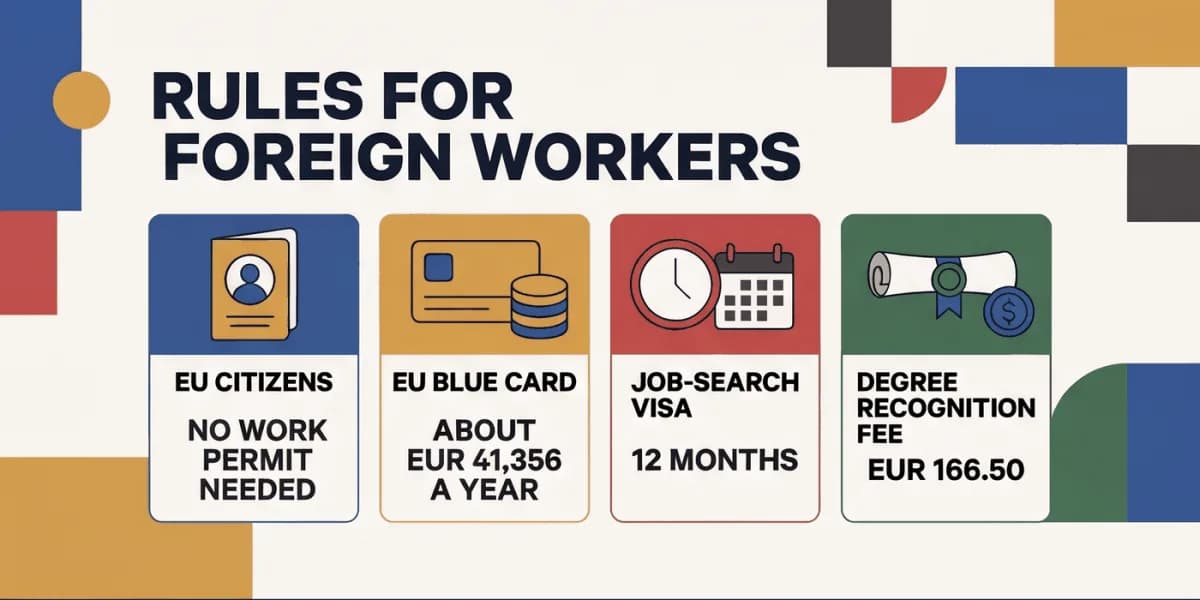
| Route | What to know in 2026 |
|---|---|
| EU, EEA and Swiss nationals | Free movement; no work permit. Registration as a Union citizen is normally needed after three months (reported standard rule; check with the Ministerio de Inclusión) |
| General route | Reglamento de Extranjería as reformed by RD 1155/2024, in force 20 May 2025. The national employment test is not applied in the cases of LO 4/2000 art. 40 or under international conventions (art. 74)[^20] |
| Catálogo de ocupaciones de difícil cobertura | Quarterly; Q3 2026 = Resolution of 3 August 2026, BOE 2 September 2026, 27 occupations[^21] |
| EU Blue Card | Higher-education qualification of at least 3 years (EQF 6) or 5 years' experience (3 for ICT professionals). Valid 3 years. Salary threshold 1.4 times the INE average (Orden PJC/44/2026), about EUR 41,356 (about USD 46,290 / JPY 7.26 million); reduced about EUR 33,085 (USD 37,032 / JPY 5.81 million) for shortage groups or recent graduates (press-reported amounts)[^22] |
| Students | The study stay allows work compatible with studies, up to 30 hours a week; exceeding it is grounds to end the stay authorisation (art. 57)[^20] |
| Job search | Job-search visa: 12 months (art. 43). Graduates (EQF 6 or higher) may stay up to 24 months, not extendable, to look for work or start a business[^20][^22] |
| Arraigo | Arraigo requires a continuous stay of at least 2 years; arraigo familiar has no minimum stay (arts 125-126)[^20] |
| Digital nomad (Ley 14/2013) | Employees may work only for companies outside Spain; professionals may serve a Spanish company up to 20% of their activity. Visa up to 1 year; residence up to 3 years, renewed by 2-year periods[^22] |
| Investor ("golden") visa | The route (arts 63-67 Ley 14/2013) ended on 3 April 2025 by LO 1/2025[^22] |
Regularisation of 2026. Royal Decree 316/2026 of 14 April amended RD 1155/2024 (BOE 15 April 2026, in force 16 April). It created an "arraigo extraordinario" for people in Spain before 1 January 2026 with five months of continuous stay and no criminal record, who worked or intend to work, live with minors or dependants, or are vulnerable, plus a route for people with an international-protection claim lodged before that date. The permit lasts one year and can be extended. The application window closed on 30 June 2026. Press reported "over 1.1 million" applications and no official final total exists; the official figure we can cite is 421,306 regularised foreigners affiliated to Social Security on 30 September 2026.[^23]
Japanese nationals
Japan's Ministry of Foreign Affairs (MOFA) counted 9,733 Japanese residents in Spain on 1 October 2025 (up 0.2%), of whom 4,941 are long-term residents and 4,792 permanent residents.[^24] A Japan-Spain working-holiday agreement was signed on 5 April 2017. MOFA's list (as of 1 April 2026) shows an annual quota of 700; applicants are 18 to 30 at the time of application, the stay lasts up to one year from entry, and work is only to supplement travel funds.[^24] Outside that scheme a Japanese national normally needs a work and residence authorisation; the digital-nomad and graduate routes above are the main alternatives.
The Japan-Spain social security agreement has applied since 1 December 2010: posted employees stay in the sending country's system for up to five years, and insurance periods can be totalled.[^34] The new tax convention, signed in Madrid on 16 October 2018, has been in force since 1 May 2021 (Japanese withholding taxes from 1 January 2022) and replaced the 1974 treaty.[^34]
Foreign workers in numbers
The Seguridad Social recorded an average of 3,635,979 foreign affiliates in September 2026, 84,220 more than in August and 547,637 more than a year earlier (+17.7%): 16.2% of the 22,437,553 total. The largest nationalities are Morocco (425,064), Colombia (387,371), Romania (338,810), Venezuela (250,468) and Italy (221,980), followed by Peru (146,079) and China (138,572).[^25] A law-firm summary of the immigration observatory's note puts residence documents in force at 7,909,008 on 30 June 2026, about half of them held by EU/EEA citizens (likely).[^43]
Labour law: hours, leave, notice and dismissal
The figures below are legal standards; your contract or collective agreement may be better.
| Topic | Rule |
|---|---|
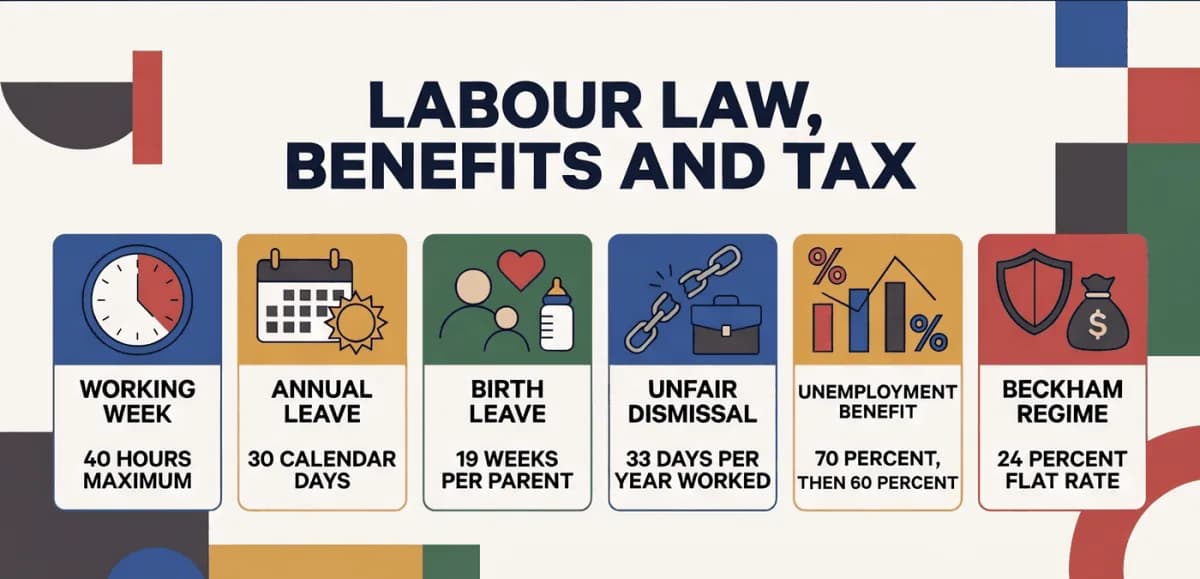
| Weekly hours | 40 hours a week on annual average, 9 hours a day unless the agreement distributes them differently (art. 34.1, 34.3); at least 12 hours between shifts; a 15-minute break if the day exceeds 6 hours (art. 34.4). A bill for a 37.5-hour week was defeated in Congress on 10 September 2025 (178 votes to 170), so 40 hours remains the legal maximum[^26][^27] |
| Daily record | The employer must guarantee a daily record of start and end times and keep it for 4 years (art. 34.9). A digital system is not required by the article; a decree to make it mandatory is only a draft (reported)[^26] |
| Overtime | Paid at least at the ordinary hourly value or compensated with rest; hours compensated within four months do not count toward the 80-hour yearly limit (art. 35)[^26] |
| Annual leave | Not less than 30 calendar days (art. 38.1)[^26] |
| Public holidays | No more than 14 a year, two of them local (art. 37.2)[^26] |
| Birth leave | 19 weeks for each parent (32 weeks for single-parent families), non-transferable, 100% of the base, since RDL 9/2025; 6 weeks mandatory right after birth, 11 flexible until the child is 12 months and 2 until age 8[^28] |
| Parental leave | Up to 8 weeks until the child is 8, unpaid (art. 48 bis)[^26] |
| Objective dismissal | 20 days' pay per year of service, maximum 12 months (art. 53.1.b)[^26] |
| Unfair dismissal | 33 days per year, maximum 24 months (art. 56.1). On 16 July 2025 the Supreme Court refused to let courts add compensation above the art. 56 cap (reported); no reform had been enacted in the sources we found[^26] |
| Procedure | Prior conciliation or mediation is generally required before a labour claim, with exceptions (LRJS art. 63)[^44] |
2026 public holidays
The BOE resolution of 17 October 2025 (BOE no. 259, 28 October 2025) lists eight dates that apply in all regions in 2026:[^26]
| Date | Holiday |
|---|---|
| Thursday 1 January | New Year's Day |
| Tuesday 6 January | Epiphany |
| Friday 3 April | Good Friday |
| Friday 1 May | Labour Day |
| Saturday 15 August | Assumption |
| Monday 12 October | National Day |
| Tuesday 8 December | Immaculate Conception |
| Friday 25 December | Christmas Day |
Regions add others. Holy Thursday (2 April) is a holiday in 17 of the 19 regions and cities, but not in Cataluña or the Comunitat Valenciana. Because 1 November and 6 December fall on Sundays in 2026, some regions move them to Monday 2 November (9 regions) and Monday 7 December (10 regions). Up to two local holidays per municipality are published in regional gazettes, so check your region and town.
Social security: what you pay and what you get
Contribution rates for 2026 (Orden PJC/297/2026, BOE 31 March 2026).[^29]
| Contribution | Total | Employer / worker |
|---|---|---|
| Common contingencies | 28.30% | 23.60% / 4.70% |
| Intergenerational equity mechanism (MEI) | 0.90% | 0.75% / 0.15% |
| Unemployment, indefinite contract | 7.05% | 5.50% / 1.55% |
| Unemployment, temporary contract | 8.30% | 6.70% / 1.60% |
| FOGASA | 0.20% | employer only |
| Vocational training | 0.70% | 0.60% / 0.10% |
For a worker on an indefinite contract these items add up to 6.50% (6.55% on a temporary contract). The employer's side comes to 30.65% before the work-accident and occupational-disease premium, which is employer-only and depends on the activity tariff. Bases for 2026: maximum EUR 5,101.20 a month (about USD 5,710 / JPY 895,300); minimum bases depend on the contribution group, from EUR 1,989.30 for group 1 (about USD 2,227 / JPY 349,100) and EUR 1,649.70 for group 2 and EUR 1,435.20 for group 3, down to EUR 1,424.40 for groups 4 to 7 (about USD 1,594 / JPY 250,000). A solidarity contribution applies above the cap: 1.15% on EUR 5,101.21 to 5,611.32, 1.25% up to EUR 7,651.80 and 1.46% above, split between employer and worker.[^29]
Unemployment benefit. Contributory benefit needs 360 days of contributions in the last six years and lasts 120 to 720 days, depending on the days contributed. It pays 70% of the base for the first 180 days and 60% afterwards, within caps.[^30] Foreign workers with legal residence and enough contributions are reported to be covered on the same terms; confirm with SEPE.
Sick pay (incapacidad temporal). For common illness you need 180 days of contributions in the last five years. No benefit is paid on days 1 to 3; from day 4 it is 60% of the base until day 20 and 75% from day 21. The employer pays days 4 to 15 and the Seguridad Social (INSS or the mutua) from day 16.[^31]
Retirement age. In 2026 it is 65 with at least 38 years and 3 months of contributions, otherwise 66 years and 10 months. From 2027 it becomes 65 with 38 years and 6 months, otherwise 67.[^30]
Japan. The Japan-Spain social security agreement lets posted workers remain in the home system for up to five years and totalises insurance periods.[^34]
Taxes on employees
IRPF. The personal income tax (IRPF) has a state scale and a regional scale set by each autonomous community, and the two halves add up. The state scale (art. 63) runs 9.5% up to EUR 12,450 (about USD 13,936 / JPY 2.19 million), 12% to EUR 20,200, 15% to EUR 35,200, 18.5% to EUR 60,000, 22.5% to EUR 300,000 and 24.5% above. The personal minimum is EUR 5,550, with extra allowances over 65 and over 75.[^32] Spain has no separate municipal income tax, so the regional half of IRPF is the closest analogue to Japan's resident tax (juminzei), but it is set and collected with the state half in a single return.
Non-residents. Non-resident income tax is 24%, or 19% for EU/EEA residents.[^32]
Beckham regime (art. 93 LIRPF). People who move to Spain for work and were not resident in the previous five tax years can opt for a special regime for the year of arrival plus five years: 24% on work income up to EUR 600,000 and 47% above. Entry routes include an employment contract (including remote work for holders of the international-telework visa), company directors, entrepreneurs and highly qualified professionals serving start-ups or R&D. Spanish-source income is taxed under non-resident rules, and the holder still pays wealth tax on assets in Spain.[^32]
VAT. IVA is 21% in general, 10% on passenger transport, hotels, restaurants and most foodstuffs, and 4% on common bread, books, newspapers and medicines, among others. In the Canary Islands the general IGIC rate is reported at 7%, and Ceuta and Melilla have their own tax (IPSI).[^33]
Treaty. The Japan-Spain tax convention (in force 1 May 2021) governs double taxation for people who live or work in both countries, so check its residence rules for your case.[^34]
Where to find jobs, recruitment agencies and job scams
| Channel | Use |
|---|---|
| SEPE and regional employment services | Public vacancies and training; use sepe.es and your region's employment service |
| EURES | EU job-mobility portal and Spain guidance[^2] |
| Portal del Ciudadano (administracion.gob.es) | Public-sector vacancies[^37] |
| InfoJobs, Tecnoempleo, Indeed | General job boards[^38] |
| Adecco, Michael Page, Hays, Manpower, Jobandtalent, Robert Walters | Recruitment agencies and consultancies[^38] |
We could not open LinkedIn Jobs, Infoempleo or Randstad from our network, so we do not link them here; check them in your browser. Whichever channel you use, never pay anyone for a job or for placement.
Scams. Verify the company, never pay for "permit processing", equipment, training or a job offer, and never send an ID scan before a real contract. INCIBE's free and confidential cybersecurity helpline is 017, and you can also report to the Policía Nacional or Guardia Civil.[^35]
Final checks before you apply
- [ ] The language matches the vacancy or portal.
- [ ] The CV is one page, or two with a lot of experience, and the strongest evidence is easy to find.
- [ ] Every date, qualification and language level is defensible.
- [ ] Marital status, children, religion and politics are left out; the photo decision is yours.
- [ ] No salary expectation or references on the CV.
- [ ] The work-authorisation line is short and true.
- [ ] I know my collective agreement, the SMI and the number of pay payments.
- [ ] I checked degree recognition and regulated-profession rules.
- [ ] No one asked me for a fee before a signed contract.
- [ ] The PDF has selectable text and I saved the version I sent.
FAQ
What is the standard Spain CV format?
There is no statutory template. A practical default is a clear, vacancy-specific CV of one page (two at most with much experience), latest job first, in Spanish, sent as a PDF.[^1][^2]
Should a Spanish CV include a photo?
No law requires one. SEPE calls a photo "recomendable" and EURES says it is not compulsory, so follow the vacancy and your preference.[^1][^2]
Should I include my age, marital status or children?
SEPE advises leaving marital status, children, religion and politics out, and asking for personal data in a discriminatory way is a very serious infringement.[^1][^5]
Do I need to write my CV in Spanish?
Spanish is the default; EURES says the CV and letter should be in Spanish unless otherwise indicated. Use English when the advert asks for it.[^2]
What is the minimum wage in Spain in 2026?
EUR 1,221 a month in 14 payments (about USD 1,367 / JPY 214,300), EUR 17,094 a year, or EUR 40.70 a day.[^11]
Can a non-EU citizen get a Spanish work permit?
Yes, through the routes of RD 1155/2024, such as employer-backed authorisation, the shortage catalogue, the Blue Card (about EUR 41,356 salary threshold) or a graduate stay of up to 24 months.[^20][^22]
Can Japanese citizens use a working holiday in Spain?
Yes. Spain is on Japan's working-holiday list with an annual quota of 700 for ages 18 to 30, for up to one year.[^24]
What income tax will I pay?
IRPF combines a state scale from 9.5% to 24.5% with a regional scale set by each community. There is no separate municipal income tax.[^32]
Do foreign workers get unemployment benefits in Spain?
Foreign workers with legal residence and enough contributions are reported to be covered on the same terms as Spaniards. You need 360 days of contributions in the last six years. Check with SEPE.[^30]
Is the workweek 37.5 hours?
No. A bill for 37.5 hours was defeated in Congress on 10 September 2025; the legal maximum remains 40 hours a week on annual average.[^26][^27]
How to use AIResume
Keep one master CV in AIResume and create a Spain version for each vacancy: remove personal data you do not need, localise the headline and first-page evidence, then export a PDF unless the employer requests another format. Use our ATS-friendly CV guide for file checks and save the exact version and date you send.
Related AIResume guides
- Job boards in Spain
- Portugal CV format
- France CV format
- How to write an ATS-friendly CV
- UK CV format guide
Sources
[^1]: SEPE, Spain CV and cover letter guide (2025)
[^2]: EURES, living and working conditions in Spain (page dated 6 June 2026)
[^3]: Estatuto de los Trabajadores, consolidated text (arts 4, 14, 15, 17, 31, 64)
[^4]: Ley 15/2022, equal treatment and non-discrimination
[^5]: LISOS, Real Decreto Legislativo 5/2000 (arts 16 and 40)
[^6]: Ley General de derechos de las personas con discapacidad, RDL 1/2013 (arts 4 and 42)
[^7]: AEPD, data protection in labour relations (reported; not reloaded)
[^8]: Ley Orgánica 8/2021, art. 57; Ministerio de Justicia, Certificado de Delitos de Naturaleza Sexual
[^9]: Real Decreto 889/2022
[^10]: Seguridad Social, informe de vida laboral
[^11]: Real Decreto 126/2026 (SMI 2026)
[^12]: Real Decreto-ley 5/2026, art. 28
[^13]: INE, Encuesta anual de estructura salarial 2024
[^14]: INE, Encuesta de Población Activa, second quarter 2026
[^15]: Real Decreto 902/2020; Ley Orgánica 3/2007; PwC, transposition of the pay-transparency directive (reported); EY, draft royal decree (reported)
[^16]: TREBEP, art. 57
[^17]: Seguridad Social, prácticas formativas; Orden PJC/297/2026
[^18]: World Bank, World Development Indicators: Spain (accessed 24 October 2026)
[^19]: ECB euro foreign exchange reference rates, 23 October 2026
[^20]: Real Decreto 1155/2024, Reglamento de Extranjería
[^21]: Resolución de 3 de agosto de 2026, catálogo de ocupaciones de difícil cobertura
[^22]: Ley 14/2013, consolidated text; Orden PJC/44/2026
[^23]: Real Decreto 316/2026
[^24]: MOFA, working holiday; MOFA, overseas Japanese residents survey
[^25]: Seguridad Social, foreign affiliation September 2026
[^26]: Estatuto de los Trabajadores, consolidated text; BOE-A-2025-21667, 2026 public holidays
[^28]: Real Decreto-ley 9/2025
[^29]: Orden PJC/297/2026, BOE 31 March 2026
[^30]: Ley General de la Seguridad Social, consolidated text
[^31]: Seguridad Social, sick-pay amounts
[^32]: Ley del IRPF, consolidated text; Non-resident income tax law
[^33]: Ley del IVA, consolidated text
[^34]: Japan Pension Service, status of social security agreements (Spain in force); Ministry of Finance Japan, list of tax conventions (Spain: signed 16 October 2018, in force 1 May 2021)
[^35]: INCIBE, cybersecurity helpline 017
[^36]: REGCON, register of collective agreements
[^37]: Europass; Portal del Ciudadano, administracion.gob.es
[^38]: InfoJobs; Tecnoempleo; Indeed Spain; Adecco; Michael Page; Hays; Manpower; Jobandtalent; Robert Walters
[^39]: Ley 31/1995, prevención de riesgos laborales, art. 22
[^40]: Congreso de los Diputados, Proyecto de Ley 121/000087
[^41]: Ministerio de Ciencia, Innovación y Universidades, Valida-TE
[^42]: White & Case, EU AI omnibus enters into force (reported)
[^43]: ARC Legal, summary of the OPI note of 30 June 2026 (reported)
Your next step
- DeelFor employers hiring across borders: contracts, payroll and visas handled.See how Deel works
Affiliate links: we may earn a commission at no cost to you. Affiliate link