

Mexico CV Format: How to Write a Currículum for Mexican Employers in 2026
A Mexican CV (currículum vitae, or simply "CV") is usually a one- or two-page document in Spanish, written in reverse-chronological order under a small set of standard headings. The format is not hard. What trips people up is personal data. Traditional Mexican CVs carried a photo, age and marital st
By AIResume Editorial Team
Last updated: 29 September 2026
A Mexican CV (currículum vitae, or simply "CV") is usually a one- or two-page document in Spanish, written in reverse-chronological order under a small set of standard headings. The format is not hard. What trips people up is personal data. Traditional Mexican CVs carried a photo, age and marital status, and many templates still do. Mexican labour law, however, prohibits refusing to hire on those grounds, and leading Mexican job sites now advise leaving much of it off.
This guide covers the CV itself: structure, personal data, the documents you will be asked for after an offer, and foreign degrees. For where to find vacancies, see our Mexico job board comparison.
Before you apply
- SafetyWing Nomad InsuranceHealth insurance that works in your new country from day one.Get a quote
Affiliate links: we may earn a commission at no cost to you. Affiliate link
The Mexican CV at a glance
| Item | Mexican practice in 2026 | Why |
|---|---|---|
| Language | Spanish, unless the advert is in English | Most recruiters screen in Spanish. Multinationals may ask for an English version. |
| Length | 1 page for early career, 2 pages at most for experienced candidates | Computrabajo México recommends a short, clearly sectioned CV |
| Order | Reverse-chronological | Recruiters expect the most recent role first |
| File | PDF, simple fonts (Arial, Calibri or Helvetica), at most two colours | Keeps the layout stable and readable by applicant tracking systems |
| Photo | Optional, and increasingly left off | OCC Mundial notes the photo is a Latin American habit that can invite discrimination |
| Age, marital status | Leave off | Federal Labour Law art. 133 prohibits refusing to hire on these grounds |
| CURP, RFC, NSS | Leave off. Provide them after the offer. | These are onboarding identifiers, not selection evidence |
Structure: the standard Spanish headings
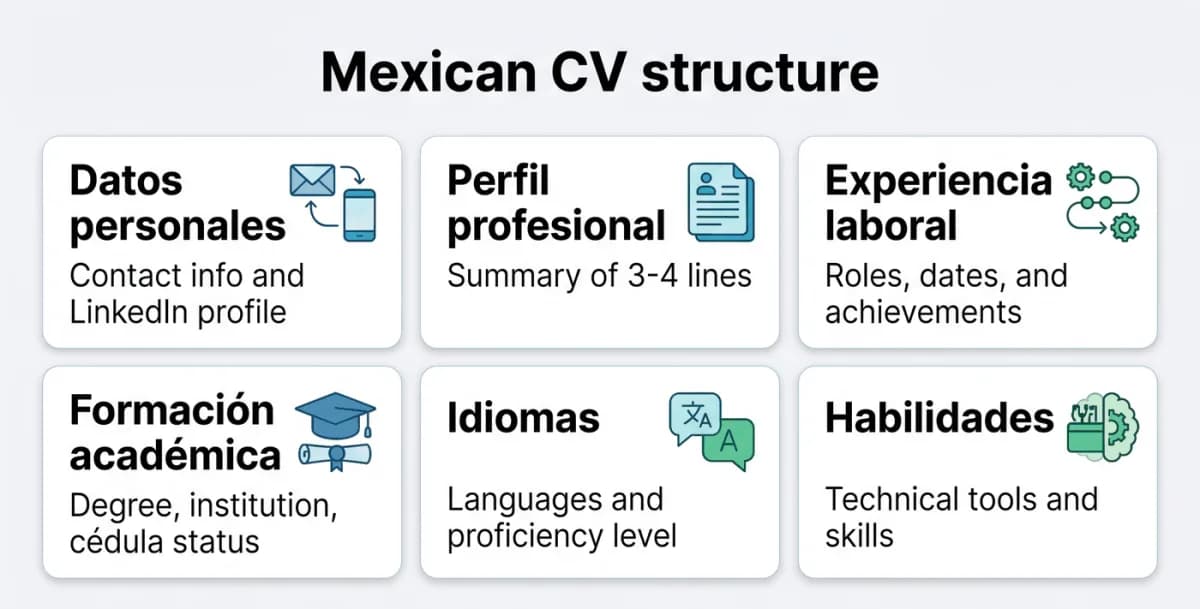
Mexican recruiters scan for familiar headings. Computrabajo México uses this structure, and using the same Spanish labels makes your CV easier to read and to parse:
| Spanish heading | What goes there | Tip |
|---|---|---|
| Datos personales (or Datos de contacto) | Name, city (and state), phone, professional email, LinkedIn | No street address, age or marital status |
| Perfil profesional | 3–4 lines on your target role, years of experience and strongest skills | Recent graduates often use "Objetivo profesional" instead |
| Experiencia laboral | Role, company, city, dates, and 3–5 achievement bullets | Explain unfamiliar foreign employers in one line |
| Formación académica | Degree, institution, year. Add "cédula profesional" status if relevant. | See the foreign degree section below |
| Idiomas | Language and level (for example "Inglés: avanzado (C1)") | Give a certificate if you have one |
| Habilidades | Tools, software and technical skills | Keep soft skills for the bullets, where you can prove them |
Mexico's public employment service, the Portal del Empleo, also advises investing in the CV title and short summary (semblanza). They are what recruiters read first when searching candidate databases.
Personal data: what Mexican law says
Two federal laws shape what you should put on a Mexican CV.
The Federal Labour Law (Ley Federal del Trabajo, LFT). Article 133, section I, prohibits employers from refusing to hire people because of ethnic or national origin, gender, age, disability, social condition, health, religion, opinions, sexual preference, marital status or any other discriminatory criterion. Section XIV prohibits requiring a medical certificate of non-pregnancy (certificado de no embarazo) for hiring, continued employment or promotion. Article 3 adds that working conditions may not discriminate on these grounds, including migration status.
The Federal Law to Prevent and Eliminate Discrimination (LFPED). It defines discrimination broadly and is overseen by CONAPRED (conapred.gob.mx), which accepts complaints about discriminatory treatment.
In practice, this means a Mexican employer should not screen you on age, sex, marital status or pregnancy. The practical conclusion for your CV is simple: don't hand over data the employer is not allowed to use. Many older templates still ask for age and marital status, and a recruiter will not be surprised by them. But leaving them off is safe and increasingly common, and it keeps attention on your experience.
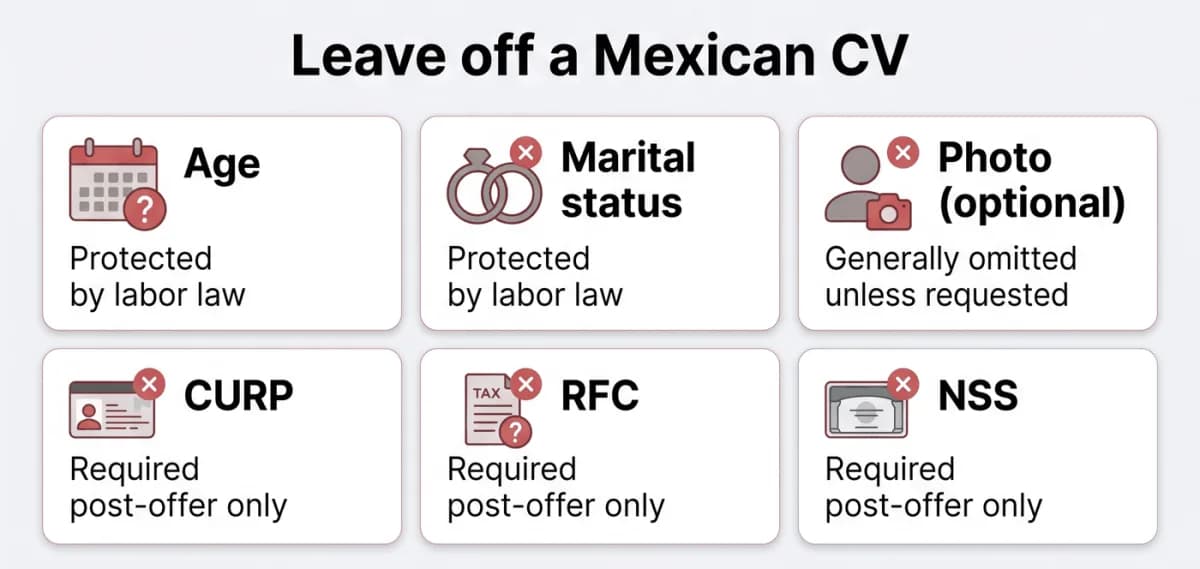
Photo: optional, not expected
OCC Mundial, one of Mexico's main job sites, describes the photo as a very Latin American practice that has been reconsidered in recent years, because it is not relevant to the hiring decision and can invite conscious or unconscious discrimination. If you include one, use a neutral professional headshot. If the advert does not ask for it, you can leave it off.
Data protection changed in 2025
Mexico replaced its 2010 private-sector data protection law with a new Federal Law on the Protection of Personal Data Held by Private Parties (LFPDPPP). It was published in the Official Gazette (DOF) on 20 March 2025 and took effect on 21 March 2025. The former regulator, INAI, was dissolved after a constitutional reform, and oversight of private-sector data protection passed to the Secretaría Anticorrupción y Buen Gobierno. For you, this matters in two ways. Employers must tell you how they use your CV and identity documents in a privacy notice (aviso de privacidad). And under the new law you can object to decisions made about you solely by automated processing, such as an applicant tracking system that rejects candidates with no human review.
Documents you will be asked for after the offer
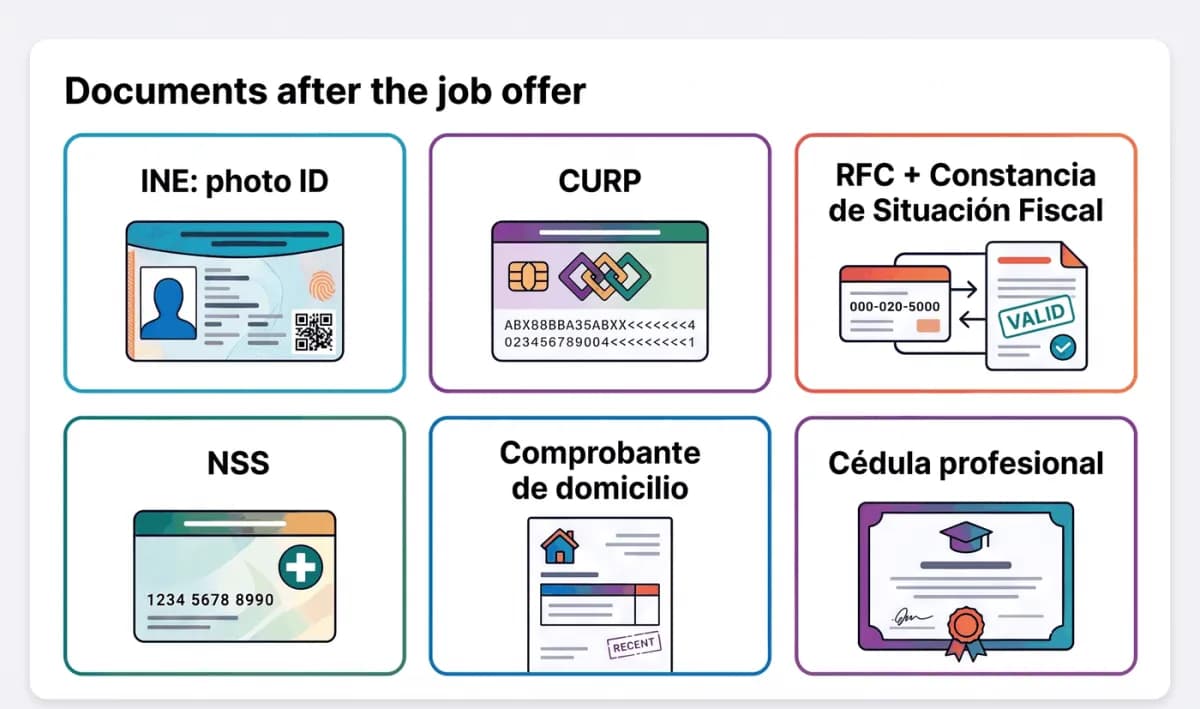
Your CV should stay free of identity numbers, because the employer will collect them during onboarding (alta):
| Document | What it is | Where it comes from |
|---|---|---|
| INE (or passport) | Official photo ID | Instituto Nacional Electoral / Secretaría de Relaciones Exteriores |
| CURP | Population registry code | gob.mx/curp |
| RFC and Constancia de Situación Fiscal | Tax ID and tax status certificate | SAT. The certificate is free to generate online. |
| NSS | Social security number for IMSS registration | IMSS |
| Comprobante de domicilio | Recent proof of address (utility bill) | Usually no more than three months old |
| Cédula profesional | Professional licence for regulated professions | SEP (Dirección General de Profesiones) |
Having these ready shortens onboarding, which matters when an employer wants you to start quickly. The Constancia de Situación Fiscal is the one people most often forget. Payroll needs it to register you correctly for tax.
Foreign degrees and foreign applicants
Degrees: revalidación and cédula profesional
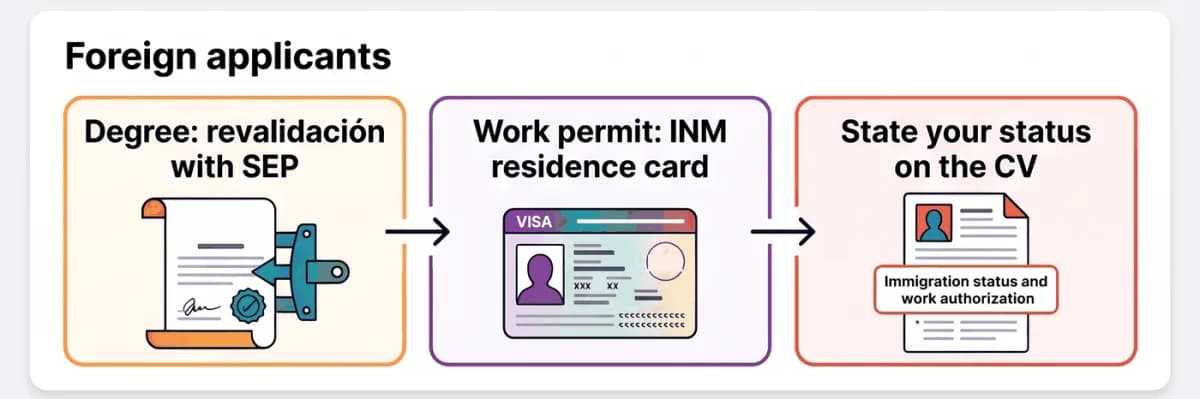
A foreign degree can be listed on your CV as it is. Write the original title with a Spanish equivalent in brackets, for example "Bachelor of Science in Nursing (Licenciatura en Enfermería)". For regulated professions such as medicine, nursing, law, engineering or accounting, practising in Mexico requires a cédula profesional. Holders of foreign degrees get one through revalidación de estudios with the Secretaría de Educación Pública (SEP). Since SEP Agreement 02/04/17 (DOF, 18 April 2017), revalidation no longer requires an apostille or legalisation of your diploma, and a simple (non-sworn) Spanish translation is accepted. For non-regulated roles such as sales, marketing or software, many employers accept the foreign degree without a cédula.
On your CV, state your status honestly:
- "Cédula profesional: 12345678" (if you have it)
- "Revalidación de estudios ante SEP en trámite" (if you have applied)
- Nothing, if the role is not regulated and the employer does not ask
Work permission for non-Mexicans
A foreign national needs a temporary or permanent residence card with permission to work, issued by the National Migration Institute (INM). This normally requires a job offer from an employer registered with INM (Constancia de Inscripción del Empleador), followed by a visa at a Mexican consulate and, after arrival, the exchange for a residence card. On your CV, add one line under Datos personales, such as "Residente temporal con permiso para trabajar" or "Requiere permiso de trabajo (oferta de empleo necesaria)", so the recruiter knows where you stand.
Carta de presentación and references
A carta de presentación (cover letter) is common but short. Three paragraphs are enough for most roles, covering why this company, what you bring and your availability. Address it to a named person if you can ("A la atención de…"), or use "A quien corresponda" if you cannot.
Cartas de recomendación (reference letters) are not a legal requirement, but many Mexican employers still ask for one or two. They are typically one page, signed by a former supervisor or HR, with contact details for verification. Do not list referees on the CV. Bring the letters or contacts when asked.
Common mistakes
- Copying an old template that asks for age, marital status, CURP and a photo.
- Three- or four-page CVs. Two pages is the practical maximum.
- No Spanish version when applying to a Mexican company that recruits in Spanish.
- Listing duties instead of results. "Reduje el tiempo de cierre contable de 10 a 6 días" beats "Encargado de contabilidad".
- Not stating cédula or work-permit status for regulated roles or foreign applicants.
FAQ
Should I put a photo on a Mexican CV?
It is optional. OCC Mundial, one of Mexico's main job sites, notes that many experts no longer recommend it because it can lead to discrimination. Include one only if the advert asks for it, or if it is standard in your sector.
Can a Mexican employer ask for a pregnancy test?
No. Article 133, section XIV, of the Federal Labour Law prohibits requiring a certificate of non-pregnancy for hiring, continued employment or promotion.
Do I put my CURP or RFC on my CV?
No. They are requested during onboarding, together with your NSS, ID and proof of address.
Who protects my personal data in Mexico now that INAI is gone?
The Secretaría Anticorrupción y Buen Gobierno oversees private-sector data protection under the new LFPDPPP, which took effect on 21 March 2025.
Should my CV be in Spanish or English?
Follow the advert. Spanish is the default for Mexican employers. Multinationals often accept English or ask for both.
How to use AIResume
Keep one master CV in AIResume and create a Mexican version with Spanish headings, no identity numbers and a clear line on your cédula or work-permit status. If you apply in several Spanish-speaking markets, compare our guides to the CV format in Spain and the CV format in Colombia. Export a PDF and keep the version name in your job tracker.
Sources
- Ley Federal del Trabajo, articles 3 and 133 — Cámara de Diputados
- Ley Federal para Prevenir y Eliminar la Discriminación — Cámara de Diputados
- CONAPRED — conapred.gob.mx
- Portal del Empleo (STPS), CV title and summary advice — empleo.gob.mx
- Computrabajo México, how to write a CV — mx.computrabajo.com
- OCC Mundial, photo on the CV — blog-candidatos.occ.com.mx
- SEP, revalidación de estudios del tipo superior — gob.mx/sep
- SEP Acuerdo 02/04/17 amending Acuerdo 286 (DOF, 18 April 2017) — dof.gob.mx
- SAT, Constancia de Situación Fiscal — gob.mx/sat
- IMSS, número de seguridad social — imss.gob.mx
Your next step
- DeelFor employers hiring across borders: contracts, payroll and visas handled.See how Deel works
Affiliate links: we may earn a commission at no cost to you. Affiliate link