

Chile CV Format 2026: Photo, Personal Data, Minimum Wage, Visas and Labour Law
The safest Chilean CV is a clear, vacancy-specific document of one or two pages, with your latest job first, written in the language of the advert. No law prescribes a currículum template and none requires a photo. What the Código del Trabajo (CT) does regulate is how an employer may choose: article
By AIResume Editorial Team
Last updated: 25 October 2026
The safest Chilean CV is a clear, vacancy-specific document of one or two pages, with your latest job first, written in the language of the advert. No law prescribes a currículum template and none requires a photo. What the Código del Trabajo (CT) does regulate is how an employer may choose: article 2 bans distinctions based on grounds such as sex, age, marital status, nationality and apariencia personal, and a job advert that lists any of those grounds as a requirement is itself discriminatory.[^1] The Dirección del Trabajo (DT) has long treated a photo requirement in an advert as discriminatory, although sending a photo is not illegal.[^2] The World Bank puts Chile's 2025 unemployment rate at 9.0% and its international migrant stock at 1,538,324 (2024), so the market is open to foreign candidates but competitive.[^3]
This guide covers the Chilean CV and application, personal data and fair hiring, an annotated fictional CV, the carta de presentación and certificates, foreign degrees, pay and the minimum wage, contracts, the economy, work permits, labour law, social security, taxes and job scams. For where to find vacancies, see our Chile job-board guide. It is written for Chileans, Latin American nationals (Venezuela, Peru, Colombia, Haiti, Bolivia, Argentina), other foreigners and Japanese nationals, and it uses Chilean terms such as currículum, pretensión de renta, RUT, finiquito, AFP and Fonasa / Isapre.
Editorial boundary: This is practical job-search guidance, not legal, immigration or tax advice. We only list figures we could read in an official or primary source, and we mark figures from press reports or a single secondary summary as "reported" or "likely". Confirm details with the Biblioteca del Congreso Nacional (Ley Chile), the Dirección del Trabajo, SENCE, the Servicio Nacional de Migraciones (SERMIG), the Superintendencia de Pensiones, the SII (tax authority) and the INE (statistics institute) before you sign anything. Several sites could not be opened from our network (the Superintendencia de Pensiones, the Banco Central's own site, SERNAC, the Fiscalía, Trabajando, Computrabajo, Indeed, Chiletrabajos, LinkedIn Jobs, Hays and Robert Walters), so items that depend on them are marked "reported" or "likely".
We convert Chilean pesos (CLP) at the Banco Central de Chile observed dollar of 23 October 2026: USD 1 = CLP 986.58, so CLP 1,000 is about USD 1.01 / JPY 159.[^4] We write "about" because rates move daily.
Before you apply
- SafetyWing Nomad InsuranceHealth insurance that works in your new country from day one.Get a quote
Affiliate links: we may earn a commission at no cost to you. Affiliate link
Chile CV format at a glance
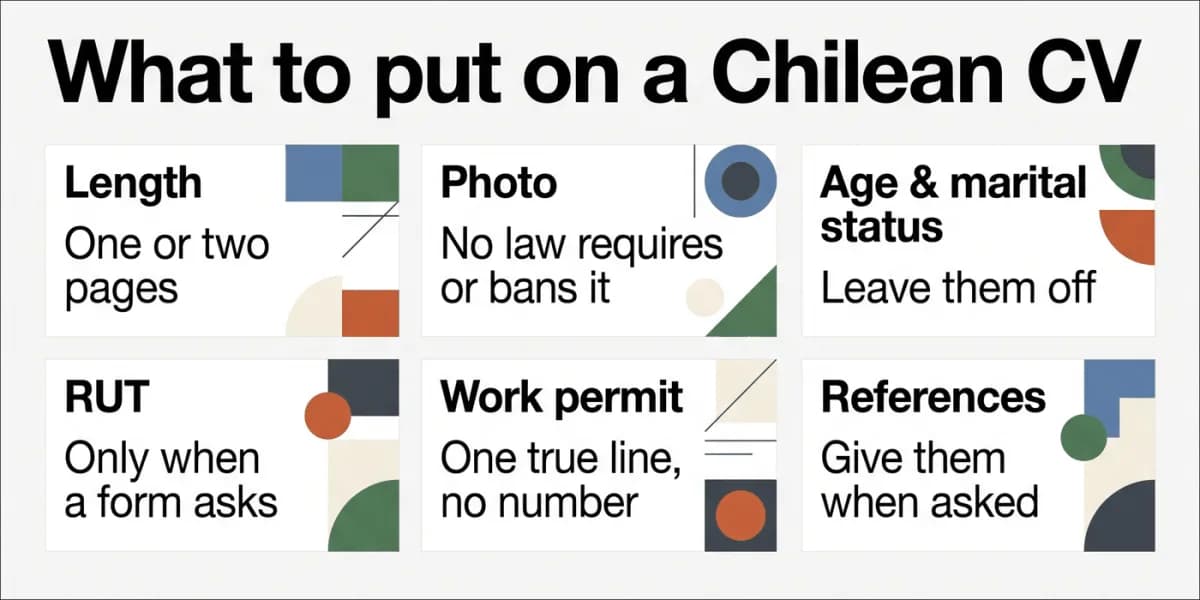
| Topic | Chilean practice in 2026 | Law or official guidance |
|---|---|---|
| Length | One or two pages, latest job first | Market practice; we found no official rule |
| Photo | Not required. Include one only if you are comfortable and the employer asks | No law requires or bans a photo. DT treats a photo requirement in an advert as discriminatory; sending one is not illegal[^2] |
| Personal data (RUT, age, marital status) | Name, city or commune, email, phone, profile link. Leave out age, marital status and children. Give your RUT only when asked | CT art. 2 lists age and marital status among the grounds of discrimination; leaving them out is minimisation, not a legal duty[^1] |
| Work-authorisation line | A short true line for foreigners, for example "Temporary residence with permission to work" | Only the SERMIG-listed documents allow work[^5] |
| References | Do not list them on the CV; give them when asked | Practice; we found no rule |
| Pretensión de renta (salary expectation) | Give it when the form asks, as a monthly CLP figure; check whether the form means líquido (net) or bruto (gross) | Practice; no primary source |
| Degree recognition | Name the award as issued; add recognition only if you hold it | Universidad de Chile revalidates degrees from countries without an agreement[^6] |
| File / ATS | Follow the portal; otherwise a readable PDF whose text you can copy | Not an official rule. Check links and copy/paste |
| Language | Spanish for Chilean employers; English if the advert is in English | No legal rule |
| Cover letter | Short; two or three paragraphs | Practice; no official rule |
Personal data, photo and fair hiring
Grounds of discrimination (CT art. 2). The article lists distinctions, exclusions or preferences based on race, colour, sex, gender, maternity, breastfeeding, age, marital status, union membership, religion, political opinion, nationality, national ancestry, socioeconomic situation, language, beliefs, guild membership, sexual orientation, gender identity, filiation, apariencia personal, illness or disability, and social origin, and it adds "any other motive". Job offers that state any of these as a requirement are themselves acts of discrimination, while qualifications the job truly requires are not. The same article bars making hiring conditional on having no commercial or financial debts (with exceptions for managers with powers of representation and staff who handle funds) or on never having had cancer.[^1]
Employer powers (art. 5). An employer's powers are limited by the constitutional rights of the worker, in particular intimidad, vida privada and honra.[^1]
Pregnancy (art. 194). The last paragraph bars an employer from conditioning hiring, renewal or promotion on the presence or absence of pregnancy, and from demanding a certificate or exam.[^1]
Confidentiality and harassment protocols (arts. 154 bis and 154 ter). Art. 154 bis is the harassment-prevention protocol given to workers when they sign. The confidentiality rule on private information is art. 154 ter, which protects information of the worker obtained through the employment relationship. It does not name applicants, so do not assume it covers every CV you send.[^1]
Ley Karin. Ley 21.643 was published on 15 January 2024 and, as reported by the DT, took effect on 1 August 2024. Its text sits in CT art. 2 and in the art. 154 bis protocol.[^7]
The photo: practice versus law. We found no statute and no DT ruling that names the photo specifically. A DT press release of 2005 listed "curriculum con fotografía", age, sex and "buena presencia" among the most frequent discriminatory requirements in adverts, and Ord. 850/29 of 28 February 2005 says the DT can inspect and sanction discriminatory adverts under art. 2. Art. 2 now also lists apariencia personal. The safe reading: an advert that demands a photo is treated as discriminatory by the DT, but a candidate who sends one breaks no rule. If a vacancy asks for a photo, decide whether you are comfortable; if it does not, a CV without one is normal.[^2]
Data protection. Today the 1999 Ley 19.628 applies. Ley 21.719 (published in the Diario Oficial on 13 December 2024) replaces it and creates the Agencia de Protección de Datos Personales; it is scheduled to take effect on 1 December 2026.[^8] A bill (boletín 18.623-07, submitted around 1 September 2026) would postpone that date to 1 December 2027; the Senate Constitution Committee approved it in general on 20 October 2026 (reported), and it is not law. Check the date before you rely on it.[^9] Under Ley 21.719 art. 13 c), processing needed for pre-contract steps requested by the person does not need consent, and art. 14 d) requires data collected for those steps to be deleted or anonymised. Art. 8 bis gives a right not to be subject to decisions based only on automated processing that significantly affect you, with exceptions, and always with the right to an explanation and human review. It is a right to review, not a ban on automated screening.[^8]
Disability quota. Companies with 100 or more workers must employ at least 1% persons with disability or invalidity-pension holders (CT art. 157 bis, from Ley 21.015). Disability is certified under art. 13 of Ley 20.422, and such contracts are registered with the DT within 15 days. Ley 21.690 would raise the share to 2%, but only after a government report shows 1% compliance in 80% of obliged entities; that has not happened, so 1% applies.[^1][^10] Mentioning a disability on a CV is voluntary.
Structure of a Chilean CV
The sections below are editorial advice and market practice, not a legal template.
1. Header and headline
Name, a professional email, a mobile number (+56 9 ...), your commune and region, and a LinkedIn or portfolio link. A full street address is unnecessary before an offer. Under the name, put a headline naming the target role.
2. Profile
Three or four lines connecting your evidence to the role. Weak: "Dynamic person looking for new challenges." Stronger: "Customer operations coordinator with four years' experience handling bilingual service requests and weekly Excel reporting."
3. Experience in reverse chronology
Title, employer, city, dates and two to five bullets. Build each bullet from an action, an object, the context and a result you can verify. Use the advert's keywords only where they truthfully describe your work. For a practical layout check, see our ATS-friendly CV guide.
4. Education and training
The most relevant award first, with institution, country and year. Use Chilean terms where they apply: enseñanza media is secondary school, and many adverts ask for "educación media completa", so list it when it is your highest completed qualification. Do not translate a foreign award into a Chilean title unless recognition has been granted.
5. Skills, languages and gaps
State each language with a level you can defend. Explain a long gap in one factual line with dates (study, care, relocation, a project); no medical or family detail is needed. A student práctica creates no employment contract (CT art. 8), so label it as a practice placement, not as a job.[^1]
Annotated fictional Chilean CV
The sample is entirely fictional: person, employers, contacts and numbers. Replace every item with truthful information.
Camila Rojas, Customer Operations Coordinator · Santiago, Región Metropolitana · [email protected] · +56 9 0000 0000
*Annotation: fictional contacts. Use a commune-level location; add your RUT only if a form asks.*
Profile: Customer operations coordinator with four years' experience handling bilingual service requests, maintaining case records and improving hand-offs between sales and operations.
*Annotation: align the role label and evidence with the vacancy. Do not add years or languages you cannot prove.*
Experience: Customer Operations Coordinator, Andes Example SpA · Santiago · Feb 2023 to present
- Handled 35 to 45 weekly customer cases in Spanish and English across email and phone, recording owners and next actions in the service log.
- Built an Excel reconciliation sheet that cut the team's weekly manual check from two hours to 45 minutes.
- Coordinated sales and operations on recurring order-status errors and documented a shared escalation checklist.
*Annotation: organisation and figures are fictional. Support real claims with records, work samples or a referee.*
Experience: Service Assistant, Barrio Example Foundation · Valparaíso · Jun 2021 to Jan 2023
- Scheduled appointments, updated service records and prepared a weekly unresolved-case report for the coordinator.
*Annotation: one relevant bullet beats a long list of duties.*
Education and training: Técnico de Nivel Superior en Administración, Example Institute, 2021
*Annotation: the institution is fictional. Keep the official award name.*
Skills and languages: Excel reporting · case logging · customer email · Spanish (native) · English [truthful level]
Work authorisation (for a foreign applicant): "Temporary residence with permission to work, valid until [date]."
*Annotation: one short true line. Do not paste permit numbers.*
Carta de presentación, references and certificates
Cover letter. We found no official guidance on the carta de presentación. In practice it is short, often the body of the email: two or three paragraphs saying why this employer, why this role, and one or two proof points that connect your background to the advert. Do not repeat the CV.
RUT and RUN. Your RUT (RUN for a person) is needed for a contract and payroll, not for a first CV. Give it when a form asks. Foreigners receive a RUN with the cédula de identidad, which should be requested within 30 days of the permit taking effect.[^11]
Certificado de antecedentes. The DT accepts that an employer asks for a certificado de antecedentes only when criminal-record status is part of fitness for the job, "absolutamente indispensable" in the words of Ord. 628 of 3 February 2017. There is no general ban on hiring someone with a record.[^12] For jobs with direct and habitual contact with minors the rule is stricter: under Ley 20.594 the employer must, before hiring, ask the Registro Civil whether the person is disqualified under article 39 bis of the Código Penal. The Registro Civil answers only yes or no.[^13]
References. We found no Chilean rule on references. Keep names ready, ask each person first and give them at interview.
Foreign degrees: recognition in Chile
Universidad de Chile recognises and revalidates degrees from countries that have no recognition agreement with Chile. The fixed fees are an entry fee of 2 UTM (CLP 144,302, about USD 146 / JPY 22,900) and a curricular study of 3 UTM (CLP 216,453, about USD 219 / JPY 34,400), together 5 UTM, CLP 360,755 (about USD 366 / JPY 57,300) at the October 2026 UTM of CLP 72,151.[^6][^14] Registration takes about 20 business days, and the unit has 60 business days for the study after payment; extra academic requirements are priced by the unit. Advice at the office is free, and UChile says it will never ask for payment into a personal account. Documents are apostilled or legalised, and UChile's FAQ explains the Hague apostille; we did not read the details, so check them.[^15] Treaty-based recognition has its own UChile page, which we did not read.
Doctors: passing the EUNACOM exam revalidates a foreign medical title and is required (Ley 20.261) to work in public health services and municipal health establishments.[^16]
Do not write "Chilean equivalent" on a CV before you hold a recognition decision.
Pay: minimum wage, gratificación and the 85% rule
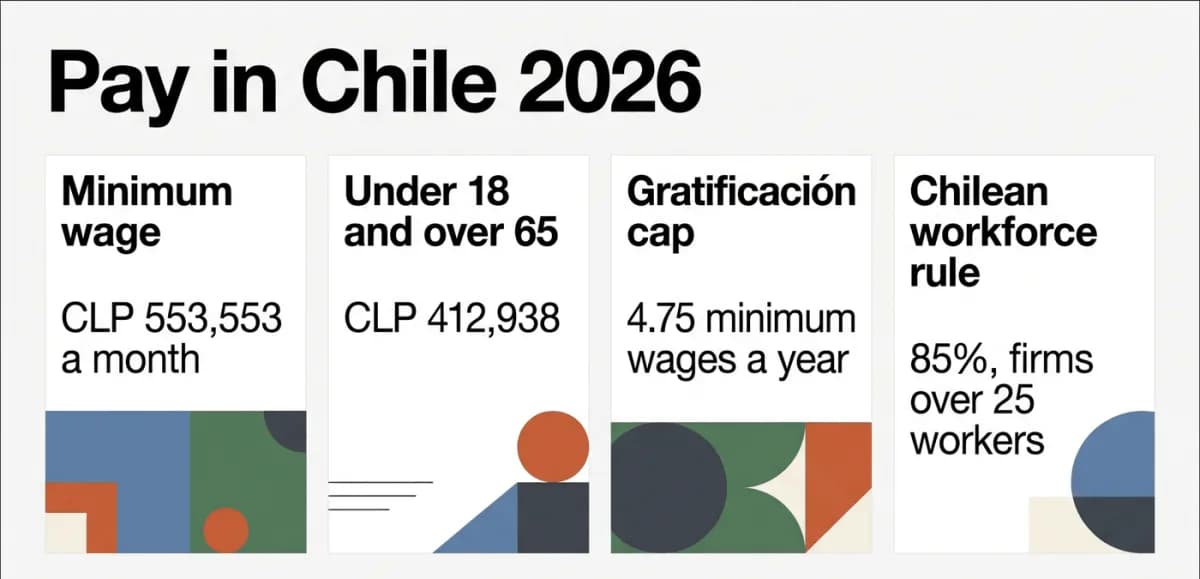
Minimum wage (ingreso mínimo mensual, IMM). Since 1 May 2026, Ley 21.830 (published 22 June 2026) sets CLP 553,553 a month (about USD 561 / JPY 88,000) for workers over 18 and up to 65, CLP 412,938 (about USD 419 / JPY 65,600) for workers under 18 and over 65, and CLP 356,815 (about USD 362 / JPY 56,700) for non-remunerative purposes. From 1 January to 30 April 2026 it was CLP 539,000 (about USD 546 / JPY 85,700) under Ley 21.751. From 1 January 2027 it rises by the accumulated CPI change between 1 May and 31 December 2026.[^17][^18]
Average pay. INE's Encuesta Suplementaria de Ingresos (ESI) puts mean monthly employment income in 2025 at CLP 962,945 (about USD 976 / JPY 153,000) and the median at CLP 680,000 (about USD 689 / JPY 108,100), both net of pension and health contributions (published 14 July 2026).[^19]
Gratificación legal. Art. 47 CT is the profit-sharing rule (30% of net profits). Under the alternative in art. 50, the employer pays 25% of the monthly remunerations accrued in the year, and each worker's gratificación cannot exceed 4.75 minimum wages a year. At CLP 553,553 that cap is about CLP 219,115 a month (about USD 222 / JPY 34,800; our calculation).[^1]
Colación and movilización. Allowances for meals and transport do not count as remuneration (CT art. 41).[^1]
The 85% rule. At least 85% of an employer's workers must be Chilean (art. 19); employers with 25 or fewer workers are exempt. For the count (art. 20), technical specialists are excluded, and a foreigner counts as Chilean if the spouse, civil partner or children are Chilean, if widowed from a Chilean, or if resident in Chile for more than five years.[^1]
What this means: the minimum wage is a floor, not a market rate. Ask whether a quoted figure is líquido or bruto, whether gratificación is included and whether colación and movilización are on top. The 85% rule is about the employer's total workforce, not a ban on hiring you.
Contracts, working hours and probation
No statutory probation. A text search of the whole Código del Trabajo (version of 23 July 2026) found no period de prueba provision. Employers sometimes use short fixed-term contracts instead, but we found no source for typical durations.[^1]
Fixed-term contracts (plazo fijo). The maximum is one year, or two years for managers and holders of a professional or technical title from a recognised institution. Staying on after the end, or a second renewal, makes the contract indefinite. More than two fixed-term contracts totalling 12 months or more in a 15-month period are presumed indefinite (art. 159 no. 4).[^1]
Written contract. The contract must be signed within 15 days of the start, or within 5 days for obra or faena contracts and for contracts under 30 days; the fine is 1 to 5 UTM (CLP 72,151 to 360,755, about USD 73 to 366) (art. 9).[^1][^14]
Hours. Law 21.561 cuts the weekly limit in steps: 44 hours from 26 April 2024, 42 hours from 26 April 2026 (now) and 40 hours from 26 April 2028 (art. 34 bis). The week cannot be spread over fewer than five or more than six days, and an ordinary day is at most 10 hours (art. 28). The law covers workers under the CT, not honorarios or contrata staff.[^20]
Public sector. Vacancies appear on empleospublicos.cl, a portal linked to the Dirección Nacional del Servicio Civil; senior posts go through Alta Dirección Pública.[^21][^22] Under the Estatuto Administrativo (art. 12 a), a candidate must be a citizen or a foreigner holding a residence permit. Municipal staff and primary-health staff under Ley 19.378 still need citizenship (reported), so read the bases of each call.[^23]
Chile's economy in numbers
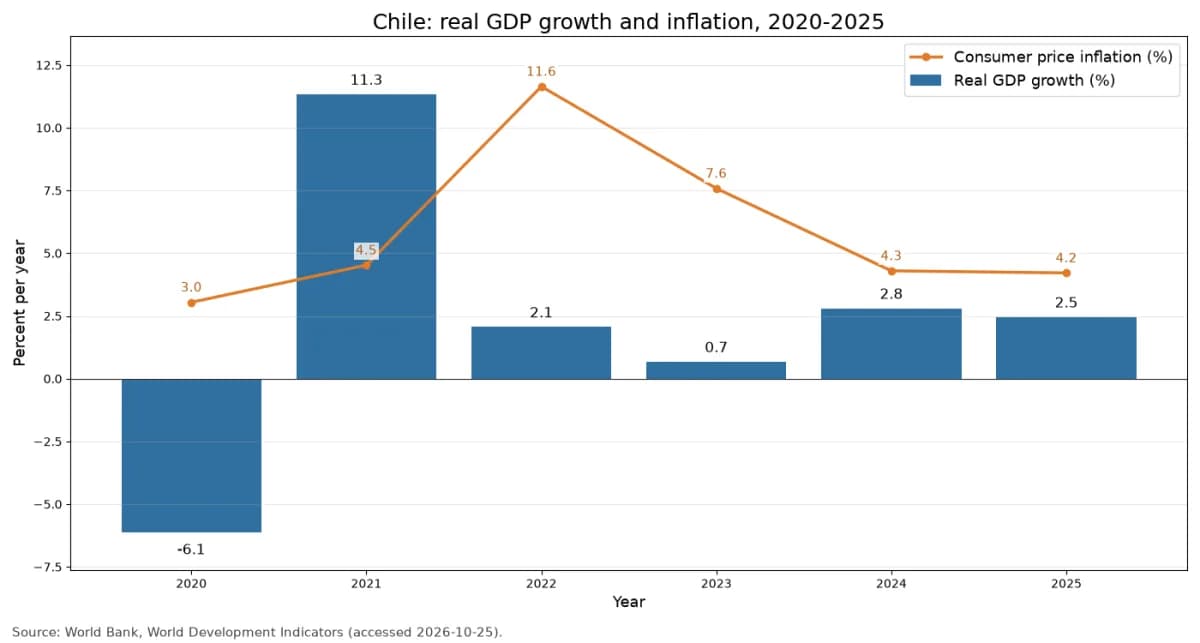
| Indicator | 2020 | 2021 | 2022 | 2023 | 2024 | 2025 |
|---|---|---|---|---|---|---|
| GDP (USD billion) | 254.1 | 315.5 | 301.1 | 335.8 | 329.3 | 357.4 |
| GDP per person (USD) | 13,118 | 16,216 | 15,399 | 17,082 | 16,659 | 17,995 |
| Real GDP growth (%) | -6.1 | 11.3 | 2.1 | 0.7 | 2.8 | 2.5 |
| Inflation (%) | 3.0 | 4.5 | 11.6 | 7.6 | 4.3 | 4.2 |
| Population (million) | 19.37 | 19.46 | 19.55 | 19.66 | 19.76 | 19.86 |
*Source: World Bank, World Development Indicators (accessed 25 October 2026).*[^3]
The World Bank also lists unemployment at 9.0% and youth unemployment (ages 15 to 24) at 21.6% for 2025, and an international migrant stock of 1,538,324 for 2024.[^3]
2026 labour data. INE's labour survey (ENE) puts unemployment at 9.6% in the June to August 2026 quarter, informal employment at 26.3% and unemployment among the foreign population at 6.8%. The July to September figures were due around 30 October. The World Bank annual figure and the INE rolling quarter are different series, so compare like with like.[^24]
What this means: growth of 2.5% in 2025 has not brought unemployment down to single digits in the INE series, and youth unemployment is above 21%, so a precise, evidence-led CV still matters.
Work permits and rules for foreign workers
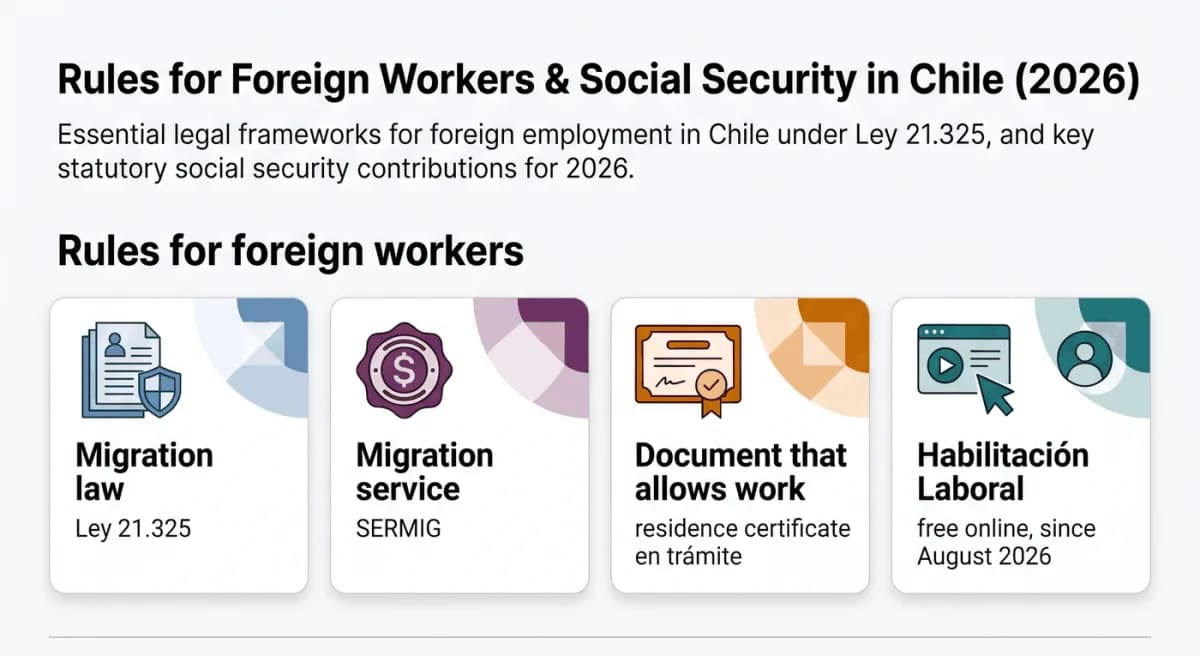
The law. Ley 21.325, the Ley de Migración y Extranjería, is administered by the Servicio Nacional de Migraciones (SERMIG). Art. 70 provides that a supreme decree defines the temporary-residence subcategories, which SERMIG lists on its site, including paid work activities, family and study.[^25]
Changing status inside Chile. Under art. 58, a person on transitory stay (for example a tourist) cannot apply for residence from inside Chile, except in the cases of art. 69, such as family ties with Chileans or permanent residents. It is not a total ban, but do not plan on it. SERMIG's pages describe the work-residence route as applied for from abroad (reported).[^25]
Which documents allow you to work. SERMIG lists these as the only documents that enable work: a cédula with Residencia Temporal or Definitiva; the Certificado de Residencia Temporal (or Definitiva) en trámite; extensions of those; estampado electrónico; a resolución exenta; and an autorización de trabajo con permanencia transitoria. The e-mailed application receipt (comprobante de solicitud) does not allow work. People over 18 may work once the "certificado de residencia en trámite" has been issued, which happens only when the application is accepted. The term "Permiso de Trabajo en Trámite" is not a legal term.[^5][^26]
Habilitación Laboral. Since 18 August 2026 SERMIG offers a free online "Habilitación Laboral" consultation that issues a QR certificate showing that a foreign person may work; employers can ask for it.[^27]
RUN. Request the foreigner's cédula within 30 days of the permit taking effect; it carries your RUN.[^11]
Japanese nationals
MOFA counted 1,630 Japanese residents in Chile in October 2025.[^28] A Japan–Chile working-holiday scheme has existed since 23 February 2018: ages 18 to 30 inclusive at application, a stay of one year extendable once, applications at the Chilean consulate in Tokyo, no change of residence status during the stay, and a funds suggestion of USD 700 a month.[^29] Japan and Chile have no social security agreement (see below). The tax treaty is covered in the tax section.
Foreign workers in numbers
INE and SERMIG estimated 1,918,583 foreign residents at 31 December 2023, up 82,446 (4.5%) on 2022: Venezuela 38.0%, Peru 13.6%, Colombia 10.9%, Haiti 9.8%, Bolivia 9.4% and Argentina 4.3%.[^30] The 2024 census counted 1,608,650 people born abroad, 8.8% of the population; this is a different measure from the estimate.[^31]
Labour law: hours, leave, notice and dismissal
The figures below are legal standards from the Código del Trabajo (version of 23 July 2026); your contract or collective agreement may be better.[^1]
| Topic | Rule |
|---|---|
| Hours | 42 hours a week from 26 April 2026, 40 from 26 April 2028; at most 10 hours a day; 5 or 6 days a week (arts. 28, 34 bis); meal break of at least 30 minutes, not counted (art. 34) |
| Overtime | Paid with a 50% surcharge; at most 2 hours a day; only by written pact for temporary needs, up to 3 months, renewable (arts. 31 and 32); it can be compensated with up to 5 extra days of leave |
| Remote work | At least 12 continuous hours of disconnection in 24 for remote workers who distribute their time freely (art. 152 quáter J); Ley 21.645 (29 December 2023) obliges employers to offer remote work where feasible to carers of a child under 14 or of a person with disability or dependence[^32] |
| Annual leave | 15 working days after one year (20 in Magallanes, Aysén and Palena) (art. 67); after 10 years of work, one extra day for every 3 new years (art. 68) |
| Parental leave | Prenatal 6 weeks and postnatal 12 weeks, then parental postnatal 12 weeks (18 on half-time); father 5 paid days (arts. 195, 197 bis); fuero from pregnancy until one year after the end of maternity rest (art. 201) |
| Notice | 30 days written notice or one month's last pay in lieu (art. 162); a worker resigning gives 30 days (art. 159) |
| Severance | 30 days of last monthly pay per year or fraction over 6 months, maximum 330 days (11 years), only after one year and for business-need dismissals (art. 163); monthly base capped at 90 UF, CLP 3,708,464 (about USD 3,759 / JPY 589,400) at the 23 October 2026 UF of CLP 41,205.16 (art. 172) |
| Unjustified dismissal | Claim within 60 business days; severance surcharges of 30%, 50%, 80% or 100% (art. 168). Tutela de derechos fundamentales adds an indemnity of 6 to 11 months' pay (art. 489) |
| Finiquito | Put at your disposal within 10 business days; ratified before a labour inspector, notary or other ministro de fe, or signed electronically on the DT site (art. 177) |
The UF value comes from the SII.[^33]
2026 public holidays
Chile has 16 national holidays in 2026, listed below.[^34] The days marked * are irrenunciables, but that rule is mandatory rest for employees in commerce (dependientes del comercio) only, with exceptions such as restaurants, entertainment venues, casinos, fuel sales and pharmacies on duty.[^35] Two regional holidays (7 June in Arica and 20 August in Chillán) are not among the 16.
| Date | Holiday |
|---|---|
| Thursday 1 January* | Año Nuevo |
| Friday 3 April | Viernes Santo |
| Saturday 4 April | Sábado Santo |
| Friday 1 May* | Día del Trabajo |
| Thursday 21 May | Glorias Navales |
| Sunday 21 June | Día de los Pueblos Indígenas |
| Monday 29 June | San Pedro y San Pablo |
| Thursday 16 July | Virgen del Carmen |
| Saturday 15 August | Asunción de la Virgen |
| Friday 18 September* | Independencia Nacional |
| Saturday 19 September* | Glorias del Ejército |
| Monday 12 October | Encuentro de Dos Mundos |
| Saturday 31 October | Iglesias Evangélicas y Protestantes |
| Sunday 1 November | Todos los Santos |
| Tuesday 8 December | Inmaculada Concepción |
| Friday 25 December* | Navidad |
Social security: what you pay and what you get
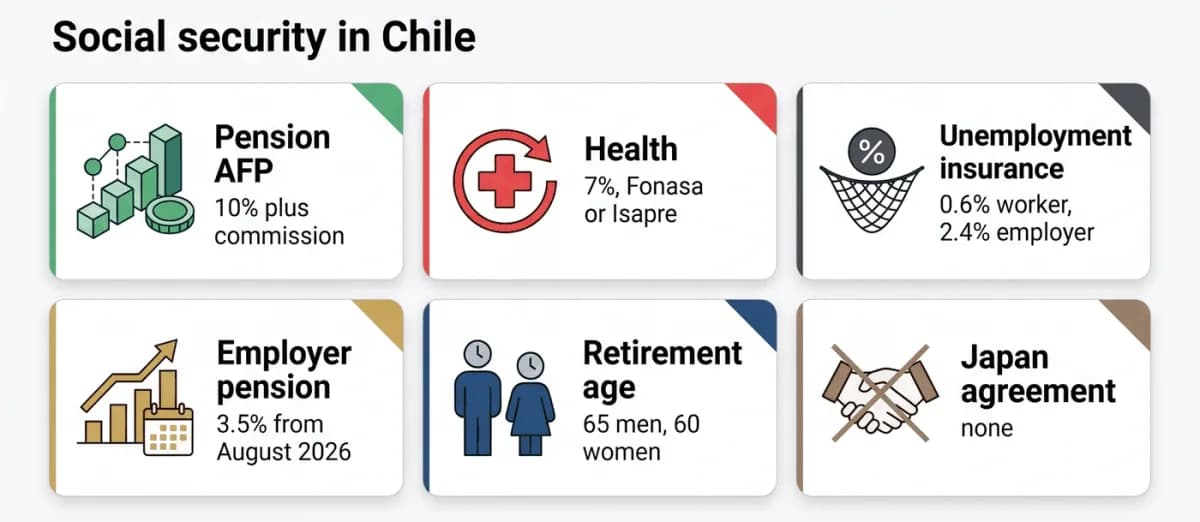
Pension (AFP) and health. The worker pays 10% of taxable pay to an AFP plus the AFP's commission, and 7% to Fonasa or an Isapre. We could not read the Superintendencia de Pensiones site and quote no commission figure. The 2026 taxable ceiling is 90 UF for pensions and health (about CLP 3,708,464 at the 23 October UF) and 135.2 UF for unemployment insurance (reported from the Superintendencia's announcement; likely).[^36]
Ley 21.735 (pension reform). The employer pays an extra contribution that the worker does not pay: 1% from August 2025, 3.5% from August 2026 (in force now, and from this date it includes the SIS, the disability and survivor insurance), 4.25% from August 2027, 5.0% from August 2028, then 0.7 percentage points more each August to 8.5% in August 2033.[^37][^38]
Unemployment insurance (AFC). For indefinite contracts the worker pays 0.6% and the employer 2.4%; for fixed-term and obra contracts the employer pays 3% (reported from a Ministry note we did not open). Access depends on a contract under the Código del Trabajo and affiliation with AFC, not on nationality; we found no explicit AFC statement on foreigners, so confirm with AFC.[^39]
Retirement age. 65 for men and 60 for women under DL 3.500 art. 3; the universal guaranteed pension (PGU) starts at 65.[^37]
Japan. There is no Japan–Chile social security agreement: the Japan Pension Service list of 24 agreements in force does not include Chile, and MOFA's list of bilateral treaties has none. A worker moving between the two countries may be covered by both systems and cannot count on totalisation. Check with the Japan Pension Service and the Chilean authorities.[^28][^40]
Taxes on employees
Impuesto único de segunda categoría. The tax applies to the income net of pension and health contributions (renta líquida imponible). The SII monthly table for October 2026, using the UTM of CLP 72,151, is below.[^41]
| Monthly taxable income up to | Marginal rate |
|---|---|
| CLP 974,038.50 (13.5 UTM; about USD 987 / JPY 154,800) | Exempt |
| CLP 2,164,530.00 (30 UTM) | 4% |
| CLP 3,607,550.00 (50 UTM) | 8% |
| CLP 5,050,570.00 (70 UTM) | 13.5% |
| CLP 6,493,590.00 (90 UTM) | 23% |
| CLP 8,658,120.00 (120 UTM) | 30.4% |
| CLP 22,366,810.00 (310 UTM) | 35% |
| Above | 40% |
The rate applies to the slice above the previous threshold; the SII table also lists a deduction (rebaja) for each bracket. Someone earning the minimum wage of CLP 553,553 is below the exemption threshold.
Tax residence. As we read it in an earlier check, you count as resident if you stay more than six months in a calendar year, or more than six months over two consecutive tax years; new settlers are taxed on Chilean-source income for their first three years (reported). Check with the SII.
IVA. Value-added tax is 19% (likely; we did not open an SII page for it).
No municipal income tax. Chile has no municipal or regional income tax on salaries (likely; structural, no contrary source found), so there is no equivalent of Japan's resident tax (juminzei). Municipalities charge patentes and contribuciones.
Japan–Chile tax treaty. Signed in Santiago on 21 January 2016 and in force since 28 December 2016; Japan applies it from tax years beginning on 1 January 2017. Check the employment-income article of the treaty text.[^28]
Where to find jobs, recruitment agencies and job scams
| Channel | Use |
|---|---|
| Bolsa Nacional de Empleo (BNE) | Run by SENCE; free registration online or at an OMIL; bne.cl[^42] |
| OMIL (Oficina Municipal de Intermediación Laboral) | Municipal office that helps with job search, offers in the commune through the BNE and placement; open to everyone[^43] |
| empleospublicos.cl | Public-sector vacancies, linked to the Servicio Civil[^21] |
| General job boards and recruiters | Laborum, Get on Board (tech), Michael Page, Randstad, Adecco and ManpowerGroup. These are market practice, not an official ranking |
We could not open several well-known portals from our network, so we do not link them here; check them in your browser.
Scams. The PDI's cybercrime unit has issued job-scam alerts, for example about task scams run through TikTok and fake offers that ask for an advance payment (reported from press coverage). The PDI advises reporting at a police unit or to the Ministerio Público. Never pay anyone for a job or for placement.[^44]
Final checks before you apply
- [ ] The language matches the vacancy or portal.
- [ ] The CV is one or two pages and the strongest evidence is easy to find.
- [ ] Every date, qualification and language level is defensible.
- [ ] Age, marital status, children, religion and politics are left out; the photo decision is yours.
- [ ] RUT only where a form asks; no passport number or bank details on the CV.
- [ ] The work-authorisation line is short and true, and the document you hold is on the SERMIG list.
- [ ] I know the pay basis: líquido or bruto, gratificación and allowances.
- [ ] I checked degree recognition and any professional requirement such as EUNACOM.
- [ ] No one asked me for a fee before a signed contract.
- [ ] The file reads cleanly when copied and I saved the version I sent.
FAQ
What is the standard Chile CV format?
There is no statutory template. A practical default is a clear, vacancy-specific CV of one or two pages, latest job first, in the language of the advert.
Should a Chilean CV include a photo?
No law requires one. The DT treats a photo requirement in an advert as discriminatory, though sending one is not illegal. Follow the vacancy and your own preference.[^2]
Can an employer ask about my marital status or pregnancy?
CT art. 2 lists age and marital status among the grounds of discrimination, and art. 194 bars conditioning hiring on pregnancy or demanding a pregnancy certificate or exam.[^1]
Is a certificado de antecedentes always required?
No. The DT accepts it only when criminal-record status is part of fitness for the job; for work with minors, Ley 20.594 requires the employer to check the Registro Civil.[^12][^13]
What is the minimum wage in Chile in 2026?
CLP 553,553 a month (about USD 561 / JPY 88,000) since 1 May 2026 for workers over 18 and up to 65.[^17]
Can I work with the application receipt from SERMIG?
No. The e-mailed comprobante de solicitud does not allow work; the Certificado de Residencia Temporal en trámite does, as do the other SERMIG-listed documents.[^5]
Can I change from a tourist stay to residence inside Chile?
Not in general. Art. 58 of Ley 21.325 bars it, with exceptions in art. 69, for example family ties with Chileans.[^25]
Can Japanese citizens use a working holiday in Chile?
Yes. The scheme has run since 23 February 2018 for ages 18 to 30, for one year extendable once.[^29]
How long is the working week?
42 hours since 26 April 2026, falling to 40 hours on 26 April 2028.[^20]
How much notice and severance do I get?
Thirty days' notice or one month's pay in lieu; severance is 30 days per year of service, up to 330 days, for business-need dismissals.[^1]
How to use AIResume
Keep one master CV in AIResume and create a Chile version for each vacancy: remove personal data you do not need, move the strongest evidence for the role to the top, state language levels truthfully, then export a PDF unless the employer asks for another format. Use our ATS-friendly CV guide for file checks and save the exact version and date you send.
Related AIResume guides
- Job boards in Chile
- Argentina CV format
- Mexico CV format
- Colombia CV format
- Spain CV format
- How to write an ATS-friendly CV
Sources
[^1]: Biblioteca del Congreso Nacional, Código del Trabajo (DFL 1 de 2002), Ley Chile
[^2]: Dirección del Trabajo, discriminatory requirements in job adverts (2005 press release; Ord. 850/29)
[^3]: World Bank, World Development Indicators: Chile (accessed 25 October 2026)
[^4]: Banco Central de Chile observed dollar, 23 October 2026 (read via a relay of the BCCh series); JPY cross from the ECB reference rate of the same day (USD 1 = JPY 156.80)
[^5]: SERMIG, documents that enable work
[^6]: Universidad de Chile, revalidation of foreign titles: stages of the process
[^7]: Biblioteca del Congreso Nacional, Ley 21.643 (Ley Karin)
[^8]: Biblioteca del Congreso Nacional, Ley 21.719 (data protection)
[^9]: Actualidad Jurídica DOE, postponement of the data-protection law advances in the Senate (legal press)
[^10]: Ley Chile, Ley 21.690 (disability quota)
[^11]: ChileAtiende, cédula de identidad para extranjeros
[^12]: Dirección del Trabajo, Ord. 628 of 3 February 2017 (certificado de antecedentes)
[^13]: Ley Chile, Ley 20.594 (disqualification registry for work with minors)
[^14]: SII, UTM 2026
[^15]: Universidad de Chile, revalidation FAQ
[^16]: EUNACOM
[^17]: Ley Chile, Ley 21.830 (ingreso mínimo mensual)
[^18]: Ley Chile, Ley 21.751
[^19]: INE, press release of 14 July 2026 on the Encuesta Suplementaria de Ingresos 2025
[^20]: Ley Chile, Ley 21.561 (40-hour week)
[^21]: Empleos Públicos
[^22]: Servicio Civil, Alta Dirección Pública
[^23]: Biblioteca del Congreso Nacional, Estatuto Administrativo (DFL 29 de 2004)
[^24]: INE, ocupación y desocupación (ENE)
[^25]: Biblioteca del Congreso Nacional, Ley 21.325 (Ley de Migración y Extranjería)
[^26]: SERMIG, temporary residence: stages in Chile
[^27]: SERMIG, Habilitación Laboral step by step
[^28]: Ministry of Foreign Affairs of Japan, Chile basic data
[^29]: Gobierno de Chile, working holiday Chile–Japan
[^30]: INE, estimate of the foreign population 2023 (30 December 2024)
[^31]: SERMIG, estimates of foreigners
[^32]: Ley Chile, Ley 21.645 (remote work for carers)
[^33]: SII, UF 2026
[^34]: 24horas, official 2026 calendar of holidays (press)
[^35]: Dirección del Trabajo, irrenunciable holidays
[^36]: Superintendencia de Pensiones, taxable ceilings (page not opened from our network; read through a search summary)
[^37]: Previsión Social, technical note on Ley 21.735 (Ley 21.735, idNorma 1212060)
[^38]: Previsión Social, new employer contribution under the pension reform
[^39]: AFC Chile and Previsión Social, unemployment-insurance note
[^40]: Japan Pension Service, status of social security agreements (no agreement with Chile)
[^41]: SII, impuesto de segunda categoría 2026
[^42]: Bolsa Nacional de Empleo and BNE FAQ
[^43]: SENCE, OMIL
[^44]: Policía de Investigaciones de Chile and CNN Chile, PDI warns about a TikTok scam (press)
Your next step
- DeelFor employers hiring across borders: contracts, payroll and visas handled.See how Deel works
Affiliate links: we may earn a commission at no cost to you. Affiliate link