

Brazil CV Format 2026: Currículo, Personal Data, Minimum Wage, Visas and Labour Law
The safest Brazilian currículo is a clear, vacancy-specific document of one or two pages, with your latest job first, written in Portuguese unless the advert is in English. No law we found prescribes a CV template and none requires a photo. What the law does regulate is how an employer may choose: t
By AIResume Editorial Team
Last updated: 25 October 2026
The safest Brazilian currículo is a clear, vacancy-specific document of one or two pages, with your latest job first, written in Portuguese unless the advert is in English. No law we found prescribes a CV template and none requires a photo. What the law does regulate is how an employer may choose: the CLT bars refusing a candidate because of sex, age, colour, family situation or pregnancy, and Lei 9.029/1995 lists further grounds.[^3][^4] The World Bank puts Brazil's 2025 unemployment rate at 6.0% and its international migrant stock at 1,406,299 (2024), so the market is open to foreign candidates but competitive.[^1]
This guide covers the Brazilian CV and application, personal data and fair hiring, an annotated fictional currículo, the carta de apresentação and documents, foreign degrees, pay and the minimum wage, contracts, the economy, work permits, labour law, social security, taxes and job scams. For where to find vacancies, see our Brazil job-board guide. It is written for Brazilians, Mercosur and other Latin American nationals, Portuguese nationals, other foreigners and Japanese nationals and Nikkei, and it uses Brazilian terms such as currículo, carta de apresentação, pretensão salarial, CPF, CTPS (Carteira de Trabalho Digital), CLT, PJ, 13º salário, férias, FGTS, INSS, aviso prévio and justa causa.
Editorial boundary: This is practical job-search guidance, not legal, immigration or tax advice. We use the Planalto legislation database, the Ministério do Trabalho e Emprego (MTE), the Polícia Federal and the Ministério da Justiça, the INSS, the Receita Federal, the IBGE and the Banco Central do Brasil as our references, and we only list figures we could read in an official or primary source. Items that rest on press reports or one secondary summary are marked "reported" or "likely". Several government sites could not be opened from our network, so some court and ministry items rest on summaries of the official news. Confirm details with the relevant authority before you sign anything.
We convert Brazilian reais (BRL) at the Banco Central do Brasil PTAX rate of 23 October 2026: USD 1 = BRL 5.0377, so BRL 1,000 is about USD 199 / JPY 31,130 (at USD 1 = JPY 156.80).[^2] We write "about" because rates move daily.
Before you apply
- SafetyWing Nomad InsuranceHealth insurance that works in your new country from day one.Get a quote
Affiliate links: we may earn a commission at no cost to you. Affiliate link
Brazil CV format at a glance
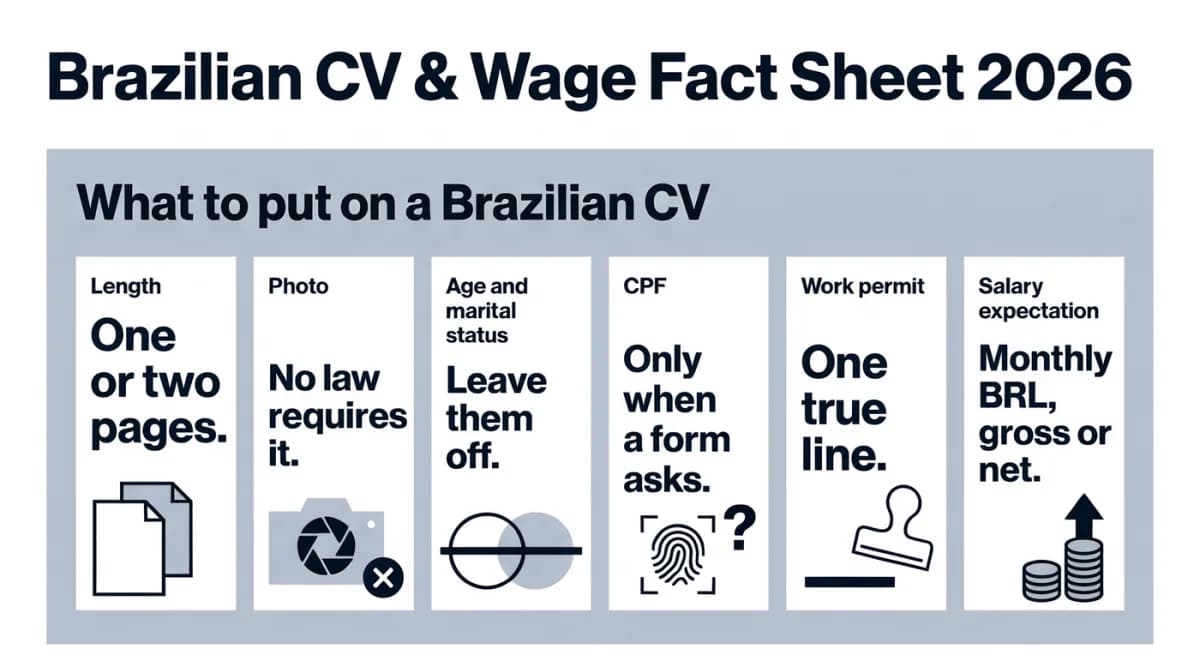
| Topic | Brazilian practice in 2026 | Law or official guidance |
|---|---|---|
| Length | One or two pages, latest job first | Market practice; we found no official rule |
| Photo | Not required. Include one only if you are comfortable and the employer asks | We found no law that requires or bans a photo. The law targets discrimination in selection, not CVs with photos[^4] |
| Personal data (CPF, age, marital status) | Name, city and state, email, mobile, LinkedIn. Leave out age, marital status, children and ID numbers. CPF and documents are needed when you are hired, not to apply | CLT art. 373-A and Lei 9.029 art. 1 bar discrimination; no law tells candidates to omit CPF or RG, so this is advice, not a rule[^3][^4] |
| Work-authorisation line | A short true line for foreigners, for example "Residence authorisation with permission to work" | Lei 13.445/2017 governs residence for work[^23] |
| References | Do not list them on the CV; give them when asked | Practice; we found no rule |
| Pretensão salarial (salary expectation) | Give it when the form asks, as a monthly BRL figure; check whether it means bruto (gross) or líquido (net) | Practice; no primary source |
| Degree recognition | Name the award as issued; add recognition only if you hold it | Revalidação or reconhecimento, see below[^15] |
| File / ATS | Follow the portal; otherwise a readable PDF whose text you can copy | Not an official rule. Check links and copy/paste |
| Language | Portuguese for Brazilian employers; English if the advert is in English | No legal rule |
| Cover letter | Short; two or three paragraphs | Practice; no official rule |
Personal data, photo and fair hiring
CLT art. 373-A. The Consolidação das Leis do Trabalho bars, among other things, job adverts that refer to sex, age, colour or family situation, refusing to hire or dismissing someone on those grounds or because of pregnancy, and using subjective criteria in selection for the same reasons. It also forbids requiring a certificate or exam proving pregnancy or sterility at hiring or during the job, and intimate searches. Religion, union membership and sexual orientation are not listed in art. 373-A.[^3]
Lei 9.029/1995. Art. 1 bans discrimination in access to a job or in keeping it based on sex, origin, race, colour, marital status, family situation, disability, professional rehabilitation or age, "among others". Art. 2 makes a pregnancy or sterilisation test a crime, punishable by 1 to 2 years' detention and a fine.[^4]
Experience requirements. Under CLT art. 442-A an employer may not require more than 6 months of prior experience in the same type of activity.[^3]
HIV. HIV tests are barred from admission exams (Portaria MTE 1.246/2010), and denying work because of HIV is a crime under Lei 12.984/2014 (1 to 4 years).[^12]
Data protection (LGPD). Lei 13.709/2018 art. 20 gives you the right to ask for review of decisions taken solely by automated processing that affect your interests, including your professional profile, and to receive clear information on the criteria used (trade secrets reserved). It does not promise review by a human. We found no rule that forces candidates to leave out CPF, RG or address, and no guidance from the data authority (ANPD) on private-sector recruitment, so what goes on a CV is market practice.[^5] The bill that would regulate artificial intelligence (PL 2.338/2023) has passed the Senate and sits in a special committee of the Chamber of Deputies; it is not law.[^11]
Criminal-record certificate. The Tribunal Superior do Trabalho (TST) ruled on 20 April 2017 (IRR Tema 1) that demanding a certidão de antecedentes criminais is lawful only when required by law or justified by the nature of the job or a special relationship of trust; otherwise it is discriminatory and gives rise to moral damages, even if the candidate was not hired.[^6]
Credit checks. TST panel decisions treat searches of a candidate's credit data (SPC or Serasa) as discriminatory; this is case law, not a statute.[^7]
Disability quota and public competitions. Lei 8.213/1991 art. 93 requires firms with 100 or more employees to fill 2% to 5% of posts with people with disabilities (2% up to 200 employees, 3% for 201 to 500, 4% for 501 to 1,000, 5% above).[^8] Lei 15.142 of 3 June 2025 reserves 30% of places for Black (pretos e pardos), Indigenous and quilombola candidates in federal public competitions and replaces Lei 12.990/2014 (federal level only).[^9]
Pay transparency. Lei 14.611/2023 art. 5 obliges firms with 100 or more employees to publish pay-transparency reports twice a year, with a fine of up to 3% of payroll. The Supremo Tribunal Federal upheld the law on 14 May 2026. It does not require salary ranges in job adverts.[^10]
Practice versus law. Nothing in the texts we read forbids a photo, a date of birth or a marital status on a CV; they simply cannot be used as grounds to refuse you. Since that information adds little to your case and can invite bias, the cautious default is to leave it off.
Structure of a Brazilian currículo
The sections below are editorial advice and market practice, not a legal template.
1. Header and headline
Name, a professional email, a mobile number (+55 and area code), your city and state, and a LinkedIn or portfolio link. A full street address is unnecessary before an offer. Under the name, put a headline naming the target role.
2. Perfil profissional (profile)
Three or four lines connecting your evidence to the role. Weak: "Dynamic person looking for new challenges." Stronger: "Sales operations analyst with four years' experience in bilingual customer reporting and weekly Excel dashboards."
3. Experience in reverse chronology
Title, employer, city, dates and two to five bullets. Build each bullet from an action, an object, the context and a result you can verify. Use the advert's keywords only where they truthfully describe your work. For a practical layout check, see our ATS-friendly CV guide.
4. Education and training
The most relevant award first, with institution, country and year. Do not translate a foreign award into a Brazilian title unless recognition has been granted.
5. Skills, languages and gaps
State each language with a level you can defend. Explain a long gap in one factual line with dates (study, care, relocation, a project); no medical or family detail is needed. Work done as a PJ (a company or sole trader invoicing clients) is not employment under the CLT, so label it as freelance or contract work, not as a job.
Annotated fictional Brazilian currículo
The sample is entirely fictional: person, employers, contacts and numbers. Replace every item with truthful information.
Camila Souza Exemplo, Sales Operations Analyst · São Paulo, SP · [email protected] · +55 11 00000-0000
*Annotation: fictional contacts. Use a city-and-state location; add your CPF only if a form asks.*
Perfil: Sales operations analyst with four years' experience preparing weekly pipeline reports, cleaning customer data and improving hand-offs between sales and billing.
*Annotation: align the role label and evidence with the vacancy. Do not add years or languages you cannot prove.*
Experiência: Sales Operations Analyst, Pampa Exemplo Ltda. · São Paulo · Mar 2023 to present
- Prepared a weekly pipeline report for 12 account managers in Excel and a BI tool, flagging stalled deals.
- Reduced duplicate customer records from roughly 300 to under 40 through a monthly clean-up routine.
- Documented a shared checklist for the sales-to-billing hand-off.
*Annotation: organisation and figures are fictional. Support real claims with records, work samples or a referee.*
Experiência: Administrative Assistant, Escritório Exemplo · Curitiba, PR · Jun 2021 to Feb 2023
- Scheduled client appointments, updated records and prepared the monthly invoicing file for the accountant.
*Annotation: one relevant bullet beats a long list of duties.*
Formação: Bacharelado em Administração, Universidade Exemplo do Paraná, 2021
*Annotation: the institution is fictional. Keep the official award name.*
Habilidades e idiomas: Excel reporting · data cleaning · customer email · Portuguese (native) · English [truthful level]
Work authorisation (for a foreign applicant): "Residence authorisation with permission to work, valid until [date]."
*Annotation: one short true line. Do not paste permit or passport numbers.*
Carta de apresentação, references and documents
Cover letter. We found no official guidance on the carta de apresentação. In practice it is short, often the body of the email: two or three paragraphs saying why this employer, why this role, and one or two proof points that connect your background to the advert. Do not repeat the CV.
CPF and CTPS. You need a CPF and a Carteira de Trabalho (CTPS) when you are hired, not for a first CV. The CTPS is issued digitally through the Carteira de Trabalho Digital on gov.br, and the employer has 5 working days to register the job in it (CLT art. 29).[^3][^13] Give your CPF in a form only when it asks.
Exame admissional (ASO). Norma Regulamentadora NR-7 requires an admission medical exam before you start work, and the employer pays for it (CLT art. 168); further tests are at the physician's discretion. Pregnancy and HIV tests are barred, as above.[^14][^3]
References. We found no Brazilian rule on references. Keep names ready, ask each person first and give them at interview.
Foreign degrees: revalidação and reconhecimento
According to the Ministério da Educação (MEC), the analysis of a foreign higher-education diploma is done by competent higher-education institutions. Undergraduate degrees are revalidated by public universities through the Plataforma Carolina Bori, and postgraduate degrees go through reconhecimento. Medicine additionally requires the national Revalida exam before the university process. MEC cites Portaria Normativa MEC 1.151/2023 and Resolução CNE/CES 2/2024 as the rules.[^15] The rules are reported to set a maximum of about 180 days for the process (the portal could not be opened from our network, so check the current deadline).
Brazil is party to the Hague Apostille Convention (Decreto 8.660/2016, in force for Brazil since 14 August 2016), so foreign documents are normally apostilled in the issuing country.[^16] Professional registration with a council such as CREA, CRM, COREN, OAB or CRC is a separate step; ask the council about its requirements. Do not write "Brazilian equivalent" on a CV before you hold a recognition decision.
Pay: minimum wage, 13º salário and salary components
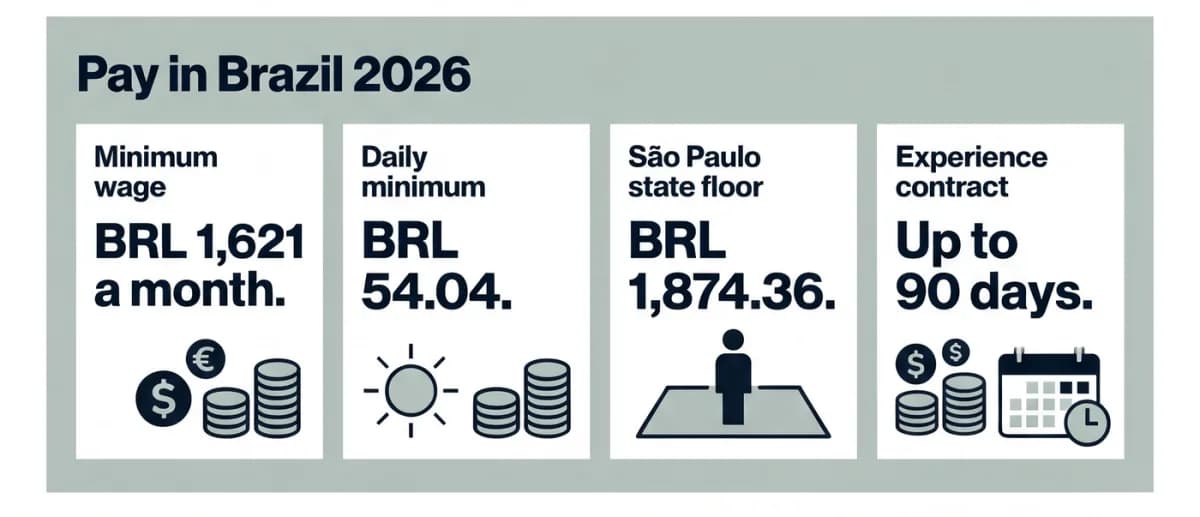
National minimum wage. Decreto 12.797 of 23 December 2025 sets the salário mínimo from 1 January 2026 at BRL 1,621.00 a month (about USD 322 / JPY 50,450), BRL 54.04 a day and BRL 7.37 an hour.[^17]
Regional floors (pisos regionais). Some states set a higher floor for workers who have no federal-law, collective-agreement or union floor. São Paulo: BRL 1,874.36 (about USD 372 / JPY 58,340) under Lei 18.471 of 27 May 2026. Rio Grande do Sul: five bands from BRL 1,884.75 to BRL 2,388.50 (about USD 374 to 474), published on 21 May 2026. Paraná (BRL 2,105.34 to 2,407.90, about USD 418 to 478) and Santa Catarina (BRL 1,842 to 2,106, about USD 366 to 418) are reported from official state pages we could not open, so confirm them.[^18]
13º salário. Lei 4.090/1962 gives every employee a 13th salary paid in December each year; it is normally paid in two instalments, by 30 November and 20 December (likely, under Lei 4.749/1965).[^19]
Férias. Paid annual leave is 30 days with a one-third bonus (see the labour-law table).
Vale-transporte and meals. The employee's share of the vale-transporte is capped at 6% of base salary, and the employer pays the rest (Lei 7.418/1985). Vale-refeição and vale-alimentação are not a CLT duty; the PAT programme (Lei 6.321/1976) is a tax incentive for employers, and meal benefits are mandatory only if a collective agreement says so.[^19]
Gross and net. Ask whether a quoted figure is bruto or líquido. Employee INSS and income tax are deducted from gross pay (see the sections below), and the employer adds its own charges on top.
What this means: the salário mínimo is a floor, not a market rate. Check whether a regional floor or a collective agreement sets a higher one for your category, ask whether a quoted pretensão is monthly, and ask which benefits (vale-transporte, meals, health plan) come on top; a company health plan is not a CLT duty.
Contracts: CLT, experience contracts and PJ
CLT contracts. A CLT employee is registered in the CTPS within 5 working days of starting (art. 29) and receives FGTS deposits, 13º salário and férias. The employer must not require more than 6 months of prior experience for the same type of activity (art. 442-A).[^3]
Contrato de experiência and fixed-term. The experience contract can last at most 90 days (art. 445, sole paragraph); a fixed-term contract at most 2 years (art. 445); renewing a fixed-term contract more than once makes it indefinite (art. 451).[^3]
Other forms. Temporary work through an agency (Lei 6.019, art. 10) runs for up to 180 days, extendable by up to 90 days. A student internship (estágio) is capped at 6 hours a day and 30 hours a week for higher education, vocational secondary and regular secondary students (4 and 20 hours for special education and basic school) under Lei 11.788, art. 10. Jovem Aprendiz places must be 5% to 15% of staff in functions that need professional training (CLT art. 429). Part-time work is up to 30 hours a week without overtime, or up to 26 hours plus 6 hours of overtime (art. 58-A).[^21][^3]
PJ and pejotização. Offers of a PJ contract (you invoice through your own company) are common. The Supremo Tribunal Federal has taken up pejotização as Tema 1389, covering whether such contracts are lawful, which court hears fraud claims and who bears the burden of proof. We found no merits judgment and no binding thesis, and the national stay on cases was lifted on 18 June 2026 for first-instance courts and regional labour courts (reported).[^20] Courts look at the real relationship, so treat a PJ offer for a full-time, supervised job with caution and take advice before accepting.
Brazil's economy in numbers
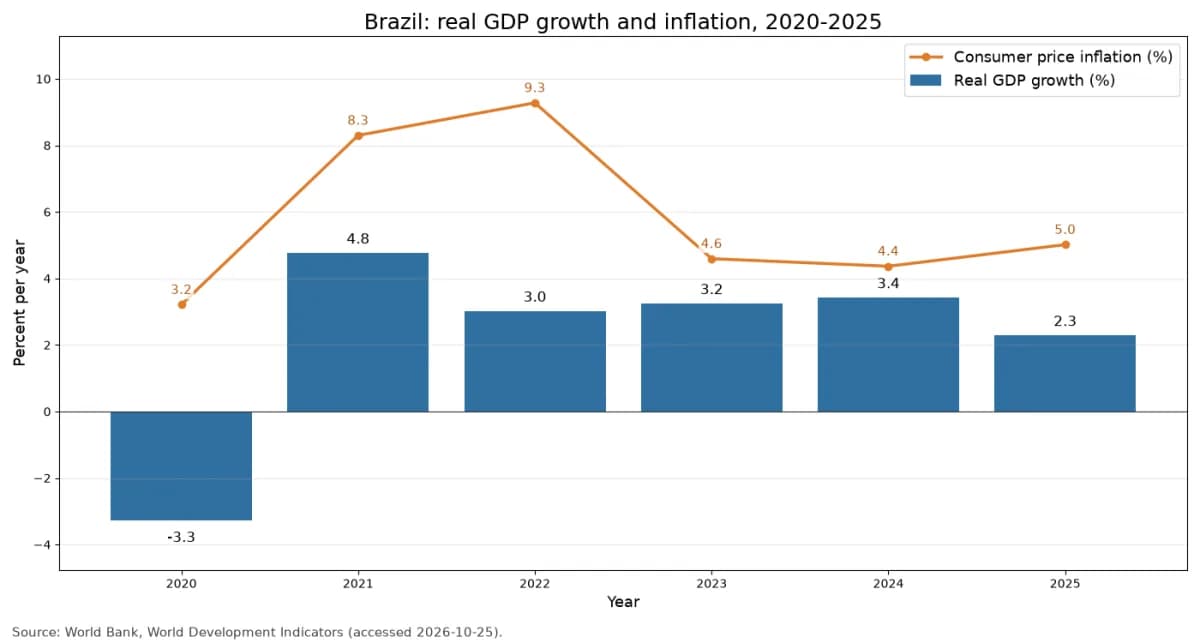
| Indicator | 2020 | 2021 | 2022 | 2023 | 2024 | 2025 |
|---|---|---|---|---|---|---|
| GDP (USD billion) | 1,476.1 | 1,670.6 | 1,951.9 | 2,191.1 | 2,185.8 | 2,279.9 |
| GDP per person (USD) | 7,074 | 7,973 | 9,281 | 10,378 | 10,311 | 10,713 |
| Real GDP growth (%) | -3.3 | 4.8 | 3.0 | 3.2 | 3.4 | 2.3 |
| Inflation (%) | 3.2 | 8.3 | 9.3 | 4.6 | 4.4 | 5.0 |
| Population (million) | 208.66 | 209.55 | 210.31 | 211.14 | 212.00 | 212.81 |
*Source: World Bank, World Development Indicators (accessed 25 October 2026).*[^1]
The World Bank also lists unemployment at 6.0% and youth unemployment (ages 15 to 24) at 14.0% for 2025, and an international migrant stock of 1,406,299 for 2024.[^1]
2026 data. The IBGE's PNAD Contínua puts unemployment at 5.3% in the quarter June to August 2026 (6.1% in the first quarter of 2026 and 5.1% in the last quarter of 2025). The IPCA consumer price index rose 4.58% over the 12 months to September 2026, after 4.26% in calendar 2025.[^22] The World Bank annual figures and the IBGE quarterly and 12-month figures are different series, so compare like with like.
What this means: with consumer prices rising about 4.6% a year, a fixed salary loses value over time. Ask when pay is reviewed and whether a collective agreement sets adjustments, and give your pretensão salarial with a date.
Work permits and rules for foreign workers
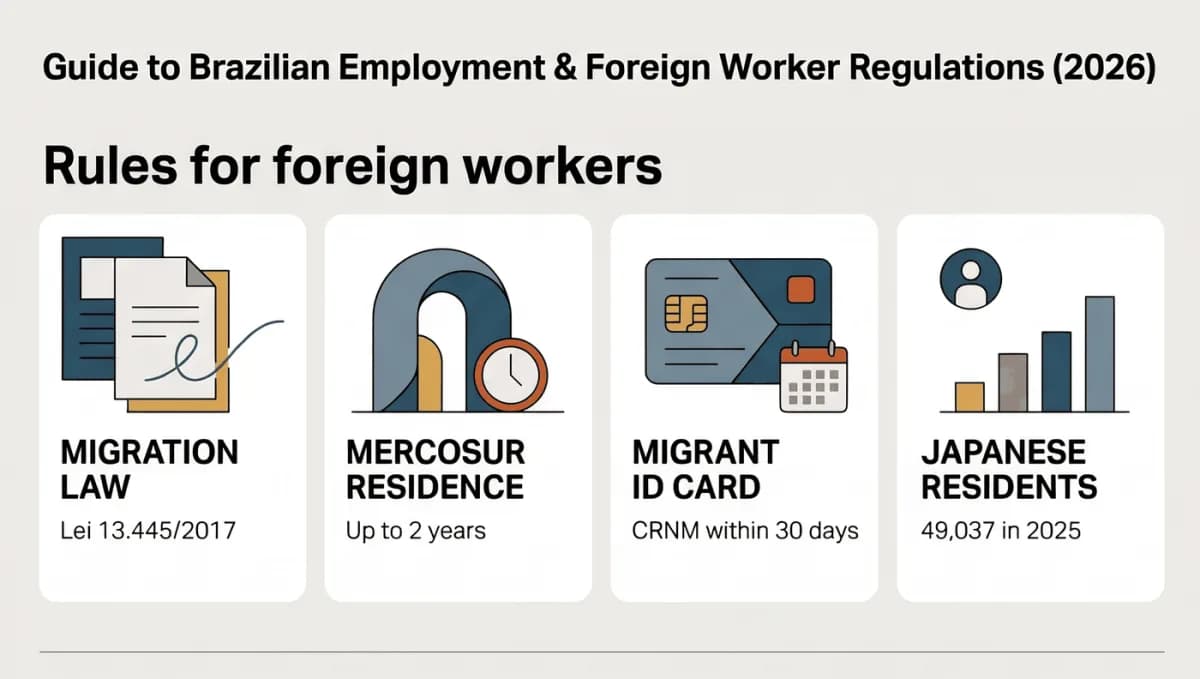
The law. Lei 13.445/2017 (Lei de Migração) and Decreto 9.199/2017 govern migrants. Art. 4 gives migrants equality with nationals in civil, social, economic and cultural rights. Art. 30 allows residence authorisation for work and for humanitarian reasons, among others; a work visa needs an offer from a legal entity (art. 14, §5). Decreto 12.657 of 7 October 2025 moved the conditions for work visas to joint acts of the Justice and Foreign Affairs ministries, so check the current rules with the Polícia Federal and the Ministério da Justiça. Registration of the foreigner (the CRNM, Carteira de Registro Nacional Migratório) is due within 30 days (Decreto 9.199, art. 66). A visitor may switch to a residence authorisation without leaving Brazil in the cases the law lists (Lei 13.445, art. 30; Decreto 9.199, art. 124).[^23]
Mercosur residence. The Acordo sobre Residência (Brasília, December 2002), promulgated by Decreto 6.964/2009 and in force for Brazil since 28 July 2009, gives nationals of the covered Mercosur States temporary residence of up to 2 years, then convertible. The decree covers the States Parties and the associated states that signed; whether your country is covered is something to confirm with the Polícia Federal. Venezuela is not covered by this agreement; Venezuelans use a separate humanitarian route.[^24]
Digital nomads. A digital-nomad visa exists (CNIg Resolution 45/2021); check the current rules with Itamaraty before you plan around it. It is not a licence to work for a Brazilian employer.
Japanese nationals and Nikkei
MOFA counted 49,037 Japanese residents in Brazil in October 2025 and estimates the Nikkei community at about 2.7 million.[^26] Japanese nationals can enter Brazil without a visa for up to 90 days with an IC passport, but not to work or look for a job (reported; the waiver was reported extended to 29 September 2029).
Brazil has no "Nikkei visa". The generation rule belongs to Japan, for Brazilians of Japanese descent going to Japan: the 定住者 (long-term resident) status covers the second and third generations, and a separate scheme for the fourth generation accepts people aged 18 to 35 within an annual quota of 4,000, with Japanese at N4/N5 level (ages 18 to 30) or N3 (ages 31 to 35) and a supporter in Japan. Since 28 December 2023 a fourth-generation person who stays 5 years with Japanese ability can obtain 定住者.[^25] Brazilians holding an ICAO-compliant ePassport have been visa-exempt for short stays in Japan since 30 September 2023; short stays do not allow work.[^27]
The Japan–Brazil social security agreement and the tax treaty are covered in the sections below.
Foreign workers in numbers
OBMigra's 12th report (30 April 2026) counts just over 2 million immigrants in Brazil, including refugees and asylum seekers, of 200 nationalities, with about 680,000 Venezuelans (an early-2026 estimate); about 410,000 foreigners held formal jobs in 2025 (RAIS, per OBMigra).[^28] The 2022 Census counted 1,009,341 foreign-born residents, about 0.5% of the population (press summary of the IBGE; likely). The World Bank's migrant-stock figure for 2024 (1,406,299) is a different measure.[^1] Japan's Immigration Services Agency counted 209,550 Brazilians in Japan at the end of June 2026.[^26]
Labour law: hours, leave, notice and dismissal
The figures below are legal standards from the CLT and the Constitution; your contract or collective agreement (convenção or acordo coletivo) may be better.[^3]
| Topic | Rule |
|---|---|
| Hours (art. 58) | 8 hours a day and 44 a week (CLT art. 58; Constitution art. 7, XIII). A shorter limit is being phased in, see below |
| Overtime (art. 59) | Allowed by agreement within the CLT limits and paid at a premium (Constitution art. 7, XVI); art. 59-A allows 12 hours of work followed by 36 hours of rest by agreement |
| Breaks and rest (arts. 66, 71, 73) | At least 11 hours of rest between two workdays (art. 66); an intra-day meal or rest break (art. 71); night work has its own rules (art. 73) |
| Férias | 30 days of paid annual leave with a one-third bonus (Constitution art. 7, XVII) |
| 13º salário | Paid in December, normally in two instalments (Lei 4.090/1962) |
| Maternity leave | 120 days (Constitution art. 7, XVIII), plus 60 days if the employer is in the Empresa Cidadã programme (Lei 11.770/2008) |
| Paternity leave | 5 days today, plus 15 days under Empresa Cidadã. Lei 15.371/2026 raises it to 10 days from 1 January 2027, 15 from 1 January 2028 and 20 from 1 January 2029 (the 20-day step depends on a fiscal target) |
| Aviso prévio (Lei 12.506/2011) | 30 days up to 1 year of service, plus 3 days per completed year, up to 90 days in total |
| FGTS on dismissal | Employer deposits 8% a month; 40% fine on the FGTS balance for dismissal without cause |
| Mutual agreement (art. 484-A) | 20% fine instead of 40%, and you may withdraw 80% of the FGTS balance |
| Justa causa | Dismissal for cause is limited by the CLT to listed grounds; the notice and the 40% fine above are for dismissal without cause. Get advice before accepting a dismissal for cause |
Working week: the 6x1 reform. Emenda Constitucional 141 of 16 October 2026 (from PEC 221/2019) amends the Constitution to set a 40-hour week and two weekly rest days (one preferably on Sunday), which ends the 6x1 schedule. It is phased in under its art. 6: not more than 42 hours from two months after publication (about mid-December 2026, our calculation), and 40 hours one year after that (about December 2027). Until the 42-hour step takes effect, the old 44-hour limit is what employers apply. A collective agreement may set a compensatory scheme (art. 7, §2), and a complementary law may set transitional measures for micro and small firms (art. 5).[^29]
Leave and dismissal figures. Paternity leave, aviso prévio and the FGTS rules are in the table above.[^30][^31][^34] The deadline to sue after the job ends is generally 2 years (likely; Constitution art. 7, XXIX).[^40]
2026 public holidays
National holidays apply to everyone. The federal calendar also lists optional days off for federal civil servants (ponto facultativo); these are not national holidays and do not bind private employers. Corpus Christi, Carnaval and local patron-saint days are matters for states, municipalities or collective agreements for private employers. The calendar follows the federal government's 2026 list as reported by Agência Brasil; 20 November is a national holiday under Lei 14.759/2023.[^32]
| Date (2026) | Day | Holiday | Type |
|---|---|---|---|
| 1 January | Thursday | Confraternização Universal | National holiday |
| 16 and 17 February | Monday, Tuesday | Carnaval | Optional day off for federal civil servants (ponto facultativo), not a national holiday |
| 18 February | Wednesday | Quarta-feira de Cinzas | Ponto facultativo until 14:00 |
| 3 April | Friday | Sexta-feira Santa (Good Friday) | National holiday |
| 20 April | Monday | Bridge day before Tiradentes | Ponto facultativo |
| 21 April | Tuesday | Tiradentes | National holiday |
| 1 May | Friday | Dia do Trabalho | National holiday |
| 4 June | Thursday | Corpus Christi | Ponto facultativo |
| 5 June | Friday | Day after Corpus Christi | Ponto facultativo |
| 7 September | Monday | Independência | National holiday |
| 12 October | Monday | Nossa Senhora Aparecida | National holiday |
| 28 October | Wednesday | Dia do Servidor Público | Ponto facultativo |
| 2 November | Monday | Finados | National holiday |
| 15 November | Sunday | Proclamação da República | National holiday (falls on a Sunday) |
| 20 November | Friday | Dia Nacional de Zumbi e da Consciência Negra | National holiday (Lei 14.759/2023) |
| 24 December | Thursday | Christmas Eve | Ponto facultativo after 13:00 |
| 25 December | Friday | Natal | National holiday |
| 31 December | Thursday | New Year's Eve | Ponto facultativo after 13:00 |
Social security: what you pay and what you get
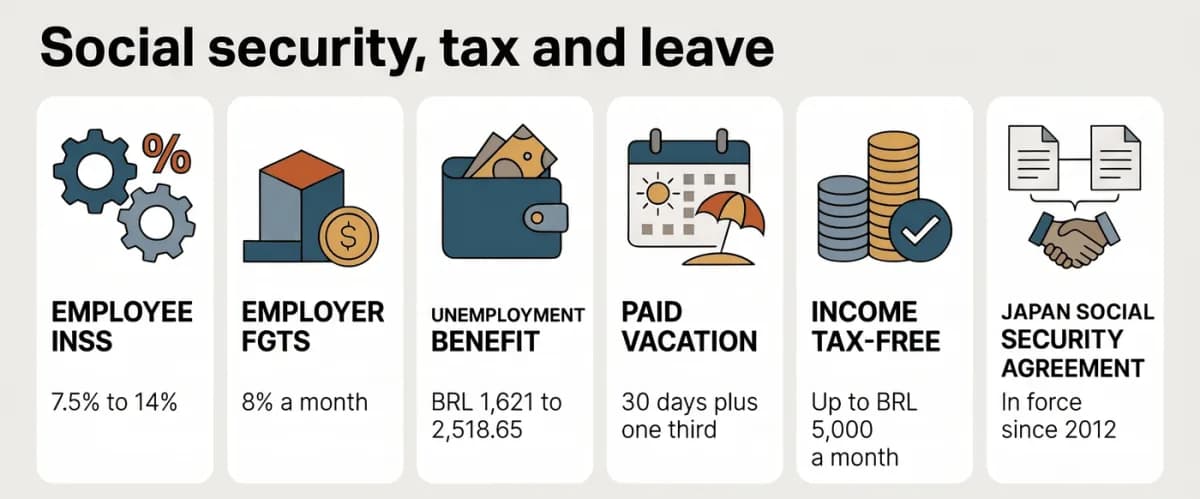
Employee INSS. The contribution is progressive: each rate applies only to its slice of salary (Portaria Interministerial MPS/MF 13 of 9 January 2026).[^33]
| Salary slice (2026) | Rate |
|---|---|
| Up to BRL 1,621.00 | 7.5% |
| BRL 1,621.01 to 2,902.84 | 9% |
| BRL 2,902.85 to 4,354.27 | 12% |
| BRL 4,354.28 to 8,475.55 (the ceiling, about USD 1,682) | 14% |
The maximum monthly employee contribution is BRL 988.09 (about USD 196).
Employer contributions. The employer pays 20% on payroll for social security (Lei 8.212, art. 22, I) and deposits 8% of your salary into your FGTS account each month. Other employer charges vary by sector and do not come out of your pay.[^34]
Seguro-desemprego. For benefits from 11 January 2026 the floor is BRL 1,621.00 and the ceiling BRL 2,518.65 (about USD 500 / JPY 78,390). In the rules as we read them, a first claim needs formal work in 12 of the last 18 months, a second 9 of the last 12 and later claims 6 months. The rules do not exclude foreigners; they apply to formal (CTPS) employment, and Lei 13.445 art. 4 gives migrants equality in social rights. That is our reading, so check with the MTE.[^35]
Retirement age. 65 for men and 62 for women (Constitution art. 201, §7, I, as amended by EC 103/2019). People who joined the system after 13 November 2019 need a minimum of 20 years of contributions (men) or 15 (women); transition rules still apply to older insured people.[^36]
Japan–Brazil social security agreement. The agreement has been in force since 1 March 2012. It totalises insurance periods for pensions and exempts a worker posted from one country to the other from the host-country scheme for up to 5 years, with a certificate of coverage. A second posting exemption is not available until 1 year after the first one ended. The agreement covers pensions only.[^37] Check with the Japan Pension Service and the INSS.
Taxes on employees
IRPF monthly table (from January 2026). Employment income is taxed under the imposto de renda da pessoa física and withheld at source each month.[^38]
| Monthly taxable income | Rate | Deduction |
|---|---|---|
| Up to BRL 2,428.80 | Exempt | n/a |
| BRL 2,428.81 to 2,826.65 | 7.5% | BRL 182.16 |
| BRL 2,826.66 to 3,751.05 | 15% | BRL 394.16 |
| BRL 3,751.06 to 4,664.68 | 22.5% | BRL 675.49 |
| Above BRL 4,664.68 | 27.5% | BRL 908.73 |
The deduction per dependant is BRL 189.59, and the simplified discount is BRL 607.20.[^38]
The BRL 5,000 exemption. Lei 15.270 of 26 November 2025 (effects from 1 January 2026) adds a monthly reduction so that income up to BRL 5,000 (about USD 993 / JPY 155,630) pays no tax. The reduction is BRL 978.62 minus 13.3145% of income between BRL 5,000.01 and BRL 7,350 (about USD 1,459), and it disappears above BRL 7,350.[^39] The same law adds a minimum tax on high incomes: for total annual income above BRL 600,000 the rate rises in a straight line from 0% at BRL 600,000 to 10% at BRL 1.2 million, and a 10% withholding applies to dividends above BRL 50,000 a month from one company.[^39]
Residents and non-residents. A person on a temporary visa with a work contract is a tax resident from arrival; otherwise residence starts from the 184th day in 12 months (Receita Federal guidance). Non-residents pay a flat 25% on work income (Lei 9.779/1999, art. 7).[^43]
No state or municipal income tax on wages. The Constitution gives income tax to the Union (art. 153, III), while states levy ICMS and municipalities ISS and IPTU, so there is no Brazilian equivalent of Japan's resident tax (住民税, juminzei) on your salary (likely).[^40]
CBS and IBS. The consumption-tax reform (Emenda Constitucional 132/2023 and Lei Complementar 214/2025) starts with a test year in 2026: CBS at 0.9% (art. 346) and IBS at 0.1% (art. 343). They are consumption taxes, not a tax on salary, and can be offset against other taxes. The full system is due by 2033.[^41]
Japan–Brazil tax treaty. The 1967 convention, as amended by a protocol, is still listed in Japan's treaty network on 1 October 2026; we found no new 2020s protocol. Check the Receita Federal and Japan's National Tax Agency about relief before you assume it applies.[^42]
Where to find jobs, recruitment agencies and job scams
| Channel | Use |
|---|---|
| SINE and Emprega Brasil | Free public employment system run by the MTE; job search and services for workers. Also see the Carteira de Trabalho Digital and the MTE[^44] |
| Job boards and applicant systems | Gupy, Trampos, Solides and ProgramaThor (tech). Catho, InfoJobs, Vagas.com, BNE, Indeed, LinkedIn and Glassdoor are also widely used (names only; market practice, not an official ranking)[^44] |
| Recruitment agencies | Michael Page, Hays, Robert Half, Randstad, Adecco and ManpowerGroup; Robert Walters and Korn Ferry are also active (names only)[^44] |
| Public competitions | Federal posts are filled by public competition. The CNU 2 offered 3,652 vacancies in 32 federal bodies; the minister said there would be no new edition in 2026 (reported). Lei 15.142 quotas apply at federal level, see above |
Scams. The Febraban banking federation warned on 12 May 2026 about fake recruiters who contact people by WhatsApp, email and social media, charge fake fees for courses or exams, or steal selfies and documents to take out loans.[^45] A real employer does not ask you to pay for a job, a "training kit", an exam or a placement. Check the company's name and CNPJ (the company registration number), be wary of offers that move to a messaging app at once or ask for your bank login, and never send photos of documents to an unverified recruiter. If you are targeted, file a boletim de ocorrência at a police station, tell your bank and report the ad to the platform. The Ministério Público do Trabalho handles labour-law complaints, and consumidor.gov.br is the government consumer-complaint channel. Never pay anyone for a job or for placement.
Final checks before you apply
- [ ] The language matches the vacancy or portal.
- [ ] The CV is one or two pages and the strongest evidence is easy to find.
- [ ] Every date, qualification and language level is defensible.
- [ ] Age, marital status, children, religion and politics are left out; the photo decision is yours.
- [ ] CPF only where a form asks; no passport number or bank details on the CV.
- [ ] The work-authorisation line is short and true, and the residence document I hold allows work.
- [ ] I know the pay basis: bruto or líquido, 13º salário and benefits such as vale-transporte.
- [ ] I checked degree recognition (revalidação or reconhecimento) and any council registration.
- [ ] If the offer is PJ, I understand that it is not a CLT employment contract.
- [ ] No one asked me for a fee before a signed contract.
- [ ] The file reads cleanly when copied and I saved the version I sent.
FAQ
What is the standard Brazilian CV format?
There is no statutory template. A practical default is a clear, vacancy-specific currículo of one or two pages, latest job first, in the language of the advert.
Should a Brazilian CV include a photo?
No law we found requires or bans one. The law targets discrimination in selection (CLT art. 373-A, Lei 9.029), so many applicants leave the photo off. Follow the vacancy and your own preference.[^3][^4]
Can an employer ask for my criminal record or credit history?
A criminal-record certificate is lawful only when required by law or justified by the nature of the job or a special relationship of trust (TST, 20 April 2017). TST decisions treat credit checks of candidates as discriminatory.[^6][^7]
What is the minimum wage in Brazil in 2026?
BRL 1,621.00 a month (about USD 322 / JPY 50,450) from 1 January 2026. São Paulo sets a regional floor of BRL 1,874.36.[^17][^18]
How long can an experience contract last?
At most 90 days (CLT art. 445, sole paragraph). A fixed-term contract can last at most 2 years, and renewing it more than once makes it indefinite.[^3]
How much income is tax-free in 2026?
Income up to BRL 5,000 a month (about USD 993) pays no income tax under Lei 15.270/2025, with a reduction that fades out at BRL 7,350.[^39]
Is the 6x1 work schedule over?
Emenda Constitucional 141 of 16 October 2026 sets two weekly rest days and a 40-hour week, phased in: 42 hours from about mid-December 2026 and 40 hours about a year later. Until then 44 hours applies.[^29]
Is there a Nikkei visa for Brazil?
No. The generation-based status is Japan's: 定住者 for the second and third generations of Brazilians of Japanese descent going to Japan, plus a fourth-generation scheme for ages 18 to 35 with a quota of 4,000.[^25]
Can I work in Brazil on a Mercosur residence?
The Mercosur residence agreement gives nationals of covered States temporary residence of up to 2 years, then convertible. Confirm that your country is covered and what the authorisation allows with the Polícia Federal.[^24]
How much notice and severance do I get?
Aviso prévio is 30 days plus 3 days per completed year of service, up to 90 days. For dismissal without cause the employer pays a 40% fine on your FGTS balance.[^31][^34]
How to use AIResume
Keep one master CV in AIResume and create a Brazil version for each vacancy: remove personal data you do not need, move the strongest evidence for the role to the top, state language levels truthfully, then export a PDF unless the employer asks for another format. Use our ATS-friendly CV guide for file checks and save the exact version and date you send.
Related AIResume guides
- Job boards in Brazil
- Argentina CV format
- Portugal CV format
- Chile CV format
- Mexico CV format
- How to write an ATS-friendly CV
Sources
[^1]: World Bank, World Development Indicators: Brazil (accessed 25 October 2026)
[^2]: Banco Central do Brasil, PTAX closing rate (selling), 23 October 2026; JPY cross from the ECB reference rate of the same day (USD 1 = JPY 156.80)
[^3]: Planalto, Consolidação das Leis do Trabalho (Decreto-Lei 5.452/1943), texto compilado
[^4]: Planalto, Lei 9.029/1995
[^5]: Planalto, Lei 13.709/2018 (LGPD)
[^6]: Tribunal Superior do Trabalho, criminal-record certificate (IRR Tema 1)
[^7]: Tribunal Superior do Trabalho, credit-data searches on driver candidates
[^8]: Planalto, Lei 8.213/1991 (texto consolidado)
[^9]: Planalto, Lei 15.142/2025
[^10]: Planalto, Lei 14.611/2023 and Agência Brasil, STF upholds the equal-pay law (press)
[^11]: Câmara dos Deputados, PL 2.338/2023, tramitação
[^12]: Planalto, Lei 12.984/2014; Portaria MTE 1.246/2010 as cited by the Ministry of Health
[^13]: gov.br, Carteira de Trabalho Digital (MTE)
[^14]: Norma Regulamentadora NR-7 (Ministério do Trabalho e Emprego), see MTE; CLT art. 168 in note 3
[^15]: gov.br/MEC, Saiba como revalidar diploma estrangeiro no Brasil (September 2026) and gov.br, reconhecer ou revalidar diploma obtido no exterior
[^16]: Planalto, Decreto 8.660/2016 (Apostille Convention)
[^17]: Planalto, Decreto 12.797/2025 (salário mínimo 2026)
[^18]: Assembleia Legislativa de São Paulo, Lei 18.471 of 27 May 2026; Governo do Rio Grande do Sul, reajuste do piso salarial regional; Paraná and Santa Catarina from official state pages found by search (likely)
[^19]: Planalto, Lei 4.090/1962 (13º salário); Lei 7.418/1985 (vale-transporte); Lei 6.321/1976 (PAT); instalment dates under Lei 4.749/1965 (likely)
[^21]: Planalto, Lei 6.019/1974 (temporary work) and Lei 11.788/2008 (estágio)
[^22]: IBGE SIDRA, PNAD Contínua unemployment (table 6381) and IPCA 12-month (table 1737)
[^23]: Planalto, Lei 13.445/2017; Decreto 9.199/2017; Decreto 12.657/2025
[^24]: Planalto, Decreto 6.964/2009 (Acordo sobre Residência do Mercosul)
[^25]: Immigration Services Agency of Japan, fourth-generation Nikkei scheme
[^26]: Ministry of Foreign Affairs of Japan, Brazil basic data and Immigration Services Agency of Japan, foreign residents at end June 2026
[^27]: Ministry of Foreign Affairs of Japan, visa-exemption list for short stays
[^28]: Agência Brasil, Brasil abriga mais de 2 milhões de imigrantes e refugiados (OBMigra, 30 April 2026) (press); formal-job figure from OBMigra via an earlier check (likely)
[^29]: Planalto, Emenda Constitucional 141/2026
[^30]: Planalto, Lei 15.371/2026 and Lei 11.770/2008 (Empresa Cidadã)
[^31]: Planalto, Lei 12.506/2011 (aviso prévio)
[^32]: Planalto, Lei 14.759/2023 (20 November); federal 2026 calendar (Portaria MGI 11.460/2025) as reported by Agência Brasil, December 2025 (press)
[^33]: gov.br/INSS, tabela de contribuição mensal
[^34]: Planalto, Lei 8.212/1991 (texto consolidado) and Lei 8.036/1990 (FGTS, texto consolidado)
[^35]: MTE, reajuste do seguro-desemprego (January 2026); Agência Brasil (press); MTE, seguro-desemprego; Planalto, Lei 7.998/1990
[^36]: Planalto, Emenda Constitucional 103/2019
[^37]: Ministry of Health, Labour and Welfare of Japan, Japan–Brazil social security agreement guide
[^38]: Receita Federal, tabelas do imposto de renda 2026 and Planalto, Lei 15.191/2025
[^39]: Planalto, Lei 15.270/2025
[^40]: Planalto, Constituição Federal
[^41]: Planalto, Lei Complementar 214/2025 and Emenda Constitucional 132/2023
[^42]: Ministry of Finance of Japan, tax treaty network (1 October 2026)
[^43]: Planalto, Lei 9.779/1999; Receita Federal guidance "Residente e Não Residente" (21 October 2025 version, via an earlier check)
[^44]: Government and company sites: MTE, SINE, Emprega Brasil, Gupy, Trampos, Solides, ProgramaThor, Michael Page, Hays, Robert Half, Randstad, Adecco, ManpowerGroup (market practice, not an official ranking)
[^45]: Agência Brasil, Febraban alerta para golpe do falso emprego (12 May 2026) (press)
Your next step
- DeelFor employers hiring across borders: contracts, payroll and visas handled.See how Deel works
Affiliate links: we may earn a commission at no cost to you. Affiliate link