

Saudi Arabia CV Format 2026: Photo, Personal Data, Iqama, Pay, Saudization and Labor Law
No law sets the format of a Saudi CV. There is no required page count, no required photo and no required file type. What does differ from many other markets is the system around the CV: an iqama (residence permit) tied to a work permit, a localisation programme (Saudization, measured through Nitaqat
By AIResume Editorial Team
Last updated: 24 October 2026
No law sets the format of a Saudi CV. There is no required page count, no required photo and no required file type. What does differ from many other markets is the system around the CV: an iqama (residence permit) tied to a work permit, a localisation programme (Saudization, measured through Nitaqat) that shapes how larger employers hire, a pay package built from a basic wage plus allowances, no general statutory minimum wage for foreign private-sector workers, no personal income tax, and an end-of-service award instead of a pension for most foreigners. This guide turns those rules into practical choices for the CV and the application.
It is written for Saudis, expatriates already in the Kingdom on an iqama, professionals applying from abroad, and Japanese nationals. It covers the CV format, personal data, iqama status and job changes, degree equivalency, an annotated sample CV, pay, the economy, rules for foreign workers, labor law, holidays, social security, taxes and job scams. For where to find vacancies, see our Saudi Arabia job-board guide.
Editorial boundary: This is practical job-search guidance, not legal, immigration or tax advice. We only list figures we could read in an official or primary source: the Ministry of Human Resources and Social Development (MHRSD, also written HRSD), the Qiwa platform, the General Organization for Social Insurance (GOSI), the Saudi Data and AI Authority (SDAIA), the Zakat, Tax and Customs Authority (ZATCA), the General Authority for Statistics (GASTAT), the Saudi Central Bank (SAMA) and the Bureau of Experts legal portal (laws.boe.gov.sa). Some Qiwa and MHRSD pages could not be opened when we checked, so the items that rest on press reports or professional summaries are marked "reported" or "likely". Confirm details with the authority concerned before you sign.
The riyal (SAR) is pegged by SAMA at 3.75 per US dollar, so SAR 1 is about USD 0.27.[^1] For yen we use the MUFG mid-rate (TTM) of 23 October 2026, about JPY 41.8 per riyal, so SAR 4,000 is about USD 1,067 or JPY 167,200.[^2] The dollar rate is fixed but the yen rate moves, so treat yen figures as approximate.
Before you apply
- SafetyWing Nomad InsuranceHealth insurance that works in your new country from day one.Get a quote
Affiliate links: we may earn a commission at no cost to you. Affiliate link
Saudi CV format at a glance
| Topic | Saudi practice in 2026 | Law or official guidance |
|---|---|---|
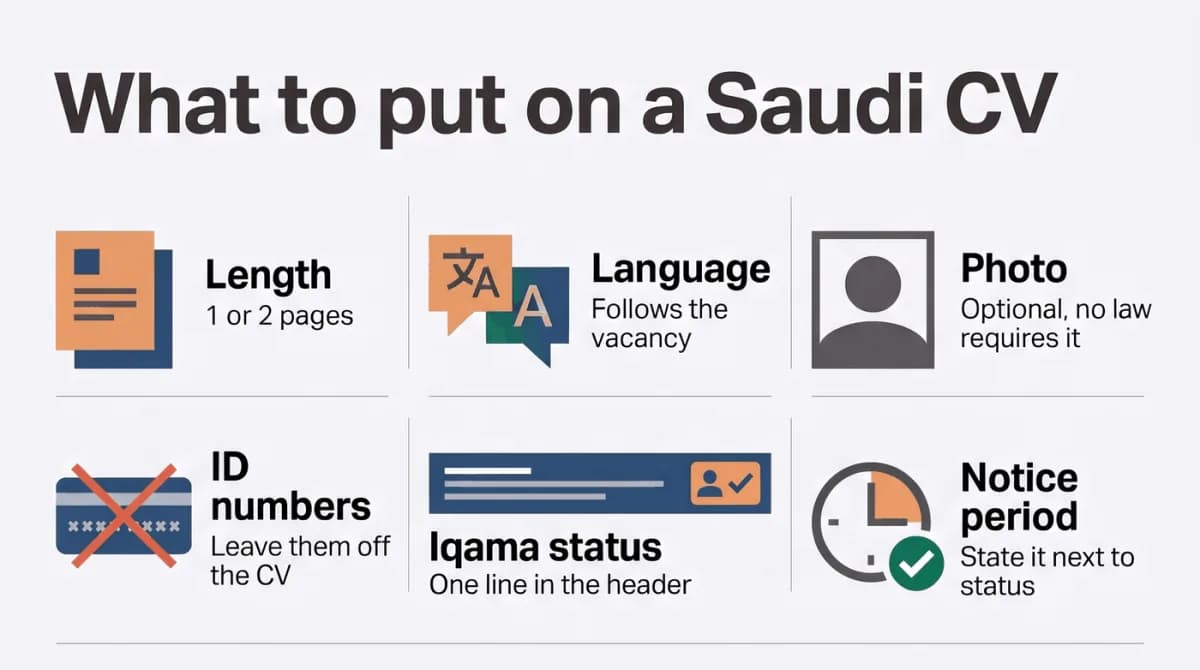
| Length | One or two focused pages; more only when seniority, projects or regulated credentials need it | Convention, not law |
| Photo | Depends on the vacancy; follow the advert or portal. Omit it if nothing asks for one | No law we could read requires or bans a CV photo; a photo counts as personal data under the PDPL[^7] |
| Nationality and iqama-status line | One plain line in the header, for example "Resident in Riyadh, current employment iqama, notice 60 days"; do not write the iqama number | Work and residence rules in the Labor Law, Arts. 35 and 40[^4] |
| Notice and availability | State notice next to your status; check your contract first | Art. 75 notice rules; probation capped at 180 days (Art. 53)[^4] |
| Personal data | Leave off National ID, iqama and passport numbers, scans and full address; give them in the employer's secure form at hiring | Personal Data Protection Law (PDPL), regulator SDAIA[^7] |
| Degree equivalency | Write the real award name; start equivalency only when an employer or regulator asks | Ministry of Education (MOE) equivalency e-service[^18] |
| References and service certificate | "References available on request"; a service certificate states dates, occupation and last wage | Labor Law Art. 64[^3] |
| Salary expectation | Leave current pay off the CV; give expectations in the employer's form as a package | Convention; no general minimum wage |
| File and ATS | Text-searchable PDF, simple headings, a clean DOCX in reserve | Convention |
| Language | CV language follows the vacancy (English or Arabic). Arabic is required for statutory records and employment contracts and prevails over another language | Labor Law Art. 9[^3] |
Make your current title, sector, core skills, experience, languages, iqama status and notice period easy to find in the first third of page one. Treat the live vacancy as the source of truth for required documents. For layout basics see our ATS-friendly CV guide.
Personal data, photo and fair hiring
Photo, marital status and date of birth. We found no Saudi law that requires a photograph on a CV and none that bans one. This is practice, not law: add a photo if the advert or portal asks, otherwise leave it off, especially on a CV that circulates internationally. The same logic applies to marital status, number of children, religion and exact date of birth: include them only if a trusted employer form explains why it needs them. Keep your National ID, iqama and passport numbers off any CV that may be emailed or forwarded; that is editorial privacy advice, not a quotation from the law.
Personal data law (PDPL). The Personal Data Protection Law was issued by Royal Decree M/19 on 16 September 2021 and amended by Royal Decree M/148 in March 2023. It entered into force on 14 September 2023 with a one-year compliance period that ended on 14 September 2024. The regulator is SDAIA.[^7][^8] Article 1 lists photos and videos, personal identification numbers, addresses and contact numbers among personal data, so a photo on a CV is personal data. The law sets data-minimisation and purpose-limitation principles; it does not list the fields an applicant may or may not put on a CV. The amended SDAIA regulation on transferring personal data outside the Kingdom has been reported to apply since 1 September 2024, which matters if a Saudi employer sends your CV to an overseas group office.[^9]
Non-discrimination. Article 3 of the Labor Law (as amended by Royal Decree M/134 of 1440 H) says citizens are equal in the right to work without discrimination on the basis of sex, disability, age or any other form, at work, at hiring and in job advertising. The 2025 amendments (Royal Decree M/44) added a new item 4 to Article 61: the employer must refrain from anything that nullifies or impairs equality of opportunity or treatment in employment, including exclusion, distinction or preference among applicants or workers on the basis of race, colour, sex, age, disability, marital status or any other form of discrimination.[^3][^6] The 2025 text names marital status, yet it does not say what a CV or an interview form may contain. We found no article that bans a photo or a marital-status line on a CV, so treat that choice as practice: leave them off unless asked, and treat a request for sensitive documents before an interview as a reason to ask why.
What no law covers. We did not find a rule on pregnancy tests, medical-history questions or family-planning questions in the articles and summaries we read, so we do not claim one. Medical checks, where they occur, belong to the visa and onboarding process rather than the CV.
Iqama status, job changes and Saudization
Changing employer. The Labor Reform Initiative (LRI), announced by MHRSD on 4 November 2020 and effective 14 March 2021, states that "employee mobility will allow expatriate workers to transfer between employers upon the expiry of the binding work contract without the employer's consent". During a valid contract a transfer is possible subject to a notice period and specific measures that the official announcement does not itemise, so we give no notice length and no list of conditions. The same initiative lets workers travel on an exit/re-entry visa without the employer's approval after submitting a request, with the employer notified electronically, and lets them take final exit after the contract ends without the employer's consent; the worker bears the consequences of breaking a contract. The services run on Absher and Qiwa.[^10] Under Article 40 (as amended in 2025) the new employer bears the transfer fee, and the employer bears exit/re-entry fees and the return ticket at the end of the relationship.[^3] Article 35 lets the ministry refuse to renew the work permit of an employer that breaches localisation standards, and the regulation provides for moving the worker to another employer without that employer's consent.[^3][^4]
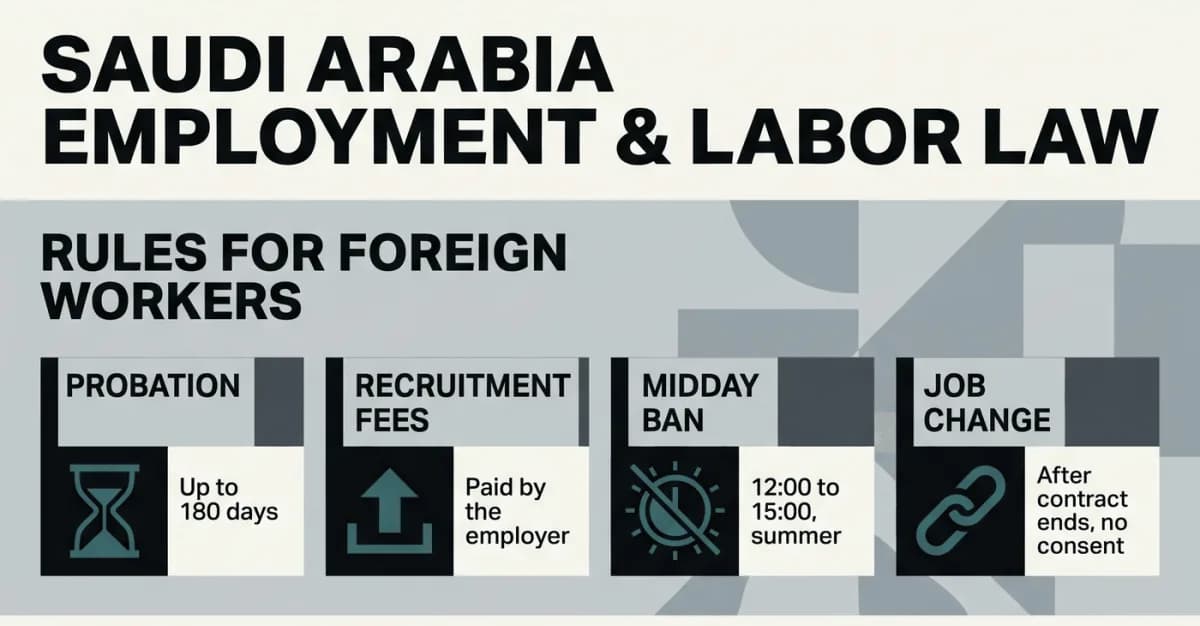
Contract and probation. Under Article 37, a non-Saudi worker's contract is fixed-term, one year by default, and renews automatically.[^4] Under Article 53 as amended, the contract must expressly provide for probation, the total may not exceed 180 days in any case, and either party may end the contract during it.[^4]
Exit and re-entry on a CV. Do not put exit/re-entry or final-exit details on a CV. They are process steps, not qualifications.
How to state iqama status and notice. Put one truthful line in the header: "Resident in Jeddah, employment iqama, notice 60 days" or "Overseas applicant, needs employer sponsorship". There is no official status vocabulary on Qiwa or MHRSD for a CV, which treat transfer as a process rather than a label, so do not copy phrases from other people's CVs, and do not write the iqama number.
Nitaqat. Nitaqat is an establishment-level framework: it rates an employer, not a vacancy, and it does not tell you whether one job is open to you. A Saudi counts as a full worker in Nitaqat at a social-insurance wage of SAR 4,000 or more (about USD 1,067) under a ministerial decision of November 2020. This is reported through press, because the Qiwa page could not be opened; the wage that counts is the wage on which social insurance is paid, not "basic salary".[^16][^17]
2025 to 2026 localisation decisions. These are quotas on employers in a profession group, not rules for a single vacancy. They decide how many Saudis a firm of a given size must employ in that group, and the minimum wage a Saudi must earn to count toward the quota. They do not stop a foreign applicant from being hired for one role.
| Profession | Quota | Applies to | Minimum wage for a Saudi to count | From |
|---|---|---|---|---|
| Technical engineering | 30% | 5 or more workers | SAR 5,000 | 27 July 2025[^11] |
| Pharmacy | 35% community pharmacies and medical complexes, 65% hospital pharmacy, 55% other | 5 or more workers | SAR 7,000 | 27 July 2025[^11] |
| Dental | 45%, then 55% | 3 or more workers | SAR 9,000 and valid SCFHS accreditation | 27 July 2025; 27 January 2026[^11][^15] |
| Accounting | 40% in phase 1, rising to 70% over five phases | 5 or more accountants (44 professions) | SAR 6,000 bachelor's; SAR 4,500 diploma | 27 October 2025[^13] |
| Marketing | 60% | 3 or more workers (10 professions) | SAR 5,500 | Announced 26 January 2026[^14] |
| Sales | 60% | 3 or more workers | No minimum stated | Announced 26 January 2026[^14] |
| Engineering professions (46) | 30% | 5 or more workers | SAR 8,000 | Announced 21 January 2026; enforcement 6 months after issuance[^12] |
| Procurement (12 professions) | 70% | 3 or more workers | Not read | Announced 21 January 2026; enforcement 6 months after issuance[^12] |
MHRSD also published a headline on 9 September 2026 about raising localisation of project management professions; we have not confirmed the details, so we give no quota. Check the current decision for your profession on Qiwa before you assume anything about a specific role.
Degree equivalency, skill verification and professional licences
Degree equivalency (MOE). The Ministry of Education operates an e-service for the equivalency of degrees obtained outside the Kingdom. It asks for a national ID or passport, the certificate and the transcript. Equivalency is not needed for every private-sector job, so ask the employer before you start.[^18] Put your real award name, institution and country on the CV, and write "MOE equivalency: pending" only if a real application is pending. We did not find an official requirement for a stamping step after entry into the Kingdom, so we do not describe one.
Professional Verification Program. MHRSD uses the name "Professional Verification Program". For highly skilled professions it verifies documents and qualifications automatically (reported up to 15 working days). For medium- and low-skilled trades it tests practical and theoretical skills before arrival and after entry. It has been extended to 160 labour-exporting countries (reported).[^21][^22] We do not give exam lengths or validity periods because only third-party sources state them.
Health practitioners (SCFHS). The Saudi Commission for Health Specialties verifies foreign qualifications through DataFlow, runs exams through Prometric or Pearson VUE, and takes classification applications from foreign applicants through Mumaris Plus. Non-Saudis need at least one year of experience. Registration applies only to health practitioners.[^19][^20]
Engineers (SCE). The Saudi Council of Engineers requires registration for engineering practice under the engineering professions law, and foreign engineers are reported to need SCE membership for iqama issue and renewal. We could not open the council's page, so confirm the current requirement with the council. Write "SCE membership" on a CV only if you hold it, and never print the number.[^23]
Annotated sample Saudi CV
Everything below is fictional: the person, employer, contact details and results. Replace every item with facts you can prove.
Noor Hassan, Supply Chain Operations Specialist
Riyadh, Saudi Arabia · +966 50 000 0000 · [email protected]
Status: Resident in Riyadh, employment iqama · Notice period: 60 days
Annotation: city only, no National ID, iqama or passport number, no date of birth, no photo unless the vacancy asks. Status and notice answer two early screening questions.
Profile
Supply chain operations specialist with five years of fictional experience coordinating orders, inventory records and vendor follow-up for consumer-goods teams.
Annotation: names the target role and evidence in two lines.
Core skills
Inventory reporting · vendor coordination · SAP order tracking · Excel reconciliation · process documentation
Experience
*Supply Chain Operations Specialist, Desert Example Trading Co., Riyadh | March 2023 to present*
- Reconciled a fictional weekly inventory file of 420 stock-keeping units and documented exceptions for warehouse owners.
- Built a fictional supplier follow-up tracker that cut unresolved delivery checks from 31 to 12 a week.
- Prepared bilingual fictional status notes for sales and warehouse teams from verified order data.
*Operations Assistant, Coast Example Foods Ltd., Jeddah | July 2021 to February 2023*
- Updated fictional purchase-order records and prepared a weekly late-delivery report for the operations manager.
Annotation: each bullet starts with a verb and names a deliverable. Replace every fictional number with a record you can explain.
Education and languages
Bachelor of Business Administration, Example University, 2021 (fictional). Arabic (native), English (C1, fictional).
Annotation: keep the real award name. Add equivalency or licence status only when verified. References: available on request, after you have asked the referees.
Salary packages and the minimum wage
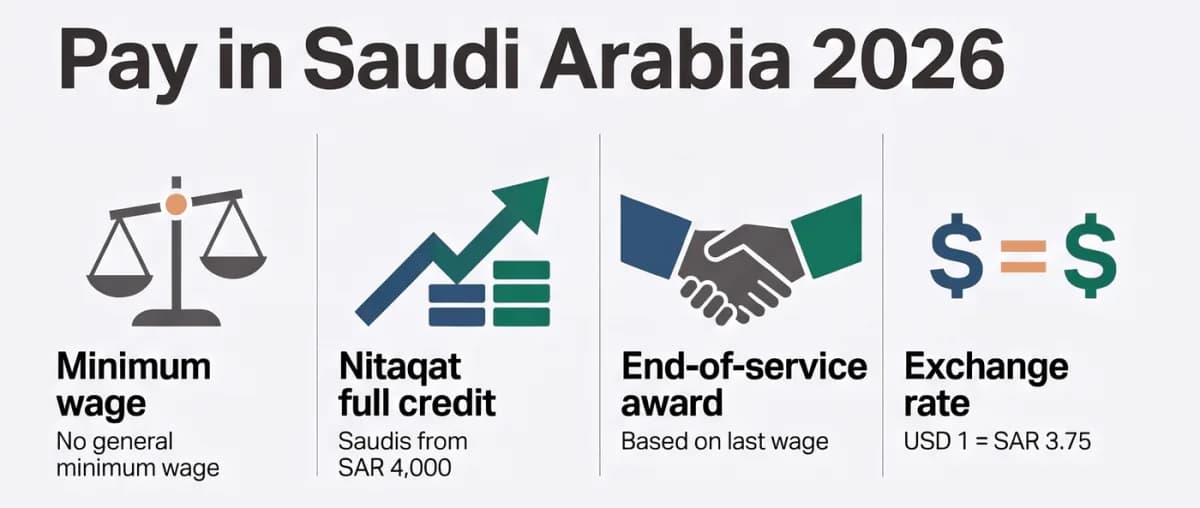
Package structure. A Saudi offer is usually negotiated as several lines: basic wage, housing, transport and other allowances. Ask for the breakdown in writing. The percentage splits between basic wage and allowances are market practice, not law, so do not assume one. The law defines the "actual wage" as the basic wage plus allowances, customary commissions and bonuses, and in-kind benefits.[^5]
What the law does say. Article 61 items 5 and 6, added in 2025, oblige the employer to provide suitable housing, which it may replace with a suitable cash allowance paid with the wage, and suitable transport from residence to work, or a cash allowance.[^3] The end-of-service award under Article 84 is calculated on the last (actual) wage, so a package with a very low basic wage and large cash allowances can still produce a reasonable award, but ask how your contract defines the wage.[^4] Overtime under Article 107 is the hourly basic wage plus 50%.[^4]
No general minimum wage. We found no general statutory minimum wage for non-Saudi private-sector workers. SAR 4,000 (about USD 1,067 or JPY 167,200) is the full-credit counting threshold for a Saudi in Nitaqat, not a statutory minimum wage, and the localisation minimums in the table above likewise decide only whether a Saudi counts toward a quota.[^16][^11]
Average wages. The National Labor Observatory (NLO) reports average monthly wages in the private sector at the end of Q1 2026 of SAR 9,331 for Saudis (about USD 2,488 or JPY 390,000) and SAR 2,615 for non-Saudis (about USD 697 or JPY 109,300).[^30] The gap reflects different occupations, not a pay scale by nationality, and many non-Saudi workers are in lower-paid trades.
Wage Protection System (WPS). The Mudad platform has run the WPS since 2013; it has applied to all private firms, including micro and small ones, since 31 December 2020. MHRSD reports more than 900,000 establishments covered and compliance above 88% in 2024. Non-compliance is reported to bring fines and suspension of ministry services.[^46] Keep every pay slip and check that your pay matches your Qiwa contract.
What this means: without a minimum wage, your protection is the written contract, the end-of-service rules and WPS. Compare offers on the full package and the basic wage, ask how the contract defines "wage", and keep your records.
Saudi Arabia's economy in numbers
| Indicator | 2020 | 2021 | 2022 | 2023 | 2024 | 2025 |
|---|---|---|---|---|---|---|
| GDP (USD billion) | 768.0 | 982.7 | 1,239.1 | 1,218.6 | 1,254.1 | 1,276.9 |
| GDP per person (USD) | 24,339 | 31,921 | 38,510 | 36,157 | 35,528 | 34,537 |
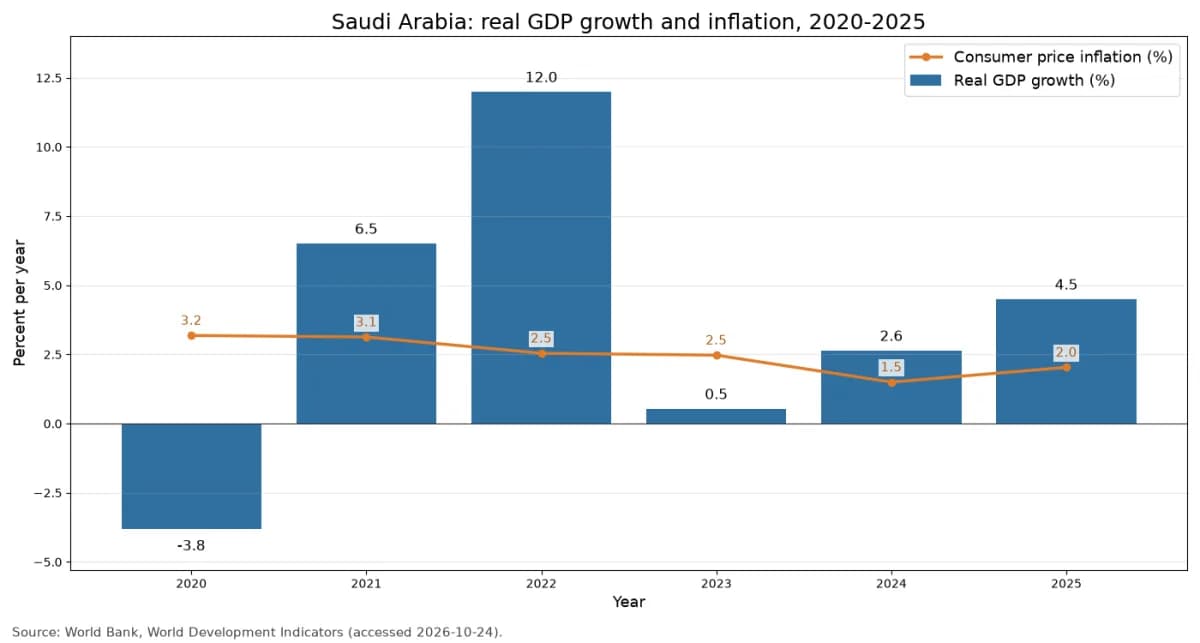
| Real GDP growth (%) | -3.8 | 6.5 | 12.0 | 0.5 | 2.6 | 4.5 |
| Inflation (%) | 3.2 | 3.1 | 2.5 | 2.5 | 1.5 | 2.0 |
| Population (million) | 31.55 | 30.78 | 32.18 | 33.70 | 35.30 | 36.97 |
*Source: World Bank, World Development Indicators (accessed 24 October 2026).*[^51]
The World Bank also lists unemployment of 3.0% for 2025, youth unemployment (ages 15 to 24) of 10.0% and an international migrant stock of 13,683,841 for 2024.[^51]
| Measure | Value | Source |
|---|---|---|
| Consumer prices, September 2026 | 1.9% | GASTAT home page[^25] |
| Real GDP growth, Q2 2026 | 4.7% | GASTAT home page headline[^25] |
| Unemployment, Q2 2026 | Total 3.0%; Saudis 6.5%; Saudi women 9.6%; non-Saudis 1.3% | GASTAT Labour Force Survey[^26] |
| Participation, Q2 2026 | Saudi women 33.7% | GASTAT Labour Force Survey[^26] |
| IMF forecast (Article IV, 29 July 2026) | 2025: 4.6%; 2026: 1.7% (forecast); 2027: 5.5% (forecast) | IMF[^28] |
| World Bank forecast | 2026: -2.0%; 2027: +7.9% (reported) | Zawya, quoting the World Bank[^29] |
| Population | Census 2022: 32,175,224; mid-2024 estimate 35.3 million (Saudis 19.6 million, non-Saudis 15.7 million) | GASTAT[^27] |
The IMF names disruption to shipping through the Strait of Hormuz as a downside risk to the forecasts. Forecasts are projections, not outcomes, and the IMF and World Bank figures differ.
What this means for a job seeker: a 3.0% overall unemployment rate hides a large gap between non-Saudis (1.3%) and Saudis (6.5%), and between Saudi women and men. Expect strong demand for Saudi nationals in localised professions, and treat 2026 growth forecasts as uncertain when you weigh an offer that depends on a project start date.
Rules for foreign workers
| Topic | Rule | Source |
|---|---|---|
| Work-permit skill tiers | Since 5 July 2025 (workers already in the Kingdom) and 3 August 2025 (new arrivals), work permits are classed High-skilled, Skilled or Basic by occupation group, qualification, experience, wage and age (likely; details not itemised) | Law-firm summaries; confirm on Qiwa[^50] |
| Employer-borne fees | The employer bears recruitment fees, residence and work-permit fees and renewals, occupation-change and exit/re-entry fees, fines caused by its own delay, and the return ticket | Labor Law Art. 40[^3] |
| Expatriate levy | Reported SAR 800 a month per non-Saudi worker when non-Saudis outnumber Saudis in the establishment, SAR 700 otherwise; paid by the employer. Reported abolished for licensed industrial establishments (Cabinet, December 2025). Check Qiwa | Reported[^50] |
| Dependant fee | Reported SAR 400 a month per dependant, paid by the expatriate at iqama renewal. It is a fee, not a tax | Reported[^50] |
| Work-permit fee | Reported SAR 100 a year per non-Saudi worker | Reported[^50] |
| Premium Residency | Five new categories announced 25 January 2024. Reported salary floors of SAR 14,000 to SAR 80,000 a month for the Special Talent categories; Investor reported at SAR 7 million with 10 jobs; Entrepreneur from SAR 400,000. Check sapr.gov.sa | Deloitte (likely)[^37] |
| Passport retention | Employers may not hold a non-Saudi worker's passport, iqama or medical card (reported; we give no fine amount) | Reported |
| Midday ban | No outdoor work 12:00 to 15:00 from 15 June to 15 September 2026; MHRSD reported 94% compliance in 2025 | DLA Piper summary of the MHRSD announcement[^36] |
| Job change | Mobility on contract expiry without employer consent; notice and measures during a valid contract | LRI[^10] |
Japanese nationals
Japan is on the Kingdom's tourist e-visa list: a one-year multiple-entry visa with stays of up to 90 days each. A tourist cannot work, so a job needs a work visa and an iqama through an employer.[^33] The Ministry of Foreign Affairs of Japan counted 718 Japanese residents in Saudi Arabia on 1 October 2025 (660 long-term and 58 permanent), up 8.6% on the year.[^32] Japan and Saudi Arabia have no social security agreement: Saudi Arabia is not among the 24 countries in force from 1 December 2025 on the Japan Pension Service list, so ask your Japanese employer or the Japan Pension Service how pension and health contributions apply.[^34] The Japan-Saudi tax treaty was signed in Tokyo on 15 November 2010 and entered into force on 1 September 2011.[^35]
Foreign workers in numbers
| Measure | Value |
|---|---|
| Private-sector employment, end Q1 2026 (NLO) | 13.570 million |
| of which Saudis | 2.627 million (about 19%) |
| of which non-Saudis | 10.942 million |
| Domestic workers, Q2 2026 (GASTAT administrative records) | 4,346,173 |
| Workers registered with GOSI, Q2 2026 | 13,987,636 |
| Non-Saudi share of all employment (Q4 2025, GASTAT via Argaam) | 77 to 78% |
| International migrant stock, 2024 (World Bank) | 13,683,841 |
| Japanese residents, 1 October 2025 (MOFA) | 718 |
Sources: NLO, DataSaudi, World Bank, MOFA.[^30][^31][^32][^51] Domestic workers are covered by separate regulations.
Labor law: hours, leave, notice and dismissal
The private sector is governed by the Labor Law, Royal Decree M/51 of 23 August 1426 H (27 September 2005), as amended by Royal Decree M/44 of 12 August 2024, which took effect on 19 February 2025 (38 articles amended, 7 omitted, 2 added; some firms give 18 February).[^6][^4] The English translation at the Bureau of Experts carries the amendments appendix. The table cites articles as we read them.
| Topic | Rule |
|---|---|
| Working hours (Art. 98) | 8 hours a day and 48 hours a week, 6 and 36 in Ramadan for Muslim workers. The official sources are not fully consistent: the Bureau of Experts appendix also shows a 2015 text of 9 hours and 45 hours, while MHRSD teaching pages still use 8 and 48. Check your contract[^4] |
| Weekly rest (Art. 104) | Friday, paid, at least 24 consecutive hours; it cannot be paid in cash; the employer may move it to another day after notifying the labour office[^4] |
| Overtime (Art. 107) | Hourly basic wage plus 50%; with the worker's consent, paid leave days in lieu[^4] |
| Annual leave (Art. 109) | At least 21 days; at least 30 days after 5 consecutive years; it cannot be waived or cashed during service[^4] |
| Sick leave (Art. 117) | 30 days at full pay, 60 days at 75%, then 30 days unpaid, per year counted from the first sick day[^4] |
| Maternity (Art. 151) | 12 weeks at full pay (up from 10), 6 of them straight after delivery; one month unpaid extension; one extra paid month for a sick or disabled child[^4] |
| Special leave (Art. 113) | 5 days paid for marriage or the death of a spouse, ascendant or descendant; 3 days for the death of a sibling; 3 days paternity within 7 days of birth[^4] |
| Notice (Art. 75) | Monthly-paid, indefinite contracts: employee 30 days, employer 60 days, in writing; non-monthly pay: 30 days either side[^4] |
| Compensation (Arts. 76 to 77) | Unobserved notice means wages for the notice period; unlawful termination of an indefinite contract: 15 days' wage per year of service unless the contract sets more; fixed-term: the wage for the rest of the term; never less than 2 months' wage[^4] |
| Resignation (Art. 79 bis) | Fixed-term resignation is deemed accepted if the employer is silent for 30 days; the employer may defer up to 60 days with a written reason; the worker may withdraw within 7 days[^4] |
| Summary dismissal (Art. 80) | Grounds include absence of more than 30 days in a contract year or more than 15 consecutive days, after written warnings at 20 and 10 days[^4] |
| End-of-service award (Arts. 84 to 85) | See the social security section |
| Service certificate (Art. 64) | Free, on request at the end of the contract: start date, end date, occupation and last wage; nothing that harms your reputation or reduces future job chances[^3][^5] |
Disputes
The ministry first tries an amicable settlement, described by the ILO as within 21 days (reported), and unresolved claims go to the labour court. Claims are time-barred 12 months after the end of employment (Art. 234).[^45][^4] Domestic workers have a separate committee.
2026 public holidays
Founding Day (22 February) and National Day (23 September) have fixed dates. Eid al-Fitr and Eid al-Adha are 4 days each in the private sector; the exact 2026 dates depend on moon sighting and are reported from press, not from a ministry page we could open. Compensation is due if a holiday falls on the weekly rest day or the worker works (executive regulations, Art. 24).
| Holiday | 2026 date | Days | Status |
|---|---|---|---|
| Founding Day | Sunday 22 February | 1 | Fixed date |
| Eid al-Fitr | Break reported from the end of Wednesday 18 March; Eid day 1 reported as Friday 20 March | 4 | Reported[^47][^48] |
| Eid al-Adha | Arafah on Tuesday 26 May, Eid on Wednesday 27 May; break reported Tuesday 26 to Friday 29 May (one report says Saturday 30 May) | 4 | Reported; end date varies[^49] |
| National Day | Wednesday 23 September | 1 | Fixed date |
Social security, end-of-service, unemployment insurance and health cover
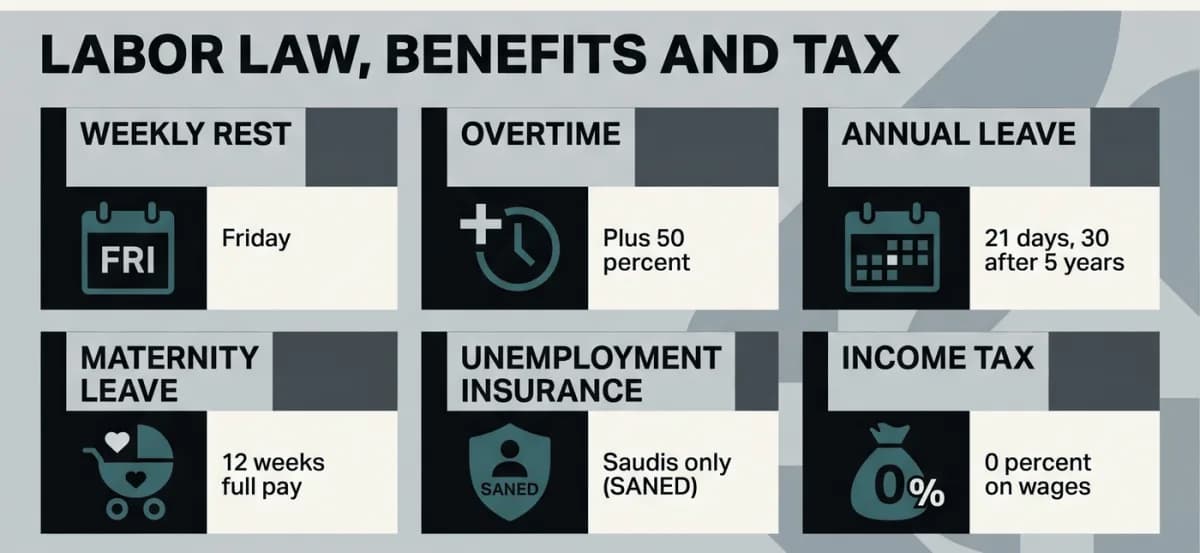
GOSI for Saudis. For Saudis, the legacy annuities contribution is 18%, split 9% employer and 9% employee. The SANED unemployment-insurance contribution is 1.5% (0.75% each) since 1 January 2022. The contributory wage is capped at SAR 45,000 a month (about USD 12,000).[^38][^39] A new Social Insurance Law (Royal Decree M/273, approved 2 July 2024) applies only to new civil entrants with no prior contributions, with the pension contribution rising by 0.5 point a year from year two, reported as 11% instead of 9% in total; we do not state the split between employee and employer.[^40][^41]
Occupational hazards. The employer pays 2% of wages for all workers, whatever their nationality.[^39]
Non-Saudis. The annuities branch is compulsory for Saudis only, so non-Saudis have no state pension in Saudi Arabia.[^39] The end-of-service award replaces it.
End-of-service award (Arts. 84 and 85). Article 84 applies to every worker under the Labor Law, not only foreigners. It pays half a month's wage for each of the first five years and a full month's wage for each later year, on the last (actual) wage, pro rata for part-years. On resignation (Art. 85) you receive one third after 2 to 5 years, two thirds after 5 to 10 years and the full award after 10 years, and nothing under 2 years. Article 87 gives the full award for force majeure, and for a woman who resigns within 6 months of marriage or 3 months of childbirth.[^4] Commissions and variable pay may be excluded by agreement (Art. 86).
Unemployment insurance (SANED). SANED covers Saudis only. Foreign workers have no unemployment insurance in Saudi Arabia, so keep savings and a plan for an exit.[^38]
Health insurance. Private employers must insure Saudi and non-Saudi employees and their covered family members (spouse, sons up to 25 and unmarried non-working daughters), reported; employers need not insure parents or siblings. We did not read the Council of Health Insurance law text, so ask your employer in writing what the policy covers.
Taxes on employees
- Personal income tax: none on wages. Zakat and corporate income tax apply to businesses, not to your payslip.[^42]
- VAT: 15% since 1 July 2020.[^42]
- Excise tax: from 1 January 2026, the 50% rate on sweetened drinks is replaced by a per-litre tier by sugar per 100 ml: SAR 0 for sugar-free and under 5 g, SAR 0.79 for 5 g to under 8 g and SAR 1.09 for 8 g or more (about USD 0.29). Tobacco and energy drinks stay at 100%.[^43]
- Real estate transaction tax (RETT): 5% on transfers of real estate by sale or gift, with exceptions.[^44]
- Local personal tax: none. There is no municipal or regional income tax on individuals, so nothing like Japan's resident tax (juminzei).
- Closest recurring charge for expatriates: the dependant fee (reported SAR 400 a month per dependant), which is a fee and not a tax.[^50]
- Treaty with Japan: signed 15 November 2010, in force 1 September 2011, with withholding taxes applying from 1 January 2012.[^35]
Recruitment agencies and job scams
Article 30 of the Labor Law allows only persons licensed by MHRSD to recruit Saudis or workers from abroad. Under Article 22 the ministry's employment channels are free to use. Under Article 40, the employer, not the applicant, bears the recruitment, residence and work-permit costs, so never pay for a visa, a permit or a job.[^3] The implementing regulations also bar licensed offices from charging the worker (reported).[^52] MHRSD continues to report enforcement against unlicensed recruitment; a headline of 28 September 2026 reports 10 establishments detected operating recruitment services without a licence. A fine of SAR 200,000 to 500,000 for unlicensed manpower supply was reported with the 2025 amendments.[^10][^24] A reporting hotline of 920002866 was reported by MHRSD in 2024. Musaned is the platform for domestic workers, not a general agency checker.
Warning signs: a recruiter who asks for a fee, a "visa" sold for cash, an offer with no named employer, a request for your passport or iqama scan before any interview, and payment to a personal account. Check that an agency holds an MHRSD licence, and keep your documents out of messaging apps.
Final checks before you apply
- [ ] Plain layout, one or two focused pages, tailored to the vacancy, saved as a text-searchable PDF.
- [ ] Language of the CV follows the vacancy; Arabic version ready if asked.
- [ ] No National ID, iqama or passport number or scan; no salary history; photo only if the vacancy asks.
- [ ] Iqama status and notice period in the header; no promises about sponsorship or transfer.
- [ ] Real award names; MOE equivalency started only when required.
- [ ] For health roles, SCFHS route checked; for engineers, SCE membership stated only if held.
- [ ] Offer broken down into basic wage, housing, transport and other allowances; contract definition of "wage" read.
- [ ] Contract read for probation (180 days at most), notice, end-of-service and WPS payment.
- [ ] Agency licence checked; no fee paid.
- [ ] Referees have agreed; documents shared only through the employer's own secure channel.
FAQ
Is there an official Saudi Arabia CV format?
No. No law sets a page count, layout, photo or file type. Follow the vacancy and platform, and keep a clean master CV.
Is a photo required on a Saudi CV?
No law we read requires or bans one. Some employers and platforms ask for it. If the advert does not, omit it. A photo is personal data under the PDPL.[^7]
Should I put my iqama, National ID or passport number on the CV?
No. Give the numbers through the employer's secure form when they are needed. This is privacy advice; the PDPL does not prescribe CV fields.[^7]
Must my CV be in Arabic?
Not universally. Article 9 of the Labor Law requires Arabic for statutory records, files and employment contracts, and Arabic prevails if another language is used alongside. It is not a CV-language rule. Follow the vacancy.[^3]
Does Nitaqat mean foreigners cannot apply?
No. Nitaqat rates an employer's Saudi share. Localisation decisions set quotas by profession and firm size, not rules for a single vacancy. Check the specific role.[^16][^11]
Is there a minimum wage in Saudi Arabia?
We found no general statutory minimum wage for non-Saudi private-sector workers. SAR 4,000 (about USD 1,067) is the full-credit counting threshold for a Saudi in Nitaqat.[^16]
Do I pay income tax on my salary?
No personal income tax applies to wages. VAT is 15% and there is no local personal tax like Japan's resident tax (juminzei).[^42]
How is the end-of-service award calculated?
Half a month's last wage for each of the first five years and a full month for each later year, pro rata. On resignation you receive a third, two thirds or the full amount depending on service, and nothing under two years.[^4]
Does Saudi Arabia have unemployment insurance for foreigners?
No. SANED covers Saudis only.[^38]
Can Japanese citizens work in Saudi Arabia?
Yes, with an employer-sponsored work visa and iqama. The tourist e-visa for Japanese nationals does not allow work, and there is no Japan-Saudi social security agreement.[^33][^34]
How to use AIResume
Keep one master CV in AIResume and create a version for each advert using our ATS-friendly CV guide. Remove ID numbers, set your iqama-status and notice-period line, choose the English or Arabic version the employer asks for, and save the exact version and date you send.
Related AIResume guides
- Job boards in Saudi Arabia
- UAE CV format guide
- Qatar CV format guide
- UK CV format guide
- How to write an ATS-friendly CV
Sources
[^1]: Saudi Central Bank (SAMA), riyal peg of 3.75 per US dollar
[^2]: MUFG Bank, published exchange rates of 23 October 2026 (SAR TTM 41.80 yen)
[^3]: Bureau of Experts, Labor Law (current Arabic text with amendment notes)
[^4]: Bureau of Experts, Labor Law English translation with amendments to Royal Decree M/44
[^5]: MHRSD, Labor Law English translation (2023 edition, definitions and Art. 64)
[^6]: MHRSD, announcement of the Labor Law amendments taking effect
[^7]: SDAIA, Personal Data Protection Law (English)
[^8]: Latham & Watkins, Saudi Arabia's data protection law enters into force
[^9]: Clyde & Co, 10 legal updates in KSA tech and data laws (transfer regulation)
[^10]: MHRSD, Labor Reform Initiative announcement (4 November 2020)
[^11]: MHRSD, localisation of technical engineering, pharmacy and dental professions
[^12]: MHRSD, localisation of engineering professions and procurement
[^13]: MHRSD, localisation of 44 accounting professions (6 November 2025)
[^14]: MHRSD, localisation of marketing and sales professions
[^15]: MHRSD, phase 2 of dental localisation
[^16]: Saudi Press Agency, Nitaqat full-credit wage of SAR 4,000
[^17]: Saudi Gazette, Nitaqat wage threshold
[^18]: Ministry of Education, equivalency of qualifications issued outside the Kingdom
[^19]: SCFHS, Mumaris FAQ
[^20]: SCFHS, professional classification requirements
[^21]: Gulf News, Saudi professional scheme accredits nearly 210,000 expat workers
[^22]: MHRSD, Skills and training (Professional Verification Program)
[^23]: Bryan Cave Leighton Paisner / BAL, Saudi Arabia online registration for engineers (SCE)
[^24]: King & Spalding, Amendments to the Saudi Labor Law approved
[^25]: General Authority for Statistics (GASTAT), home page headlines
[^26]: GASTAT, Labour Force Survey Q2 2026 (text of the release, read from a mirror)
[^27]: GASTAT, Population Estimates Statistics 2024
[^28]: IMF, Saudi Arabia 2026 Article IV conclusion (29 July 2026)
[^29]: Zawya, World Bank forecast of Saudi rebound (press)
[^30]: National Labor Observatory, Q1 2026 labor force snapshot report
[^31]: DataSaudi, GASTAT administrative records
[^32]: Ministry of Foreign Affairs of Japan, Japanese residents overseas, 1 October 2025
[^33]: Visit Saudi, eVisa portal
[^34]: Japan Pension Service, social security agreements
[^35]: Ministry of Finance Japan, list of tax conventions
[^36]: DLA Piper, Saudi Arabia enforces seasonal midday work ban
[^37]: Deloitte Middle East, expansion of the Premium Residency program
[^38]: GOSI, annuities
[^39]: GOSI, social insurance (legacy law text)
[^40]: Saudi Gazette, social insurance law update
[^41]: Argaam, GOSI contribution rise
[^42]: ZATCA
[^43]: KPMG, amendments to the excise tax implementing regulations
[^44]: ZATCA, RETT implementing regulations
[^45]: ILO, description of Saudi labour dispute settlement
[^46]: ILO, wage protection systems
[^47]: Gulf News, Saudi Arabia announces Eid al-Fitr holidays for private sector
[^48]: Gulf News, first day of Eid al-Fitr 2026
[^49]: Time Out Jeddah, Eid al-Adha 2026 in Saudi
[^51]: World Bank, World Development Indicators, Saudi Arabia
[^52]: Gulf Labour Markets, summary of the implementing regulation of the Saudi Labor Law
Your next step
- DeelFor employers hiring across borders: contracts, payroll and visas handled.See how Deel works
Affiliate links: we may earn a commission at no cost to you. Affiliate link