
Qatar Job Boards in 2026: Kawader, LinkedIn, Employer Portals and the Rules That Shape Hiring
Qatar's job market runs on two tracks. Qatari nationals are steered towards a government platform, Kawader, and a 2025 law now requires private employers to look for Qatari candidates first. Everyone else competes through LinkedIn, regional job boards and the career portals of large employers such a
Qatar Job Boards in 2026: Kawader, LinkedIn, Employer Portals and the Rules That Shape Hiring
By AIResume Editorial Team
Last updated: 2 October 2026
Qatar's job market runs on two tracks. Qatari nationals are steered towards a government platform, Kawader, and a 2025 law now requires private employers to look for Qatari candidates first. Everyone else competes through LinkedIn, regional job boards and the career portals of large employers such as QatarEnergy, Qatar Airways and Hamad Medical Corporation. Knowing which track you are on decides where your applications should go.
This guide covers where to search and how hiring works for each type of applicant. It does not cover CV layout. For that, see our Qatar CV format guide.
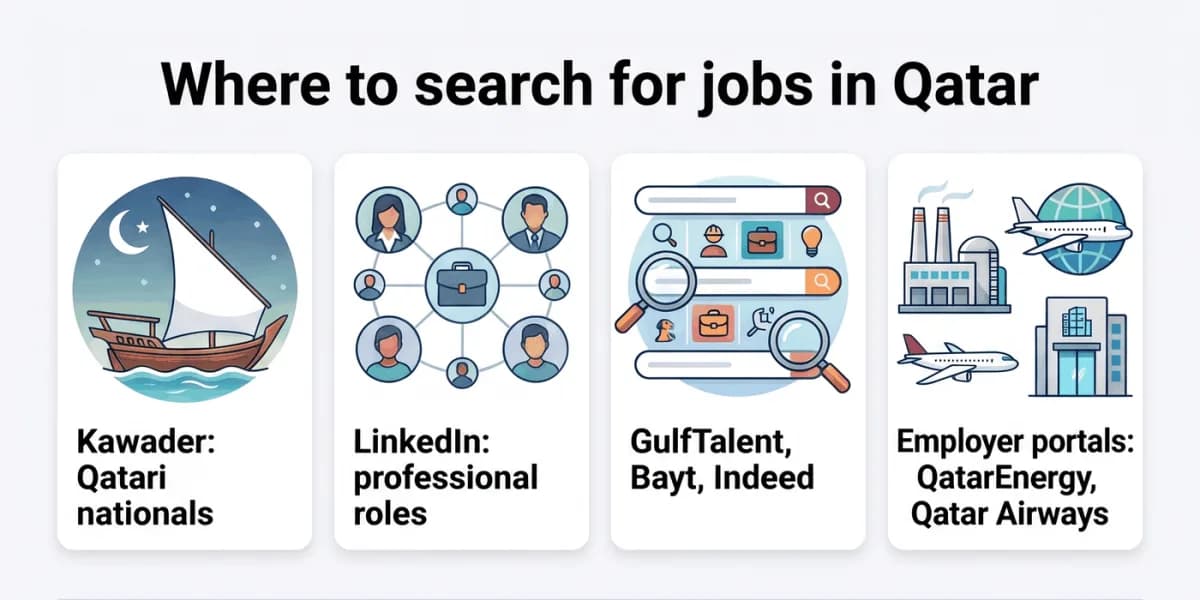
Qatar job search in one table
| Channel | Best for | Who can use it | What to know |
|---|---|---|---|
| Kawader (national employment platform) | Government and private jobs for nationals | Qatari citizens and children of Qatari women | Run by the Civil Service and Government Development Bureau; upgraded with AI matching in January 2026 |
| Ministry of Labour services (via Hukoomi) | Contracts, job changes, complaints | Employers and workers | Not a job board; it is where contracts and employer changes are processed |
| Professional, corporate and executive roles | Everyone | Strong for multinationals, finance and free-zone employers | |
| GulfTalent and Naukrigulf | Engineering, construction, energy services | Everyone, especially expatriates | Regional Gulf boards with many mid-level technical roles |
| Bayt and Indeed Qatar | High-volume commercial and service roles | Everyone | Aggregators; check each listing against the employer's own site |
| Employer career portals | QatarEnergy, Qatar Airways, Hamad Medical Corporation, Qatar Foundation, Ooredoo | Everyone | Large employers recruit directly and process visas themselves |
The practical rule: Qatari nationals should start with Kawader. Expatriates should focus on LinkedIn, the regional boards and employer portals, and check that the role is genuinely open to foreign applicants.
Kawader and the Qatarization law
Kawader: the national platform
Kawader is the unified employment platform for Qatari citizens and the children of Qatari women. It lists jobs in government bodies and private companies. In January 2026 the Civil Service and Government Development Bureau upgraded it with AI-based matching. Government employers can now nominate candidates without seeing their names at the shortlisting stage, which is meant to reduce bias.
Law No. 12 of 2024: Qatarization in the private sector
Law No. 12 of 2024 on the Qatarization of jobs in the private sector was published on 17 October 2024 and came into force on 17 April 2025, according to Clyde & Co. Its main points:
| Rule | What it means |
|---|---|
| Hiring priority | Private employers must prioritise Qatari citizens, then children of Qatari women. Expatriates can be hired when no suitable national candidate is available. |
| Scope | All commercial companies and private institutions; companies fully or partly owned by QatarEnergy and petroleum and petrochemical operations are excluded |
| Penalties for faking compliance | Up to 3 years' imprisonment and/or a fine of up to QAR 1,000,000 for using fraudulent methods or false information |
| Implementation | Detailed rules come from Council of Ministers and Ministry of Labour decisions |
For expatriates, this means mainland private-sector roles that a Qatari could fill are increasingly closed to new foreign hires. Your best openings are specialist roles, sectors excluded from the law (such as the energy companies), and employers that are clearly recruiting internationally.
Changing jobs and pay rules for expatriates
No NOC needed to change employer
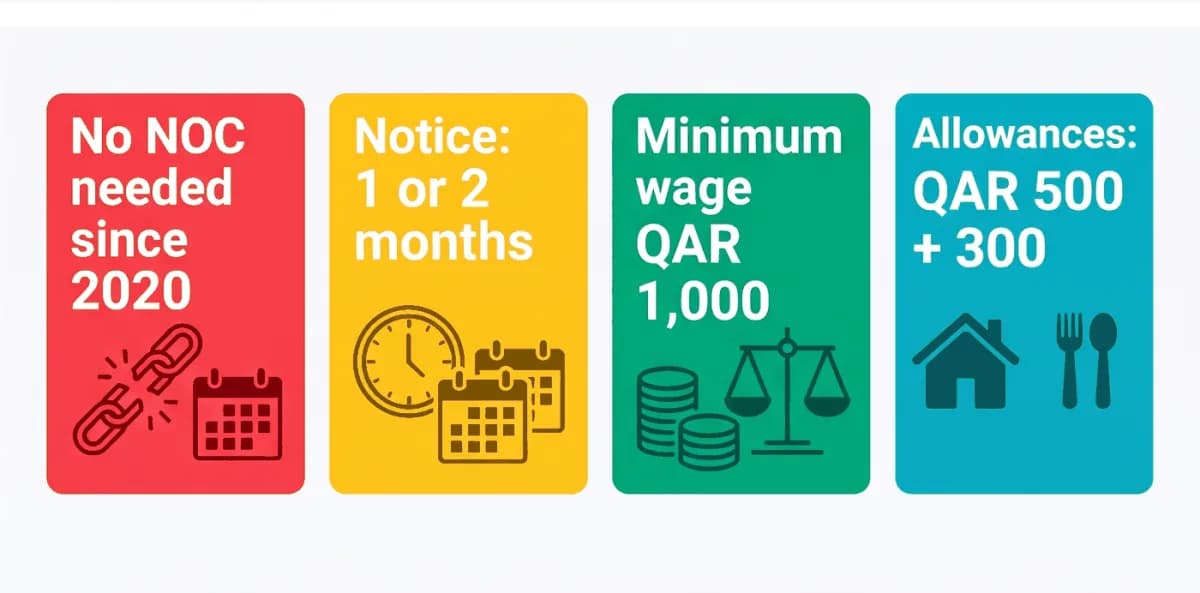
Qatar abolished the No Objection Certificate (NOC) requirement for changing jobs in August 2020, through Decree-Laws No. 18 and No. 19 of 2020, which amended the Labour Law and the sponsorship law. It remains abolished in 2026. You can move to a new employer without your current employer's permission, as long as you follow the rules:
| Rule | Requirement |
|---|---|
| Notice period | 1 month if you have worked for the employer 5 years or less; 2 months if more than 5 years |
| How to apply | Through the Ministry of Labour's change-of-employer service |
| Leaving during probation | The new employer may have to reimburse some recruitment costs to the previous employer |
| Non-compete clauses | Allowed only for limited roles and for at most one year after the contract ends |
Minimum wage
Law No. 17 of 2020, adopted on 30 August 2020 and in force since March 2021, set a non-discriminatory minimum wage for all workers of all nationalities, including domestic workers:
| Component | Minimum per month |
|---|---|
| Basic wage | QAR 1,000 |
| Housing allowance (if housing is not provided) | QAR 500 |
| Food allowance (if food is not provided) | QAR 300 |
Salaries are paid into local bank accounts through the Wage Protection System, which lets the Ministry of Labour spot late or missing payments. If an offer pays below these amounts, it does not comply with Qatari law.
How a foreign applicant is hired
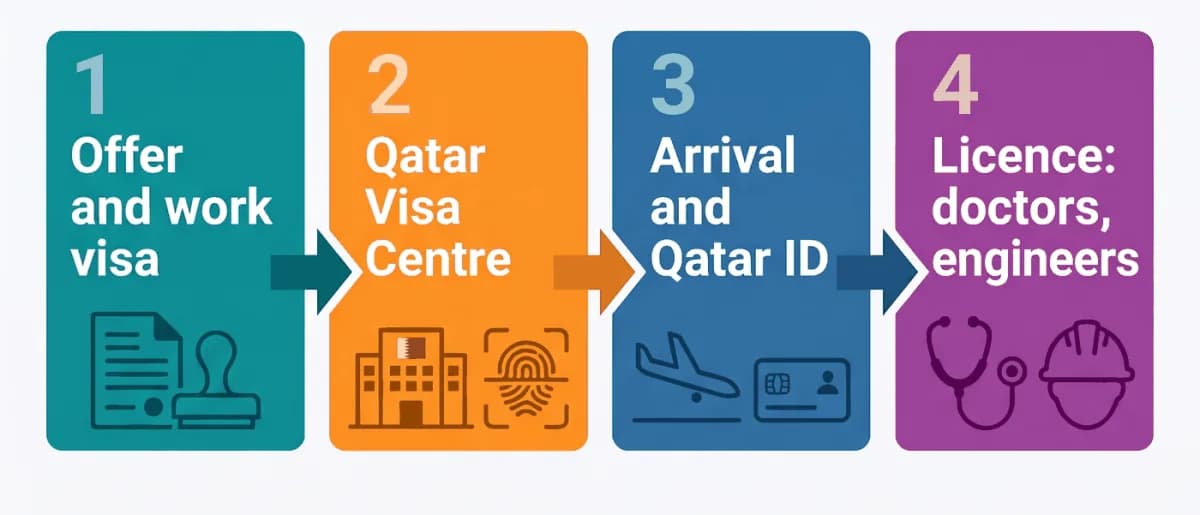
- The employer secures a work visa. Mainland employers need visa approval from the Ministry of Labour. Under the Qatarization law, this increasingly depends on showing that no suitable Qatari candidate was found.
- Qatar Visa Centre (QVC). In major source countries, including India, Pakistan, Bangladesh, Nepal, Sri Lanka, the Philippines and Kenya, you complete biometrics, a medical check and the signing of your employment contract at a QVC before you travel.
- Arrival and Qatar ID. After arrival, the employer completes your residence permit (Qatar ID) and your contract is registered with the Ministry of Labour.
Regulated professions need a licence first, and it often takes longer than the visa:
| Profession | Licensing body | What to expect |
|---|---|---|
| Doctors, nurses, pharmacists and allied health | Ministry of Public Health, Department of Healthcare Professions | Credential verification and, for many roles, an exam before you can practise |
| Engineers | Ministry of Municipality engineers registration committee (Law No. 19 of 2005) | Degree attestation and registration; practising without registration is illegal |
Start credential checks as soon as you are shortlisted. An employer may choose a candidate who is already licensed.
Avoiding recruitment scams
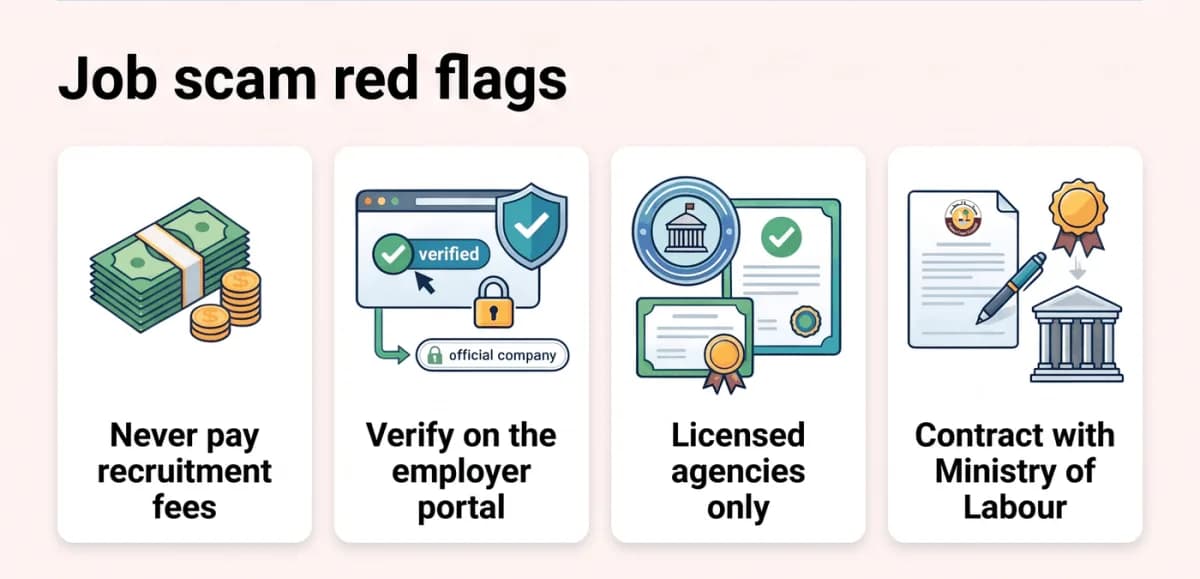
Qatar's labour rules do not allow employers or recruitment agencies to charge workers recruitment fees. The ILO has worked with Qatar on these reforms. In practice:
- Never pay for a job, a visa or "processing". Recruitment costs are the employer's responsibility.
- Verify the offer on the employer's own career portal. Fake offer letters often use the logos of large employers such as QatarEnergy or Hamad Medical Corporation.
- Use licensed recruitment agencies only. Check the agency with the Ministry of Labour.
- Check your contract. It should be registered with the Ministry of Labour, and your salary should be paid into a bank account through the Wage Protection System.
A practical weekly routine
| Day | What to do |
|---|---|
| Monday | Qatari nationals: check Kawader and update your profile. Everyone: review saved alerts. |
| Tuesday | LinkedIn: new roles and recruiter messages at target companies |
| Wednesday | GulfTalent, Naukrigulf, Bayt and Indeed for your sector |
| Thursday | Employer portals: QatarEnergy, Qatar Airways, Hamad Medical Corporation, Qatar Foundation, Ooredoo |
| Weekend | Licensing paperwork and follow-ups |
Keep one tracker for all channels, so you do not apply twice to the same job through a job board and an employer portal.
FAQ
Do I still need an NOC to change jobs in Qatar?
No. The NOC requirement was abolished in August 2020 and remains abolished in 2026. You must give notice (1 or 2 months, depending on length of service) and apply through the Ministry of Labour.
Can expatriates use Kawader?
Kawader is designed for Qatari citizens and the children of Qatari women. Expatriates usually get better results from LinkedIn, regional job boards and employer portals.
What is the minimum wage in Qatar?
QAR 1,000 a month basic wage, plus QAR 500 for housing and QAR 300 for food if the employer does not provide them, under Law No. 17 of 2020.
Does the Qatarization law stop foreigners being hired?
No, but private employers must give priority to Qatari citizens and the children of Qatari women. Companies owned by QatarEnergy and petroleum and petrochemical operations are excluded from the law.
Are recruitment fees legal in Qatar?
No. Workers should not pay recruitment or visa fees. Treat any request for payment as a warning sign.
How to use AIResume
Build one master CV in AIResume and a Qatar version following our Qatar CV format guide. If you are comparing Gulf markets, see our guides to job boards in Saudi Arabia and job boards in the United Arab Emirates. Keep the role-specific file name in your job tracker.
Sources
- ILO NATLEX, Law No. 12 of 2024 on job nationalisation in the private sector — natlex.ilo.org
- Clyde & Co, Qatar Law No. 12/2024: Qatarisation of jobs (October 2024) — clydeco.com
- ILO, Qatar adopts a non-discriminatory minimum wage — ilo.org
- ILO, Dismantling the kafala system and introducing a minimum wage — ilo.org
- The Peninsula, Upgraded Kawader platform (6 January 2026) — thepeninsulaqatar.com
- Sharek (Government of Qatar), Registration on the Kawader platform — sharek.gov.qa