
Macau Job Sites Compared: DSAL, Local Boards and LinkedIn
Compare Macau job sites by eligibility and application route. Use DSAL, local boards and LinkedIn without mixing resident and non-resident pathways.

The best Macau job site depends first on which hiring route you can legally and practically use. Macao's Labour Affairs Bureau (DSAL) provides free job-referral services for residents, while local commercial boards advertise directly for employers. LinkedIn can expose professional and international-company roles, but its location filter can also return jobs that are not actually based in Macao. Non-residents face a separate employer-led authorization process; finding an advertisement is not permission to work.
This guide compares the channels by evidence you can verify: access, vacancy scope, application route and follow-up. It is career guidance, not immigration or legal advice. Always follow the vacancy, employer and current Macao SAR government instructions.
Quick answer: which Macau job site should you use?
If you are a Macao resident, start with the DSAL job-seeking service because it connects to the public matching route and includes job-registration, interview, application-record and saved-vacancy areas. Add one local commercial board—hello-jobs.com or eJobMacau—to broaden discovery. Use LinkedIn Jobs in Macao for professional-network and employer-brand discovery, but verify the actual workplace and original employer page before applying.
If you are not a Macao resident, do not treat a resident-only DSAL referral or a public job-board result as proof of eligibility. DSAL states that a non-resident can work legally only after the employer has the employment permit and the worker has authorization to stay; the worker may work only for the employer and position stated on the non-resident worker card. DSAL's employer FAQ is the primary source for that boundary.
Macau job-site comparison
| Channel | Best use | What the source actually confirms | Main check before applying |
|---|---|---|---|
| DSAL job-seeking service | Resident job registration, public matching, interview and application tracking | The service shows areas for job-seeking registration, interviews, job-search records and saved vacancies. DSAL says its job referral and recruitment services are free for Macao residents and companies. | Confirm that you meet the resident-service conditions and that your DSAL profile is current. |
| hello-jobs.com | Local commercial vacancies across hospitality, casino, administration, finance, retail and other categories | The site exposes category, industry, part-time and advanced-search controls. Its about page describes it as a direct advertising platform connecting Macao employers and jobseekers. | Open the full posting; record employer, location, eligibility wording, deadline and application method. |
| eJobMacau | Additional local vacancy discovery, especially Chinese-language listings | The live site displays employer, role, salary band where supplied, location, experience, education and publication date fields. | Treat each field as advertiser-supplied; verify the company and current vacancy on the original page. |
| LinkedIn Jobs in Macao | Professional roles, company discovery, recruiter and network context | The page presents a Macao location search and company postings. The current result set also contains entries whose titles or employers appear unrelated to a Macao workplace. | Do not trust the location filter alone. Confirm workplace, entity, role and application URL. |
| Employer career pages | Final verification and direct application when the employer publishes the role | The employer—not an aggregator—controls the vacancy details and application instructions. | Compare the board copy with the employer page; use the employer's current instructions if they differ. |
| Employment agencies | Roles where a licensed intermediary is genuinely involved | DSAL publishes a searchable employment-agency licence list, including licence number, validity, fee model, contact details and permitted origin areas. | Search the agency and licence status before sharing documents or paying any permitted fee. |
This is not a league table. Each channel solves a different part of the search. A public matching service, a local advertising site and a professional network should not be compared only by a visible job count.
Start by separating resident and non-resident routes
The current article's biggest risk is mixing discovery with eligibility. Use this decision table before creating alerts:
| Your situation | First route | Evidence to keep | Boundary |
|---|---|---|---|
| Macao resident seeking local work | DSAL job-seeking service plus local boards | Job target, availability, language skills, education, experience and application record | DSAL's public referral route is described for residents. |
| Macao resident seeking professional or international-company roles | Local boards, LinkedIn and verified employer career pages | Exact workplace, reporting line, tools, language requirements and original application URL | A broad LinkedIn location result may not be a Macao job. |
| Non-resident approached for a Macao role | Verified employer or licensed agency; then official authorization steps | Employer legal name, proposed position, written offer/contract information and authorization status | The employer-led permit and worker authorization must be completed before legal work begins. A job ad is not authorization. |
| Student or graduate | School career service, graduate channels, local boards and employer pages | Enrollment/graduation status, internship conditions and any work authorization instruction | Do not assume a student status automatically permits the advertised work. Check current official rules. |
DSAL's published job-seeking form provides a useful clue about the information its matching process uses. It records education, work experience, desired occupation, work area, expected remuneration, availability and spoken/written levels for Cantonese, Mandarin, Portuguese and English. The same form says a brief CV displayed for matching excludes name, gender, age and contact information. DSAL job-seeking registration form.
That does not mean every private employer requires the same fields. It means your public-service profile and your application CV should not contradict one another on material facts.
Use current labour data to choose search categories—not to predict an offer
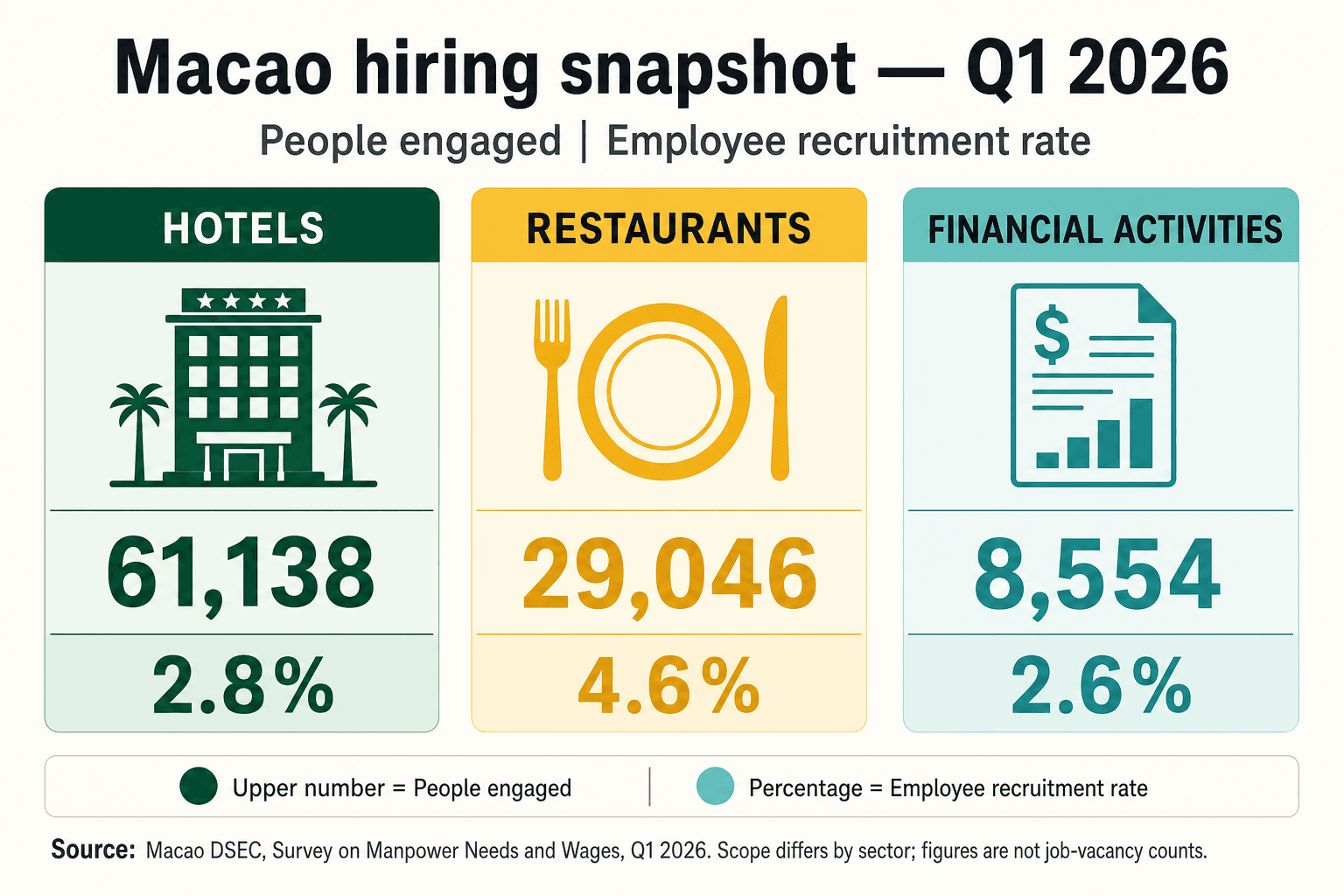
Source: Macao DSEC Survey on Manpower Needs and Wages, first quarter 2026. The survey reported 61,138 people engaged in hotels, 29,046 in restaurants and 8,554 in financial activities. Employee recruitment rates were 2.8%, 4.6% and 2.6% respectively. The survey covers different establishments by sector, includes resident and non-resident employees, and excludes the self-employed. These figures are not vacancy counts, applicant success rates or forecasts.
Use the data only as a search-planning prompt:
- Restaurants had the highest recruitment rate among these three sectors in that quarter, so a relevant candidate could test restaurant categories on local boards.
- Hotels had the largest number of people engaged, so the sector deserves its own employer-career-page list rather than a single generic alert.
- Financial activities had a smaller covered workforce and a lower quarterly recruitment rate than restaurants, so professional-network and targeted employer searches may be more useful than relying on volume.
Do not infer that a sector is easy to enter, that a role is open now, or that an employer can sponsor a non-resident. Check the live vacancy.
A three-layer search plan
Layer 1: authoritative and local discovery
Residents should build or refresh their DSAL job-seeking profile, then search the available-vacancy area. DSAL's employment unit says it provides free job-referral and recruitment services to residents and companies. A 2026 DSAL matching-event notice shows that residents could sign in through Macao One Account, choose a session and position, and receive an SMS if accepted for the event. This supports using the public service for structured matching; it does not promise an interview or offer.
At the same time, search hello-jobs and eJobMacau with the same role-family terms. Record the original language of the listing and the exact language requirement rather than assuming Portuguese, Cantonese, Mandarin or English from the employer's sector.
Layer 2: professional and employer verification
Use LinkedIn to identify employers, recruiters and professional roles, then verify each role on the employer's own careers page. Reject or quarantine a result when the workplace, employer entity or role description does not clearly point to Macao.
For local listings, perform the same verification when possible. Save the page date, closing date and contact domain. A recognizable brand name in an advertisement is not enough if the application destination is unrelated.
Layer 3: licensed intermediaries where relevant
When an agency is involved, search DSAL's licence register before providing identity documents or accepting a fee request. The register separates valid licences and shows whether the agency is fee-charging or non-fee-charging, plus the areas from which it may recruit or provide referral services. Record a screenshot or PDF of the licence detail with your application notes because status can change.
This check does not validate the vacancy itself. Confirm both the intermediary and the employer/role.
Convert one vacancy into channel-specific application evidence
Do not send one untouched file everywhere. Keep a truthful master CV, then prepare a submission version based on the vacancy and channel.
| Evidence item | DSAL/public matching profile | Local job board submission | LinkedIn/employer application |
|---|---|---|---|
| Target occupation | Select the closest accurate occupation and preferred work area. | Match the advertised role family without inflating seniority. | Align headline and summary with the verified role. |
| Experience | Keep dates, employers and duties consistent with your CV. | Move the most relevant duties and outcomes earlier. | Add context a professional reviewer can verify: scope, tools and result. |
| Languages | Record only levels you can demonstrate; DSAL distinguishes spoken and written levels. | Follow the vacancy language and form fields. | Keep profile and CV levels consistent. |
| Availability and conditions | Keep availability and job preferences current. | Answer shift, location or contract questions exactly. | Address relocation or authorization only when relevant and truthful. |
| Application record | Use the service's job-search/interview records where available. | Save posting, submitted file and confirmation. | Save original employer URL, contact and follow-up date. |
For document structure, use an ATS-friendly CV guide. For cross-channel consistency, check LinkedIn profile and CV alignment.
Annotated sample CV for a Macao hotel operations vacancy (fictional)
Every person, employer, contact detail and result below is fictional. Replace it with evidence you can substantiate.
Mei Lin Chan
Macao · +853 6000 0000 · [email protected]
Target: Hotel Guest Services Supervisor
Profile
Guest-services professional with five years of fictional front-desk and shift-coordination experience. Prepared for rotating-shift hotel operations and experienced in Cantonese, Mandarin and English guest communication.
Relevant experience
Guest Services Senior Associate — Harbour Example Hotel, Macao | 2023–2026
- Coordinated a fictional six-person evening desk rota and documented handovers for arrivals, room changes and service recovery.
- Resolved an average fictional 28 weekly guest cases across front desk, phone and digital channels; escalated safety and payment matters under hotel procedure.
- Trained four fictional new associates on check-in controls and bilingual handover notes.
Front Desk Associate — South Bay Example Inn, Macao | 2021–2023
- Processed arrivals and departures and maintained accurate shift reports in the fictional property system.
- Worked with housekeeping and reservations to correct room-status discrepancies before guest arrival.
Education
Higher Diploma in Hospitality Operations — Example Institute, 2021
Languages
Cantonese — fluent spoken/written · Mandarin — professional spoken/written · English — professional spoken/written
Systems and evidence
Property-management workflow · shift handover · guest-case documentation · spreadsheet reporting
Why the annotations matter
| Element | What it lets a reviewer compare | Safety check |
|---|---|---|
| Target line | Role and level | Do not copy the advertised seniority if your experience does not support it. |
| Profile | Sector, shift context and language use | State only languages and conditions you can demonstrate. |
| First bullet | Team coordination and work pattern | Replace fictional team size with a verifiable number or remove it. |
| Case bullet | Workload and service scope | Never invent an average; use a measured period or describe the work without a number. |
| Systems line | Transferable workflow evidence | Use actual system names only when you have used them and disclosure is appropriate. |
Before submission, remove the “fictional” labels only after replacing every example with your real information. Review common CV mistakes that cost interviews.
A seven-day Macau job-search cycle
- Day 1 — define eligibility and role families. Separate resident-service access from any non-resident employer-led route. Choose no more than three role families.
- Day 2 — create DSAL/local-board searches. Use consistent role terms and save the precise listing URL.
- Day 3 — build an employer list. Find the original careers page for credible listings and note the workplace.
- Day 4 — tailor evidence. Edit headline, summary, skills order and experience bullets without changing facts.
- Day 5 — verify intermediaries. Check DSAL's licence register for any agency involved; stop when identity, licence or fee information is unclear.
- Day 6 — submit and record. Save the posted vacancy, submitted CV version and confirmation.
- Day 7 — follow up selectively. Follow the vacancy's contact rules. Use this job-application follow-up guide where a follow-up is appropriate.
Submission and fraud-resistance checklist
- Is the role actually located in Macao, not merely returned by a broad location filter?
- Does the employer's original page still show the vacancy and same requirements?
- If an agency is involved, does DSAL show a valid matching licence and relevant activity scope?
- Is your resident/non-resident pathway stated accurately without implying authorization you do not hold?
- Do CV, profile and application dates, employers, education and language levels agree?
- Have you removed unnecessary identity numbers and unrelated personal data from an open CV?
- Have you saved the vacancy, application version and confirmation?
- Have you avoided any claim of guaranteed interview, sponsorship or permit approval?
FAQ
What is the best job site in Macau?
There is no single best site for every applicant. Macao residents can start with DSAL's free job-seeking and matching service, then add hello-jobs or eJobMacau for local commercial vacancies. LinkedIn is useful for professional and employer discovery, but verify the workplace and original posting because location results can be noisy.
Can a non-resident use a Macau job ad as proof that they may work there?
No. A vacancy or offer is not work authorization. DSAL says legal work begins after the employer has the required employment permit and the non-resident has authorization to stay; the worker is limited to the employer and position stated on the non-resident worker card. Check current official instructions for the specific case.
Is DSAL's job-seeking service available to everyone?
DSAL describes its free job-referral and recruitment services for Macao residents and companies, and its referral documentation identifies referred candidates as local residents. Non-residents should not assume that the resident matching route applies to them.
Which language should I use for a Macau application?
Use the language requested by the live vacancy or application form. DSAL's registration form records spoken and written levels for Cantonese, Mandarin, Portuguese and English, but that does not establish one universal employer preference. State only levels you can demonstrate.
How can I check a Macau employment agency?
Search DSAL's employment-agency licence list. Match the agency name, licence number, validity, fee model, address and permitted recruitment/referral areas. A valid licence does not prove that a particular vacancy is genuine, so verify the employer and role separately.
Do the DSEC recruitment rates show where I am most likely to get hired?
No. They are sector survey measures, not applicant success rates or vacancy shares. Use them to decide which live categories and employers to investigate, then base every application on a current verified vacancy.
Primary and market sources
- DSAL job-seeking service
- DSAL job-seeking registration form and privacy notice
- DSAL employment and recruitment unit
- Macao SAR recruitment-registration service
- DSAL non-resident employment FAQ
- DSAL employment-agency licence list
- DSEC Q1 2026 manpower-needs and wages survey release
- hello-jobs.com and about page
- eJobMacau
- LinkedIn Jobs in Macao