
UAE Job Boards: Dubai, Abu Dhabi and the Free Zones Compared
In the United Arab Emirates, the board you use matters less than the status you apply with. A single vacancy can be reserved for Emirati nationals, weighted toward Golden Visa holders, or open to overseas applicants — and the employer's choice is driven by visa costs, Emiratisation quotas and whethe
UAE Job Boards: Dubai, Abu Dhabi and the Free Zones Compared
By AIResume Editorial Team
Last updated: 21 September 2026
In the United Arab Emirates, the board you use matters less than the status you apply with. A single vacancy can be reserved for Emirati nationals, weighted toward Golden Visa holders, or open to overseas applicants — and the employer's choice is driven by visa costs, Emiratisation quotas and whether the company sits on the mainland or inside a free zone. Pick the right channel for your profile, and read every vacancy as an eligibility rule, not just a job description.
This guide compares the platforms and official portals that work in the UAE and explains the work-authorisation rules that decide who actually gets hired.
What this guide does not cover: how to write the CV itself. For structure, personal-data choices and file format, see the CV guides linked at the end. Here the focus is *channels, eligibility, and lawful work*.
Quick comparison: where to spend your time
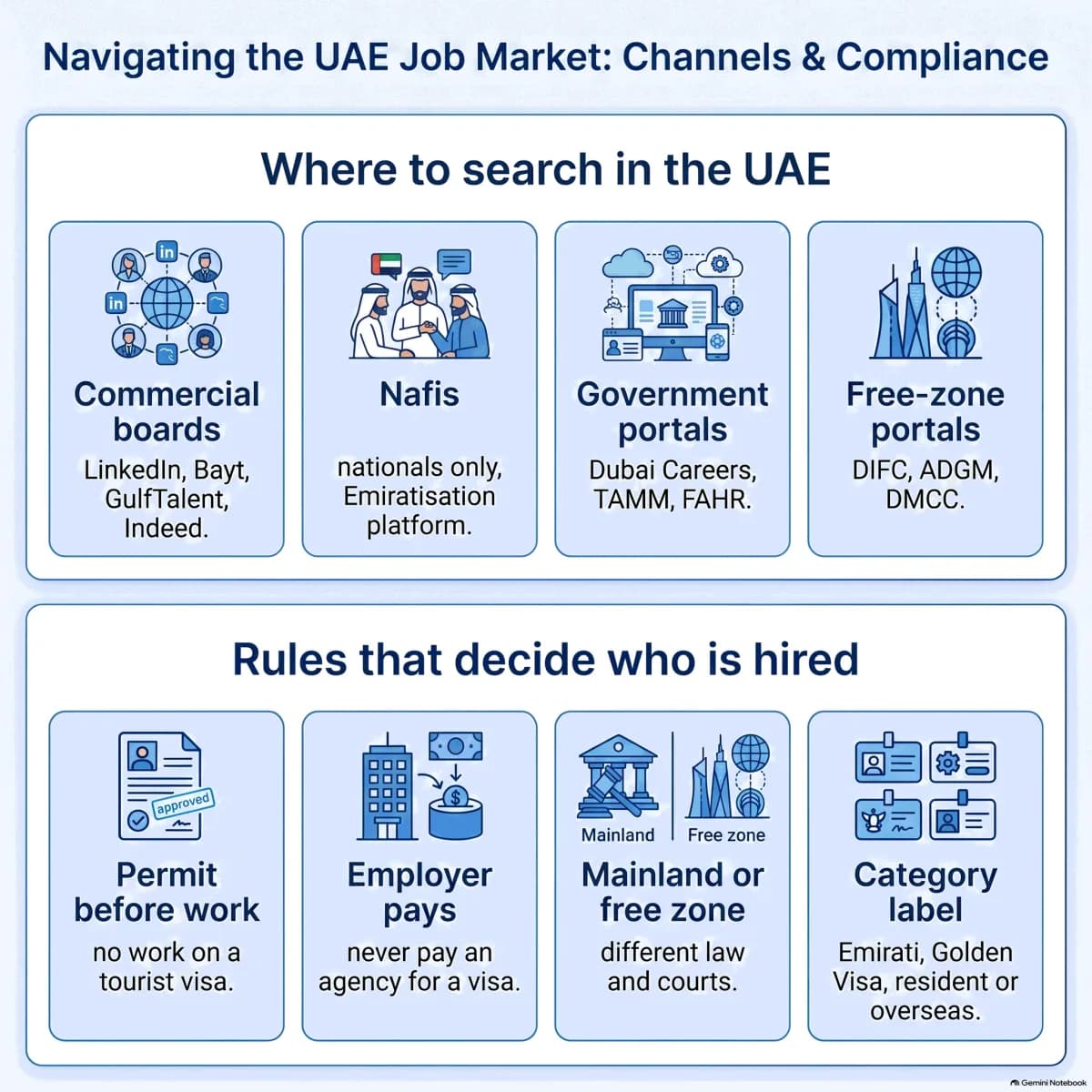
| Channel | Best for | Who it serves | How you apply |
|---|---|---|---|
| LinkedIn UAE | Professional, technical, executive | Residents + overseas | Easy Apply, company ATS, recruiter outreach |
| Bayt.com | Regional mid-market roles | MENA bilingual professionals | Profile + screening questionnaires |
| GulfTalent | Engineering, finance, energy niches | Experienced Gulf professionals | Direct application, recruiter sourcing |
| Naukrigulf / Indeed UAE | High-volume operational roles | Active job seekers | CV upload / aggregated links |
| Nafis (nafis.gov.ae) | Private-sector roles for nationals | UAE nationals only | UAE PASS account |
| Dubai Careers / TAMM / FAHR | Government roles | Nationals (some open to residents) | UAE PASS sign-on |
| Free-zone portals (DIFC, ADGM, DMCC) | Free-zone employers | Residents + overseas | Free-zone portal registration |
Where a dated figure exists: LinkedIn reported 10.0 million registered members in the UAE (DataReportal, late 2025 — registered accounts, not monthly active users); Bayt.com reported 20 million-plus registered job seekers and 40,000-plus employers; GulfTalent analysed 118,000 GCC vacancies in the first half of 2026. Treat these as dated snapshots.
Mainland versus free zone: the split that changes the rules
The UAE runs two labour regimes side by side:
- Mainland employers fall under the federal labour law and register contracts and work permits with the Ministry of Human Resources and Emiratisation (MOHRE).
- Financial free zones — the Dubai International Financial Centre (DIFC) and the Abu Dhabi Global Market (ADGM) — run their own common-law employment codes and their own courts, and do not register contracts through MOHRE.
- Non-financial free zones (such as DMCC or JAFZA) broadly follow the federal law, but the free-zone authority acts as your immigration sponsor.
Which regime an employer sits in determines your contract protections, dispute process and end-of-service benefits — so it is worth confirming before you accept.
Channel-by-channel: where the roles actually are
Commercial boards
LinkedIn dominates professional, technical and executive hiring; a large share of senior UAE roles are filled through direct recruiter outreach rather than open applications, so an optimised, findable profile matters. Bayt.com is the regional mid-market database and uses screening questionnaires that filter on visa availability and GCC experience. GulfTalent is strongest for construction, finance, engineering and petroleum niches. Naukrigulf and Indeed UAE are high-volume channels for operational, administrative and mid-tier roles (Indeed listings cluster in the AED 5,000–25,000 range).
The national platform: Nafis
Nafis (nafis.gov.ae) is not an open board — it is the federal Emiratisation system, open to UAE nationals only. Under Ministerial Decision No. 279 of 2022, private firms with 50 or more skilled workers must raise their Emirati workforce by 2% a year toward a 10% target by 2026, with a financial contribution of AED 6,000 per month for each unfilled Emirati position. That penalty is why qualified nationals are in high demand and why Nafis is essential infrastructure for larger employers.
Government portals
Dubai Careers (dubaicareers.ae) aggregates roles across 30-plus Dubai government departments; TAMM (tamm.abudhabi) is Abu Dhabi's unified portal with a "self-nomination" module; and FAHR (fahr.gov.ae) handles federal-ministry recruitment. Public roles prioritise nationals, but some specialist positions accept residents and overseas candidates.
Free-zone portals
DIFC, ADGM, DMCC and others run their own recruitment boards. These are the route into free-zone employers, who sponsor visas independently of MOHRE.
Work authorisation: no permit, no work
A foreign national cannot legally work in the UAE without a work permit issued by MOHRE (mainland) or the relevant free-zone authority. Working on a tourist or visit visa is a direct violation of federal law and exposes both worker and employer to fines and deportation.
The mainland private sector is governed by Federal Decree-Law No. 33 of 2021 on the Regulation of Labour Relations (issued 20 September 2021, in force 2 February 2022; current status: in force, as amended). Key points from the law:
- A permit comes before work (Article 6), and the employer must bear all recruitment, visa, medical and permit costs — an agency that asks you to pay is acting unlawfully.
- Contracts are written and fixed-term (up to three years, renewable); the old unlimited contracts have been phased out (Article 8).
- Probation is capped at six months with 14 days' notice (Article 9).
- End-of-service gratuity is 21 days' basic pay per year for the first five years and 30 days per year thereafter, capped at two years' basic salary (Article 51).
The executive rules (Cabinet Resolution No. 1 of 2022) recognise five work models — full-time, part-time, temporary, flexible and remote. Financial free zones apply their own codes instead: DIFC Employment Law No. 2 of 2019 (in force 28 August 2019, as amended) and the ADGM Employment Regulations 2019. Entry and residence sit under the long-standing Federal Law No. 6 of 1973, as amended.
Where a specific article number or regulation could not be confirmed against the primary text, treat it as unverified and check the current official version before relying on it.
Application conventions and candidate labels
- Language. English is the working language of the private sector and the free zones; federal ministries, Abu Dhabi government entities and legal departments often expect Arabic or a dual-language CV.
- Disclosures. Gulf applications commonly list current location, residency/visa status, nationality (for quota screening) and, for customer-facing roles, a professional headshot.
The candidate-category label usually decides eligibility before qualifications do:
| Label | What it means |
|---|---|
| Emirati / Nafis-eligible | UAE citizens only — foreigners are auto-disqualified by quota rules |
| Golden Visa holder | Self-sponsored 5- or 10-year residency; highly competitive (no visa cost to the employer) |
| Spousal / dependant visa | Sponsored by family; a work permit is still legally required |
| On visit / tourist visa | Can interview immediately but cannot start work until a permit is issued |
| Overseas applicant | Full offshore sponsorship required; usually reserved for specialist or bulk hiring |
A practical search routine
If you are a UAE national: make Nafis your primary launchpad, add Dubai Careers, TAMM and FAHR for public roles, and use Bayt and LinkedIn for nationalisation openings in multinationals.
If you are an existing resident: optimise LinkedIn for passive sourcing with your emirate in the location field, and state your visa status (for example "Golden Visa" or "transferable residency") clearly at the top of your CV. Use Indeed and Naukrigulf for active, high-volume applications.
If you are applying from overseas: target multinational career pages and network directly with UAE-based talent-acquisition managers; use GulfTalent for industry niches. Before you commit, verify the employer's trade licence, confirm the offer comes as an official MOHRE offer letter whose terms cannot be changed later, and remember that all recruitment and visa costs are the employer's by law. Complete the entry permit, medical test and Emirates ID steps, and do no work before the permit is issued.
Final checklist before you apply
- [ ] I know whether the employer is mainland (MOHRE) or in a free zone (DIFC/ADGM/other), and what that means for my contract.
- [ ] I read the candidate-category label and I actually qualify (national / Golden Visa / resident / overseas).
- [ ] No agency has asked me to pay recruitment or visa fees — those are the employer's cost by law.
- [ ] My offer is an official MOHRE offer letter (mainland), with basic salary and allowances clearly split.
- [ ] I will not start work before my work permit or entry permit is issued.
Related AIResume guides
Frequently asked questions
What is the best job board in the UAE?
It depends on your profile. LinkedIn is strongest for professional and executive roles; Bayt and GulfTalent for regional mid-to-senior roles; Naukrigulf and Indeed for high-volume operational jobs. UAE nationals should start with the government Nafis platform, which is reserved for citizens.
Can I work in the UAE on a tourist or visit visa?
No. You may attend interviews, but you cannot legally begin work until a work permit is issued by MOHRE or the relevant free-zone authority. Working on a visit or tourist visa violates federal law and can lead to fines and deportation.
Should an agency ever charge me for a UAE job or visa?
No. Under the federal labour law, the employer must bear all recruitment, visa, medical and work-permit costs. Any agency asking you to pay for placement or visa issuance should be treated as fraudulent.
What is the difference between a mainland and a free-zone job?
Mainland employers register your contract and permit with MOHRE and follow the federal labour law. Financial free zones (DIFC, ADGM) run their own employment codes and courts and handle their own visas; non-financial free zones follow the federal law but sponsor your visa themselves.
What does "Nafis-eligible" or "Emirati only" mean on a vacancy?
It means the role is reserved for UAE citizens to help the employer meet Emiratisation quotas. Foreign applicants are not eligible, regardless of qualifications.
Sources
[^1]: LinkedIn UAE audience data (DataReportal)
[^2]: Jobs in the UAE (Bayt.com)
[^3]: GulfTalent — Gulf recruitment insights
[^4]: Nafis — Emiratisation platform
[^5]: MOHRE — Ministry of Human Resources and Emiratisation
[^6]: Dubai Careers
[^7]: TAMM — Abu Dhabi government services
[^8]: DIFC Employment Law
[^9]: Federal Decree-Law No. 33 of 2021 (UAE Government portal)