
Colombia Job Sites for Foreigners: Local vs Overseas Routes
If you are already in Colombia or have a usable local status, begin with the Servicio Público de Empleo (SPE) and one major local platform such as elempleo, Magneto or Computrabajo. If you are still abroad, start with LinkedIn and verifi...

Colombia Job Sites for Foreigners: Local vs Overseas Routes
By AIResume Editorial Team
Last updated: 26 August 2026
If you are already in Colombia or have a usable local status, begin with the Servicio Público de Empleo (SPE) and one major local platform such as elempleo, Magneto or Computrabajo. If you are still abroad, start with LinkedIn and verified employer career pages, then add local boards for market vocabulary and vacancy discovery.
The encouraging part is that Colombia's official employment-service registration guide explicitly addresses people born outside Colombia or without Colombian nationality: it tells them to register with a DNI and complete additional-document fields.[^1] The important caveat? A profile is not immigration permission, and a vacancy that says “remote” may still mean “remote from inside Colombia.”
Editorial boundary: This article separates job-search access from immigration and hiring compliance. It does not determine your visa, work permission or eligibility for a particular vacancy.
Quick answer: which sites are foreigner-friendly?
| Channel | Can a foreign applicant use it? | Best for | What it does not prove |
|---|---|---|---|
| Servicio Público de Empleo | Yes, with an official foreign-user registration path using DNI fields.[^1] | Free official registration, employment-service providers, orientation and local vacancies | Permission to work or eligibility for every programme/vacancy |
| Computrabajo Colombia | Browse/search from abroad; employer-specific eligibility | Broad local-market discovery | Sponsorship, relocation or acceptance of a foreign document in every employer flow |
| elempleo.com | Browse/search from abroad; some ads mention documented foreigners | Professional and local vacancies, alerts and employer discovery | A platform-wide foreigner policy based on individual adverts |
| Magneto | Browse/search from abroad; employer-specific eligibility | Employer recruitment flows and authorised employment-service providers | That “remote” is cross-border or that every role accepts foreign applicants |
| LinkedIn Jobs Colombia | Globally accessible; mixed eligibility | Multinationals, bilingual/professional roles, recruiter and employer pages | Visa sponsorship or a Colombia-external payroll arrangement |
| Employer careers page | Often the decisive source | Confirming location, contract, relocation and application ownership | Legal eligibility unless the employer states and verifies it |
No platform deserves a blanket “best for foreigners” label. The official service has the clearest registration evidence; commercial sites have more varied employer flows; and only the named vacancy can establish whether you fit the location and status requirements.
The three checkpoints people often mix up
1. Can I browse the vacancy?
Usually, yes. Public search pages on the major platforms can be used from abroad to learn job titles, cities, salary language and employer names.
2. Can I create a profile and apply?
The official SPE guide gives foreign users a DNI registration route.[^1] Commercial-platform forms vary. Even if a form accepts your details, the employer may screen for local location, a specific document or an authorised status.
3. Can I legally perform the job?
That answer comes from Colombia's current immigration route, your status and the engagement—not from the job board. Cancillería's worker-visa guidance describes an employer-backed route with applicant and employer documentation.[^2] Migración Colombia describes the Cédula de Extranjería as an identity document for eligible visa holders; it is not itself a job-board endorsement.[^3]
Keep those checkpoints separate and the whole search becomes less confusing.
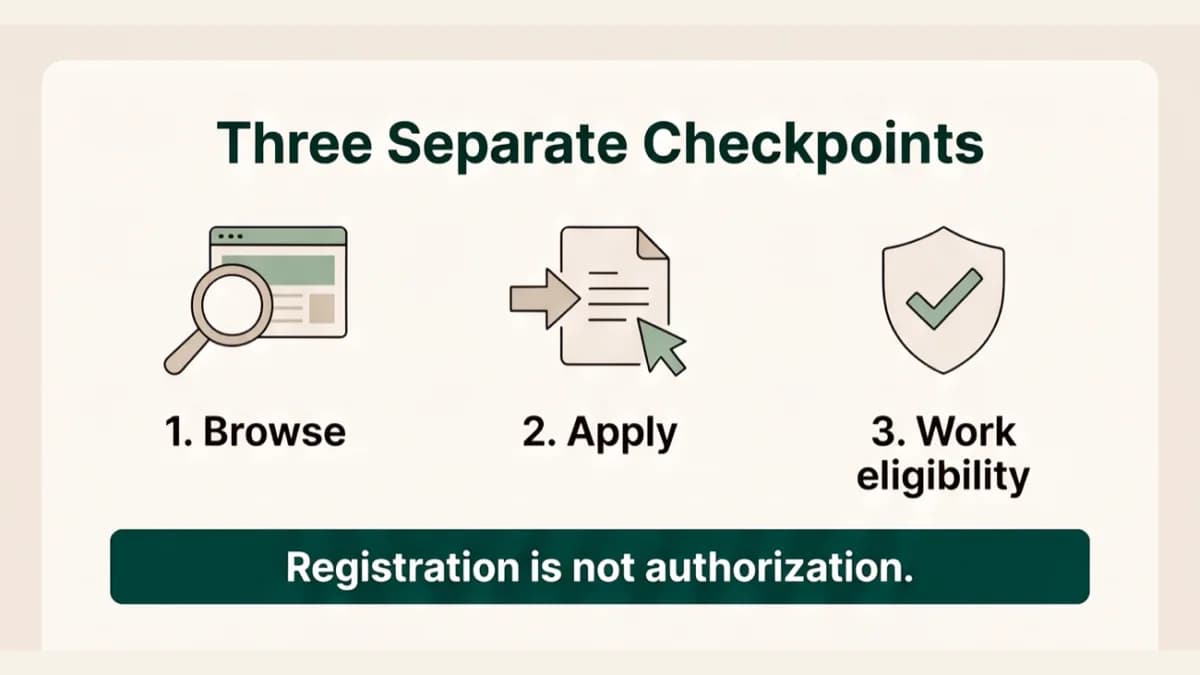
*Platform access, application access and legal work eligibility are separate questions. Registration is not work authorisation.[^1][^2][^3]*
A fictional story about one dangerous word: “remote”
Fictional example: Daniel, a data analyst in Lima, sees “Remote — Colombia” on Magneto. He reads “remote” as “work from Peru,” sends a carefully tailored CV and only later learns that payroll and residence must be in Colombia.
The listing was not necessarily misleading. Daniel skipped the country-eligibility check. Next time he asks four quick questions: Where must the employee live? Which entity signs the contract? Is cross-border work allowed? Is relocation supported? That is a much better filter than the word “remote,” isn't it?
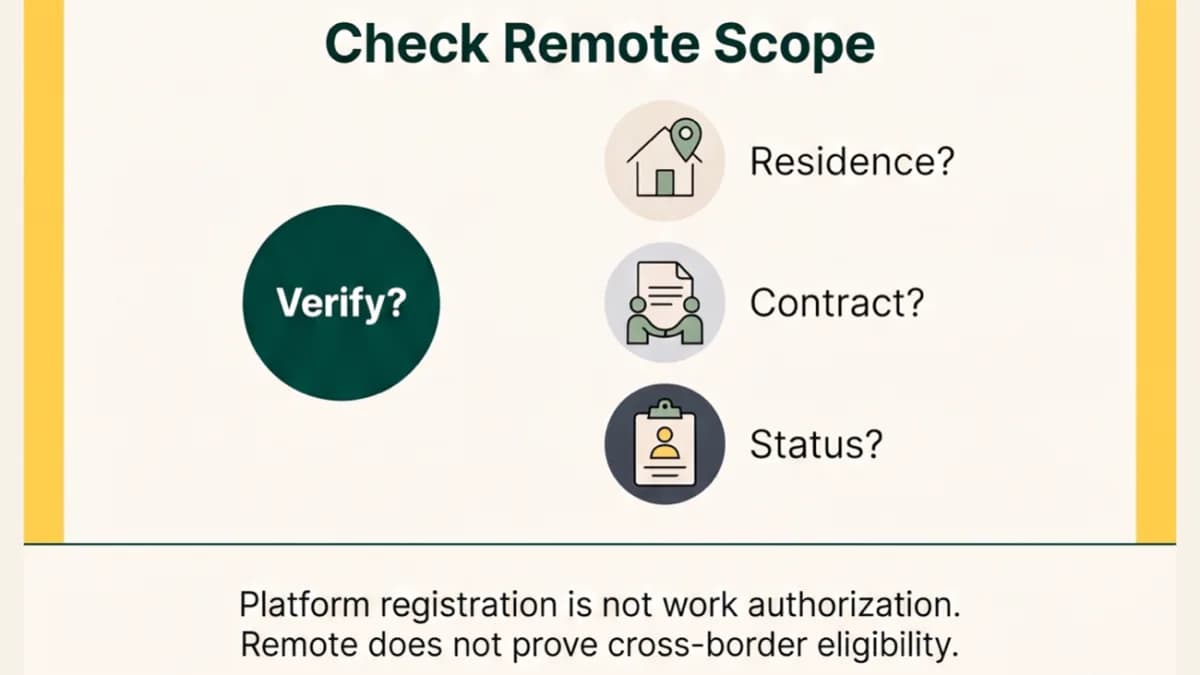
*“Remote” does not prove cross-border eligibility. Verify where the worker must reside, who signs the contract and which status the employer requires.[^2][^3]*
The official route: Servicio Público de Empleo
Colombia's SPE allows jobseekers to build and update a structured *hoja de vida* and apply to registered opportunities. Its official self-registration guide specifically tells people born outside Colombia or without Colombian nationality to use a DNI and complete additional identification fields.[^1] The registration page also says the process and services are free.[^4]
This makes SPE the clearest foreigner-accessible official employment service in this comparison. It is especially useful if you:
- are already in Colombia or have a realistic local employment route;
- want access to authorised employment-service providers and orientation;
- can keep your profile complete and current;
- are searching by city and occupation, not only by company brand.
But registration does not grant a visa or prove that a vacancy can hire you. Keep work-status evidence accurate and high level; do not turn the public CV into an identity-document folder.
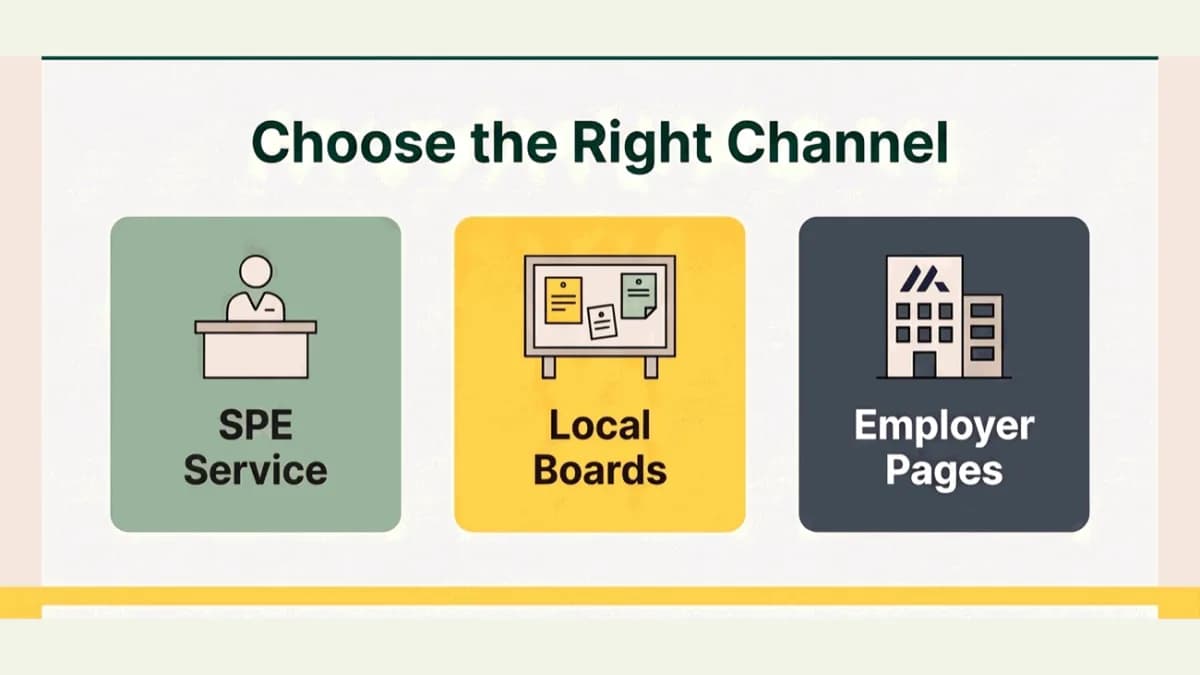
*Use SPE for the official employment-service route, local boards for market discovery and employer pages for the decisive vacancy terms.[^1][^4][^5][^6]*
Commercial boards: useful, but the vacancy owns the answer
Computrabajo
Computrabajo is a broad Colombia-facing discovery channel. Use it to compare job titles, locations and repeated requirements. Its availability does not establish that employers sponsor visas, accept applications from outside Colombia or support relocation.
elempleo.com
elempleo has live search pages for vacancies containing terms such as *extranjero*. Individual listings reviewed during research sometimes explicitly mentioned foreign applicants with current documents.[^5] That wording is evidence about that advert, not about every vacancy on elempleo.
Magneto
Magneto hosts employer and employment-service recruitment flows. A first-party vacancy page can explain steps such as creating a profile, registering a CV and answering process questions.[^6] Again, the named employer's criteria matter. Magneto's fraud guidance also reinforces a sound rule: candidates should not pay to participate in recruitment.
LinkedIn is the most practical starting point for an overseas professional because you can research multinationals, recruiters and employer pages globally.[^7] Use it to find exceptions—regional roles, bilingual teams, relocation statements and cross-border hiring—then verify them at the employer source.
Try searches such as:
- `role + Colombia + relocation`
- `role + Bogotá + bilingual`
- `role + Medellín + visa`
- `regional LATAM + Colombia`
- `remote Colombia + country eligibility`
Do not mistake an English description or multinational logo for sponsorship.
Immigration and employer compliance: what belongs in the article
Cancillería's current visa guidance includes a worker route for a foreigner contracted by a Colombian legal entity and specifies employer-supported documentation.[^2] Migración Colombia says the Cédula de Extranjería identifies qualifying foreign visa holders in Colombia.[^3] The official foreign-investment procedures page explains that SIRE is used to report links such as foreign employment or service contracting.[^8]
The editorial conclusion is deliberately modest:
- SPE registration is a job-search workflow.
- A visa/status route is an immigration workflow.
- SIRE reporting is an employer/compliance workflow.
- None should be presented as a feature of Computrabajo, elempleo, Magneto or LinkedIn.
If a recruiter asks for money, an identity scan over an unverified messaging account or a claim that “the platform handles the visa automatically,” stop and verify.
Which route fits you?
| Your situation | Start with | Add | Put near the top of the CV |
|---|---|---|---|
| Already authorised and living in Colombia | SPE + one local board | LinkedIn and employer pages | City, availability, target role and truthful status note if relevant |
| Abroad, seeking relocation | LinkedIn + employer career pages | elempleo/Computrabajo for market research | Current country, relocation need, languages and strongest role evidence |
| Venezuelan migrant in Colombia | SPE migrant guidance + authorised providers | Local boards | Exact current document/status at a high level; never claim a document you do not hold |
| Bilingual professional | LinkedIn + employer pages | elempleo/Magneto | Spanish/English evidence connected to actual work tasks |
| Regulated profession | Employer + competent recognition body | SPE/local board | Exact qualification name and only verified recognition information |
| Remote-work seeker abroad | Employer-first search | Country eligibility, time zone and contract expectations—not just “remote” |
Map the vacancy before editing the CV
| Vacancy field | Question to answer | Evidence to use |
|---|---|---|
| Location | Must I already live in the city/country? | Current city and realistic relocation/availability |
| Document/status | What is required at application versus hiring? | Short truthful status note only when useful |
| Language | Which tasks require Spanish or English? | Level plus a real example of work performed |
| Qualification | Is convalidation/recognition required? | Exact award; recognition only when verified |
| Remote | Remote from where, under which contract? | Country/time-zone availability and remote-work evidence |
| Employer | Who receives my data? | Nothing in the CV; verify the domain first |
Annotated fictional CV extract
Fictional example — every person, employer, contact and number below is invented.
VALERIA TORRES
Bilingual Customer Operations Analyst
Quito, Ecuador · Seeking a verified Bogotá relocation opportunity
[email protected] · +593 00 000 0000
PROFILE
Customer operations analyst with four years of fictional experience resolving bilingual service cases, maintaining CRM records and coordinating escalations across sales and logistics.
EXPERIENCE
Customer Operations Analyst — Andes Example S.A. | 2022–present
- Resolved 35–45 fictional weekly cases in Spanish and English and recorded owner, deadline and next action in the CRM.
- Built a fictional exception dashboard that reduced the weekly unresolved-case review from two hours to 55 minutes.
- Coordinated fictional order-status escalations across three teams and documented a shared checklist.
LANGUAGES & TOOLS
Spanish — native · English — [truthful level required] · CRM case management · Excel reporting
| Annotation | Why it helps | Truth check |
|---|---|---|
| Current city + relocation need | Prevents “already in Bogotá” assumptions | State the real location and realistic plan |
| Bilingual evidence | Links language to work | Replace the bracket with a defensible level |
| CRM scope | Shows how the tool was used | Use real case types and a number you can explain |
| No document number | Protects the general CV | Provide documents only through a verified process |
| No “visa eligible” promise | Avoids a legal claim | Discuss the correct route with the employer and authority |
For document localisation, see the Colombia CV format guide. Use the ATS-friendly CV guide to keep structured fields and the PDF consistent, and check common CV mistakes that cost interviews before submission.
A seven-day foreign-applicant search plan
- Day 1 — Choose one city and two role families. Bogotá, Medellín and “all Colombia” can produce very different noise.
- Day 2 — Collect 15 real vacancies. Separate local-first, relocation-explicit and remote-but-country-limited roles.
- Day 3 — Verify your route. Do not guess from a profile field; check current official guidance.
- Day 4 — Build one evidence map. Match five requirements to five truthful proof points.
- Day 5 — Apply employer-first. Prefer the original careers page when available.
- Day 6 — Record the version. Save URL, employer, location rule, deadline, CV filename and requested documents.
- Day 7 — Improve the search, not the story. Change keywords and channels; never invent a language, address or status to pass a filter.
The global job-board comparison can help you decide when a local board, professional network or employer page should own the next step.
Final checklist
- I can distinguish browsing, applying and legal work eligibility.
- The vacancy says where the employee must live.
- “Remote” has been checked for country and contract restrictions.
- The application domain belongs to the employer or authorised provider.
- I have not treated one foreigner-friendly advert as a platform-wide policy.
- My location, status, languages and qualifications are accurate.
- No passport, identity or banking number appears in the general CV.
- I have saved the exact application and CV version.
FAQ
Can foreigners register with Colombia's Public Employment Service?
The official self-registration guide says people born outside Colombia or without Colombian nationality should register using a DNI and complete additional-document fields.[^1] Registration does not itself give permission to work or guarantee eligibility for a vacancy.
Which Colombia job board is best for applicants abroad?
No verified platform is universally best. LinkedIn and employer career pages are usually the most efficient first route for overseas professionals; local boards are valuable for market research and employer discovery; SPE is the clearest official registration route.
Does a Colombia job board sponsor visas?
Job boards normally publish or host vacancies; sponsorship or immigration support is an employer- and role-specific decision. Look for an explicit employer statement and confirm it in the original vacancy.
Does “remote” mean I can work from outside Colombia?
No. It may mean remote within Colombia. Confirm the required country of residence, payroll entity, contract and time zone.
Do I need a Cédula de Extranjería to search for work?
Do not use the identity document as a blanket search rule. SPE documents a DNI registration path for foreign users, while Migración Colombia explains when a Cédula de Extranjería applies to qualifying visa holders.[^1][^3]
Should I include my passport or PPT number in the CV?
Keep sensitive numbers out of a general CV. If a verified official or employer process legitimately requests a document, provide it securely at the appropriate stage.
Sources
[^1]: Servicio Público de Empleo — self-registration guide
[^2]: Cancillería Colombia — current visa routes and worker requirements
[^3]: Migración Colombia — Cédula de Extranjería
[^4]: Servicio Público de Empleo — jobseeker registration page
[^5]: elempleo.com — live search for vacancies mentioning foreign applicants
[^6]: Magneto — first-party application-flow example
[^7]: LinkedIn Jobs — Colombia