
Uruguay Job Sites for Foreigners: What Actually Works
If you are searching from outside Uruguay, start with Vía Trabajo for the official employment-service route, add LinkedIn and one local commercial board for private vacancies, and use Uruguay Concursa only after reading the eligibility r...

Uruguay Job Sites for Foreigners: What Actually Works
By AIResume Editorial Team
Last updated: 26 August 2026
If you are searching from outside Uruguay, start with Vía Trabajo for the official employment-service route, add LinkedIn and one local commercial board for private vacancies, and use Uruguay Concursa only after reading the eligibility rules for the specific public competition. The important surprise? A Uruguayan identity card is not an absolute barrier at every stage: MTSS says Vía Trabajo registration can use a passport, and it explains how a foreign worker whose residence is being processed may be hired.[^1][^2]
That does not mean every employer recruits abroad. A job site can let you browse or create a profile while the vacancy itself still expects someone already in Montevideo, with Spanish and local work eligibility. So the useful question is not “Which site is best?” It is “Which channel fits my current stage?”
Editorial boundary: This is practical job-search guidance, not immigration or legal advice. Always confirm current status requirements with the competent authority and the named employer.
The 30-second answer: foreigner-friendly or local-first?
| Channel | Can you research from abroad? | Foreigner access signal | Best use | The catch |
|---|---|---|---|---|
| Vía Trabajo | Yes | Strong official signal: MTSS says registration can use a passport, identity document or border identity card.[^2] | Official employment intermediation, profile support, training and local employment-centre help | Registration is not a job offer, and each vacancy can have its own eligibility rules |
| Uruguay Concursa | Yes | Competition-specific | Public-administration competitions | Citizenship, residence, qualifications and documents must be checked in the complete *bases* |
| Buscojobs Uruguay | Yes | Platform accessible; employer decision | Local private-sector discovery and structured profile search | No platform-wide promise of visa support or overseas hiring |
| Gallito Trabajo | Yes | Local-first | Classified-style local vacancies and quick scans by area/date | Employer quality and application destination need verification |
| Computrabajo Uruguay | Yes | Local-first | Extra private-market coverage | “Remote” or “international company” does not automatically mean overseas eligibility |
| LinkedIn Jobs Uruguay | Yes | Mixed: local roles plus occasional regional/relocation vacancies | Professional, multinational, tech, finance, shared-services and recruiter-led searches | Read the location and work-authorisation line; do not infer sponsorship from the brand |
Here is the practical rule: official services can explain the local process; commercial boards help you discover employers; only the individual vacancy can tell you whether an overseas application is realistic. Simple enough, isn't it?
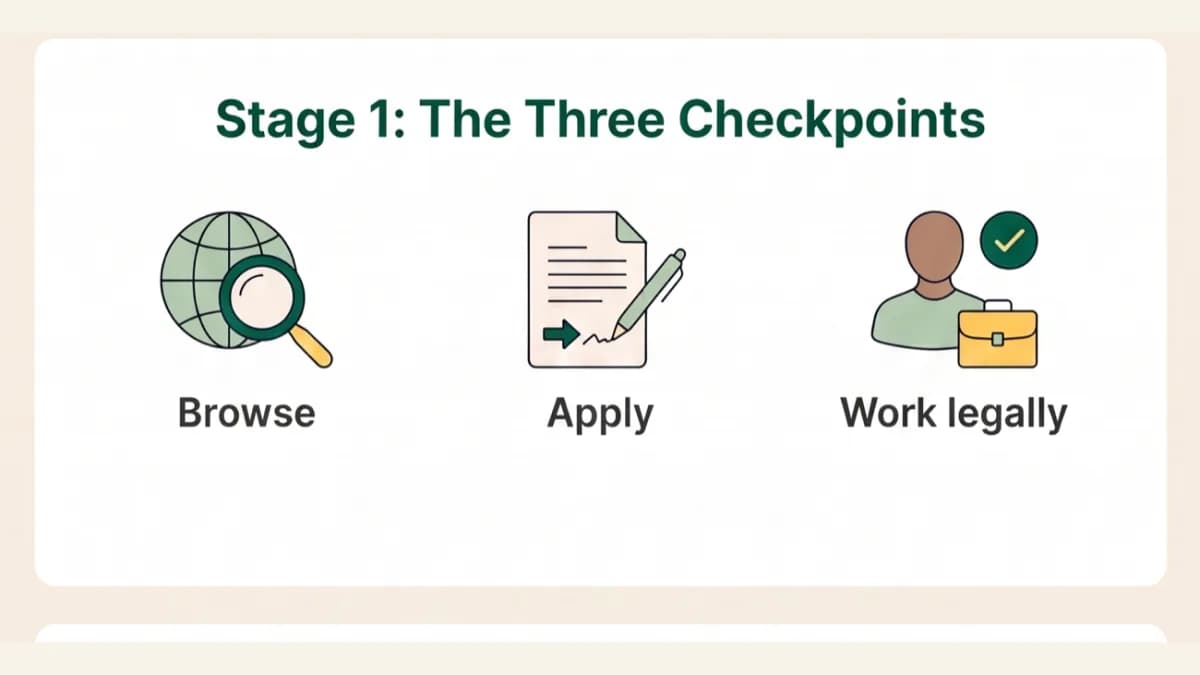
*The three checkpoints are separate: seeing a vacancy and submitting an application do not by themselves establish permission to work. Source basis: MTSS foreign-worker guidance and the named vacancy's eligibility terms.[^1]*
Before you search: Uruguay does not use a document called a “work permit”
This is where many generic guides become misleading. Uruguay's Ministry of Labour says the country does not issue a certificate called a *work permit*. Residence status is what enables a foreign national to work. It also says an employer may hire someone whose temporary or permanent residence is being processed, provided the current official evidence is available; initial social-security registration can use a passport or origin-country identity document in that situation.[^1]
If your nationality requires a visa to enter for work, the foreign ministry publishes a separate work-visa route and asks for an employment promise or contract from a registered Uruguayan organisation.[^3] In other words, “I can create a profile” and “I have the documents to start this job” are two different checkpoints.
A tiny fictional story that catches a common mistake
Fictional example: Ana, a bilingual operations coordinator in São Paulo, sees a Montevideo role on LinkedIn marked “hybrid.” She spends an hour tailoring her CV, then notices the application form asks when she can attend the office—not whether she wants relocation support. She has not found a bad job; she has found a local-first job.
Her second search adds `relocation`, `visa`, `regional` and `remote Uruguay`, and she checks the employer's careers page before tailoring anything. Five minutes of eligibility checking saves an hour of CV work. Not glamorous, perhaps, but wonderfully effective.
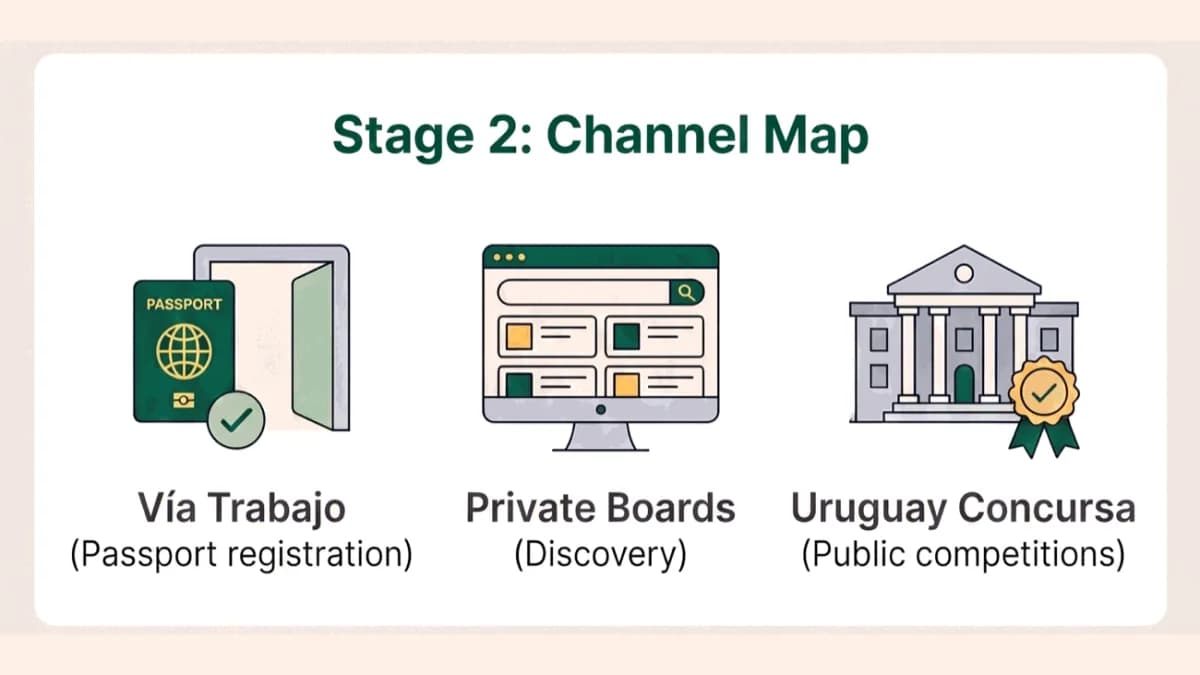
*Use Vía Trabajo for official employment support, private boards for employer discovery and Uruguay Concursa for public competitions whose complete rules must be checked.[^2][^5][^6][^7]*
How each channel works for a foreign applicant
1. Vía Trabajo: the clearest official starting point after—or close to—arrival
MTSS describes Vía Trabajo as a free nationwide platform connected to employment opportunities, training and Technical Employment Centres.[^2][^4] The Centres help with labour-profile creation, CV preparation and interview preparation. Crucially for this guide, the current official page says a person aged 15 or older may register with a passport as well as other accepted identity documents.[^2]
Use Vía Trabajo when you:
- are living in Uruguay or actively regularising your status;
- want a structured local profile and official employment guidance;
- can provide a reachable email or phone for the login workflow;
- are willing to keep your dates, titles, qualifications and target role current.
Do not describe Vía Trabajo as “foreigner sponsorship.” It is an employment service, not an immigration decision-maker.
2. Uruguay Concursa: official, but never assume eligibility
Uruguay Concursa is the public-administration competition portal.[^5] It is useful because the named *llamado* and its complete rules own the process: deadline, qualifications, declarations, documents and selection stages.
For a foreign applicant, that makes it a verify-first channel. Search it, certainly—but before preparing documents, answer these questions from the competition rules:
- Is nationality or citizenship specified?
- Is Uruguayan residence or a local identity document required?
- Does a foreign qualification need recognition?
- Which documents must be uploaded now, and which originals are checked later?
One public vacancy cannot establish the rule for the next one. The portal is consistent; the competitions are not identical.
3. Buscojobs, Gallito and Computrabajo: useful local windows, not visa filters
Buscojobs documents keyword/filter search, a registered CV profile, alerts and employer-controlled application status.[^6] Gallito exposes local search filters such as area, date, level and remuneration.[^7] Computrabajo adds another Uruguay-facing commercial search lane.
These sites are helpful for learning local job titles and employer names. For example, you may discover that your “customer success” experience appears under Spanish terms closer to *atención al cliente*, *operaciones* or *soporte*. That is excellent market research.
But a public listing page does not prove that:
- the employer will interview someone abroad;
- the role includes relocation or immigration support;
- an overseas phone number works in every form;
- the employer accepts your current status.
When the listing is promising, continue to the employer's first-party careers page and look for a clear location, contract and eligibility statement.
4. LinkedIn: the best place to find the exception—then verify it
LinkedIn's Uruguay search mixes local vacancies, remote roles and occasional postings that explicitly discuss relocation. That makes it useful for foreign applicants, especially in professional and multinational hiring. Yet one relocation-friendly ad does not make LinkedIn a relocation platform.[^8]
Try searches such as:
- `role + Montevideo + relocation`
- `role + Uruguay + visa`
- `regional LATAM + Uruguay`
- `remote + Uruguay + country eligibility`
Then open the employer site. If relocation matters, you want it stated by the employer—not inferred from a recruiter headline.
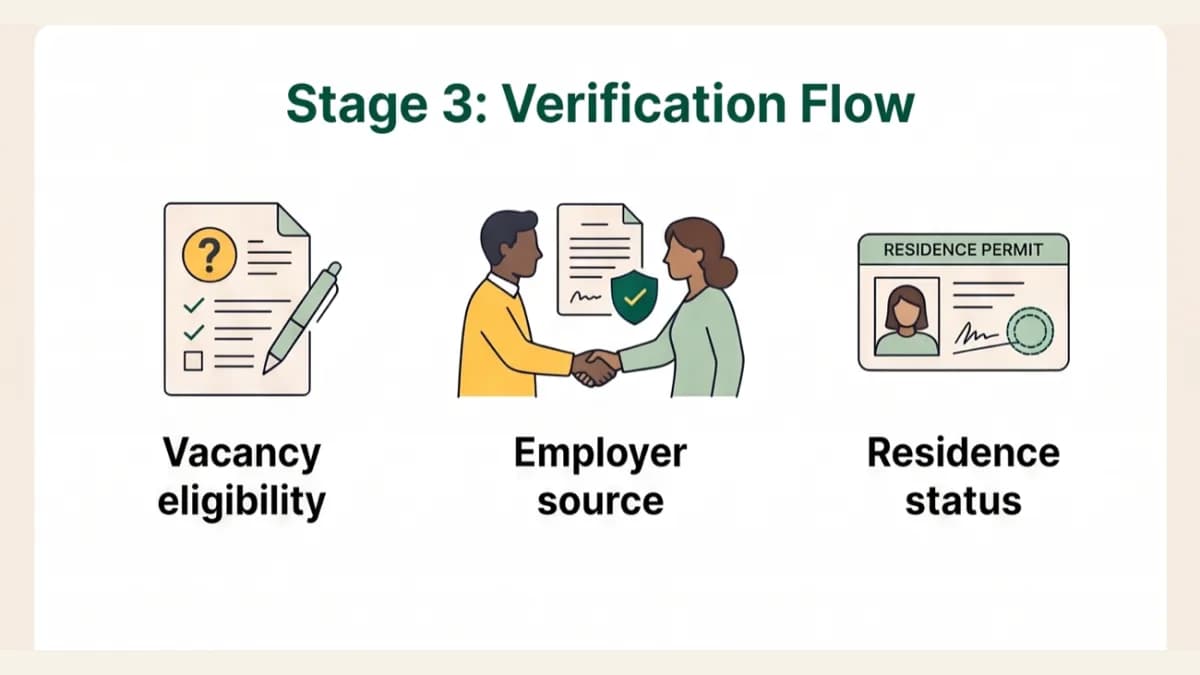
*Before tailoring, verify the vacancy's eligibility, confirm the original employer source and check your residence or entry route with the competent authority.[^1][^3]*
A foreign-applicant decision table
| Your situation | Start here | Add next | What to prove in the first screen |
|---|---|---|---|
| Still abroad, exploring the market | LinkedIn + Buscojobs | Employer career pages | Current country, realistic availability, Spanish level and whether relocation is required |
| Residence application in progress | Vía Trabajo | One local board | Accurate status at a high level; never paste identity numbers into the CV |
| Already living in Uruguay | Vía Trabajo + local boards | LinkedIn and referrals | City, availability, local phone if you genuinely have one, and relevant evidence |
| Public-sector target | Uruguay Concursa | Qualification-recognition authority if needed | Exact eligibility and every document in the named competition |
| Remote/international target | LinkedIn + employer sites | Regional boards | Payroll/location eligibility, time zone, language and contract country |
Turn a listing into evidence before writing the CV
| Listing clue | What to verify | What your CV can show |
|---|---|---|
| “Montevideo, hybrid” | Required office days and interview location | Real current location and honest relocation availability |
| “Spanish and English” | Working level and which tasks use each language | Defensible level plus a task where you used the language |
| “Excel reporting” | Reports, frequency, audience and tools | A truthful bullet showing scope and outcome |
| “Residence/work eligibility” | Official requirement and application stage | A short high-level status only when relevant; no document number |
| “Foreign degree accepted” | Whether recognition is required for this role | Exact original qualification name and verified recognition only |
Annotated fictional CV extract
Fictional example — all people, employers, contacts and figures below are invented.
MATEO SILVA
Operations Support Coordinator
Porto Alegre, Brazil · Open to verified relocation to Montevideo
[email protected] · +55 00 00000 0000
PROFILE
Operations coordinator with four years of fictional experience maintaining bilingual service records, investigating order exceptions and improving hand-offs between sales and logistics teams.
SELECTED EXPERIENCE
Operations Coordinator — Río Example Ltda. | 2023–present
- Tracked 40–55 fictional weekly order exceptions in Excel and assigned an owner and next action to each case.
- Rebuilt a fictional hand-off checklist, reducing the team's weekly reconciliation time from two hours to 50 minutes.
- Prepared Portuguese and Spanish customer updates using approved templates.
LANGUAGES
Portuguese — native · Spanish — [replace with a truthful level] · English — [replace with a truthful level]
| Annotation | Why it helps | Truth check |
|---|---|---|
| Current country + relocation note | Stops the recruiter from guessing | Only promise relocation you can realistically discuss |
| Target role | Connects the CV to the vacancy | Use the employer's wording only if it fits your real work |
| Evidence bullets | Show task, scope and result | Replace every fictional number with a record you can explain |
| Language levels | Make multilingual fit visible | Remove brackets and use defensible levels before submitting |
| No ID number | Keeps the CV useful and privacy-aware | Send official documents only through a verified process when requested |
For the document itself, use the guide to CVs for international applications, test the file with the ATS-friendly CV guide, and avoid the traps in common CV mistakes that cost interviews.
A friendly seven-day search plan
- Day 1 — Pick two job families. “Anything in Uruguay” is too broad. Choose, say, operations and customer support.
- Day 2 — Learn the local vocabulary. Collect 10–15 live ads and note repeated Spanish titles, tools and location terms.
- Day 3 — Split local-first from overseas-possible. Look for explicit relocation, regional scope, remote-country eligibility or international recruitment.
- Day 4 — Verify the employer. Find the first-party careers page and confirm the application destination.
- Day 5 — Tailor evidence, not identity. Reorder your strongest truthful achievements; do not add a passport number.
- Day 6 — Apply and record the exact version. Save the vacancy URL, deadline, CV filename and requested documents.
- Day 7 — Review the signal. Change search terms if results are irrelevant. Silence alone does not prove that a platform “doesn't work.”
For a broader channel strategy, compare this with the global job-board guide and keep your LinkedIn profile and CV aligned.
Final checklist for a foreign applicant
- [ ] I know whether the role is local-first, remote-within-Uruguay or genuinely open to overseas applicants.
- [ ] The employer and application domain are verified.
- [ ] My location and relocation availability are accurate.
- [ ] I have not confused platform registration with permission to work.
- [ ] Every language level, tool and number in the CV is defensible.
- [ ] I have removed passport, identity, banking and unnecessary family information.
- [ ] I followed the named vacancy's language, document and deadline instructions.
- [ ] I saved the exact CV version and application date.
FAQ
Can I register for Vía Trabajo without a Uruguayan identity card?
The current MTSS Technical Employment Centres page says people aged 15 or older can register using an identity document, passport or border identity card.[^2] That means a Uruguayan CI is not the only registration document described. It does not guarantee eligibility for a specific job.
Can a company hire me while my Uruguayan residence is being processed?
MTSS says an employer may hire a foreign worker without a Uruguayan CI when the person proves that temporary or permanent residence is being processed with current official evidence.[^1] Individual circumstances differ, so confirm the current procedure before relying on it.
Which Uruguay job board is best for applying from abroad?
There is no verified universal winner. LinkedIn and commercial boards are useful for researching employers from abroad; Vía Trabajo has the clearest official foreign-document registration signal; and the employer's own vacancy must establish overseas eligibility or relocation.
Is Uruguay Concursa open to foreigners?
Do not answer this at portal level. Read the complete rules of the named competition, because nationality, residence, qualifications and documents can be vacancy-specific.
Does a remote Uruguay job let me work from another country?
Not automatically. “Remote” may mean remote within Uruguay. Confirm payroll location, contract country, work-authorisation expectations and time zone before applying.
Should I put my passport number in my CV?
No general job-search source verified a need to place it in the CV. Keep identity documents for a secure, verified official or employer process at the appropriate stage.
Sources
[^1]: MTSS — employment of foreign workers
[^2]: MTSS — Technical Employment Centres and Vía Trabajo registration
[^3]: Uruguay Ministry of Foreign Affairs — work visa
[^4]: MTSS — Vía Trabajo registration guide
[^5]: Uruguay Concursa — official public-employment portal
[^6]: Buscojobs Uruguay — applicant FAQ