
Tunisia Job Boards: Where to Search and How to Apply Legally
Tunisia's job market runs mostly in French and Arabic, and the smartest first move is to separate the commercial boards (where most private-sector roles are posted) from ANETI, the state employment agency that runs public-sector listings and the graduate-insertion programmes. If you are a foreign ap
Tunisia Job Boards: Where to Search and How to Apply Legally
By AIResume Editorial Team
Last updated: 21 September 2026
Tunisia's job market runs mostly in French and Arabic, and the smartest first move is to separate the commercial boards (where most private-sector roles are posted) from ANETI, the state employment agency that runs public-sector listings and the graduate-insertion programmes. If you are a foreign applicant, there is a further rule that decides everything: an employer must get government authorisation before hiring you, and national candidates come first.
This guide compares the channels that actually work in Tunisia and explains the work-authorisation and language rules you need before you apply.
What this guide does not cover: how to write the CV itself. For structure, personal-data choices and file format, see the CV guides linked at the end. Here the focus is *channels, eligibility, and lawful work*.
Quick comparison: where to spend your time
| Channel | Best for | Who it serves | How you apply |
|---|---|---|---|
| Tanitjobs | Broad private-sector roles | General job seekers | Profile + email alerts |
| Keejob | CDI, CDD, stages, freelance | General + early-career | Direct application |
| Emploi.tn / TunisieJob / OptionCarriere | Aggregated listings | General | Aggregated links |
| Professional / multinational | Professionals | Easy Apply, recruiter outreach | |
| ANETI (emploi.nat.tn) | Public sector + insertion programmes | Tunisian nationals | Official portal account |
| Employer career pages | Larger firms and groups | Depends on the vacancy | Direct company form |
Tanitjobs is one of the historical market leaders, valued for its volume across sectors and its email alerts. Keejob pairs a modern interface with a careers blog and covers permanent (CDI), fixed-term (CDD), internship and freelance roles. ANETI — the Agence Nationale pour l'Emploi et le Travail Indépendant — is the official state portal for public-sector offers and civil-service competitions, and the entry point for the graduate-insertion schemes below.
ANETI and the graduate-insertion programmes
If you are a recent Tunisian graduate, two state schemes run through ANETI are worth understanding, because many first jobs are structured around them:
- SIVP (Stage d'Initiation à la Vie Professionnelle) is ANETI's flagship scheme for higher-education graduates (licence, master, engineer). The placement runs for up to 12 months, with ANETI paying a monthly allowance of about 150 TND and the employer topping it up.
- CIVP (Contrat d'Insertion à la Vie Professionnelle) is the equivalent for vocational-training graduates (for example BTS), also running 12 months with partial ANETI support.
These are insertion contracts, not open-ended jobs — treat them as a paid route into a first role, and confirm the current terms on ANETI before signing.
Channel-by-channel: where the roles actually are
Commercial boards
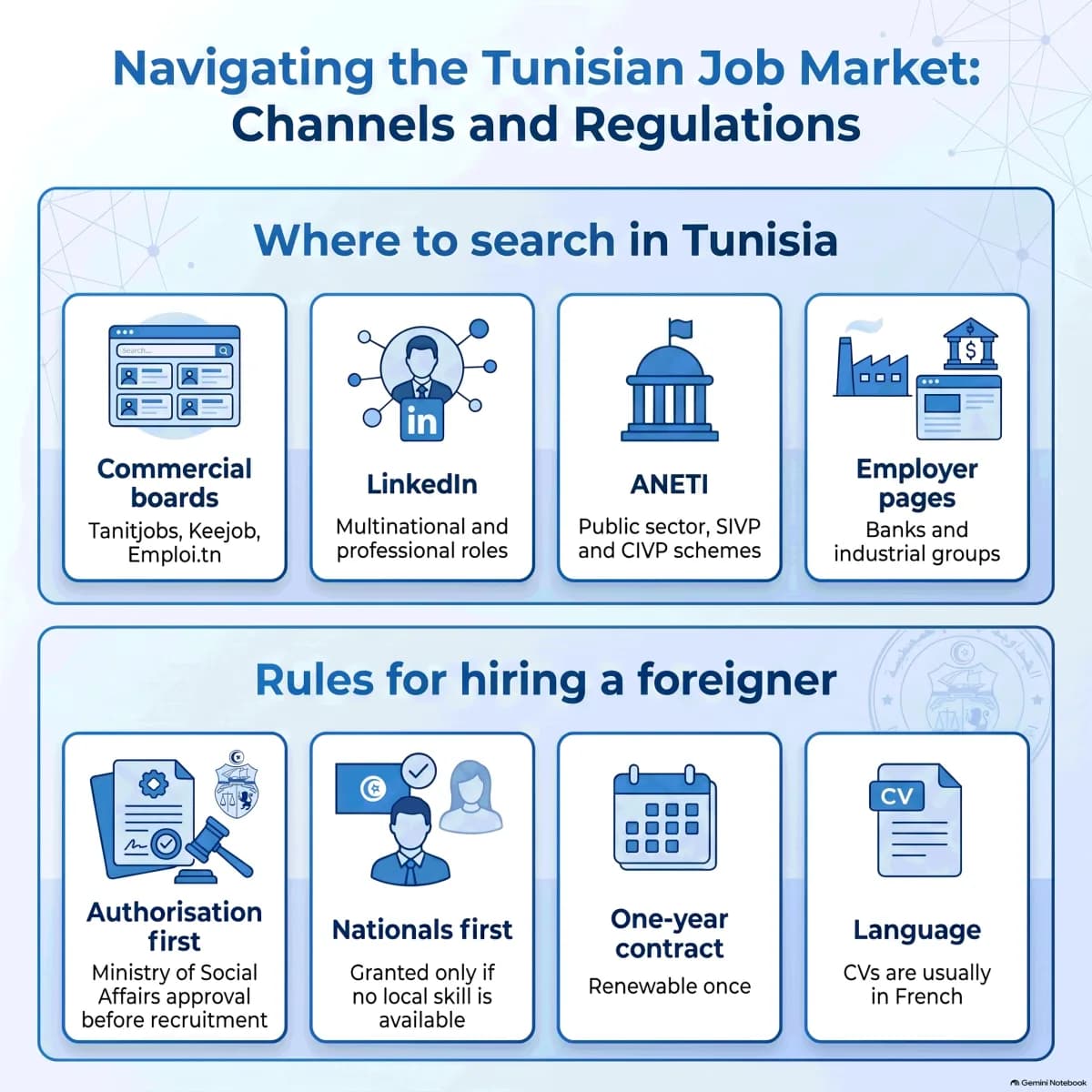
For private-sector work, start with Tanitjobs and Keejob, the two boards with the most consistent Tunisian coverage. Add Emploi.tn, TunisieJob and OptionCarriere to widen the net through aggregation. LinkedIn is the strongest channel for professional, technical and multinational roles, and for being found by recruiters.
The public service: ANETI
ANETI (emploi.nat.tn) centralises public-sector offers and civil-service competitions and administers the SIVP/CIVP schemes. Register if you are a Tunisian national targeting public roles or a state-supported first job.
Employer career pages
Larger Tunisian firms, banks and industrial groups often post on their own sites and on LinkedIn. For a specific employer, check the company page directly rather than relying only on aggregators.
Work authorisation: the employer needs permission before hiring a foreigner
Tunisia applies a clear priority-to-national-employment rule, so the authorisation step is where most foreign applications succeed or fail.
A foreign national who wants to work in Tunisia needs an employment contract and a residence card that states "autorisé à exercer un travail salarié en Tunisie" (authorised to carry out salaried work in Tunisia). Crucially, the employer must obtain authorisation to employ a foreign worker from the Ministry of Social Affairs before recruitment, and the request must be filed before the worker arrives in the country. Authorisation is granted only where equivalent Tunisian skills are not available on the local market.
Other rules that shape a foreign hire, as commonly reported (confirm the current text before relying on them):
- Company quotas for foreign staff: fewer than 10 employees → at most 1 foreign worker; 10–50 employees → up to 10%; more than 50 employees → up to about 4%.
- A foreign national's employment contract should not exceed one year, renewable once with the relevant authority's approval.
- Under Article 263 of the Tunisian Labour Code, foreign workers have the same employment rights and obligations as local workers.
These figures and provisions are reported from secondary summaries of the Labour Code. Because thresholds and procedures change, check the current official text or the Ministry of Social Affairs before you rely on any specific number.
Language and application conventions
- Language. French is the primary language of business and administration; Arabic is the official language and appears in public-sector processes; English is a plus in multinationals and tech. Most CVs are in French, with Arabic used for some public roles — follow the language of the advert.
- Read the vacancy label. A role advertised in French for a multinational is not automatically open to overseas applicants; eligibility still depends on whether the employer can obtain foreign-worker authorisation and has quota headroom.
A practical search routine
If you are a Tunisian national: keep profiles on Tanitjobs and Keejob with email alerts on, register on ANETI for public-sector roles, and — if you are a recent graduate — ask employers whether a role can run as an SIVP or CIVP placement. Use LinkedIn for professional and multinational openings.
If you are a foreign applicant: target multinationals and specialised roles where Tunisian skills are genuinely scarce, because that is the condition for authorisation. Before you commit, confirm the employer will file for Ministry of Social Affairs authorisation before you travel, that they have quota headroom for a foreign worker, and that your contract and residence card will carry the correct work authorisation. Never plan to start work on a tourist visa and "regularise later."
Final checklist before you apply
- [ ] I am using the right channel: Tanitjobs/Keejob/LinkedIn for private roles, ANETI for public and insertion schemes.
- [ ] My CV is in the language of the advert (usually French; Arabic for some public roles).
- [ ] For a first job, I checked whether the role is an SIVP/CIVP placement and what that means for pay and duration.
- [ ] As a foreigner, the employer will obtain Ministry of Social Affairs authorisation before I travel, and has quota headroom.
- [ ] I checked the current official rules for any legal detail I am relying on.
Related AIResume guides
Frequently asked questions
What are the best job sites in Tunisia?
For private-sector roles, Tanitjobs and Keejob have the most consistent coverage, supported by Emploi.tn, TunisieJob and OptionCarriere for aggregation, and LinkedIn for professional and multinational roles. For public-sector jobs and state-supported first placements, use the official ANETI portal (emploi.nat.tn).
What are SIVP and CIVP in Tunisia?
They are ANETI insertion programmes for new graduates. SIVP is for higher-education graduates (licence, master, engineer) and CIVP is for vocational-training graduates. Both run up to 12 months, with ANETI paying part of a monthly allowance and the employer topping it up. Confirm current terms on ANETI before signing.
Can a foreigner work in Tunisia without authorisation?
No. A foreign national needs an employment contract and a residence card authorising salaried work, and the employer must obtain authorisation from the Ministry of Social Affairs before recruitment — filed before the worker arrives. Authorisation is granted only where equivalent Tunisian skills are unavailable.
What language should my Tunisia CV be in?
Usually French, which is the main language of business and administration. Arabic is used in some public-sector processes, and English helps for multinationals and tech roles. Match the language of the specific vacancy.
Does an English or French advert mean the role is open to foreigners?
No. Language does not determine eligibility. A foreign hire still depends on the employer securing Ministry of Social Affairs authorisation and having quota headroom for a foreign worker.
Sources
[^1]: Tanitjobs — job board and careers guidance (CIVP/SIVP 2026)
[^2]: Keejob — job offers in Tunisia
[^3]: ANETI — Agence Nationale pour l'Emploi et le Travail Indépendant
[^4]: Employment of foreign nationals in Tunisia — Expat.com
[^5]: Local employment laws in Tunisia — Atlas HXM