
Iraq Job Boards: Where to Search in Federal Iraq and Kurdistan
The most important thing to decide before you open a single Iraq job board is which Iraq you are applying in. Federal Iraq (administered from Baghdad) and the Kurdistan Region of Iraq (KRI, administered from Erbil) run separate labour rules, separate government portals, and separate foreign-worker q
Iraq Job Boards: Where to Search in Federal Iraq and Kurdistan
By AIResume Editorial Team
Last updated: 21 September 2026
The most important thing to decide before you open a single Iraq job board is which Iraq you are applying in. Federal Iraq (administered from Baghdad) and the Kurdistan Region of Iraq (KRI, administered from Erbil) run separate labour rules, separate government portals, and separate foreign-worker quotas. The same vacancy title can mean very different eligibility depending on the region and on whether you are an Iraqi national or a foreign applicant.
This guide compares the channels that are genuinely useful, separates national from international eligibility, and shows the work-authorisation evidence you need before you start work.
What this guide does not cover: how to write the CV itself. For structure, personal-data choices and file format, use our separate CV guides linked at the end. Here the focus is *channels, eligibility, and lawful work*.
Quick comparison: where to spend your time
| Channel | Best for | Who it serves | How you apply |
|---|---|---|---|
| Corporate, banking, telecom, energy, INGOs | Nationals + expatriates | Easy Apply, company ATS, recruiter outreach | |
| Bayt.com | Regional professional roles | MENA professionals, Iraqi specialists | Profile + "Easy Apply" |
| Tanqeeb | Broad aggregation across cities | General labour force, mid-level | Aggregated links to employer forms |
| Indeed | Discovery / passive search | General + international | Redirects to employer ATS |
| jobs.krd (KAZI) | Private-sector roles in Kurdistan | KRI nationals, local employers | Official KRG portal account |
| ReliefWeb / UN portals | Humanitarian and development | Nationals *and* internationals (by role category) | Agency career sites |
| Employer career pages | Banks, telecom, oil & gas | Depends on the vacancy label | Direct company form |
Platform reach, where a dated figure exists: LinkedIn had 2,421,000 registered users in Iraq (NapoleonCat, August 2026); Bayt.com listed 400+ live Iraq vacancies in mid-2026 (Basra 92, Baghdad 70); Tanqeeb indexed 232,740 regional postings in a 90-day window (August 2026); ReliefWeb hosted 1,027 open humanitarian positions globally in August 2026, including Iraq-based roles. Treat every number as a dated snapshot, not a permanent fact.
Federal Iraq versus the Kurdistan Region
This is the split that changes your results:
- Language. In Federal Iraq (Baghdad, Basra, the south), Arabic is expected for administrative and compliance roles, with English required inside multinational energy firms, professional-services practices and development agencies. In the Kurdistan Region (Erbil, Sulaymaniyah, Duhok), Kurdish (Sorani or Badini) and English are the primary working languages, with Arabic valued for inter-governorate coordination.
- Government portal. The KRG Ministry of Labour and Social Affairs runs jobs.krd (kar.molsa.gov.krd), an official job-matching portal. Federal MOLSA does not run a commercial job board, but it does enforce mandatory digital worker registration.
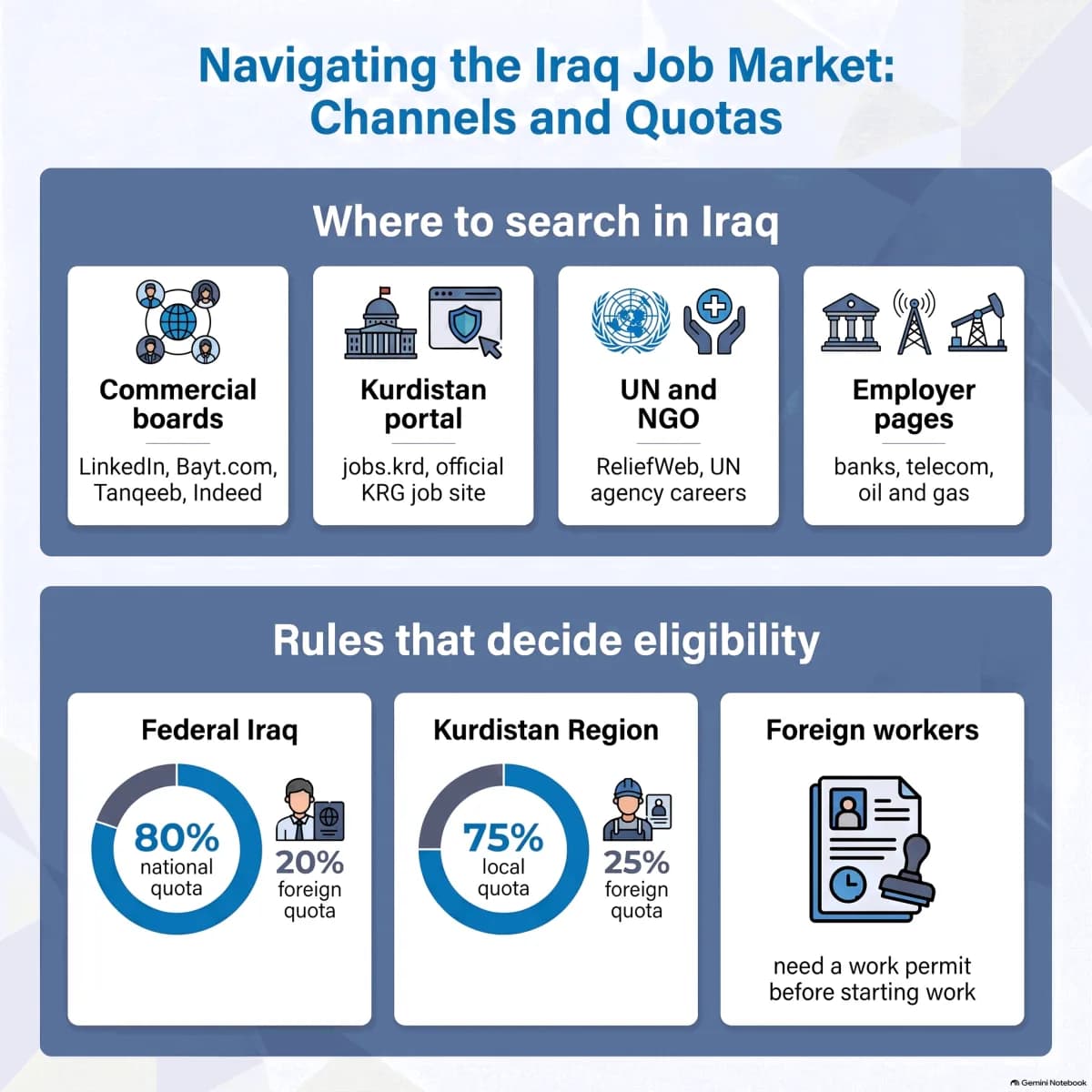
- Foreign-worker quota. Federal Iraq caps foreign staff at 20% (80% national); the Kurdistan Region caps them at 25% (75% local). These quotas decide whether an employer can sponsor you at all.
If you are searching across both regions, keep two mental lists — the rules do not transfer.
Channel-by-channel: where the roles actually are
Commercial boards
LinkedIn is the primary corporate channel in both regions — international oil companies, private banks, telecom operators and INGOs use it for professional and executive hiring. Bayt.com carries regional professional roles (including Big Four firms such as Deloitte and EY) and uses screening questionnaires. Tanqeeb is a broad MENA aggregator useful for mid-level sales, IT, administrative and technical roles. Indeed works mainly as a discovery layer that redirects you to the employer's own system.
The Kurdistan government portal
jobs.krd is not just a board — under the 2024 KRG foreign-worker regulation it has a statutory role: private-sector vacancies must be published there so local availability can be checked before an employer sponsors a foreign worker. If you are job-hunting in the Kurdistan Region, register a profile so you are inside the KRG candidate pool.
UN, NGO and development channels
ReliefWeb (run by UN OCHA) is the main clearing-house for INGO and humanitarian roles, with Iraq positions from organisations such as the Danish Refugee Council and Mercy Corps. UN roles are advertised on individual agency sites (UNDP, UNICEF, IOM and others) and aggregated on UNjobs. Eligibility is labelled and strict (see below).
Employer career pages
For banking, telecom and energy, apply directly. Telecom operators Zain Iraq, Asiacell (Ooredoo) and Korek recruit through their own portals and LinkedIn pages. In banking, First Iraqi Bank (which grew to 341 employees by Q1 2026, per Revelio Labs) accepts applications at fib.iq/careers; Bank of Baghdad and the Trade Bank of Iraq recruit through formal filings. In oil and gas, technical hiring is usually handled by MOLSA-licensed manpower agencies rather than open boards.
Work authorisation: the job comes before the permit
A foreign national cannot lawfully work in Federal Iraq or the Kurdistan Region without a work permit and matching residence authorisation. Employing an unauthorised foreign worker is an offence carrying fines, business closure and deportation. You also cannot self-apply — an Iraqi employer or a licensed local sponsor must file for you.
Federal Iraq
The framework rests on Iraqi Labour Law No. 37 of 2015 (in force from 1 January 2018; current status: in force). Article 30 prohibits employing a foreign worker without a valid MOLSA permit, and Article 31 prohibits the worker starting before the permit is issued. Probation is capped at three months (Article 37). Foreign residence is governed by Foreigners' Residence Law No. 76 of 2017. Private employers must keep at least 80% Iraqi staff (foreign workers capped at 20%); licensed investment companies operate on a 50/50 ratio. After MOLSA approval, an entry visa is issued via an Iraqi embassy; residence is finalised within 7 days and the work permit within about 60 days, with cross-agency processing typically 60–90 days. Permits are valid one year and renewed annually.
Kurdistan Region
The KRG issued its own Regulation on the Employment of Foreign Workers on 8 March 2024 (in force the same day, with a six-month compliance window). It requires employers to advertise open private-sector roles on jobs.krd for 30 consecutive days, and a foreign permit is approved only if no qualified local candidate applies. The regional quota is 75% local / 25% foreign, and foreign contracts are capped at a two-year term (eight-year cumulative maximum).
Where exact issue dates or a regulation number could not be confirmed against a primary source, treat that detail as unverified and check the current official text before relying on it.
Application conventions and eligibility labels
Local hiring norms differ from Western "blind CV" practice:
- Personal data is expected. A professional headshot at the top of the CV is standard, and applications typically disclose full name, date of birth, gender, marital status, nationality and a local address.
- Contact. Include a +964 number and indicate WhatsApp availability — early screening and interview scheduling often happen there.
Read the candidate-category label on every vacancy, because it is really an eligibility rule:
| Label | Who can apply |
|---|---|
| "Iraqi Nationals Only" / "Iraqi Leadership" | Iraqi citizens only (satisfies the 80% or 75% quota) |
| National Professional Officer (NPO) | Iraqi citizens (UN staff rule) |
| General Service (GS) | Iraqi citizens and foreigners with valid legal residence |
| International Professional (P / D) | Open to international candidates |
| "Sponsorship Available" | Employer has a registered branch or licensed agency that can sponsor a pre-arrival permit |
A practical search routine
If you are an Iraqi national: keep LinkedIn and Bayt current, apply directly on company portals (for example fib.iq/careers), and — if you are in the Kurdistan Region — register on jobs.krd so local employers can find you. For humanitarian work, check ReliefWeb daily and keep UN agency profiles active. Before you sign, confirm the contract matches Labour Law No. 37 of 2015 (three-month probation cap, at least 21 days' annual leave after a year) and that your employer registers you for social security.
If you are a foreign applicant: apply only through legitimate corporate channels, global boards, INGO systems or licensed agencies, and target roles that explicitly offer sponsorship. Confirm the employer has a registered Iraqi branch or a licensed sponsor and free foreign headcount under the quota. For Kurdistan roles, check that the vacancy has completed its 30-day jobs.krd listing. Sign a bilingual, MOLSA-approved contract and obtain a work-linked entry visa before you travel — Articles 30 and 31 make starting work without a permit unlawful. Never accept an offer that asks you to enter on a tourist or business visa and "sort out the paperwork later."
Final checklist before you apply
- [ ] I know whether the role is in Federal Iraq or the Kurdistan Region, and I am following the right rules.
- [ ] I read the vacancy's candidate-category label and I actually qualify.
- [ ] For a foreign role, the employer can sponsor a permit and has free headcount under the 80/20 (Federal) or 75/25 (KRI) quota.
- [ ] My CV language matches the region (Arabic / Kurdish / English) and the vacancy.
- [ ] I have a work-linked entry visa before travelling — not a tourist or business visa.
- [ ] I checked the live official text for any legal detail I am relying on.
Related AIResume guides
Frequently asked questions
What is the best job board for jobs in Iraq?
There is no single best board. For corporate, banking, telecom and energy roles, start with LinkedIn and direct company career pages. For private-sector roles in the Kurdistan Region, register on the official jobs.krd portal. For humanitarian and development work, use ReliefWeb and UN agency sites. Match the channel to the sector and region.
Can a foreigner work in Iraq without a work permit?
No. A foreign national needs a work permit and residence authorisation issued before starting work, and only an Iraqi employer or licensed sponsor can file for it. Iraqi Labour Law No. 37 of 2015 (Articles 30 and 31) prohibits employing a foreign worker, or starting work, without a valid permit.
Are the rules the same in the Kurdistan Region and Federal Iraq?
No. The Kurdistan Region has its own foreign-worker regulation (issued 8 March 2024), its own government job portal (jobs.krd), a 30-day local-advertising rule, and a 75%/25% local-to-foreign quota, versus the 80%/20% quota in Federal Iraq. Languages differ too.
Does an English-language vacancy mean the role is open to foreigners?
No. English is used widely by multinationals and agencies, but eligibility is set by the candidate-category label and the employer's quota headroom, not the language of the advert.
Which language should my CV be in?
It depends on the region and the vacancy. Arabic is expected for administrative roles in Federal Iraq; Kurdish and English are primary in the Kurdistan Region; English is expected in multinationals, energy firms and development agencies. Follow the language named in the advert.
Sources
[^1]: LinkedIn users in Iraq — August 2026 (NapoleonCat)
[^2]: Jobs in Iraq / Erbil (Bayt.com)
[^3]: Tanqeeb — Jobs in Iraq
[^4]: Jobs | ReliefWeb (UN OCHA)
[^5]: Jobs.krd — Kurdistan Region job portal
[^6]: Careers — First Iraqi Bank (FIB)
[^7]: Work permits and foreign employment in Iraq — Al Tamimi & Company
[^8]: Regulation on Employment of Foreign Workers in the Kurdistan Region — Al Tamimi
[^9]: Iraqi Work Permits / Foreign Worker Authorisation — Etihad Law