
Argentina Job Boards: Where to Search and How to Work Legally
The first question before you open an Argentine job board is whether you can already work in Argentina. A resident with a CUIL can apply for almost anything locally; an overseas applicant — for example a Japanese professional — usually needs an employer willing to sign a pre-contract and sponsor a w
Argentina Job Boards: Where to Search and How to Work Legally
By AIResume Editorial Team
Last updated: 27 September 2026
The first question before you open an Argentine job board is whether you can already work in Argentina. A resident with a CUIL can apply for almost anything locally; an overseas applicant — for example a Japanese professional — usually needs an employer willing to sign a pre-contract and sponsor a work residence.
This guide compares the useful channels and the work-authorisation steps to complete before you start.
What this guide does not cover: how to write the CV itself. For structure, language and personal-data choices, see our Argentina CV format comparison. Here the focus is *channels, eligibility, and lawful work*.
Quick comparison: where to spend your time
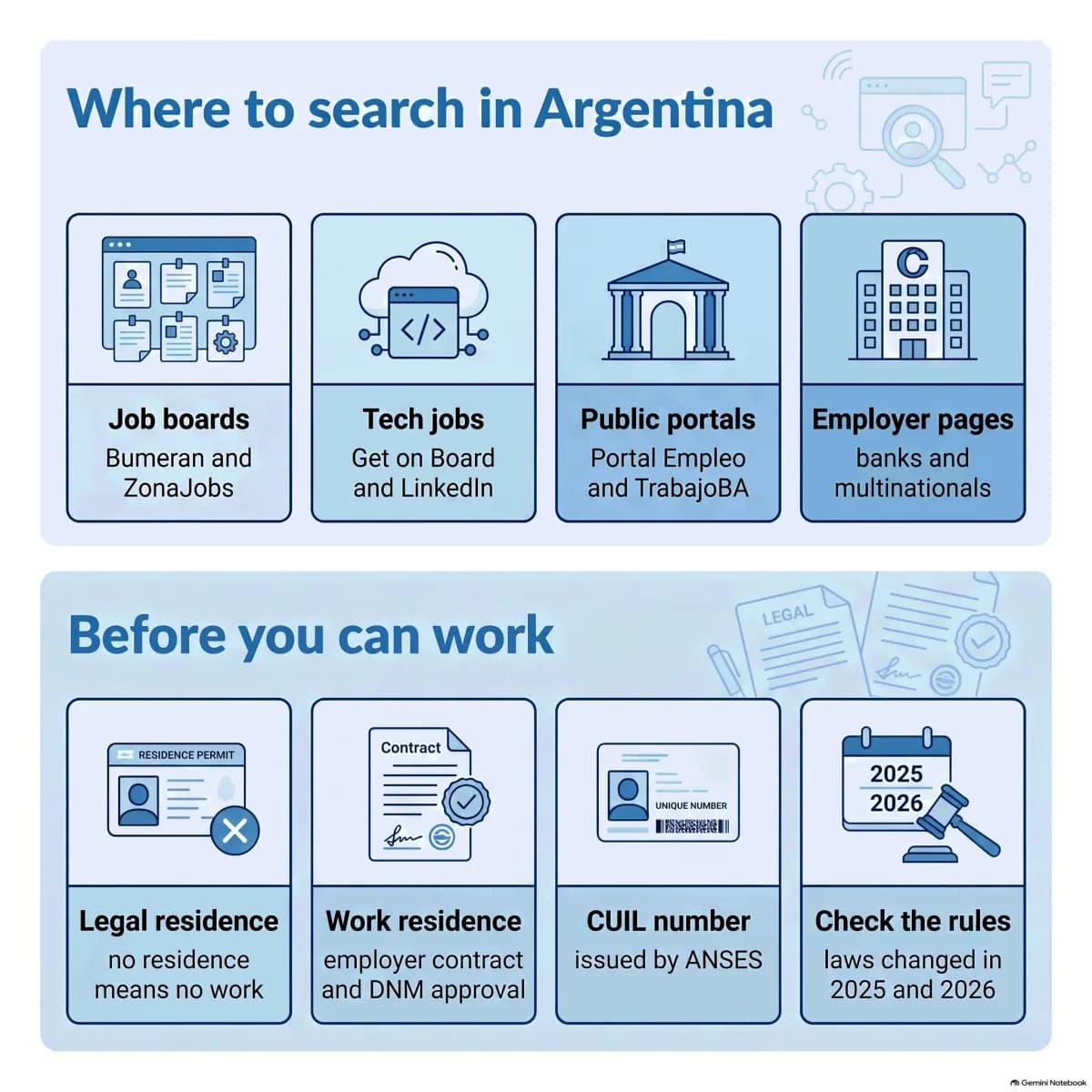
| Channel | Best for | Who it serves | How you apply |
|---|---|---|---|
| Bumeran (Jobint) | Broad private-sector roles | Residents, local job seekers | Candidate profile + online application |
| ZonaJobs (Jobint) | Broad private-sector roles in Argentina | Residents, local job seekers | Candidate profile + online application |
| Get on Board | Tech, data, product and startup roles, including LatAm-remote | Tech professionals in Argentina and abroad | Profile + direct application |
| Corporate, multinational and professional roles | Residents and international candidates | Company ATS, Easy Apply, recruiter outreach | |
| Portal Empleo (national) | Public employment-service offers and programmes | Residents registered with a CUIL | Online registration with CUIL |
| TrabajoBA (Buenos Aires City) | Vacancies published by employers in the City | Residents with a MiBA account | Log in with MiBA and apply |
| Employer career pages | Multinationals, banks, larger local firms | Depends on the vacancy | Direct company form |
Self-reported reach: Jobint, the group behind Bumeran and ZonaJobs, reports 70,000+ job listings, 10M+ monthly visits and 20,000+ publishing companies across 7 countries (group-wide, not Argentina only; observed September 2026)[^1]. Get on Board reports 1,600,000+ professionals, 16,000+ companies and 4,100,000+ applications (observed September 2026)[^2]. Treat these as undated snapshots.
Channel-by-channel: where the roles actually are
Commercial boards: Bumeran and ZonaJobs (Jobint)
Bumeran and ZonaJobs are both owned by Jobint, headquartered in Palermo, Buenos Aires. Jobint also runs Laborum (Chile), Multitrabajos (Ecuador), Konzerta (Panama) and Bumeran in Peru, Mexico and Venezuela[^1]. Keep one complete profile on each, and avoid applying twice to the same company.
They suit residents seeking mainstream private-sector roles, and most listings assume you can already work in Argentina.
Tech roles: Get on Board
Get on Board describes itself as the largest tech and startup job community in Latin America[^2]. Categories include programming, data, DevOps, AI, product and cybersecurity. Listings are concentrated in Chile, with Peru, Colombia, Mexico, Argentina and many LatAm-remote roles.
For overseas tech professionals it is often the most realistic entry point, but check each listing's location: "remote" can still mean "remote within Argentina".
LinkedIn is the natural channel for multinational and corporate hiring. It is especially useful for overseas applicants looking at international employers with an Argentine entity.
Public employment channels
The national labour authority is now the Secretaría de Trabajo, Empleo y Seguridad Social, part of the Ministerio de Capital Humano — the former Ministry of Labour is no longer a standalone ministry[^3]. It points job seekers to local Oficinas de Empleo and programmes such as "Fomentar Empleo"[^3].
- Portal Empleo (portalempleo.gob.ar) is the national public job portal; registration uses your CUIL[^4].
- TrabajoBA (trabajo.buenosaires.gob.ar) is run by the Buenos Aires City government. Applicants log in through MiBA, and employers create a company profile and publish vacancies[^5].
Public channels are mainly useful once you are resident and have a CUIL.
Employer career pages
For multinationals and larger Argentine companies, apply directly on the career page. Confirm the employer's CUIT (tax ID) matches the company name on your offer.
Work authorisation: the residence comes before the job
The legal framework
Immigration is governed by Ley 25.871 (Ley de Migraciones), sanctioned on 17 December 2003 and promulgated on 20 January 2004[^6]. Three articles matter most for job seekers:
- Art. 51: permanent residents may carry out any paid activity.
- Art. 53: foreigners in an irregular situation may not work.
- Art. 55: no person or entity may give paid work to a foreigner who is irregularly resident.
The law is regulated by Decreto 616/2010, which current DNM service pages still cite[^7].
Law status notes (check before relying on them):
- DNU 366/2025 reformed the migration law. It was published and entered into force on 29 May 2025; it amended several articles of Ley 25.871 (including art. 53), required health insurance for non-permanent residents and moved citizenship processing to the DNM[^8].
- On 30 June 2026 the Cámara Nacional Electoral declared DNU 366/2025 null with respect to citizenship, reasoning that citizenship, being tied to electoral rights, cannot be regulated by decree[^9]. Its effect on the decree's other changes is not established. Confirm the current status of the other DNU 366/2025 changes — including residence and health-insurance requirements — directly with the DNM before you apply.
- Since DNU 793/2025 (in force 11 November 2025), the Dirección Nacional de Migraciones (DNM) sits under the Ministerio de Seguridad Nacional, not the Interior Ministry[^10].
The DNM classifies residence as transitoria (up to one year, no DNI), temporaria (up to three years, temporary DNI) and permanente[^11].
Temporary residence as a migrant worker
This is the main route for overseas applicants who have an Argentine job offer. It is based on art. 23 inc. a) of Ley 25.871 and is for dependent, paid employment[^7]. The key requirements:
- A pre-contract stating duties, hours, duration, place of work, pay in line with the collective agreement and the employer's CUIT, with notarised signatures.
- The employer must be registered with ARCA and in the DNM employer registry, and provide an ARCA early-registration certificate.
- Your passport and criminal records from Argentina and from any country where you lived more than a year in the last three years.
- Apply online via RaDEX, then attend in person. Granted for one year, renewable[^7].
The employer does much of the preparation, so target companies that already sponsor foreign staff.
Mercosur residence — not for Japanese nationals
The Mercosur residence (art. 23 inc. l) is open to nationals of Uruguay, Brazil, Paraguay, Bolivia, Chile, Peru, Ecuador, Colombia, Venezuela, Guyana and Suriname, and does not require a job offer[^12]. Japan is not on the list, so Japanese applicants need a different category, typically the migrant-worker residence above.
Digital-nomad residence — only for foreign employers
The digital-nomad residence (a transitoria under art. 24 inc. h) lasts 180 days, extendable once for the same period. It is only for remote work for people or companies based abroad — it does not allow you to work for an Argentine employer[^13]. It is limited to visa-exempt nationalities; check eligibility with the DNM.
CUIL
With a valid residence, get a CUIL from ANSES. It is free and needs no appointment. Foreigners without a DNI can present the migration file showing their residence type and entry, or a passport showing residence status — tourist status does not qualify[^14]. You need a CUIL to register on Portal Empleo and to be employed formally.
Spotting fake job offers
The Ministerio de Capital Humano warns that fake job offers can be linked to human trafficking[^15]. Warning signs include:
- Unusually high pay for few requirements.
- Offers that require relocating to another city, province or country.
- Requests for advance payments for fees, documents or travel.
- Photo or video "castings".
- Unpaid "trial periods".
- Requests to hand over your ID documents.
Reports can go to the 145 hotline. Never pay to apply, and verify the employer's CUIT.
A practical search routine
If you are a resident: keep one complete profile on Bumeran and ZonaJobs, register on Portal Empleo with your CUIL, and — if you live in Buenos Aires City — on TrabajoBA through MiBA. Tech professionals should add Get on Board. Set job alerts and visit your local Oficina de Empleo for programmes.
If you are an overseas applicant (for example from Japan): focus on channels where employers expect international candidates — LinkedIn, Get on Board and multinational career pages. Ask early whether the employer will sign a pre-contract and is registered with the DNM. If you want to live in Argentina while working for a company abroad, look at the digital-nomad residence instead — but remember it does not cover local employers. Do not start working on a tourist entry.
Final checklist before you apply
- [ ] I know whether I can already work in Argentina, or need a sponsored work residence.
- [ ] For a local employer, it can sign a notarised pre-contract and is registered with ARCA and the DNM.
- [ ] I am not using a digital-nomad residence to work for an Argentine employer.
- [ ] I have, or know how to get, a CUIL from ANSES.
- [ ] I checked the employer's CUIT and the offer shows none of the fake-job warning signs.
- [ ] I confirmed with the DNM the current status of the DNU 366/2025 changes that affect me.
Related AIResume guides
- Argentina CV format comparison
- How to write an ATS-friendly CV
- Job board comparison for global candidates
Frequently asked questions
What is the best job board in Argentina?
No single board wins. Use Bumeran and ZonaJobs for mainstream roles, Get on Board for tech, and LinkedIn and career pages for multinationals. Residents should also register on Portal Empleo and, in Buenos Aires City, TrabajoBA.
Can a Japanese national work in Argentina?
Yes, with the right residence. The usual route is the temporary migrant-worker residence under art. 23 inc. a) of Ley 25.871, which needs a notarised pre-contract from an employer registered with ARCA and the DNM. The Mercosur residence is not available to Japanese nationals.
Can I work for an Argentine company on a digital-nomad residence?
No. The digital-nomad residence only covers remote work for people or companies based abroad. To work for an Argentine employer you need a residence that permits local employment.
What happened to DNU 366/2025?
It reformed the migration law from 29 May 2025. On 30 June 2026 the Cámara Nacional Electoral declared it null with respect to citizenship. Confirm the status of its other changes, such as residence rules, with the DNM.
Do I need a CUIL to apply for jobs?
You need a CUIL to register on Portal Empleo and to be employed formally. ANSES issues it free of charge; foreigners need a valid residence, as tourist status does not qualify.
Sources
[^1]: Quiénes somos — Jobint
[^2]: Get on Board — Tech jobs in Latin America
[^3]: Buscás trabajo — Argentina.gob.ar (Capital Humano)
[^4]: Portal Empleo — Argentina
[^5]: TrabajoBA — Gobierno de la Ciudad de Buenos Aires
[^6]: Ley 25.871 — texto actualizado (InfoLeg)
[^7]: Obtener una residencia temporaria como trabajador migrante — Argentina.gob.ar
[^8]: Decreto 366/2025 — Boletín Oficial
[^9]: La Cámara Nacional Electoral anuló el DNU sobre ciudadanía y migraciones — Ámbito
[^10]: Decreto 793/2025 — Boletín Oficial
[^11]: Residencias — Dirección Nacional de Migraciones
[^12]: Obtener una residencia temporaria por nacionalidad Mercosur — Argentina.gob.ar
[^13]: Obtener una residencia transitoria como Nómada Digital — Argentina.gob.ar